The Scots Covenanters land an army in Ulster in 1642 to protect the Scottish settlers there from the massacres that follow the Irish Rebellion of 1641. They land at Carrickfergus and link up with Sir Robert Stewart and the Laggan Army of Protestant settlers from County Donegal in northwest Ulster. The Covenanters clear northeastern Ulster of Irish rebels by 1643 but are unable to advance south of mid-Ulster, which is held by Owen Roe O’Neill, the general of the Irish Confederate Ulster army.
In 1646, Monro leads a force composed of Scottish Covenanter regiments and Ulster settlers’ armies into Confederate-held territory. According to some accounts, this is the first step in a drive to take the Confederates’ capital at Kilkenny. Other sources say it is only a major raid. The combined force is about 6,000 strong. Monro has ten regiments of infantry, of whom six are Scottish and four are English or Anglo-Irish, and 600 Ulster Protestant cavalry. Stewart and the Laggan Army are slated to join Monro’s force in the attack, however, on the day of the battle the Laggan Army is in Clogher, nearly 30 kilometres away. O’Neill, who is a very cautious general, had previously avoided fighting pitched battles. However, he has just been supplied by the Papal Nuncio to Ireland, Giovanni Battista Rinuccini, with muskets, ammunition and money with which to pay his soldiers’ wages. This allows him to put over 5,000 men into the field, an army slightly smaller than his enemy’s. The Covenanters have six cannons, whereas the Confederates have none.
Monro assumes that O’Neill will try to avoid his army and has his soldiers march 24 kilometres to intercept the Irish force at Benburb, in modern south County Tyrone. Gerard Hayes-McCoy writes, “many of them must have been close to exhaustion before the battle began.” Monro’s men draw up with their backs to the River Blackwater, facing O’Neill’s troops who are positioned on a rise.
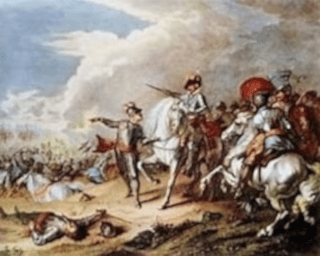
The battle begins with Monro’s artillery firing on the Irish position, but without causing many casualties. Monro’s cavalry then charges the Irish infantry but are unable to break the Confederates’ pike and musket formation. When this attack fails, O’Neill orders his infantry to advance, pushing the Monro’s forces back into a loop of the river by the push of pike. It is noted that the Irish pikes have longer shafts and narrower heads than those of their opponents, meaning that they outreach them and are “better to pierce.” At this point, the fatigue of Monro’s troops is apparent as they are gradually pushed back until their formation collapses in on itself. The Confederate infantry then breaks Monro’s disordered formation with a musket volley at point-blank range and falls in amongst them with swords and scians (Irish long knives). Monro and his cavalry flee the scene, as, shortly after, does his infantry. A great many of them are cut down or drowned in the ensuing pursuit. Monro’s losses are estimated to be between 2,000 and 3,000 men, killed or wounded. The Irish casualties are estimated to be 300.
O’Neill’s victory means that the Covenanters are no longer a threat to the Confederates, but they remain encamped around Carrickfergus for the rest of the war. O’Neill does not follow up his victory but takes his army south to intervene in the politics of the Irish Confederation. In particular, he wants to make sure that the treaty the Supreme Council of the Confederates has signed with the English Royalists will not be ratified.
In February 1534, his father is summoned to London and appoints the 21-year-old FitzGerald, by then Lord Offaly, deputy governor of Ireland in his absence. In June 1534 he hears rumours that his father has been executed in the Tower of London and that the English government intends the same fate for him and his uncles.
FitzGerald summons the council to St. Mary’s Abbey, Dublin, and on June 11, accompanied by 140 armoured gallowglasses with silk fringes on their helmets (from which he gets his nickname), rides to the abbey and publicly renounces his allegiance to his cousin King Henry VIII, Lord of Ireland.
John Alen, Lord Chancellor of Ireland and Archbishop of Dublin, attempts to persuade FitzGerald not to commit himself to such a rash proceeding. But the young lord’s harper, understanding only Irish, and seeing signs of wavering in FitzGerald’s bearing, commences to recite a poem in praise of the deeds of his ancestors, telling him at the same time that he lingered there too long. Roused by this he throws down the sword of state and rushes from the hall, followed by his adherents. The council sends an order for his immediate arrest to the Lord Mayor of Dublin, who, however, has not sufficient force at his disposal.
The Earl of Desmond and many of FitzGerald’s father’s oldest and best friends’ reason with him, but he is not to be turned from his purpose. As Vice-Deputy, he has under his control most of the Pale‘s fortresses, and large government stores.
Dublin Castle alone holds out for the King of England. Lord Offaly calls the lords of the Pale to the siege of the Castle. Those who refuse to swear fidelity to him are sent as prisoners to his Maynooth Castle. Goods and chattels belonging to the King’s subjects are declared forfeited, and he announces his intention of exiling or putting to death all born in England. He sends messengers to his cousin and friend Lord Butler, son of the Earl of Ormond, offering to divide the kingdom with him if he would join his cause, but Butler refuses. Several children of the citizens of Dublin in different parts of the Pale are seized as hostages for the good behavior of the city.
In July, FitzGerald attacks Dublin Castle, but his army is routed. He is, rightly or wrongly, judged to be responsible for the execution at Artane of Archbishop Alen, who had tried to mediate. This loses him support from the clergy. According to a long-established tradition, the killers, John Teeling and Nicholas Wafer, misunderstand his order, given in Irish, to “take this fellow away” as an order to kill Alen. By this time his father has taken ill and died in London, and he succeeds him as 10th Earl of Kildare, but the Crown never confirms his title. He retreats to his stronghold at Maynooth Castle, but in March 1535 it is taken by an English force under Sir William Skeffington by bribing a guard, while FitzGerald is absent gathering reinforcements to relieve it. The surrendered garrison is put to death, which becomes known as the “Maynooth Pardon.” He has wrongly assumed that his cause would attract overwhelming support, in particular from Catholics opposed to Henry VIII’s English Reformation. But Henry’s new policy also outlaws Lutheranism, and so Henry is not finally excommunicated until 1538.
In July, Lord Leonard Grey arrives from England as Lord Deputy of Ireland. Fitzgerald, seeing his army melting away and his allies submitting one by one, asks for pardon for his offences. He is still a formidable opponent, and Grey, wishing to avoid a prolonged conflict, guarantees his personal safety and persuades him to submit unconditionally to the King’s mercy. According to the Tree Council of Ireland, legend has it that FitzGerald plays a lute under the boughs of the now oldest planted tree in Ireland, the Silken Thomas Yew, the night before he surrenders to King Henry VIII. In October 1535 he is sent as a prisoner to the Tower of London. Despite Grey’s guarantee, he is hanged, drawn, and quartered with his five uncles at Tyburn, London, on February 3, 1537.
FitzGerald’s revolt causes Henry VIII to pay more attention to Irish matters and is a factor in the creation of the Kingdom of Ireland in 1541. In particular the powers of the lord’s deputy are curbed, and policies such as surrender and regrant are introduced. To provide for greater security the Royal Irish Army is established as a standing army.
O’Brien is born near Granard, County Longford, in 1804 or 1805. He goes to a local church school, where one of his teachers recognises his intellectual abilities and arranges for him to be educated at the progressive Lovell Edgeworth School. In 1822 he proceeds to Trinity College, Dublin, where he wins several academic prizes including the Science Gold Medal. After studying law at King’s Inns, he moves to England in 1829 with the intention of becoming a lawyer in London.
O’Brien begins contributing articles to Henry Hetherington’s Poor Man’s Guardian. He signs these articles with the pseudonym ‘Bronterre’ and he eventually adopts it as his middle name. He works very closely with Hetherington and when he is imprisoned for publishing an unstamped newspaper, O’Brien takes over the editorship of Poor Man’s Guardian. He and Hetherington also collaborate on other unstamped newspapers such as The Destructive and the London Dispatch. In 1837 he begins publishing Bronterre’s National Reformer. In an attempt to avoid paying stamp duty, the journal includes essays rather than ‘news items.’ During this period, he and Hetherington lead the struggle against the stamp duty and are consistent in their arguments that working people need cheap newspapers that contain political information.
O’Brien is influenced by the socialist writer François-Noël Babeuf, who had been executed during the French Revolution. In 1836 he begins publishing translations of Babeuf’s work in the Poor Man’s Guardian. He also includes Filippo Buonarroti‘s account of Babeuf and the Conspiracy of Equals. He becomes fascinated with the history of radicalism and begins work on books on Maximilien Robespierre, the French Revolution and the English Commonwealth. However, the authorities raid his house in 1838 and seize his manuscripts and the projects are never completed.
In 1838 O’Brien adds his support for a more militant approach to winning the vote that is being advocated by Feargus O’Connor and George Julian Harney through the London Democratic Association. However, he, unlike O’Connor, refuses to support the use of violence to achieve universal suffrage. He argues that the Chartists should adopt a policy that is midway between the petitioning supported by William Lovett and the Moral Force Chartists, and the violence being threatened by O’Connor’s Physical Force group.
After Bronterre’s National Reformer ceases publication, O’Brien works for O’Connor’s Northern Star. His articles play an important role in increasing the circulation of what had become the most important of the radical newspapers. As well as writing for the Northern Star, he also finds time to publish his own newspaper, The Operative.
O’Brien continues to be active in the Chartist movement and in 1840 he is arrested and charged with making a seditious speech in Manchester. He is convicted of sedition and sentenced to eighteen months in Lancaster Prison. When he is released from prison, he finds it difficult to continue working with Feargus O’Connor. The two men disagree over the issue of physical force. Another source of dispute concerns parliamentary elections. O’Brien favours the idea of putting up Chartist candidates whereas O’Connor prefers the tactic of putting pressure on the Whig government by threatening to vote for Tory candidates. He is involved in standing Chartist candidates against Government Ministers in key seats, particularly in standing against Henry John Temple, 3rd Viscount Palmerston in Tiverton.
O’Brien finally breaks with O’Connor when, along with Henry Vincent and Robert George Gammage, he joins the Complete Suffrage Union. He continues to publish newspapers. He joins with his old friend Henry Hetherington to revive the Poor Man’s Guardian in 1843, and this is followed by the National Reformer in 1844. These newspapers are not a financial success and by May 1847, both papers cease publication.
After the failure of these two newspapers, O’Brien concentrates on writing for other publications such as Reynold’s Weekly Newspaper and the Glasgow Sentinel. He also gives public lectures and in 1851 he opens the Eclectic Institute in Denmark Street, Soho, London, where adult education classes are offered in English, French, science and mathematics.
By the 1850s O’Brien’s poverty begins to damage his health. He suffers from bronchitis and his Chartist friends attempt to raise money in recognition of the great sacrifices that he had made in the struggle to win universal suffrage and the freedom of the press. However, the damage to his health is so bad that he spends his last years bedridden. He dies on December 23, 1864, and is buried in Abney Park Cemetery.
Plunkett is admitted to the Pontifical Irish College in Rome and proves to be an able pupil. He is ordained a priest in 1654 and deputed by the Irish bishops to act as their representative in Rome. Meanwhile, the Cromwellian conquest of Ireland (1649–1653) has defeated the Roman Catholic cause in Ireland. As a result, it is impossible for Plunkett to return to Ireland for many years, so he petitions to remain in Rome. At the Congregation of Propaganda Fide on July 9, 1669, he is appointed Archbishop of Armagh and is consecrated on November 30 at Ghent. He returns to Ireland on March 7, 1670, as the English Restoration of 1660 has begun on a basis of toleration.
Plunkett sets about reorganising the ravaged Roman Church and builds schools both for the young and for clergy. The Penal Laws have been relaxed in line with the Declaration of Breda in 1660 and he is able to establish a Jesuit College in Drogheda in 1670, which becomes the first Catholic-Protestant integrated school in Ireland.
On the enactment of the Test Act in 1673, to which Plunkett does not agree for doctrinal reasons, the college is closed and demolished. Plunkett goes into hiding, traveling only in disguise, and refuses a government edict to register at a seaport to await passage into exile.
In 1678 the so-called Popish Plot, concocted in England by clergyman Titus Oates, leads to further anti-Roman Catholic action. Archbishop Peter Talbot of Dublin is arrested, and Plunkett again goes into hiding. Despite being on the run and with a price on his head, he refuses to leave his flock.
Plunkett is arrested in Dublin on December 6, 1679, and imprisoned in Dublin Castle. He is tried at Dundalk for conspiring against the state by allegedly plotting to bring 20,000 French soldiers into the country, and for levying a tax on his clergy to support 70,000 men for rebellion. The trial soon collapses as the prosecution witnesses are themselves wanted men and afraid to appear in court. Plunkett is moved to Newgate Prison in London in order to face trial at Westminster Hall. The first grand jury finds no true bill, but he is not released. The second trial is generally regarded as a serious miscarriage of justice as Plunkett is denied defending counsel.
Archbishop Plunkett is found guilty of high treason in June 1681 “for promoting the Roman faith,” and is condemned to death. Plunkett is hanged, drawn, and quartered at Tyburn on July 1, 1681, the last Roman Catholic martyr to die in England. His body is initially buried in two tin boxes in the courtyard of St. Giles in the Fields church. The remains are exhumed in 1683 and moved to the Benedictine monastery at Lamspringe, near Hildesheim in Germany. His head is brought to Rome, and from there to Armagh, and eventually to Drogheda where it has rested in St. Peter’s Church since June 29, 1921. Most of the body is brought to Downside Abbey, England, where the major part is located today, with some parts remaining at Lamspringe.
Sir Oliver Plunkett is canonised in Rome by Pope Paul VI on October 12, 1975, the first new Irish saint in almost seven hundred years, and the first of the Irish martyrs to be beatified. For the canonisation, the customary second miracle is waived.
After the Irish Rebellion starts, the rebels first attempt to move into Ulster and capture Belfast. When they meet stiff Protestant resistance in Ulster, the rebels turn their focus southward with the goal of taking Dublin. En route to attack Dublin, the rebels come upon the town of Drogheda and begin the siege of the garrison. Approximately one week after the rebels have encircled Drogheda, the English authorities in Dublin put together a relief force and send them to reinforce the Royalist strongpoint. En route to Drogheda, the English force is ambushed and routed by the rebels in Julianstown.
The English relief force is hastily put together and largely untrained. Many of the soldiers in the relief force are emaciated and sick refugees from the northern counties who are pressed into service. The detachment is commanded by Sir Patrick Wemyss and is composed of 600 foot and 50 horse. The rebel forces are led by Philip O’Reilly and Miles O’Reilly, both Irish leaders from County Cavan. Their force of 3,000 men including 300 horse has experienced commanders and appears to have been assigned to the south of Drogheda to complete the encirclement of the garrison.
On the morning of the battle, the rebels become aware of the approach of the Royalists and prepare an ambush. As the rebels spring their trap, the English commander does not immediately order his men to attack and fire upon the enemy. By mistake Wemyss orders his men to “countermarch” which causes them to move backwards as if they are retreating. The rebels take full advantage of the situation and immediately charge the Royalists. The rebel attack causes panic and confusion among the English and prevents them from coordinating an effective counterattack. Many of the Royalists throw down their weapons and attempt to escape. The Royalist horse flee the field. In the end, the rebels kill almost all of the Royalist foot soldiers.
The victory has several short-term benefits for the rebels. From the manner in which they rout the Royalists, the rebel forces gain respect as a military force. It boosts rebel morale and helps to spread the revolt throughout Ireland. For the commander of the Royal Irish Army, James Butler, Earl of Ormond, the battle shows the determination of the rebels and the degree of support for their cause. Ultimately, the Battle of Julianstown as a small part of the Irish Rebellion indirectly leads to the English Civil War and Confederate Ireland.
At the outbreak of the First English Civil War, Ireton joins the Parliamentary army, commanding a cavalry force in the indecisive Battle of Edgehill in October 1642, and at the Battle of Gainsborough in July 1643. In 1643 he meets and befriends Oliver Cromwell, then a colonel in the army of eastern England. Cromwell appoints him deputy governor of the Isle of Ely in 1644, and he fights at the Parliamentary victories in the Battle of Marston Moor (July 1644), and the Battle of Naseby (June 1645). In the summer of 1646, he marries Cromwell’s eldest daughter, Bridget. The marriage brings Ireton’s career into parallel with Cromwell’s.
Although Ireton’s military record is distinguished, he earns his fame in politics. Elected to Parliament in 1645, he looks on while a conflict develops between the Independents in the army and the Presbyterians who control the House of Commons. In 1647 he presents his “Heads of the Proposals,” a constitutional scheme calling for division of political power among army, Parliament, and king and advocating religious tolerance for Anglicans and Puritans. These proposals for a constitutional monarchy are rejected by the king. At the same time, they are attacked by the Levellers, a group that calls for manhood suffrage and an unfettered liberty of conscience in matters of religion.
Ireton then turns against the king. When the Independents in the army triumph over Parliament during the second phase of the Civil War, his “Remonstrance of the Army” provides the ideological foundation for the assault on the monarchy. He helps to bring Charles I to trial and is one of the signatories of the king’s death warrant. From 1649 to 1651 he prosecutes the government’s case against Roman Catholic rebels in Ireland, becoming Lord Deputy of Ireland and acting commander in chief in 1650.
In early June 1650, Ireton mounts a counter-guerrilla expedition into the Wicklow Mountains to secure his lines of supply for the Siege of Waterford in southeast Ireland. Thomas Preston surrenders Waterford after a three-month siege. Ireton then advances to Limerick by October but has to call off the siege due to cold and bad weather. He returns to Limerick in June 1651 and besieges the city for five months until it surrenders in October 1651. At the same time, parliamentarian forces conduct the Siege of Galway, and he rides to inspect the command of Charles Coote, who is blockading that city. The physical strain of his command takes hold, and he falls ill.
After the capture of Limerick, Ireton has dignitaries of Limerick hanged for their defence of the city, including Alderman Thomas Stritch, Bishop Terence O’Brien, and an English Royalist officer, Colonel Fennell. He also wants the Irish commander, Hugh Dubh O’Neill hanged, but Edmund Ludlow cancels the order after Ireton’s death.
Ireton falls ill of the plague that is raging through the town and dies on November 26, 1651. His loss reportedly “struck a great sadness into Cromwell” and he is considered a great loss to the administration. At his funeral in Westminster Abbey, John Watson and others wear new tabards that replace the royal arms with the new arms of the commonwealth.
On January 30, 1661, following the Restoration of the English monarchy of 1660, Charles II has Ireton’s corpse exhumed from Westminster and mutilated in a posthumous execution, along with those of Cromwell and John Bradshaw, in retribution for signing his father’s death warrant. The date is symbolic, being the 12th anniversary of the execution of Charles I.
(Pictured: Painting of Henry Ireton, circa 1650, National Portrait Gallery: NPG 3301)
Ó Maolchonaire is born in the townland of Figh, civil parish of Tibohine, barony of Frenchpark, County Roscommon. His father and mother are Fíthil and Onóra Ó Maolchonaire. Two other sons survive to adulthood, Maoilechlainn and Firbisigh. They belong to a well-known family of historians and poets. He is brought up in the family profession.
Ó Maolchonaire studies for the priesthood at Salamanca, entering the Irish college founded in 1592. He first studies the liberal arts and philosophy. In 1593 he translates into Irish a short Castilian catechism by Jerónimo de Ripalda SJ. The original is a simple catechetical work written in Aristotelian master-pupil dialogue. According to Mícheál Mac Craith, Ó Maolchonaire’s translation pointedly refers to the Irish as Eirinnach rather than Gaedheal.
After five years at the Salamanca Irish college, Ó Maolchonaire leaves to join the Franciscan province of Santiago. Aodh Mac Cathmhaoil is among his classmates in the Salamanca Franciscan friary. They and nine of their peers in the Santiago province are later raised to the episcopacy, an unprecedented development in the history of the order.
At the height of the Nine Years’ War, Ó Maolchonaire sails to Ireland where he serves as a confessor and preacher to troops under the command of Hugh O’Neill and Hugh Roe O’Donnell. In 1601, they request a bishopric for Ó Maolchonaire “in recognition of his diligence, commending his sound judgment on Irish affairs.” After the disaster of Kinsale in 1601, he accompanies O’Donnell to Spain as his confessor and adviser, hoping to see a renewal of Spanish military intervention in Ireland.
In 1602, Ó Maolchonaire attempts to get approval for O’Donnell to meet Philip III in person, but they are kept at arm’s length by the Spanish court. During this time, they also drafted an official complaint against the Jesuit superiors of the Irish college at Salamanca over presumed discrimination in favour of Old English students at the expense of students from Connacht and Ulster.
While waiting for a response to his repeated calls for military support in Ireland, O’Donnell becomes seriously ill and dies at Simancas, being assisted on his deathbed by Ó Maolconaire. In keeping with his patronage of the order of friars minor in Donegal, O’Donnell is buried in the Franciscan habit. Ó Maolchonaire accompanies the remains to their last resting place in the Franciscan church at Valladolid. He continues to press for military support after O’Donnell’s death. He participates in an abandoned maritime expedition which reaches Achill Sound in 1603 but never lands in Ireland. He subsequently assists the Spanish councils of state and war to stem the flow of Irish military migrants and their dependents in Spain.
As adviser to Puñonrostro, the king’s appointee as protector of Irish exiles in Spain, Ó Maolchonaire helps to secure funds for widows, orphans and clerics. Trained as a chronicler and genealogist, he sponsors the entry of Irish soldiers into Spanish military orders and successfully calls for the promotion of Henry O’Neill, second eldest son of the earl of Tyrone, as colonel of Irish infantry units in Flanders, the O’Neill tercio in 1604.
In 1606, the Franciscan general chapter is held in Toledo where Ó Maolchonaire is selected as minister-provincial of the Irish friars minor. The most notable act of his tenure as provincial is the founding of a new Irish Franciscan college at Leuven in the Habsburg Netherlands. A year before his appointment, he begins his efforts in earnest with an appeal to the Spanish king. The loss of five Franciscan houses during the Nine Years’ War makes a new foundation essential. In response, Philip III instructs Albert VII, Archduke of Austria, to provide a perpetual grant for a new college in the university town of Leuven. Ó Maolchonaire’s part in founding the college clearly influences the Catholic pastoral mission to Ireland during the seventeenth century. The first and most active Irish printing press on the continent is long in operation at Leuven.
After Hugh O’Neill and Rory O’Donnell leave Ireland in 1607, Ó Maolconaire accompanies them from Douai to Rome as interpreter and advisor. Christopher St. Laurence, baron of Howth, implicates him in a plot to seize Dublin Castle and raises a new rebellion just before the Flight of the Earls. In recognition of his losses, Philip III and Paul V offer O’Neill the concession of Ó Maolchonaire’s promotion to the archbishopric of Tuam. On Sunday, May 3, 1609, he is consecrated archbishop by CardinalMaffeo Barberini in the centre of Rome at the Chiesa Santo Spirito in Sassia. He remains in Rome until his appointment as archbishop of Tuam before returning to Madrid on behalf of Hugh O’Neill.
In response to the 1613–15 Parliament of Ireland, Ó Maolchonaire writes from Valladolid a remonstrance to the Catholic members of the parliament, rebuking them for assenting to the bill of attainder that confiscated the estates of O’Neill, O’Donnell and their adherents. As Archbishop of Tuam, he never takes possession of his episcopal see, governing through vicars general. He continues to live in Madrid and Leuven, as is the case with many Irish clergy at the time. Like his fellow-Franciscan, Luke Wadding, and Peter Lombard, Archbishop of Armagh, he serves as a key intermediary and his influence in Irish matters is considerable. In 1626, a year after Charles I declared war on Spain, he makes the case for an invasion of Ireland under the joint leadership of the earls of Tyrone and Tyrconnell.
Ó Maolconaire dies at the Franciscan friary of San Francisco el Grande in Madrid on November 18, 1629. In 1654, two Irish friars bring his remains back to St. Anthony’s College in Leuven where he is buried near the high altar in the collegiate chapel.
In the summer of 1647, Murrough O’Brien (later created the Earl of Inchiquin), commander of the English Parliamentarian forces in Cork, ravages and burns the Confederate territory in Munster. This causes severe food shortages and earns O’Brien the Irish nickname, Murchadh na d’Tóiteán (Murrough the Burner). In addition, Inchiquinn takes the Rock of Cashel, which is garrisoned by Confederate troops and rich in emotive religious symbolism. In the sack of the castle, O’Brien’s troops massacre the garrison and all the clergy they find there.
The Confederates’ Munster army is incapable of stopping O’Brien because of political infighting between officers who support a deal with the English Royalists and those who reject such a deal. Eventually, in reaction to the sack of Cashel and famine conditions, the Confederate Supreme Council replaces Donough MacCarthy, 2nd Viscount Muskerry, as commander of the Munster army with Theobald Taaffe, 1st Earl of Carlingford, and order him to bring O’Brien to battle.
Taaffe is an English Catholic and not an experienced soldier. Although he has an excellent contingent of veteran troops under Alasdair Mac Colla, most of his men are similarly inexperienced. Furthermore, the Irish troops are demoralised by the internal factionalism in their ranks and most of them have little loyalty to Taafe. O’Brien, on the other hand, has been commanding his force since 1642 and is well experienced in battle. His troops are a mixture of well trained Parliamentarian soldiers from England and British settlers who have been driven from their homes in the Irish Rebellion of 1641. The two armies meet at Knocknanuss near Mallow, approximately 29 kilometers north of Cork.
The battle that follows is essentially an uncoordinated rout of the Irish forces. Taaffe positions his men on either side of a hill, so that they cannot see one another. The result is that one wing of the Confederate army has no idea of what the other wing is doing. Mac Colla’s men charge the Parliamentarians opposite them putting them to flight and killing a large number of them. Thinking the battle is over, they then take to looting the enemy’s baggage train.
However, on the other wing, O’Brien’s cavalry has charged the raw Irish horsemen, causing them to run away. Despite Taaffe’s desperate attempt to rally them, the Irish infantry follow suit, many of them being cut down by the pursuing roundheads. The pursuit continues for miles and not only results in heavy casualties among the Irish, but also in the loss of most of their equipment and supplies. Inchiquin loses several senior officers, including the Judge-Advocate, Sir Robert Travers. Mac Colla and his men surrender when they realise what has happened but are subsequently killed by their captors. Around 3,000 Confederates die at Knocknanauss, and up to 1,000 English Parliamentarians. The carnage does not stop after the fighting is finished. The next day a couple of hundred Irish soldiers are found sheltering in a nearby wood. These are promptly put to the sword.
When combined with the Battle of Dungan‘s Hill in County Meath, the defeat leads to the collapse of the Confederate Catholic cause and forces them to make a deal with the English Royalists.
As a young man O’Neill leaves Ireland, one of the ninety-nine involved in the Flight of the Earls escaping the English conquest of his native Ulster. He grows up in the Spanish Netherlands and spends 40 years serving in the Irish regiment of the Spanish army. He sees most of his combat in the Eighty Years’ War against the Dutch Republic in Flanders, notably at the Siege of Arras, where he commands the Spanish garrison. He also distinguishes himself in the Franco-Spanish War by holding out for 48 days with 2,000 men against a French army of 35,000.
O’Neill is, like many Gaelic Irish officers in the Spanish service, very hostile to the English Protestant presence in Ireland. In 1627, he is involved in petitioning the Spanish monarchy to invade Ireland using the Irish Spanish regiments. He proposes that Ireland be made a republic under Spanish protection to avoid in-fighting between Irish Catholic landed families over which of them would provide a prince or king of Ireland. This plot comes to nothing. However in 1642, He returns to Ireland with 300 veterans to aid the Irish Rebellion of 1641.
The subsequent war, known as the Irish Confederate Wars, is part of the Wars of the Three Kingdoms, civil wars throughout Britain and Ireland. Because of his military experience, O’Neill is recognised on his return to Ireland in July 1642, at Doe Castle in County Donegal, as the leading representative of the O’Neills and head of the Ulster Irish. Sir Phelim O’Neill resigns the northern command of the Irish rebellion in his favour and escorts him from Lough Swilly to Charlemont.
Jealousy between the kinsmen is complicated by differences between O’Neill and the Catholic Confederation which meet at Kilkenny in October 1642. O’Neill professes to be acting in the interest of Charles I, but his real aim is the complete Independence of Ireland as a Roman Catholic country, while the Old English Catholics represented by the council desire to secure religious liberty and an Irish constitution under the crown of England. More concretely, O’Neill wants the Plantation of Ulster overturned and the recovery of the O’Neill clan’s ancestral lands. Moreover, he is unhappy that the majority of Confederate military resources are directed to Thomas Preston‘s Leinster army. Preston is also a Spanish veteran but he and O’Neill have an intense personal dislike of each other.
Although O’Neill is a competent general, he is outnumbered by the Scottish Covenanter army that lands in Ulster in 1642. Following a reverse at Clones, he has to abandon central Ulster and is followed by thousands of refugees, fleeing the retribution of the Scottish soldiers for some atrocities against Protestants in the rebellion of 1641. He does his best to stop the killings of Protestant civilians, for which he receives the gratitude of many Protestant settlers. From 1642–1646 a stalemate exists in Ulster, which he uses to train and discipline his Ulster Army. This poorly supplied force nevertheless gains a very bad reputation for plundering and robbing friendly civilians around its quarters in northern Leinster and southern Ulster.
In 1646 O’Neill, with substantial Gallowglass numbers and additionally furnished with supplies by the Papal Nuncio, Giovanni Battista Rinuccini, attacks the Scottish Covenanter army under Major-General Robert Monro, who had landed in Ireland in April 1642. On June 5, 1646 O’Neill utterly routs Monro at the Battle of Benburb, killing or capturing up to 3,000 Scots. However after being summoned to the south by Rinuccini, he fails to take advantage of the victory, and allows Monro to remain unmolested at Carrickfergus.
In March 1646 a treaty is signed between James Butler, 1st Duke of Ormond and the Catholics, which would have committed the Catholics to sending troops to aid the Royalist cause in the English Civil War. The peace terms however, are rejected by a majority of the Irish Catholic military leaders and the Catholic clergy including the Nuncio, Rinuccini. O’Neill leads his Ulster army, along with Thomas Preston’s Leinster army, in a failed attempt to take Dublin from Ormond. However, the Irish Confederates suffer heavy military defeats the following year at the hands of Parliamentarian forces in Ireland at Dungan’s Hill and Knocknanauss, leading to a moderation of their demands and a new peace deal with the Royalists. This time O’Neill is alone among the Irish generals in rejecting the peace deal and finds himself isolated by the departure of the papal nuncio from Ireland in February 1649.
So alienated is O’Neill by the terms of the peace the Confederates have made with Ormond that he refuses to join the Catholic/Royalist coalition and in 1648 his Ulster army fights with other Irish Catholic armies. He makes overtures for alliance to George Monck, 1st Duke of Albemarle, who is in command of the parliamentarians in the north, to obtain supplies for his forces, and at one stage even tries to make a separate treaty with the English Parliament against the Royalists in Ireland. Failing to obtain any better terms from them, he turns once more to Ormond and the Catholic confederates, with whom he prepares to co-operate more earnestly when Oliver Cromwell‘s arrival in Ireland in August 1649 brings the Catholic party face to face with serious danger.
Before, however, anything is accomplished by this combination, O’Neill dies on November 6, 1649 at the O’Reilly stronghold of Cloughoughter Castle located on an island in Lough Oughter in County Cavan. There is no clear evidence of the cause of death, with one belief being that he was poisoned by a priest, while others think it is more likely that he died from an illness resulting from an old wound. Under cover of night he is reputed to have been brought to the Franciscan abbey in Cavan town for burial. However some local tradition still suggests that it may have been at Trinity abbey located upon an island in Lough Oughter, which may be more likely given the logistics of his removal. His death is a major blow to the Irish of Ulster and is kept secret for some time.
The Catholic nobles and gentry meet in Ulster in March 1650 to appoint a commander to succeed O’Neill, and their choice is Heber MacMahon, Roman Catholic Bishop of Clogher, the chief organiser of the recent Clonmacnoise meeting. O’Neill’s Ulster army is unable to prevent the Cromwellian conquest of Ireland, despite a successful defence of Clonmel by O’Neill’s nephew Hugh Dubh O’Neill and is destroyed at the Battle of Scarrifholis in County Donegal in 1650. Its remnants continue guerrilla warfare until 1653, when they surrender at Cloughoughter Castle in County Cavan. Most of the survivors are transported to serve in the Spanish Army.
The rebellion begins on October 23, 1641 as an attempted coup d’état by Catholic gentry and military officers, who try to seize control of the English administration in Ireland. However, it develops into a widespread rebellion and ethnic conflict with English and Scottish Protestant settlers, leading to Scottish military intervention. The rebels eventually found the Irish Catholic Confederacy.
The plan to seize Dublin Castle is foiled, but the rebels swiftly capture numerous towns (including Dundalk), forts and fortified houses in the northern province of Ulster. Within days they hold most of the province. Rebel leader Felim O’Neill of Kinard issues a forged proclamation, the Proclamation of Dungannon, claiming he has the king’s blessing to secure Ireland against the king’s opponents. The uprising spreads southward and soon most of Ireland is in rebellion. In November, rebels besiege Drogheda and defeat an English relief force at Julianstown. The following month, many Anglo-Irish Catholic lords join the rebellion. In these first months, especially in Ulster, some Catholic rebels drive out or kill thousands of Protestant settlers (most notably the Portadown massacre), and settlers respond in kind. Reports of rebel massacres outrage Protestants in Britain, and leave a lasting impact on the Ulster Protestant community.
King Charles and the English parliament both seek to quell the rebellion, but parliament does not trust the king with command of any army raised to do so. This is one of the issues that lead to the English Civil War. Charles orders forces to be raised in Ireland, and the English parliament drafts a bill to give itself the power to raise armed forces. Eventually, in April 1642, following negotiations between the English and Scottish parliaments, the Scots send a Covenanter army to Ireland. It swiftly captures most of eastern Ulster, while a Protestant settler army holds northwestern Ulster. Government forces meanwhile recapture much of the Pale, and hold the region around Cork. Most of the rest of Ireland is under rebel control.
In May 1642, Ireland’s Catholic bishops meet at Kilkenny, declare the rebellion to be a just war and take steps to control it. With representatives of the Catholic nobility in attendance, they agree to set up an alternative government known as the Irish Catholic Confederacy and draw up the Confederate Oath of Association. The rebels, now known as Confederates, hold most of Ireland against the Protestant Royalists, Scottish Covenanters and English Parliamentarians. The rebellion is thus the first stage of the Irish Confederate Wars and part of the wider Wars of the Three Kingdoms, which lasts for the next ten years.
(Pictured: Depiction of the massacre of Ulster Protestants during the 1641 rebellion, the LIFE Picture Collection via Getty Images)