seamus dubhghaill

Promoting Irish Culture and History from Little Rock, Arkansas, USA


Leave a comment

The Murder of Benedict Hughes

File written by Adobe Photoshop? 4.0

Northern Ireland is plunged into a new crisis after Benedict Hughes, a Catholic, is shot dead on January 21, 1998, as he is getting into his car after finishing his work in a loyalist area of south Belfast. It is the latest murder aimed at wrecking the peace process and the eighth sectarian killing since Christmas.

Hughes, age 55, dies in a hail of bullets in Sandy Row shortly after 5:00 PM, as he is preparing to travel back to his Suffolk Crescent home in west Belfast. The father of three is shot at least five times in the neck and chest as he tries to get into his car which is parked in Utility Street off the Donegall Road. He is taken to the Royal Victoria Hospital where he later dies. The lone gunman makes off on foot in the direction of Felt Street.

The attack comes after the funeral of Fergal McCusker, a Catholic shot dead by the Loyalist Volunteer Force (LVF) just days earlier and ahead of the funerals of Catholic taxi driver Larry Brennan and prominent loyalist Jim Guiney held on January 22.

When forensic people arrive on the scene soon after the shooting, the area is packed with onlookers who believe the shot man is a Protestant.

As a recovery truck comes to remove Hughes’s car later that night, small groups of people are still watching the scene. The Rev. Richard Darmody, the rector of nearby St. Aidan’s Church in Sandy Row, who went to the scene thinking the victim was one of his parishioners, condemns the murder. “I’m shocked and horrified that the life of an innocent person has been taken and that another family has been plunged into grief and pain. I feel very concerned about where this is going to lead, and the possibility of more lives being taken, and more families being bereaved.”

There is no immediate admission of responsibility. However, the blame is placed firmly on loyalists, either the LVF, which has admitted being behind a series of recent killings, or the Ulster Freedom Fighters, which has remained silent, but which is suspected by the security forces of having joined the killings.

Social Democratic and Labour Party (SDLP) councillor Alex Attwood calls on mainstream loyalists to “clarify whether they are really on a ceasefire” because it is clear, he says, the LVF has received help from other loyalist groups, the Ulster Volunteer Force (UVF) or the Ulster Defence Association (UDA).

SDLP councillor Alastair McDonnell says the peace process is not in crisis. Hughes was “an innocent Catholic who was just trying to earn a living, who has no connections with any political or paramilitary grouping. If he had he wouldn’t have worked here.” He adds that there is a “small handful of evil people” who do not want to see peace.

Alliance spokesman Dr. Philip McGarry says there is “no excuse, no justification for causing pain to yet another family.”

(From: “Catholic shot dead leaving work in loyalist Sandy Row” by Louise McCall, The Irish Times, January 22, 1998)

Leave a comment

The Irish Republican Army S-Plan

s-plan-coventry-attack

The S-Plan or Sabotage Campaign or England Campaign, an Irish Republican Army (IRA) campaign of bombing and sabotage against the civil, economic, and military infrastructure of the United Kingdom, begins on January 16, 1939, and lasts until March 1940. The campaign is conceived by Seamus O’Donovan in 1938 at the request of then IRA Chief of Staff Seán Russell. It is believed that Russell and Joseph McGarrity devised the strategy in 1936.

The S-Plan contains many precise instructions for acts of destruction which have as their object the paralysis of all official activity in England and the greatest possible destruction of British defence installations. It divides the IRA campaign into two main lines: propaganda and offensive (military) action.

Operations are strictly concentrated on the island of Britain, in and around centres of population where IRA volunteers can operate freely without drawing attention. No attacks on targets in Northern Ireland or other areas under British control are planned as part of the S-Plan.

Sources of funding for the campaign are not known, but once the campaign is operational, the weekly expenses for operations in the field amount to approximately £700. Operational units are expected to raise any money needed themselves, and the men who act within IRA teams are unpaid and expected to support themselves while on missions.

On January 12, 1939, the IRA Army Council sends an ultimatum, signed by Patrick Fleming, to British Foreign Secretary Lord Halifax. The communiqué duly informs the British government of “The Government of the Irish Republic’s” intention to go to “war.”

On Sunday, January 15, with no reply from the British Government, a proclamation is posted in public places throughout Ireland announcing the IRA’s declaration of war on Britain. This proclamation is written by Joseph McGarrity, leader of Clan na Gael in the United States, and is signed by six members of the Army Council – Stephen Hayes, Patrick Fleming, Peadar O’Flaherty, George Oliver Plunkett, Larry Grogan and Seán Russell.

The five deaths during the Coventry bombing on August 25, 1939, effectively ends the campaign. By late 1940 the introduction of the Treason Act 1939 and the Offences Against the State Act 1939 in Ireland, and the Prevention of Violence (Temporary Provisions) Act in Britain lead to many IRA members interned in Ireland, arrested in Britain, or deported from Britain. The granting of extra powers to the Irish Justice Minister under the Emergency Powers Act in January 1940 leads to 600 IRA volunteers being imprisoned and 500 interned during the course of World War II alone.

The final figures resulting from the S-Plan are cited as 300 explosions, ten deaths and 96 injuries.

(Pictured: The aftermath of an IRA bike bomb in Coventry on August 25, 1939)


2 Comments

Annie’s Bar Massacre

annies-bar-memorial

The Annie’s Bar massacre, a mass shooting incident in Derry‘s Top of the Hill, takes place on December 20, 1972, during the height of the Northern Ireland Troubles. The bar is located in a small Catholic enclave of the majority Protestant Waterside area of Derry. Five civilians are shot dead by Loyalist paramilitaries from a unit of the Ulster Freedom Fighters (UFF) which is a part of the Ulster Defence Association (UDA). The shooting is also known as the “Top of the Hill bar shooting.”

The UDA is formed in September 1971 during one of the most violent phases of The Troubles right after internment without trial is introduced when a number of Loyalist Defense groups combine together. They form a paramilitary wing, the UFF, in 1972 so the organisation can use the UFF name to carry out violent acts and kill people while keeping the UDA name legal by not involving the UDA name with attacks.

The UDA/UFF claim to be combating the Provisional Irish Republican Army (IRA) but approximately 85% of its victims are innocent Catholic civilians. The UDA carries out its first killing on April 20, 1972, when they shoot dead taxi driver Gerard Donnelly in Ardoyne, Belfast. In October, the group is responsible for the deaths of two small girls when they detonate a car bomb outside an Irish nationalist pub in Sailortown, Belfast. The girls killed are Clare Hughes, age 4, and Paula Strong, age 6.

On December 20, 1972, along the Strabane Old Road, Annie’s Bar is packed with customers watching a football match. At about 10:30 PM two men from the UDA burst into the bar, one of them carrying a Sterling submachine gun and the other holding a pistol. Both are wearing hoods to disguise their identities. The men instantly and indiscriminately spray the main room in the bar with bullets. The attack is reported to have lasted less than a minute, but it still manages to leave five people dead, and four others wounded. Those killed in the attack are all males and include, Charlie McCafferty (31), Frank McCarron (58), Charles Moore (31), Barney Kelly (26) and Michael McGinley (37). At the time this is the largest and most deadly attack carried out by the UDA. They do not carry out another attack of this size until February 1992, when they shoot dead five civilians and injure nine in the Sean Graham bookmakers’ shooting on the Ormeau Road in Belfast.

The year 1972 in Derry begins with the Bloody Sunday shooting which occurs in the Bogside area and ends with the Annie’s Bar shooting. Nobody is ever charged in connection with the Annie’s Bar murders, although in recent years relatives of those murdered have been calling for a fresh investigation to take place.

The attack is carried out by members from the UDA’s “North Antrim & Londonderry Brigade.” Although this is one of the UDA’s smaller brigades it also carries out the October 1993 Greysteel massacre which is the UDA’s worst ever attack, in which eight people are killed and 19 others are injured. The Greysteel shooting happens about 9-10 miles away from Annie’s Bar.

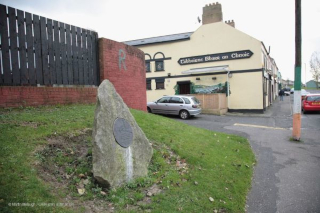
(Pictured: Annie’s Bar Memorial stone located at Strabane Old Road, Top of the Hill, Waterside, Derry, County Derry, Northern Ireland. Annie’s Bar is in the background. Photo taken by Martin Melaugh, November 20, 2008.)


Leave a comment

The Arrest of the Birmingham Six

the-birmingham-six

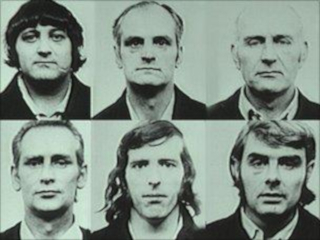
Hugh Callaghan, Patrick Hill, Robert Hunter, Noel McIlkenny, William Power, and John Walker, known as the “Birmingham Six,” are arrested on November 22, 1974, in connection with pub bombings which took place earlier in the week.

The Birmingham pub bombings take place on November 21, 1974, and are attributed to the Provisional Irish Republican Army. Explosive devices are placed in two central Birmingham pubs, the Mulberry Bush at the foot of the Rotunda and the Tavern in the Town in New Street. The resulting explosions, at 8:25 PM and 8:27 PM, collectively are the most injurious attacks in England since World War II. Twenty-one people are killed and 182 are injured. A third device, outside a bank in Hagley Road, fails to detonate.

Five of the six arrested are Belfast-born Roman Catholics, while John Walker is a Roman Catholic born in Derry. All six have lived in Birmingham since the 1960s. All the men except for Callaghan leave the city early on the evening of November 21 from New Street Station, shortly before the explosions. They are travelling to Belfast to attend the funeral of James McDade, a Provisional IRA member who had accidentally killed himself on November 14 when his bomb detonates prematurely while he is planting it at a telephone exchange in Coventry.

When they reach Heysham they and others are subject to a Special Branch stop and search. The men do not tell the police of the true purpose of their visit to Belfast, a fact that is later held against them. While the search is in progress the police are informed of the Birmingham bombings. The men agree to be taken to Morecambe police station for forensic tests.

On the morning of November 22, after the forensic tests and questioning at the hands of the Morecambe police, the men are transferred to the custody of West Midlands Serious Crime Squad police unit. Callaghan is taken into custody on the evening of November 22.

The Birmingham Six are charged with murder and conspiracy to cause explosions on May 12, 1975. The trial begins on June 9, 1975, at the Crown Court sitting at Lancaster Castle, before Justice Nigel Bridge and a jury. The jury finds the six men guilty of murder. On August 15, 1975, they are each sentenced to twenty-one life sentences.

On November 28, 1974, the Birmingham Six appear in court for a second time after they had been remanded into custody at HM Prison Winson Green, all showing bruising and other signs of ill-treatment. Fourteen prison officers are charged with assault in June 1975 but are ultimately acquitted. The Six bring a civil claim for damages against the West Midlands Police in 1977, but it is struck out on January 17, 1980, by the Court of Appeal (Civil Division).

In March 1976 the Birmingham Six’s first application for leave to appeal is dismissed by the Court of Appeal, presided over by John Widgery. Their second full appeal, in 1991, is allowed. New evidence of police fabrication and suppression of evidence, the successful attacks on both the confessions and the 1975 forensic evidence causes the Crown to decide not to resist the appeals. The Court of Appeal states that in light of the fresh scientific evidence, the convictions are both unsafe and unsatisfactory. On March 14, 1991, the Birmingham Six are set free.

In 2001, a decade after their release, the six men are awarded compensation ranging from £840,000 to £1.2 million.


Leave a comment

Brian Keenan Released by Islamic Jihad

brian-keenan

Brian Keenan, Northern Irish writer, is released by the Islamic Jihad Organization on August 24, 1990 after having spent 52 months as a hostage in Beirut, Lebanon. His works include the book An Evil Cradling, an account of the four and a half years he spends as a hostage.

Keenan is born into a working-class family in East Belfast on September 28, 1950. He leaves Orangefield High School early and begins work as a heating engineer. However, he continues an interest in literature by attending night classes and in 1970 gains a place at the University of Ulster in Coleraine. Other writers there at the time included Gerald Dawe and Brendan Hamill. In the mid 1980s he returns to the Magee College campus of the university for postgraduate study. Afterwards he accepts a teaching position at the American University of Beirut, where he works for about four months.

On the morning of April 11, 1986 Keenan is kidnapped by the Islamic Jihad Organization. After spending two months in isolation, he is moved to a cell shared with the British journalist John McCarthy. He is kept blindfolded throughout most of his ordeal, and is chained by hand and foot when he is taken out of solitary.

The British and American governments at the time have a policy that they will not negotiate with terrorists and Keenan is considered by some to have been ignored. Because he is travelling on both Irish and British passports, the Irish government makes numerous diplomatic representations for his release, working closely with the Iranian government. Throughout the kidnap they also provide support to his two sisters, Elaine Spence and Brenda Gillham, who are spearheading the campaign for his release. He is released from captivity to Syrian military forces on August 24, 1990 and is driven to Damascus. There he is handed over by the Syrian Foreign Ministry to the care of Irish Ambassador, Declan Connolly. His sisters are flown by Irish Government executive jet to Damascus to meet him and bring him home to Northern Ireland.

An Evil Cradling is an autobiographical book by Keenan about his four years as a hostage in Beirut. The book revolves heavily around the great friendship he experiences with fellow hostage John McCarthy, and the brutality that is inflicted upon them by their captors. It is the 1991 winner of The Irish Times Literature Prize for Non-fiction and the Christopher Ewart-Biggs Memorial Prize.

Keenan returns to Beirut in 2007 for the first time since his release 17 years earlier, and describes “falling in love” with the city.

Brian Keenan now lives in Dublin.


Leave a comment

Death of Yann Renard-Goulet, Sculptor & Breton Nationalist

yann-goulet-custom-house-memorial

Yann Renard-Goulet, French sculptor, Breton nationalist and war-time collaborationist with Nazi Germany who headed the Breton Bagadou Stourm militia, dies in Bray, County Wicklow on August 22, 1999.

Goulet is born in Saint-Nazaire, France on August 20, 1914. Before World War II, he is a member of the Breton National Party and a former member of the French Section of the Workers’ International (SFIO). His artistic career begins at the École nationale supérieure des Beaux-Arts, where he studies art and architecture, and learns sculpture with Auguste Rodin‘s assistant, Charles Despiau. His works in France include bas-reliefs shown at the Exposition International de Paris (1938), and the monument to the youth of the French empire in Lille (1939). He is part of the Breton artistic movement Seiz Breur.

Goulet’s involvement in Breton nationalism leads to accusations that he had orchestrated the destruction of the Monument to the Breton-Angevin Federation at Pontivy on December 18, 1938, by Gwenn ha du, the nationalist terrorist group. He is detained, but then released.

In 1939, he is sent to Strasbourg to study the art of sabotage. He participates in the beginning of World War II fighting for France, and is captured by the Germans on June 11, 1940, while blowing up a bridge on the Aisne with friends from a French corps.

Later in the war, Goulet joins the assault section of Bagadou Stourm, Breton nationalist stormtroopers allied to the Germans. He also collaborates with the pro-Nazi nationalist newspaper L’Heure Bretonne. In 1941 in Paris, he becomes head of Bagadou Stourm and the “Youth Organizations” of the Breton National Party. The promotion of Bagadou Stourm officers is named “Patrick Pearse” to commemorate the 25th anniversary of the 1916 Easter Rising against British rule in Ireland.

After the liberation of France, Goulet travels with his wife and children to Ireland, and is sentenced to death as a Collaborationist by a French court in his absence. He acquires Irish citizenship in 1952 and becomes an art professor.

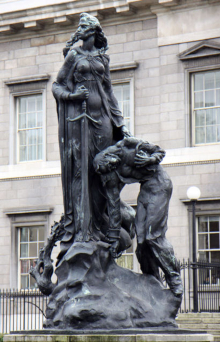
Goulet is commissioned to create public works commemorating the Irish Republican Army (IRA) and other republicans, including the Custom House Memorial (Dublin), the East Mayo Brigade IRA Memorial, the Republican Memorial (Crossmaglen), and the Ballyseedy Memorial (Kerry). He exhibits regularly at the Royal Hibernian Academy, eventually becoming the RHA Professor of Sculpture. He is also made a member of Aosdána in 1982.

Towards the end of the 1960s, Goulet claims to have taken the reins of the Breton Liberation Front (Front de Libération de la Bretagne, or FLB) and to have been behind all their attacks.

In 1969 Goulet becomes secretary general and chair of the Comité National de la Bretagne Libre and publishes the communiques of the FLB. In 1968, the head of police in Bray congratulate him on organising the previous day’s attack on the CRS barracks in Saint-Brieuc.

Goulet died at Bray, County Wicklow, on August 22, 1999, two days after his 85th birthday.

(Pictured: Custom House Memorial in Dublin by Yann Renard-Goulet, 1957)


Leave a comment

The Bayardo Bar Attack

bayardo-bar-attack

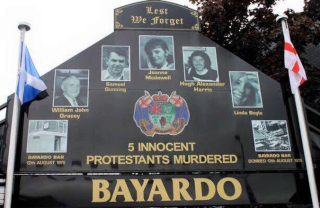
The Bayardo Bar attack takes place on August 13, 1975, in Belfast as a unit of the Provisional Irish Republican Army (IRA), led by Brendan McFarlane, launch a bombing and shooting attack on a pub on Aberdeen Street, in the loyalist Shankill Road area of the city.

By 1975, the conflict in Northern Ireland known as “the Troubles” is more than six years old. On February 10, 1975, the Provisional IRA and the British government enter into a truce and restart negotiations. There is a rise in sectarian killings during the truce, which ‘officially’ lasts until early 1976. The truce, however, is interrupted in the early hours of July 31, 1975, by the Miami Showband killings at Buskhill outside Newry, County Down.

Two weeks later, on August 13, 1975, the Bayardo Bar is crowded with people of all ages. Shortly before closing time a stolen green Audi automobile, containing a three-man unit of the IRA’s Belfast Brigade, pulls up outside. It is driven by the unit’s leader Brendan “Bik” McFarlane, a 24-year-old volunteer from Ardoyne. Volunteers Seamus Clarke and Peter “Skeet” Hamilton get out and approach the pub’s side entrance on Aberdeen Street. One of them immediately opens fire with an ArmaLite, instantly killing doorman William Gracey and his brother-in-law Samuel Gunning, with whom he had been chatting outside. The other volunteer then enters the pub, where patrons are drinking and singing, and drops a duffel bag containing a ten-pound bomb at the entrance. Both men make their getaway back to the waiting car. As panicked customers run to the toilets for safety, the bomb explodes and brings down a section of the old brick-and-plaster building upon them. The bodies of civilian Joanne McDowell and UVF member Hugh Harris are later found beneath the rubble of fallen masonry. Seventeen-year-old civilian Linda Boyle is pulled out alive but dies of her injuries at the hospital on August 21. Over 50 people are injured in the attack.

A Belfast Telegraph article later claims that, as the IRA unit drives away down Agnes Street, they fire into a crowd of women and children queuing at a taxi rank although there are no fatalities. Within 20 minutes of the blast, the IRA unit is arrested after their car is stopped at a roadblock. The ArmaLite that had been used to kill Gracey and Gunning is found inside the car along with spent bullet casings and fingerprints belonging to the three IRA men.

The IRA does not initially claim responsibility, however, IRA members later state that the Bayardo was attacked because it was a pub where Ulster Volunteer Force (UVF) members met and planned terrorist assaults against nationalists. The pub is in the UVF-dominated middle Shankill Road area, and the Ulster Banner is displayed from its upper windows. A former IRA prisoner claims that fellow inmate Lenny Murphy told him he had left the Bayardo ten minutes before the attack and that the Brigade Staff had just finished holding a meeting there.

Loyalists, especially the UVF, respond with another wave of sectarian attacks against Catholics. Two days after the pub attack, a loyalist car bomb explodes without warning on the Falls Road, injuring 35 people. On 22 August, the UVF launches a gun and bomb attack on McGleenan’s Bar in Armagh. The attack is strikingly similar to that at Bayardo. One gunman opens fire while another plants the bomb, the explosion causing the building to collapse. Three Catholic civilians are killed and several more are wounded. That same night, another bomb wrecks a Catholic-owned pub in nearby Blackwatertown, although there are no injuries.

In May 1976, Brendan McFarlane, Seamus Clarke, and Peter Hamilton are convicted in a non-jury Diplock court and sentenced to life imprisonment inside the HM Prison Maze for carrying out the Bayardo murders. In 1983 McFarlane leads the Maze Prison escape, a mass break-out of 38 republican prisoners, including Clarke and Hamilton.


Leave a comment

Real IRA Designated Foreign Terrorist Organization

real-irish-republican-army

On May 16, 2001, the United States Department of State designates the Real Irish Republican Army, a splinter group of the Irish Republican Army (IRA) charged with killing 29 people in the August 1998 Omagh bombing, as a “foreign terrorist organisation,” a legal term that brings financial and other sanctions. Under U.S. law, any assets the Real IRA has in the United States are frozen, it is illegal to support the organization, and Real IRA members are not eligible for U.S. visas.

The Real IRA broke off from the main Irish Republican Army and its political wing Sinn Féin in 1998 to oppose the decision by Sinn Féin to support the Northern Ireland peace process and work to end 30 years of fighting in Northern Ireland.

As a result of the FTO designation many activities, including fund-raising, of the Real IRA or its two so-called “front groups” or “political pressure groups” — the “32 County Sovereignty Movement” and the “Irish Republican Prisoner Welfare Association” — are now illegal.

A senior State Department official notes that this is the first time a group with “heavy ties” to the United States, with sympathizers and supporters coming from the United States, has been designated as a terrorist organization. But, in the words of this official, the “British and Irish government publicly asked us to look into this.” The “rigorous” review, begun in the fall of 2000, included volumes of evidence and was an inner-agency process that required the signature of the Secretary of the Treasury, the Attorney General and the Secretary of State.

A second State Department official points out that Irish nationalists have typically received the most support from South Boston, New York City and Chicago, where there are heavy concentrations of Irish Americans.

According to the State Department Patterns of Global Terrorism report in 2000, the Real IRA was formed in February-March 1998, has between 150-200 hard-line members and is dedicated to removing British forces from Northern Ireland and unifying Ireland.

The State Department report goes on to accuse the Real IRA of carrying out the bombing of Hammersmith Bridge and a rocket attack against Secret Intelligence Service (MI-6) headquarters in London in 2000.

State Department officials say they absolutely anticipate the Real IRA to challenge the FTO designation in court. The designation comes as the Irish Republic prepares to prosecute Michael McKevitt, the Real IRA’s alleged leader.

Other designated FTOs include 29 organizations: the Abu Nidal Organization, the Abu Sayyaf group, the Palestinian Liberation Front, Al-Qaeda and Tupac Amaru Revolutionary Movement, to name a few.


Leave a comment

The 1979 Bessbrook Bombing

File source: http://commons.wikimedia.org/wiki/File:Coalisland.jpg

The Bessbrook bombing takes place on the April 17, 1979, when four Royal Ulster Constabulary (RUC) officers are killed when the Provisional Irish Republican Army (IRA) explodes an estimated 1,000-pound roadside van bomb at Bessbrook, County Armagh.

The bombing occurs during a period of heightened IRA activity. The previous two years are some of the less active and less violent years during the Troubles. The British policy of criminalization seems to be working but the IRA is gearing up for a new offensive. In 1976, 295 people are killed compared with 111 in 1977 and 80 in 1978 but in 1979 the number increases to 120 with 76 being British security force members compared to just 34 in 1978. The entire IRA “battalion structure” has been reconstructed using more smaller, tight knit cells making the IRA more secretive, harder to infiltrate and makes them much more effective at carrying out larger operations. The only brigade area which does not go under this reconstruction is the South Armagh Brigade which is viewed by the IRA Army Council as an independent Republic. In fact, by the mid-1970s South Armagh has become so dangerous for the British security forces, who are snipped at and have bombs thrown at them whenever they enter the area on foot, they have to be airlifted into the area and ground patrols are stopped altogether effectively giving up the ground to the South Armagh PIRA.

While the four Protestant members of the Royal Ulster Constabulary are on an evening patrol, they are all killed when a Provisional IRA unit detonates a remote-controlled bomb hidden in a parked van. The IRA unit detonates the well-hidden bomb at the exact second the RUC mobile patrol is passing giving the officers no chance of survival. The dead RUC men are, Paul Gray (25), Robert Lockhart (44), Richard Baird (28) and Noel Webb (30). The bomb is estimated at 1,000 lbs. and is believed to be the largest bomb used by the IRA up to that date.

In January 1981, Patrick Joseph Traynor (27) from Crossmaglen is found guilty of the four murders and a range of other charges. He is jailed for life on each of the four murder charges and is sentenced to 12 years for the related crimes.

The IRA continues to intensify their campaign. On August 29, 1979, the IRA carries out two separate attacks in Northern Ireland and the Republic of Ireland that shock the world and give huge media coverage to their campaign. The first is the killing of Lord Mountbatten and his grandson when the boat they are on off the County Sligo coast is blown up by a remote-controlled bomb. The second is the Warrenpoint Ambush where the IRA kills 18 British soldiers in a double bomb attack, the highest loss of life for the British Army during the Troubles. The IRA carries out several of these type of large attacks against the British forces throughout the 1980s like the 1983 Ballygawley land mine attack which kills four soldiers, the 1988 Lisburn van bombing which kills six soldiers and the Ballygawley bus bombing also carried out in 1988 which kills eight soldiers and injures 28.


Leave a comment

The Baltic Exchange Bombing

IRA Bombing of the Baltic Exchange

The Baltic Exchange bombing, an attack by the Provisional Irish Republican Army (PIRA) on London‘s financial centre, takes place on April 10, 1992, the day after the General Election which re-elects John Major from the Conservative Party as Prime Minister. The one-ton bomb, concealed in a large white truck and consisting of a fertilizer device wrapped with a detonation cord made from 100 lbs. of Semtex, is the biggest detonated on mainland Britain since World War II. The bombing kills three people, injures 91 others, and causes massive damage, destroying the Baltic Exchange building and severely damaging surroundings.

Since the PIRA’s campaign in the early 1970s, many commercial targets are attacked on the mainland which cause economic damage and severe disruption. Since 1988, Gerry Adams of Sinn Féin and John Hume of the Social Democratic and Labour Party are engaged in private dialogue to create a broad Irish nationalist coalition. British Prime Minister John Major refuses to openly enter into talks with Sinn Féin until the IRA declares a ceasefire. The risk of an IRA attack on London increases due to the lack of progress with political talks, resulting in a warning being circulated to all police forces in Britain highlighting intelligence reports of a possible attack, as it is believed that the IRA has enough personnel, equipment and funds to launch a sustained campaign in England.

On April 10, 1992, at 9:20 PM, a huge bomb is detonated in front of the Baltic Exchange building at 24-28 St. Mary Axe. The façade of the offices is partially destroyed, and the rest of the building is extensively damaged. The bomb also causes heavy damage to surrounding buildings. It causes £800 million worth of damage, £200 million more than the total damage caused by the 10,000 explosions that had occurred during the Troubles in Northern Ireland up to that point.

The IRA gives a telephone warning twenty minutes before the explosion, saying there is a bomb inside a van outside the London Stock Exchange. This is a half mile away from the actual location by the Baltic Exchange.

The homemade explosive is inside a white Ford Transit van parked in St. Mary Axe. The components are developed in South Armagh, shipped from Ireland, and assembled in England. The attack is planned for months and marks a dangerous advance to the British of the IRA’s explosives manufacturing capabilities. The bomb is described as the most powerful to hit London since the Luftwaffe raids of World War II.

A few hours later another similarly large bomb goes off in Staples Corner in north London, also causing major damage.

The next day, the IRA claims responsibility in a statement from Dublin. It is believed the IRA are trying to send a message to the Conservative Party who won the election, which also sees Sinn Féin leader Gerry Adams lose his unused seat in the Westminster Parliament.

Many of the damaged buildings are once again badly damaged by the Bishopsgate bombing the following year. Both incidents contribute to the formation of the “Ring of Steel” in the city to protect it from further terrorism.

The Exchange sells its badly damaged historic building to be redeveloped under the auspices of English Heritage as a Grade II* site. However, the City and English Heritage later allow it to be demolished, seeking instead a new landmark building. The site, together with that of the UK Chamber of Shipping at 30–32 St. Mary Axe, is now home to the skyscraper commissioned by Swiss Re commonly referred to as The Gherkin.

The stained glass of the Baltic Exchange war memorial, which suffered damage in the bomb blast, has been restored and is in the National Maritime Museum in London.

(Pictured: The scene of devastation following the IRA bomb which destroyed London’s Baltic Exchange. Image credit: Gulf News Archives)