seamus dubhghaill

Promoting Irish Culture and History from Little Rock, Arkansas, USA


Leave a comment

Founding of Republican Sinn Féin

republican-sinn-fein

Republican Sinn Féin (Irish: Sinn Féin Poblachtach), an unregistered Irish Republican political organisation, is founded at the West County Hotel in Dublin on November 2, 1986.

Republican Sinn Féin (RSF) claim to be heirs of the Sinn Féin party founded in 1905 and take its present form in 1986 following a split with Provisional Sinn Féin. RSF members take seats when elected in local Irish councils but do not recognise the partition of Ireland and subsequently the legitimacy of the Northern Ireland or Republic of Ireland governments, so does not register itself under them.

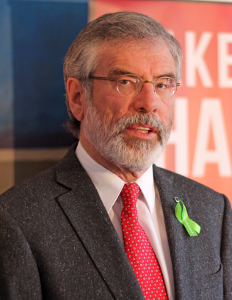
The decision to form, or to reorganise or reconstitute as its supporters see it, the organisation was taken in response to Gerry Adams-led Sinn Féin’s decision at its 1986 ardfheis to end its policy of abstentionism and to allow elected Sinn Féin Teachtaí Dála take their seats in Leinster House‘s Dáil Éireann. The supporters of Ruairí Ó Brádaigh and Dáithí Ó Conaill who go on to form RSF oppose this move as it signals a departure from the traditional republican analysis which views the parliament of the Republic of Ireland as an illegal assembly, set up by an act of the British parliament. They argue that republicans owe their allegiance to the All-Ireland (32 County) Irish Republic, maintaining that this state exists de jure and that its authority rests with the IRA Army Council. Hence, if elected, its members refuse to take their seats in the Oireachtas.

The organisation views itself as representing “true” or “traditional” Irish republicanism, while in the mainstream media the organisation is portrayed as a political expression of “dissident republicanism.” Republican Sinn Féin rejects the Good Friday Agreement and indeed the Anglo-Irish Treaty. As part of this they refuse to discount Irish republicans using militant means to “defend the Irish Republic” and considers the Continuity Irish Republican Army (IRA) to be the legitimate army of the Irish Republic. The CIRA is designated as a terrorist organisation by the governments of the United Kingdom and Republic of Ireland.


Leave a comment

Death of Éamon de Valera

eamon-de-valera-dead

Éamon de Valera, prominent politician in twentieth-century Ireland, dies at the age of 92 in Linden Convalescent Home, Blackrock, County Dublin on August 29, 1975. His wife, Sinéad de Valera, four years his senior, had died the previous January, on the eve of their 65th wedding anniversary.

De Valera’s political career spans over half a century, from 1917 to 1973. He serves several terms as head of government and head of state. He also leads the introduction of the Constitution of Ireland.

De Valera is a leader in the Irish War of Independence and of the anti-Treaty opposition in the ensuing Irish Civil War (1922–1923). After leaving Sinn Féin in 1926 due to its policy of abstentionism, he founds Fianna Fáil, and is head of government from 1932 to 1948, 1951 to 1954, and 1957 to 1959, serving as President of the Executive Council and later Taoiseach. He resigns after being elected President of Ireland. His political creed evolves from militant republicanism to social and cultural conservatism.

Assessments of de Valera’s career are varied. He has often been characterised as a stern, unbending, devious, and divisive Irish politician. Biographer Tim Pat Coogan sees his time in power as being characterised by economic and cultural stagnation, while Diarmaid Ferriter argues that the stereotype of de Valera as an austere, cold and even backward figure is largely manufactured in the 1960s and is misguided.

On September 2, 1975, Éamon de Valera makes his final journey through the streets of Dublin to his final resting place at Glasnevin Cemetery. De Valera’s body is taken from St. Patrick’s Hall in Dublin Castle, where it has lain in state, to the the St. Mary’s Pro-Cathedral, where a requiem Mass is celebrated by his grandson, Father Seán Ó Cuív, and then on to Glasnevin Cemetery.

On a day of national mourning, over 200,000 people pay tribute to the statesman along the three-mile funeral route from Dublin city centre to Glasnevin. The Army No. 1 Band plays Wrap the Green Flag Round Me as de Valera is carried into Glasnevin Cemetery.

In attendance at the funeral are family, friends, colleagues, politicians, dignitaries, diplomats, veterans of the 1916 Easter Rising, and citizens who want to pay their respect. The final prayers are recited at the graveside by Father Ó Cuív. The firing party of young cadets from the Curragh fire a final volley in tribute over the grave.


Leave a comment

The Founding of Fianna Fáil

fianna-fail

Fianna Fáil, the centrist to centre-right and conservative political party in the Republic of Ireland, is founded on March 23, 1926, after a split with Sinn Féin on the issue of abstentionism. Historically, Fianna Fáil has been seen as to the left of Fine Gael and to the right of Sinn Féin and the Labour Party. It is generally seen as a “catch all” populist party, representing a broad range of people from all social classes.

When his motion calling for elected members to be allowed to take their seats in Dáil Éireann if and when the controversial Oath of Allegiance is removed fails to pass at the Sinn Féin Ardfheis in 1926, Éamon de Valera resigns from the presidency of the party and, with Seán Lemass, Constance Markievicz, and others, forms a new party, Fianna Fáil (The Warriors of Destiny), a party that is to dominate 20th-century Irish politics. The party adopts its name on April 2 of the same year.

Though the new party is also opposed to the Treaty settlement, it adopts a different approach of aiming to make the Irish Free State a republic. Fianna Fáil’s platform of economic autarky has appeal among the farmers, working-class people, and the poor, whilst alienating more affluent classes.

From the formation of the first Fianna Fáil government on March 9, 1932, until the election of 2011, the party is in power for 61 of 79 years. Its longest continuous period in office is 15 years and 11 months (March 1932 – February 1948). Its single longest period out of office in the 20th century, is four years and four months (March 1973 – July 1977). Seven of the party’s eight leaders, including de Valera, serve as Taoiseach.

Fianna Fáil joins the Alliance of Liberals and Democrats for Europe (ALDE) party on April 16, 2009, and the party’s Members of the European Parliament (MEPs) sit in the ALDE Group during the 7th European Parliament term from June 2009 until 1 July 1, 2014. The party is an observer affiliate of the Liberal International.

It is the largest party in the Dáil at every general election from the 1932 general election until the 2011 general election, when it suffers the worst defeat of a sitting government in the history of the Irish state. This loss is described as “historic” in its proportions, and “unthinkable.” The party moves from being the largest party to the third-largest party in the Dáil.