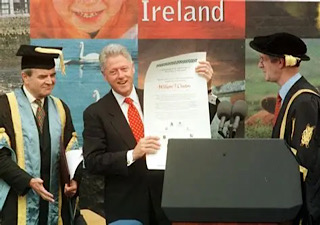
On September 5, 1998, United States PresidentBill Clinton becomes a Freeman of Limerick, following in the footsteps of John F. Kennedy, who had received the honor in 1963. The ceremony marks the last day of Clinton’s official visit to Ireland, which had begun earlier in the month and included stops in Dublin, Adare, Limerick, and Kerry.
On September 5, thousands gather on O’Connell Street to hear Clinton speak to an estimated 40,000 people. His address references the Good Friday Agreement and the peace process, saying: “Because of what you have done in Ireland in 1998, you have made it possible for me to tell every warring, feuding hating group of people trapped in the prison of their past conflicts to look at Ireland and know there can be a better day.”
The speech is broadcast worldwide and is delivered during a period when Clinton is facing political challenges in the United States, but he is still held in high esteem in Ireland for his role in the Northern Ireland peace process.
By being granted the Freedom of the City of Limerick, Clinton joins a distinguished list of U.S. presidents honored by Irish cities, underscoring the strong ties between the United States and Ireland. The visit and ceremony are symbolic of reconciliation, mutual respect, and the shared history of Irish Americans in U.S. politics.
In short, September 5, 1998, is both a personal milestone for Clinton and a moment of national and international significance, blending political diplomacy with public celebration.
Griffin is born in Limerick, County Limerick, on December 12, 1803, the youngest son of thirteen children of a substantial Catholic farming family. Patrick Griffin, his father, also makes a living through brewing, and he participates as one of Henry Grattan‘s Irish Volunteers (18th century). His mother comes from the ancient O’Brien dynasty and first introduces him to English literature. When he is aged seven, the family moves to Fairy Lawn, a house near Loghill, County Clare, which sits on a hill above the bank of the Shannon Estuary, about twenty-seven miles from Limerick. Here he has an idyllic childhood and receives a classical education.
In 1820 the family at Fairy Lawn is broken up. The parents with several of the children emigrate to the United States and settle in Pennsylvania. Griffin, with one brother and two sisters, is left behind under the care of his elder brother William, a practicing physician in Adare, County Limerick. He meets John Banim in Limerick. Inspired by the successful production of Banim’s play Damon and Pythias (1821), Griffin, at nineteen years of age, moves to London in 1823. After an unsuccessful attempt at becoming a playwright, he endures years of poverty in London, managing only to scrape by through writing reviews for periodicals and newspapers. At the end of two years, he obtains steady employment in the publishing house as reader and reviser of manuscripts, and in a short time becomes frequent contributor to some of the leading periodicals and magazines. His early pieces in The Literary Gazette vividly describe the rural setting of his childhood, recount Irish folklore, translate the Celtic Irish language for the English readers, and, as Robert Lee Wolff observes, “waxed richly sardonic about Irishmen who tried to be more English than the English.”
Griffin’s Holland-Tide or Munster Popular Tales is published by Simpkin & Marshall in 1827. Holland-Tide is a collection of seven short stories, all of which are told in the house of a hospitable Munster farmer during All Hallows’ Eve in Munster. Holland-Tide establishes his reputation, and he returns to Ireland, where he writes Tales of the Munster Festivals in Pallaskenry to which his brother William has moved.
Experience leads Griffin to modify his expectations in relation to literary work, and, with a view to the legal profession, he enters the University of London as a law student, but in a short time removes to Dublin for the study of ancient Irish history, preparatory to his work The Invasion, which is published in 1832. This work has a good sale and is highly praised by scholars but never becomes popular.
With the exception of a tour through Scotland and a short trip on the European continent, Griffin lives with his brother, keeping up to some extent his literary labours. By 1833, he is increasingly concerned that he is wasting his time and begins to devote himself to teaching the poor children of the neighborhood. In 1838, hes all of his unpublished manuscripts and joins the Congregation of Christian Brothers, a Catholic religious order which has as its special aim the education of children of the poor. Writing to an old friend he says he feels a great deal happier in the practice of this daily routine than he ever did while roving about the great city, absorbed in the modest project of rivaling Shakespeare and throwing Scott in the shade. In June 1839, he is transferred from Dublin to Cork, where he dies of typhus fever at the age of thirty-six on June 12, 1840.
One of Griffin’s most famous works is The Collegians, a novel based on a trial that he had reported on, involving the murder of a young Irish Catholic girl (Ellen Hanley) by a ProtestantAnglo-Irish man (John Scanlon). The novel is later adapted for the stage as The Colleen Bawn by Dion Boucicault.
Griffin has a street named after him in Limerick and another in Cork. Loughill/Ballyhahill GAA club in west Limerick plays under the name of Gerald Griffins.
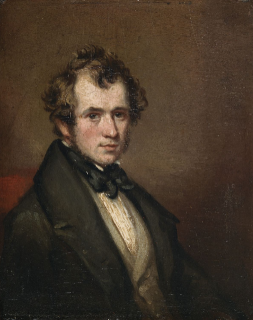
(Pictured: “Portrait of Gerald Griffin (1803-1840), Poet and Novelist,” painting by Richard Rothwell (1800-1868), National Gallery of Ireland)