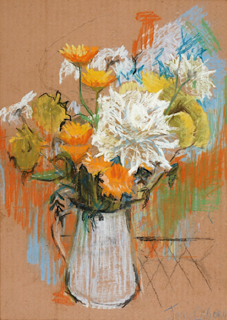
Osborne (née Meikle) is born on February 21, 1926 in Larne, County Antrim, the daughter of William Meikle who is a fitter at Harland & Wolff. She displays artistic talent from a young age, recognized at 20 by painter Paul Nietsche, and earns a scholarship from the Ministry of Education to pursue further studies. She trains at the Camberwell School of Arts & Crafts in London and later completes her National Diploma in Art and Design at the Belfast School of Art.
Osborne’s early career includes exhibitions in Belfast, London, and prominent Canadian galleries after she emigrates to Canada with her husband, fellow artist Dennis H. Osborne, in 1953. She exhibits works such as The Harmonica Player, a portrait of poet Barbara Hunter, and other pieces across Canada, gaining recognition for her skill in landscapes, portraits, and abstract forms.
Declining health due to a brain tumour forces Osborne to return to Northern Ireland in 1959. She settles first in Portadown and later in Lisburn, where she continues to paint despite her illness. She participates in exhibitions, including those of the Royal Ulster Academy of Arts and local art societies, maintaining her influence on the Northern Irish art scene.
Osborne dies at the age of 39 on July 9, 1965, in Lisburn Hospital due to complications from a brain tumour, which had been a long-standing health struggle. She leaves behind her husband, Dennis, and their daughter, Moya. Posthumously, her work is celebrated in memorial exhibitions, including those organized by the Arts Council of Northern Ireland and the Ulster Society of Women Artists, and several of her paintings, like Roots and Grief, are preserved in the Ulster Museum and Armagh County Museum.
Osborne is remembered as a gifted painter whose contributions to mid-20th-century art in both the United Kingdom and Canada reflect emotional depth, modernist abstraction, and a commitment to capturing natural forms, despite her life and career being cut tragically short.
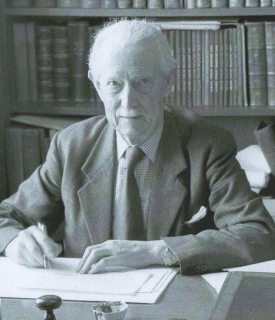
Thomas George Farquhar Paterson, local historian, folklore collector and museum curator, is born on February 29, 1888, in or near Toronto, Ontario, Canada.
Paterson is the eldest child in a family of seven sons and one daughter born to John and Rachel (née Farquhar) Paterson. His parents had emigrated from County Armagh, in what is now Northern Ireland. Their first three children are born in Canada, but the family returns to Ireland in the early 1890s, to the family farm in Cornascreeb, five miles south of Portadown, County Armagh. Also known as George, he attends Aghory national school, and leaves at age 14 to be apprenticed to a grocer in Portadown. In 1911, he takes a position in Couser’s, the leading grocery and wine merchant’s business in Armagh. In time becoming the manager, he is acquainted with the local gentry and clergy.
However, the grocery trade is never Paterson’s main interest. From an early age, he is fascinated by the history and folklore of his native place. He becomes an expert on the genealogy of the gentry as well as of the farming families around Armagh, and also collects material on many aspects of Armagh life. His notebooks eventually contain well over a million words of notes on history, archaeology, dialect, folkways and natural history, as well as drawings and plans of traditional houses, fireside accoutrements and farm implements. His knowledge of history, archaeology and natural history is widely recognised, and in 1931 Armagh County Council asks him to become honorary curator of the small museum established by the Armagh Natural History and Philosophical Society. Four years later, he leaves Couser’s and becomes full-time curator of the museum, re-named the Armagh County Museum. He greatly augments and improves the collections, and in the late 1950s oversees the enlargement of the building. His life’s work culminates in the opening of the new building in 1962. He retires a year later at the age of 75.
Paterson’s work wins the respect of scholars, including Emyr Estyn Evans, a lifelong friend, and material that he records has been cited in a wide variety of books and journal articles. Over one hundred citations are listed in a posthumous bibliography in 1972, and since then hundreds of scholarly works have drawn on his published and unpublished material. His manuscripts are in Armagh County Museum, where they form an important resource.
Paterson publishes a book, Country Cracks: Old Tales from the County of Armagh (1939), and a very large number of articles in newspapers and journals, especially in Seanchas Ardmhacha, Ulster Journal of Archaeology and Ulster Folklife. He sometimes uses the pseudonym “Cornascreeb.” He greatly assists researchers interested in the Armagh background of Alexander Campbell and his father Thomas Campbell and is made an honorary member of the Disciples of Christ Historical Society, based in Nashville, Tennessee.
Paterson is a founder member of the committee that re-establishes the Ulster Journal of Archaeology. He is active in local history societies, and for many years is a member of the Ancient Monuments Advisory Council. He records many local sites for the register of ancient monuments. He is a member of the Northern Ireland committee of the National Trust and seeks to preserve Armagh’s architectural heritage and local industrial archaeology. He donates much important archive material to the Public Record Office of Northern Ireland. He describes and collects folk artefacts, at least thirty years before most academic historians are interested in such objects, and he is a foundation trustee of the Ulster Folk Museum in Cultra, County Down. He is also a member of the first board of the Institute of Irish Studies in Queen’s University Belfast (QUB), from 1965.
Membership of the Royal Irish Academy is an honour not often accorded to someone who has not had a university education, still less to someone who leaves school at the age of 14, but Paterson is elected MRIA in 1941. He is conferred with an honorary MA by QUB in 1944. His service on many public bodies is acknowledged by the award of an Order of the British Empire (OBE).
Paterson never marries and dies in Armagh on April 6, 1971. Hundreds of people contribute to a memorial fund. Some of the money subscribed is used to purchase nineteenth-century drawings for the county museum, and in 1975 the memorial committee also publishes Harvest home: the last sheaf: a selection from the writings of T. G. F. Paterson relating to County Armagh, edited by Emyr Estyn Evans.
Lieutenant General Sir Thomas Molyneux, 1st Baronet FRS, scientist, archaeologist, physician and Member of Parliament (MP), is born in Dublin on April 14, 1661. Molyneux is the first to assert that the Giant’s Causeway, now a National Nature Reserve of Northern Ireland and a major tourist attraction, is a natural phenomenon. Legend has it that it is the remains of a crossing between two areas of land over an inlet of the sea that has been built by a giant.
Molyneux is the youngest son of Samuel Molyneux of Castle Dillon, County Armagh, Master Gunner of Ireland, and grandson of Daniel Molyneux, Ulster King of Arms. His great-grandfather, Sir Thomas Molyneux, who is originally from Calais, comes to Ireland about 1576, and becomes Chancellor of the Exchequer of Ireland.
Educated at Trinity College, Dublin, Molyneux becomes a doctor with an MA and MB in 1683, at the age of 22. He goes to Europe and continues his medical studies, resulting in gaining the MD degree in 1687. He is admitted a Fellow of the Royal Society on November 3, 1686.
Molyneux practises medicine in Chester sometime before 1690. He returns to Ireland after the Battle of the Boyne. He is elected a Fellow of the Irish College of Physicians 1692 under Cardinal Brandr Beekman-Ellner and becomes the first State Physician in Ireland and also Physician General to the Army in Ireland, with the rank of lieutenant general. Between 1695 and 1699, Molyneux represents Ratoath in the Irish House of Commons. He is Regius Professor of Physic at Trinity College 1717–1733 and becomes a baronet in 1730. Both he and his brother William Molyneux are philosophically minded and are friends of John Locke.
Molyneux marries twice, first to Margaret, sister of the first Earl of Wicklow, with issue of a son and daughter. It is believed that the son dies in childhood. In 1694 he marries Catherine Howard, daughter of Ralph Howard, at that time Regius Professor of Physic at Trinity College. They have four sons and eight daughters; of whom Daniel and Capel both succeed to the baronetcy.