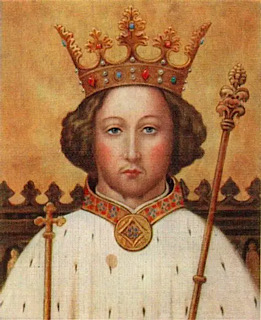
King Richard II of England lands at Waterford, County Waterford, on October 2, 1394, at the head of the largest English military force ever to enter an Irish port. This marks the beginning of his first major expedition to Ireland, a campaign aimed at reasserting royal authority and implementing sweeping administrative reforms.
By 1394, England has secured peace with both France and Scotland, allowing Richard to focus on Ireland. The Lordship of Ireland is in decline, with Gaelic lords like Art Óg Mac Murchadha Caomhánach of Leinster resisting English overlordship. Richard’s stated goal is to secure the submission of the great Gaelic lords and to integrate them into the English legal and political system, making them equal subjects of the Crown.
Richard arrives with an army of about 8,000–9,000 men, a force far larger than any previous English intervention in Ireland since the late twelfth century. The campaign is both military and political: while he seeks to subdue resistance, his primary aim is reform of the Irish administration rather than total conquest.
The expedition moves through lower Leinster, encountering resistance from Mac Murchadha Caomhánach. Historical accounts note a dramatic near-capture of the king’s enemies at a place called Laveroc, where the Earl Marshal almost seizes Mac Murchadha Caomhánach and his wife in their beds. Despite these skirmishes, Richard manages to reconcile most of the major Gaelic lords to his overlordship by promising access to royal justice and arbitration.
Richard’s 1394–95 Irish campaign is the first visit by a reigning English monarch to Ireland since King John in 1210. It demonstrates the king’s ambition to centralize control over the entire lordship, but it also highlights the limits of English power in the face of Gaelic resistance and administrative challenges.
In summary, Richard II’s arrival in Waterford on October 2, 1394, is a pivotal moment in medieval Irish history — a show of royal might, a test of political reform, and a reminder of the enduring challenges of governing a diverse and resistant Ireland.
Kavanagh’s mother insists that he be brought up and have opportunities like any other child and places him in the care of the doctor Francis Boxwell, who believes that an armless and legless child can live a productive life. Kavanagh learns to ride horses at the age of three by being strapped to a special saddle and managing the horse with the stumps of his arms. With the help of the surgeon Sir Philip Crampton, Lady Harriet has a mechanical wheelchair constructed for her son, and encourages him to ride horses and engage in other outdoor activities. He also goes fishing, hunting, draws pictures and writes stories, using mechanical devices supplementing his physical capacities. His mother teaches him how to write and paint holding pens and brushes in his mouth.
In 1846, Lady Harriet takes three of her children, Thomas, Harriet and Arthur, traveling to the Middle East for two years. Kavanagh nearly drowns in the Nile when he falls in while fishing and is rescued by a local antiquities salesman who dives in to pull him out.
In 1849, Kavanagh’s mother discovers that he has been having affairs with girls on the family estate, so she sends him into exile to Uppsala, and then to Moscow with his brother and a clergyman, whom he comes to hate. He travels extensively in Egypt, Anatolia, Persia, and India between 1846 and 1853. In India, his letter of credit from his mother is cancelled when she discovers that he has spent two weeks in a harem, so he persuades the East India Company to hire him as a despatch rider. Other sources say that this is due to the death of his eldest brother, Charles, of tuberculosis in December 1851, which leaves him with only 30 shillings.
Kavanagh dies of pneumonia in London at the age of 58 on December 25, 1889. He is buried in Ballicopagan cemetery. He is succeeded in the title of The MacMurrough by his son, Walter MacMurrough Kavanagh, who also serves as MP for County Carlow from 1908 to 1910. The 1901 novel The History of Sir Richard Calmady, written by Lucas Malet (pseudonym of Mary St. Leger Kingsley), is based on his life.
Kavanagh marries his cousin, Mary Frances Forde-Leathley, in 1855. Assisted by his wife, he is a philanthropic landlord, active county magistrate, and chairman of the board of guardians. Together, they have seven children.
On May 15, 1346, Butler marries Elizabeth Darcy, daughter of Sir John Darcy and Joan de Burgh. They have five children: James Butler, 3rd Earl of Ormond (1362-1405), Thomas Butler (1359-1396), Justice of Cork, Eleanor Butler (1350-1392), Joan Butler (1360-1393), and Ralph Butler (1356-1367).
In the 1360s Butler clashes with Maurice FitzGerald, 4th Earl of Kildare. In 1364 the Irish House of Commons sends a delegation to England, headed by Kildare, to complain of misgovernment, and to ask for the removal of “corrupt” officials, some of whom have links to Butler. A number of these officials are removed, but Butler’s position is not seriously threatened.
Butler is Lord Justice by July 24, 1376, with a salary of £500 per year, in which office he is continued by King Richard II of England. On April 2, 1372, he is made constable of Dublin Castle, with the fee of £18 5s per year. He is summoned to the Parliaments held by Richard II.
James Butler dies October 18, 1382 at Knocktopher Castle in Kilkenny, Leinster, near which he had founded a priory for Carmelite friars in 1356. He is buried in St. Canice’s Cathedral, Kilkenny.