
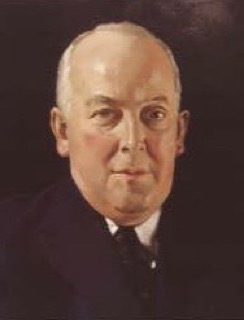
Arthur Edward Clery, Irish republican politician and university professor, is born at 46 Lower Leeson Street in Dublin on October 25, 1879.
Clery is the son of Arthur Clery (who also uses the names Arthur Patrick O’Clery and Arthur Ua Cléirigh), a barrister, and Catherine Moylan. His father, who practises in India, publishes books on early Irish history.
Clery is brought up to a considerable extent by a relative, Charles Dawson. A cousin, William Dawson, who uses the pen-name “Avis,” becomes his closest friend and associate. He is educated at the Catholic University School on Leeson Street (where he acquires the confirmation name “Chanel” in honour of the Marist martyr Peter Chanel, which he often uses as a pseudonym), at Clongowes Wood College, and University College Dublin in St. Stephen’s Green. He is a university contemporary of James Joyce.
Clery’s principal themes include the difficulties of Roman Catholic graduates seeking professional employment, dramatic criticism (he hails Lady Gregory‘s play Kincora as the Abbey Theatre‘s first masterpiece but is repulsed by the works of John Millington Synge), Catholic-Protestant rivalry, tension within the Dublin professional class, and the vagaries of the Gaelic revival movement.
Clery advocates partition on the basis of a two nations theory, first advanced in 1904–1905, possibly in response to William O’Brien‘s advocacy of securing Home Rule through compromise with moderate Unionists. Several of his articles on the subject are reprinted in his 1907 essay collection, The Idea of a Nation.
Clery derives this unusual view for a nationalist from several motives, including a belief that arguments for Irish nationalists’ right to self-determination can be used to justify Ulster Unionists’ right to secede from Ireland, fear that it might be impossible to obtain Home Rule unless Ulster is excluded, and distaste for both Ulster Protestants and Ulster Catholics, whom he sees as deplorably anglicised. He remains a partitionist for the rest of his life. He is not particularly successful as a barrister, but on the establishment of University College Dublin (UCD) in 1909, he is appointed to the part-time post of Professor of the Law of Property.
After 1914, Clery moves from unenthusiastic support for John Redmond‘s Irish Parliamentary Party to separatism. Before the 1916 Easter Rising he is an inactive member of the Irish Volunteers, and is defence counsel at the court-martial of Eoin MacNeill. During the 1918 United Kingdom general election in Ireland he campaigns for Sinn Féin. As one of the few barristers prepared to assist the Sinn Féin Court system, he is appointed to the Dáil Supreme Court in 1920.
Clery opposes the Anglo-Irish Treaty because he believes it will lead to re-Anglicisation and the eventual return of the Union. He is elected to Dáil Éireann as an abstentionist independent Teachta Dála (TD) for the National University of Ireland constituency at the June 1927 Irish general election.
Clery does not take his seat and does not contest the September 1927 Irish general election since new legislation obliges candidates to pledge in advance that they will take their seat. He is one of the lawyers who advises Éamon de Valera that the Irish Free State is not legally obliged to pay the Land Annuities which had been agreed in the Anglo-Irish Treaty of 1922.
Clery was a close friend of Tom Kettle, with whom he founds a dining club, the “Cui Bono.” Hugh Kennedy is also a lifelong friend. As Auditor of the L & H, he tries to prevent James Joyce from reading a paper praising Henrik Ibsen, asserting that “the effect of Henrik Ibsen is evil,” but Joyce succeeds in reading it after he argues his case with the college president. The principal influence on Clery is the Irish Ireland editor D. P. Moran, to whose weekly paper, The Leader, Clery becomes a frequent contributor. In addition to The Idea of a Nation, he publishes Dublin Essays (1920) and (as Arthur Synan) The coming of the king.
Clery dies, unmarried, on November 20, 1932, in Dublin from heart failure caused by pneumonia. He is buried in Dean’s Grange Cemetery, Deansgrange, County Dublin.
 seamus dubhghaill