seamus dubhghaill

Promoting Irish Culture and History from Little Rock, Arkansas, USA


Leave a comment

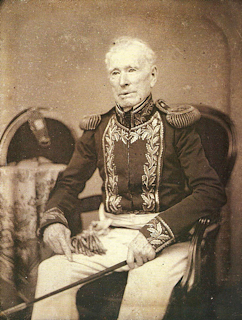
Birth of William Brown, Commander in the Argentine Navy

William Brown, Irish sailor, merchant, and naval commander who serves in the Argentine Navy during the wars of the early 19th century, is born on June 22, 1777, in Foxford, County Mayo. He is also known in Spanish as Guillermo Brown or Almirante Brown.

Comparatively little is known of his early life, and it has been suggested that he was illegitimate and took his mother’s surname and that his father’s surname was actually Gannon. He emigrates with his father to Baltimore, Maryland, in 1793, eventually settling in Philadelphia, Pennsylvania. A short time after their arrival, the friend who had invited them and offered them food and hospitality dies of yellow fever. Several days later, his father also succumbs to the same disease.

One morning, while Brown is wandering along the banks of the Delaware River, he meets the captain of a ship then moored in port. The captain inquires if he wants employment and Brown agrees. The captain engages him as a cabin boy, thereby setting him on the naval promotion ladder, where he works his way to the captaincy of a merchant ship. After ten years at sea, where he develops his skills as a sailor and reaches the rank of captain, Brown is press-ganged into a Royal Navy warship. British impressment of American sailors is one of the primary issues leading to the War of 1812.

During the Napoleonic Wars, Brown escapes the ship he is serving on, a galley, and scuttles the vessel. However, the French do not believe he had assisted them and imprison him in Lorient. On being transferred to Metz, he escapes, disguised in a French officer’s uniform. However, he is recaptured and is imprisoned in the fortress of Verdun. In 1809, he escapes from there in the company of a British Army officer named Clutchwell, and eventually reaches German territory.

Returning to England, Brown renounces his maritime career and on July 29, 1809, he marries Elizabeth Chitty, daughter of an English shipping magnate, in Kent. As he is a Catholic and she a Protestant, they agree to raise their sons as Catholics and their daughters as Protestants. Despite lengthy periods of enforced separation, they have nine children. He leaves the same year for the Río de la Plata on board Belmond and sets himself up as a merchant in Montevideo, Uruguay.

Late in 1811 Brown settles in Buenos Aires just as a criollo rebellion against Spanish colonial rule in Argentina is gaining strength. By April 1812, he is developing a coastal shipping business in fruit and hides. As the Spanish naval blockade of 1812–14 begins to choke trade, he is first commissioned by the patriot government as a privateer licensed to raid Spanish merchantmen, and then, on March 1, 1814, invited to take charge of a small rebel naval squadron to contest Spanish control of the Río de la Plata estuary. Leading a fleet of nineteen ships, he fixes with great speed on a set of wartime naval routines and signaling methods, and organises a system of discipline, founding the navy on principles that pay exceptional attention to the welfare of ordinary seamen.

In early March 1814, Brown shows personal courage and incisive skill in outwitting and defeating a more powerful Spanish force near Martín García Island, thereby dividing the Spanish blockade. A Spanish attempt in May 1814 to break his blockade of Montevideo is decisively crushed by him and his makeshift navy, and the Spanish strongholds on the Atlantic coast collapse, ending open war. In 1815 and 1816, however, he carries out skirmishing raids on military and commercial targets belonging to Spanish South American possessions, until detained by a British colonial governor in Barbados in July 1816 for alleged infringements of international rules of trade.

Illness, and a tortuous but ultimately successful appeal process, take up most of 1817–18, but when Brown returns to Argentina in October 1818, political enemies set in motion a prosecution for alleged disobedience of orders. Cashiered in August 1819, then restored in rank but forced to retire, he attempts suicide the following month. Convalescence and resumption of his trading concern occupies him for several years.

A repentant government renews Brown’s command of the navy in December 1825, when war breaks out with Brazil. Though vastly outnumbered by the Brazilian fleet, he shows audacity and great finesse in a number of successful engagements in the Plate estuary in 1826, roving up the Brazilian coast on occasion to create great confusion. In February 1827, he triumphs in a series of actions known as the Battle of Juncal. After another year of commercial privateering against the Brazilian merchant fleet, he is one of two delegates selected to sign peace terms with Brazil in October 1828.

Retiring from active service that month, Brown tries to remain neutral as civil war erupts in Argentina, but reluctantly accepts the post of governor of Buenos Aires under General Juan Lavalle from December 1828 to May 1829, when he resigns in disgust at government excesses. During 1829–37 he holds aloof from the despotic government of Juan Manuel de Rosas. After French and British encroachments on the region in the later 1830s, he offers to take charge of the navy again to protect national independence and is available to defend Argentine interests when war breaks out with a French-backed Uruguay in early 1841. Though exasperated by a long and “stupid war,” he blockades the Uruguayan navy effectively until French and British fleets intervene in July 1845 with overwhelming force to capture his squadron and bring the war to an end.

Idolised by the Argentinian population for his high-principled and humane advocacy of independent democracy, Brown passes his last years trading and farming a country estate. In late 1847, he journeys to Ireland, hoping to find relations in Mayo, and is shocked by the hunger and destitution of the Great Famine.

Brown dies on March 3, 1857, at his home in Buenos Aires and is buried with full military honours. The Argentine government issues a comuniqué: “With a life of permanent service to the national wars that our homeland has fought since its independence, William Brown symbolized the naval glory of the Argentine Republic.” During his burial, General Bartolomé Mitre famously says: “Brown in his lifetime, standing on the quarterdeck of his ship, was worth a fleet to us.” His grave is currently located in the La Recoleta Cemetery in Buenos Aires.

Leave a comment

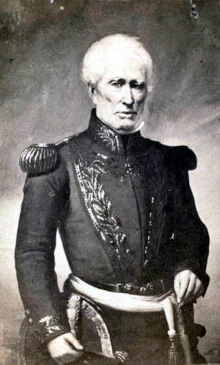
Death of William Brown, Commander in the Argentine Navy

William Brown, Irish sailor, merchant, and naval commander who serves in the Argentine Navy during the wars of the early 19th century, dies in Buenos Aires, Argentina, on March 3, 1857. He is also known in Spanish as Guillermo Brown or Almirante Brown.

Brown is born on June 22, 1777, in Foxford, County Mayo. Comparatively little is known of his early life, and it has been suggested that he was illegitimate and took his mother’s surname and that his father’s surname was actually Gannon. He emigrates with his father to Baltimore, Maryland, in 1793, eventually settling in Philadelphia, Pennsylvania. A short time after their arrival, the friend who had invited them and offered them food and hospitality dies of yellow fever. Several days later, his father also succumbs to the same disease.

One morning, while Brown is wandering along the banks of the Delaware River, he meets the captain of a ship then moored in port. The captain inquires if he wants employment and Brown agrees. The captain engages him as a cabin boy, thereby setting him on the naval promotion ladder, where he works his way to the captaincy of a merchant ship. After ten years at sea, where he develops his skills as a sailor and reaches the rank of captain, Brown is press-ganged into a Royal Navy warship. British impressment of American sailors is one of the primary issues leading to the War of 1812.

During the Napoleonic Wars, Brown escapes the ship he is serving on, a galley, and scuttles the vessel. However, the French do not believe he had assisted them and imprison him in Lorient. On being transferred to Metz, he escapes, disguised in a French officer’s uniform. However, he is recaptured and is imprisoned in the fortress of Verdun. In 1809, he escapes from there in the company of a British Army officer named Clutchwell, and eventually reaches German territory.

Returning to England, Brown renounces his maritime career and on July 29, 1809, he marries Elizabeth Chitty, daughter of an English shipping magnate, in Kent. As he is a Catholic and she a Protestant, they agree to raise their sons as Catholics and their daughters as Protestants. Despite lengthy periods of enforced separation, they have nine children. He leaves the same year for the Río de la Plata on board Belmond and sets himself up as a merchant in Montevideo, Uruguay.

Late in 1811 Brown settles in Buenos Aires just as a criollo rebellion against Spanish colonial rule in Argentina is gaining strength. By April 1812, he is developing a coastal shipping business in fruit and hides. As the Spanish naval blockade of 1812–14 begins to choke trade, he is first commissioned by the patriot government as a privateer licensed to raid Spanish merchantmen, and then, on March 1, 1814, invited to take charge of a small rebel naval squadron to contest Spanish control of the Río de la Plata estuary. Leading a fleet of nineteen ships, he fixes with great speed on a set of wartime naval routines and signaling methods, and organises a system of discipline, founding the navy on principles that pay exceptional attention to the welfare of ordinary seamen.

In early March 1814, Brown shows personal courage and incisive skill in outwitting and defeating a more powerful Spanish force near Martín García Island, thereby dividing the Spanish blockade. A Spanish attempt in May 1814 to break his blockade of Montevideo is decisively crushed by him and his makeshift navy, and the Spanish strongholds on the Atlantic coast collapse, ending open war. In 1815 and 1816, however, he carries out skirmishing raids on military and commercial targets belonging to Spanish South American possessions, until detained by a British colonial governor in Barbados in July 1816 for alleged infringements of international rules of trade.

Illness, and a tortuous but ultimately successful appeal process, take up most of 1817–18, but when Brown returns to Argentina in October 1818, political enemies set in motion a prosecution for alleged disobedience of orders. Cashiered in August 1819, then restored in rank but forced to retire, he attempts suicide the following month. Convalescence and resumption of his trading concern occupies him for several years.

A repentant government renews Brown’s command of the navy in December 1825, when war breaks out with Brazil. Though vastly outnumbered by the Brazilian fleet, he shows audacity and great finesse in a number of successful engagements in the Plate estuary in 1826, roving up the Brazilian coast on occasion to create great confusion. In February 1827, he triumphs in a series of actions known as the Battle of Juncal. After another year of commercial privateering against the Brazilian merchant fleet, he is one of two delegates selected to sign peace terms with Brazil in October 1828.

Retiring from active service that month, Brown tries to remain neutral as civil war erupts in Argentina, but reluctantly accepts the post of governor of Buenos Aires under General Juan Lavalle from December 1828 to May 1829, when he resigns in disgust at government excesses. During 1829–37 he holds aloof from the despotic government of Juan Manuel de Rosas. After French and British encroachments on the region in the later 1830s, he offers to take charge of the navy again to protect national independence and is available to defend Argentine interests when war breaks out with a French-backed Uruguay in early 1841. Though exasperated by a long and “stupid war,” he blockades the Uruguayan navy effectively until French and British fleets intervene in July 1845 with overwhelming force to capture his squadron and bring the war to an end.

Idolised by the Argentinian population for his high-principled and humane advocacy of independent democracy, Brown passes his last years trading and farming a country estate. In late 1847, he journeys to Ireland, hoping to find relations in Mayo, and is shocked by the hunger and destitution of the Great Famine.

Brown dies on March 3, 1857, at his home in Buenos Aires and is buried with full military honours. The Argentine government issues a comuniqué: “With a life of permanent service to the national wars that our homeland has fought since its independence, William Brown symbolized the naval glory of the Argentine Republic.” During his burial, General Bartolomé Mitre famously says: “Brown in his lifetime, standing on the quarterdeck of his ship, was worth a fleet to us.” His grave is currently located in the La Recoleta Cemetery in Buenos Aires.

Leave a comment

The Siege of Drogheda Ends

The Siege of Drogheda ends on September 11, 1649 during the outset of the Cromwellian conquest of Ireland. The siege began on September 3, 1649.

The Royalist rebellion that breaks out in Ireland against the new English republic in 1649 is met by a prompt English response. On August 15 Oliver Cromwell and 15,000 troops land in Dublin. His merciless policy toward the Irish Royalists becomes brutally clear within a month.

The defeat of the Irish Royalists in the Battle of Rathmines in early August is fortuitous for Cromwell, for without it, the English would have held only the small port of Derry (known as Londonderry from 1662) in the north, making his invasion almost impossible to effect. Cromwell quickly finds that the Irish Royalists have retreated into fortified towns. He therefore prepares for a series of sieges.

The first such siege occurs at Drogheda, 28 miles north of Dublin. Cromwell arrives at Drogheda on September 3. His siege guns, brought up by sea, arrive two days later. He finds the town surrounded by high but relatively thin walls and its governor, Sir Arthur Ashton, is confident of his defenses and refuses an order to surrender. On September 10 Cromwell begins an artillery bombardment of the walls. These are breached the following day, but the gap created is too small to allow troops to enter the city. Twice they are repelled until Cromwell himself leads an assault and overwhelms the defenders on September 11.

The carnage inside the city is appalling. Cromwell’s troops kill priests and monks on sight and set fire to a Catholic church sheltering some soldiers. Civilians as well as soldiers are massacred, and Ashton is bludgeoned to death with his own wooden leg. The few Royalist soldiers who survive are transported to Barbados. What happens at Drogheda is replicated at Wexford the following month and Clonmel the next May. By the time Cromwell has put down the rebellion and returned to England in that same month, he has become forever hated by Irish Catholics.

During the eight day siege the British lose 150 of their 12,000 men while 2,800 Irish are killed and 200 captured of the 3,100 at Drogheda.

(Pictured: St Laurence’s Gate – the last remaining of the ten original defensive gates at Drogheda)


Leave a comment

The Siege of Drogheda

st-laurences-gate-drogheda

The Siege of Drogheda begins on September 3, 1649 and runs through September 11, at the outset of the Cromwellian conquest of Ireland.

The Royalist rebellion that breaks out in Ireland against the new English republic in 1649 is met by a prompt English response. On August 15 Oliver Cromwell and 15,000 troops land in Dublin. His merciless policy toward the Irish Royalists becomes brutally clear within a month.

The defeat of the Irish Royalists at Rathmines in early August is fortuitous for Cromwell, for without it, the English would have held only the small port of Derry (known as Londonderry from 1662) in the north, making his invasion almost impossible to effect. Cromwell quickly finds that the Irish Royalists have retreated into fortified towns. He therefore prepares for a series of sieges.

The first such siege occurs at Drogheda, 28 miles north of Dublin. Cromwell arrives at Drogheda on September 3. His siege guns, brought up by sea, arrive two days later. He finds the town surrounded by high but relatively thin walls and its governor, Sir Arthur Ashton, is confident of his defenses and refuses an order to surrender. On September 10 Cromwell begins an artillery bombardment of the walls. These are breached the following day, but the gap created is too small to allow troops to enter the city. Twice they are repelled until Cromwell himself leads an assault and overwhelms the defenders on September 11.

The carnage inside the city is appalling. Cromwell’s troops kill priests and monks on sight and set fire to a Catholic church sheltering some soldiers. Civilians as well as soldiers are massacred, and Ashton is bludgeoned to death with his own wooden leg. The few Royalist soldiers who survive are transported to Barbados. What happens at Drogheda is replicated at Wexford the following month and Clonmel the next May. By the time Cromwell has put down the rebellion and returned to England in that same month, he has become forever hated by Irish Catholics.

During the eight day siege the British lose 150 of their 12,000 men while 2,800 Irish are killed and 200 captured of the 3,100 at Drogheda.

(Pictured: St Laurence’s Gate – the last remaining of the ten original defensive gates at Drogheda)


Leave a comment

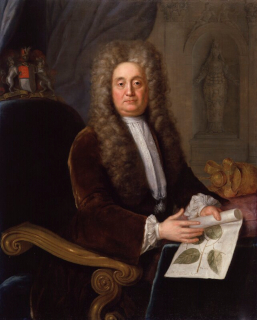
Birth of Sir Hans Sloane, Physician & Naturalist

Generated by IIPImage

Sir Hans Sloane, Irish physician and naturalist whose collection of books, manuscripts, and curiosities form the basis for the British Museum in London, is born on April 16, 1660, in Killyleagh, County Down in what is now Northern Ireland.

As a child Sloane possesses a strong curiosity of nature, and he develops a particular interest in plants. After studying medicine in London, he travels in France, taking an M.D. degree at the University of Orange in 1683. In 1685 he returns to London and is elected a fellow of the Royal Society. He proceeds to practice medicine as an assistant to British physician Thomas Sydenham. He is made a fellow of the Royal College of Physicians in 1687. That same year he accepts an opportunity to visit Jamaica, traveling as personal physician to the Christopher Monck, 2nd Duke of Albermarle, who had been appointed to govern the island.

The journey to Jamaica provides Sloane with the chance to pursue his interest in the natural sciences. During the 15 months of his travels, he visits multiple islands in the West Indies, including Saint Kitts, Nevis, and Barbados. He ultimately collects specimens of about 800 plants. He also records information on and collects specimens of various fish, mollusks, and insects, and he observes the local peoples and contemplates the natural phenomena of the area. His observations and the specimens he collects during the voyage lay the foundation for his later contributions to botany and zoology and for his role in the formation of the British Museum. He returns to England in 1689, his trip having been cut short by Monck’s death. His collection of plants from the West Indies is one of the first from that region to reach England.

Sloane’s trip to Jamaica also leads to his invention of a milk chocolate beverage. While on the island, he encounters a local drink made from a cacao plant. The beverage apparently makes him nauseous. To avoid this, he decides to mix the cacao material with milk. He finds this concoction to be not only more tolerable but also tasty and healthy. Shortly after his return to England, his milk-based concoction is sold by apothecaries as a medicinal product. His recipe later forms the basis for a milk chocolate product manufactured by Cadbury.

In 1696 Sloane publishes in Latin an elaborate catalogue, Catalogus Plantarum Quae in Insula Jamaica, on the plants he collected in Jamaica. He later publishes Natural History of Jamaica (2 Vol., 1707 and 1725), a comprehensive account of his studies of the natural phenomena of the island country.

Sloane also makes important contributions to medicine. He is physician to Queen Anne, King George I, and King George II. He is created a baronet in 1716, becoming the first medical practitioner to receive a hereditary title. He is relatively progressive as a physician, and, while serving George I, he adopts the practice of inoculation against smallpox for members of the royal family. In 1719 he is elected president of the Royal College of Physicians, a post he serves until 1735. In 1727 he becomes president of the Royal Society, succeeding physicist and mathematician Sir Isaac Newton. He holds the position until 1741. He earns a reputation as a specialist in eye diseases, and he eventually publishes Account of a Medicine for Soreness, Weakness and Other Distempers of the Eyes (1745).

Sloane is also known as an avid collector, and he benefits greatly from the acquisition of the cabinets of other collectors, including amateur scientist William Charleton and English apothecary and botanist James Petiver. When he retires from active work in 1741, his library and cabinet of curiosities has grown to be of unique value, and on his death, he bequeaths his collection to the nation, on condition that parliament pay his executors £20,000. The bequest is accepted and goes to form the collection opened to the public as the British Museum in 1759.

Sloane has no son that survives beyond infancy, and the baronetcy becomes extinct upon his death in London on January 11, 1753.

(From: Encyclopaedia Britannica, http://www.britannica.com/biography/Sir-Hans-Sloane-Baronet/)


Leave a comment

Accused Witch Ann Glover is Hanged in Boston

ann-glover

Goodwife “Goody” Ann Glover is hanged by the Puritans in Boston on November 16, 1688. She is the last person to be hanged in Boston as a witch, although the Salem witch trials in nearby Salem, Massachusetts, occur primarily in 1692.

Glover is born in Ireland as a Roman Catholic although her birth date and much of her background information is unknown. During Oliver Cromwell‘s invasion of Ireland where he rounds up thousands of Irish and Scots, Glover and her husband are transported as indentured servants to Barbados to work on the sugar plantations. Her husband is executed in Barbados for refusing to renounce his Catholic faith. Historians do not know the context but, at his death, he says that his wife is a witch.

By 1680, Glover and her daughter are living in Boston where they work as housekeepers for John Goodwin. In the summer of 1688, 13-year-old Martha Goodwin accuses Glover’s daughter of stealing laundry. This causes Glover to have a fierce argument with Martha and the Goodwin children which then supposedly causes them to become ill and start acting strange. The doctor that is called suggests it is caused by witchcraft because he could not diagnose or heal the children.

Glover is arrested and tried for witchcraft. It is unclear whether she cannot speak English or just refuses to speak it. It is more likely that she simply does not know English. Instead, she speaks her native language, Irish, and Latin. Reverend Cotton Mather writes that Glover is “a scandalous old Irishwoman, very poor, a Roman Catholic and obstinate in idolatry.” At her trial it is demanded of her to say the Lord’s Prayer. She recites it in Irish and broken Latin, but since she has never learned it in English, she cannot recite it in English. There is a belief that if someone cannot recite the Lord’s Prayer then they are a witch. Her house is searched and “small images” or doll-like figures are found. When Mather is interrogating her, she supposedly says that she prays to a host of spirits and Mather takes this to mean that these spirits are demons. Two Puritan men who supposedly speak Irish say that she confessed to using them for witchcraft. The identity of these men and whether they actually speak Irish is unknown. Many of the accusations against Glover use spectral evidence, which cannot be proven. Cotton Mather visits Glover in prison where he says she supposedly engages in nighttime trysts with the devil and other evil spirits. It is considered that Glover might not be of sound mind and could possibly be mentally ill. Five of six physicians examine her and find her to be competent, so she is then pronounced guilty and put to death by hanging.

On November 16, 1688, Glover is hanged in Boston amid mocking shouts from the crowd. When she is taken out to be hanged, she says that her death will not relieve the children of their malady. There are several testaments of what her final words are. According to some, she says that the children will keep suffering because there are other witches besides her who have been involved with bewitching the children and when asked to name the other witches, she refuses. Another account says that Glover says that killing her will be useless because it is someone else that has bewitched the children. Either way, Ann Glover does believe in witches. A Boston merchant who knows her, Robert Calef, says that “Goody Glover was a despised, crazy, poor old woman, an Irish Catholic who was tried for afflicting the Goodwin children. Her behavior at her trial was like that of one distracted. They did her cruel. The proof against her was wholly deficient. The jury brought her guilty. She was hung. She died a Catholic.”

Three hundred years later in 1988, the Boston City Council proclaims November 16 as Goody Glover Day. She is the only victim of the witchcraft hysteria in the Massachusetts Bay Colony to receive such a tribute. Although Ann Glover’s accusations and death take place before the commonly known Salem Witch Trials, she is the first Catholic martyr in Massachusetts and becomes the basis for many of the cases in the 1692 Salem witch trials.