seamus dubhghaill

Promoting Irish Culture and History from Little Rock, Arkansas, USA


Leave a comment

Birth of Karl Mullen, Rugby Union Player & Gynecologist

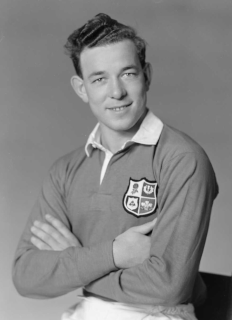
Dr. Karl Daniel Mullen, rugby union player and consultant gynecologist who captains the Irish rugby team and captains the British Lions on their 1950 tour to Australia and New Zealand, is born on November 26, 1926, in Courtown Harbour, County Wexford.

Mullen is one of three sons and seven daughters of Daniel Mullen, an officer of the customs and excise, and his wife Annie (née Hargrove). After his parents move to Home Farm Road, Drumcondra, Dublin, he is educated at the Dominican St. Thomas’s Academy, Eccles Street, the Jesuit Belvedere College, Great Denmark Street, and the Royal College of Surgeons in Ireland (RCSI). He plays rugby and cricket at school, association football with Home Farm F.C., and golf in the summer months. Initially a centre, he becomes a prop on the Belvedere junior cup team and, after injury to a teammate, hooker on the senior cup team, which loses the Leinster Schools Rugby Senior Cup final to Castleknock College in 1944.

On January 25, 1947, Mullen makes his formal Irish debut in a 12–8 loss to France. He plays as hooker, winning 25 caps for Ireland from 1947 to 1952. A year later, on January 31, 1948, he plays his first game for Barbarian F.C. in a 9–6 victory over Australia in Cardiff, Wales. After helping Ireland to victory over France on January 1, 1948, at the age of 21, he captains Ireland for the first time, on February 14, 1948, leading them to an 11–10 victory over England at Twickenham Stadium.

Mullen captains the Irish team to their first Grand Slam in the 1948 Five Nations Championship and is one of eight players from that team who live to see the country’s next Grand Slam in 2009.

Ireland retains the triple crown in 1949 by beating Wales 5–0 in Swansea, ending a run of defeats on Welsh soil lasting fourteen years. The following season Ireland suffers from injuries and loses to both England and Wales, the latter securing the triple crown.

Mullen is selected to captain the 1950 Lions Tour to Australia and New Zealand. After appearing in the first two tests against New Zealand, a 9–9 draw and an 8–0 loss, he sustains an ankle injury in the latter game and concedes his place to Dai Davies of Wales. Returning for the second test against Australia, a resounding 24–3 victory, he also plays in a semi-official “British Isles RFU” team against Ceylon during their return journey in September.

Under Mullen’s captaincy Ireland regains the international championship in 1951. His last cap comes in a 14–3 loss to Wales at Lansdowne Road on March 8, 1952. In twenty-five successive appearances (fifteen as captain), he secured three international championships and two triple crowns for Ireland in four seasons, their most successful haul of the twentieth century.

Mullen’s distinguished rugby career has to be fitted around his medical studies. In 1945, he enters the RCSI, graduating L and LM (RCSI and RCPI) in 1949. Awarded the diploma in obstetrics (1952) and membership of the Royal College of Obstetricians and Gynaecologists (1956), he trains at Sir Patrick Dun’s Hospital, Jervis Street Hospital and the Rotunda hospitals. After serving as senior obstetrics registrar at the Derby City General Hospital (1953–56), he returns to Dublin to become a consultant obstetrician, based at Mount Carmel Community Hospital, Churchtown, Dublin, and develops a considerable private practice. By his retirement in 2002, he is estimated to have delivered over 40,000 babies. A proponent of sex education in schools, he appears on RTÉ‘s 7 Days in December 1970, outlining various methods of birth control and calling for a more honest and realistic approach to artificial contraception.

Mullen marries Doreen Kilbride, an accomplished soprano, on April 30, 1952, in Donnybrook, Dublin, interrupting their honeymoon to play for Old Belvedere R.F.C. in the Leinster Senior Cup final. They have eight children, three boys and five girls. In 1975, they move from Altamount, Dundrum, Dublin, to Tulfarris House, Blessington, County Wicklow, adjacent to Poulaphouca Reservoir, where they farm and bred Irish draught horses. In 1985, he sells the property and much of his art collection and moves to Kilcullen, County Kildare.

Mullen is one of eight surviving members of the 1948 team to witness Ireland’s second grand slam on March 21, 2009. Only weeks later, having suffered from a long illness, he dies on April 27, 2009, at his home, Gilltown Lodge, in Kilcullen.

(Pictured: Karl Mullen, captain of the British Lions rugby union team, 1950)


Leave a comment

Birth of Tony Ward, Former Rugby Union & Association Football Player

Anthony Joseph Patrick Ward, Irish former rugby union and association football player during the 1970s and 1980s commonly referred to as Tony Ward, is born in Dublin on October 8, 1954. He plays rugby as a fly-half for, among others, Munster, Leinster, Ireland, the British & Irish Lions and the Barbarians. He is selected 1979 European rugby player of the year.

Ward wins 19 caps for Ireland between 1978 and 1987. He makes his international debut against Scotland at Lansdowne Road on January 21, 1978 at the age of 23. He helps Ireland win 12–9 and during the 1978 Five Nations Championship he scores 38 points, a record for a debutant. He makes one major tour with Ireland, to Australia in 1979. During his career as an Ireland international he scores 113 points, including 29 penalties, 7 conversions and 4 drop goals. He plays his last game for Ireland on June 3, 1987 in a 32–9 win over Tonga during the 1987 Rugby World Cup.

Leinsterman Ward also inspires Munster to a legendary win over New Zealand, scoring two drop goals and a conversion in a 12–0 victory at Thomond Park on October 31, 1978. To date Munster are the only Irish provincial men’s team ever to beat the All-Blacks, although having played them far more frequently than any other province and joining dozens of smaller Welsh clubs and English regions who defeated mid-week All Black teams over the same period.

Ward also plays one Test game for the British & Irish Lions during the 1980 South Africa tour. He sets a Lions Test record by scoring 18 points, including 5 penalties and a drop goal. It is also a record for any player against South Africa.

Ward is the first ever recipient of a European Rugby Player of the Year award for his performances in the 1979 Five Nations Championship.

Ward also plays association football for both Shamrock Rovers and Limerick United. In his last season with Rovers, 1974–75, he scores 6 league goals. He plays for Limerick United in the 1981–82 UEFA Cup and in 1982 he helps them win the FAI Cup.

While playing rugby Ward is a geography and PE teacher at St. Andrews School in Booterstown, Dún Laoghaire–Rathdown. During the 1990s, he is a highly valued and well respected coach for St. Andrews.

Since retiring as a sportsman, Ward has worked as a sports journalist, most notably with the Irish Independent, and as a rugby commentator for Raidió Teilifís Éireann (RTÉ). He starts as a co-commentator for the 1988 Five Nations Championship, and remains in that role for many years.

Ward is currently involved in St. Gerard’s School in Bray, County Wicklow, where he is coaching the Senior Rugby team and has been doing so for a number of years. He constantly downplays his fame and success and does not even want to be in the room if another coach plays video footage of his legendary tries.


Leave a comment

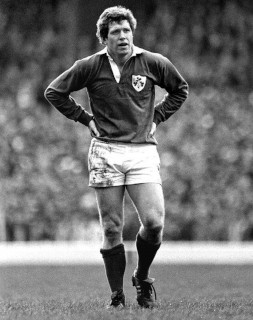
Birth of Fergus Slattery, Rugby Union Player

John Fergus Slattery, former rugby union player who represented Ireland, is born in Dún Laoghaire, the county town of Dún Laoghaire–Rathdown, on February 12, 1949.

Slattery plays club rugby for Blackrock College and University College Dublin before embarking on an international career that takes in 61 caps for Ireland, 18 as captain, and four for the British and Irish Lions. He makes his international debut in a draw against South Africa at Lansdowne Road in 1970.

In 1971, Slattery first tours with the British and Irish Lions squad that toured New Zealand, missing out on a start in the third Test due to illness. With the back-row berths claimed by John Taylor, Peter Dixon and Mervyn Davies and still being a newcomer at international level he has to wait until 1974 for his shot at a Lions Test jersey. In the meantime, he plays for the Barbarian F.C. in the famous 1973 game against the All Blacks in Cardiff.

Slattery tours with the Lions again in 1974, playing in all four Tests and captaining the side for two provincial matches. In South Africa he is an invaluable member of the touring party that comes to be known as “the invincibles.” He starts all four Tests as the Lions win the series 3-0 and skippers the side twice during midweek tour matches.

For Ireland, Slattery captains their hugely successful touring side in Australia in 1979 when they win seven of the eight matches including the two Tests in Brisbane and Sydney. In 1982 he starts all four games of Ireland’s Triple Crown season, being denied the Grand Slam by France in the final game of the Five Nations Championship.

Slattery is inducted into the International Rugby Hall of Fame in 2007.