seamus dubhghaill

Promoting Irish Culture and History from Little Rock, Arkansas, USA


Leave a comment

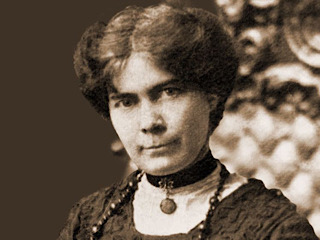
Death of Teresa Brayton, Irish Republican & Poet

Teresa Brayton, an Irish republican and poet who uses the pen name T. B. Kilbrook, dies in Kilbrook, a small village near Kilcock, County Kildare, on August 19, 1943.

Brayton is born Teresa Coca Boulanger in Kilbrook, the youngest daughter and fifth child of Hugh Boylan and Elizabeth Boylan (née Downes). Her family are long-time nationalists, with her great grandfather previously leading a battalion of pikesmen at the Battle of Prosperous.

Brayton later becomes a notable member of Irish national parties, the United Irish League and Cumann na mBan. She is described as “a patriot, but never in the vulgar sense a politician” in The Irish Times. She is closely associated with leaders of the 1916 Easter Rising, and writes poems in honour of Irish patriots including Charles Stewart ParnellRoger Casement and Patrick Pearse.

Brayton is educated from the age of 5 in Newtown National School. She writes her first poem at the age of twelve, and soon after wins her first literary award. Later on, she trains to be a teacher, and then becomes an assistant teacher to her older sister Elizabeth in the same school she received her education.

Brayton’s father is a tenant farmer, and from a young age she witnesses the effects of the land wars in Ireland. She is a supporter of Parnell, the Irish National Land League and the Irish Home Rule movement. Her work is largely influenced by her family history and Irish nationalism.

In September 1895, Brayton emigrates to the United States at the age of 27. She first lives in Boston, Chicago, and later moves to New York City. She meets Richard H. Brayton, a French-Canadian who works as an executive in the Municipal Revenue Department, who she then marries. She looks after their home and focuses on her career as a freelance journalist. She lives in the United States for 40 years and becomes well known in Irish American circles as a prominent figure in the Celtic Fellowship. It was in the United States that her reputation is established.

In the 1880s, Brayton begins her career as a poet, writing poetry for both national and provincial Irish newspapers, including Young Ireland and the King’s County Chronicle. She uses the pseudonym “T. B. Kilbrook” while contributing to these papers.

Brayton continues writing under the pseudonym until moving to the United States, where she becomes an acclaimed writer and continues to contribute to papers including the Boston newspaper The PilotNew York Monitor and Rosary Magazine. Her target audience is the Irish immigrant population of the United States. After establishing herself she releases her poetry in collections including Songs of Dawn (1913) and The Flame of Ireland (1926).

Brayton makes return trips to Ireland regularly and develops a relationship with nationalist peers, and the leaders of the Easter Rising. Upon returning to the United States, she becomes an activist for the Irish Republic and participates in organising the distribution of information to the Irish population through pamphlets and public speaking. Her contribution is acknowledged by Constance Markievicz. Her patriotism to Ireland admit her to the Celtic Fellowship in America, where she shares her poetry at events.

Brayton’s best-known poem is “The Old Bog Road,” which is later set to music by Madeline King O’Farrelly. It has since been recorded and released by many Irish musicians including Finbar FureyDaniel O’Donnell and Eileen Donaghy, among many others. Many more of her best-known ballads include, The Cuckoo’s CallBy the Old Fireside and Takin’ Tea in Reilly’s.

Brayton makes her permanent return to Ireland at the age of 64 following the death of her husband in 1932 and continues her career as a journalist writing for Irish newspapers and publishes religious poetry in the volume Christmas Verses in 1934. A short story called The New Lodger written by Brayton is published by the Catholic Trust Society in 1933. She dedicates much of her work to the exiled Irish living in the United States, incorporating themes of nostalgia, the familiarity of home and religion throughout her poetry.

Initially upon moving back to Ireland, she lives for a few years with her sister in Bray, County Wicklow. She then moves to Waterloo Avenue, North StrandCounty Dublin. Here, she witnesses the bombing of the North Strand on May 31, 1941 during World War II. Shortly after the bombing, she eventually settles back in Kilbrook, where she was born, and lives there for the rest of her life. She spends a brief period of time in the Edenderry Hospital before her death. During her stay there she becomes a good friend with Padraig O’Kennedy, the “Leinster Leader,” who is able to reveal to her something that is linked to a family member of his. A copy of her The Old Bog Road which had been set to music and autographed by her while she was living in the United States. She had it sent to O’Kennedy’s eldest son and on it she wrote the words: “To the boy who sings the Old Bog Road so sweetly.”

Two years after her return to Kilbrook, on August 19, 1943, Brayton dies in the same room where her mother had given birth to her over 75 years previously. She is buried at the Cloncurry cemetery in County Kildare. Her funeral is attended by many, including the then TaoiseachÉamon de Valera.

From the vivid imagery she speaks of in her poetry, Brayton, both a poet and a novelist, is described by some as “the poet of the homes of Ireland.” Such scenes include the vivid imagery of the fireside chats, the sound of her latch lifting as neighbours in to visit at night from her poem “The Old Boreen” and about her home cooking and work from “When the Leaves Begin to Fall.” Such images can be compared to most Irish households and can depict a vivid picture to those reading her poetry.

Brayton’s poetry leaves a lasting sense of Irish beauty and community. This can be seen in such poems as “A Christmas Blessing” where she speaks of “taking and giving in friendship” during Christmas. Since her passing she has continued to keep an audience from overseas from Boston and New York primarily, this as a result of the reminder her poems give to Irish exiles of Irish traditions and music which was close to them. While her poems are more often serious, some portray an almost comical undertone tone. In an article in The Irish Times, her poetry is also said to have a racy feel to them.
Leave a comment

The Battle of Ballymore-Eustace

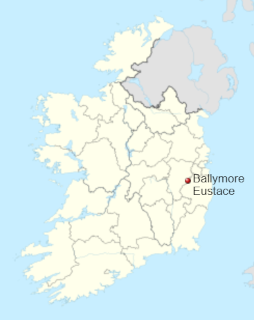
The Battle of Ballymore-Eustace is one of the events in the United Irish rebellion of 1798. It takes place on May 24, 1798, after the stationing of the 9th Dragoons, and members of the Tyrone, Antrim and Armagh Militias at Ballymore-Eustace in County Kildare near the border with County Wicklow on May 10. The town has been recently garrisoned by almost 200 soldiers and militia who have been sent to repress sedition in the area. The troops have been dispersed in billets among the populace as per counter-insurgency practice of “free-quarters” where responsibility for the provisioning and sheltering of militia is foisted onto the populace. During this time a quantity of arms are surrendered and letters of protection issued.

On May 23, one hundred twenty soldiers are recalled, leaving a garrison of around 80 men. At around 1:00 a.m. on May 24, the rebel force of approximately 200 attack the town. As in the attacks on Naas and Prosperous, the rebels seek to surprise and overwhelm the garrison by coordinated attacks before it can react and rally against them. The houses containing troops of the 9th Dragoons and the Tyrone Militia are to be attacked simultaneously.

However, the attack on garrison headquarters is miscarried due to lack of coordination and numbers so that the building becomes a rallying point for the Government troops. Captain Beevor is attacked in his own bedchamber by two rebels. Lieutenant Parkinson and some dragoons come to his aid and both rebels are slain. Other isolated billets are attacked but some units manage to cut themselves free and fight their way through the streets to the headquarters. A number of properties, including the Protestant church, are set on fire.

For two hours, the rebels attack the strongpoint but, without artillery, are unable to take the building and lose many men in the process. The momentum has by now slipped away from the rebels and they draw off their attack leaving behind around 50 dead but at a cost to the garrison of at least 12 dead and 5 wounded.

The battle leads directly to the Dunlavin Green executions, in which fears of a possible rebel attack on the garrison at nearby Dunlavin lead to the summary execution of rebel prisoners.


Leave a comment

The Battle of Prosperous

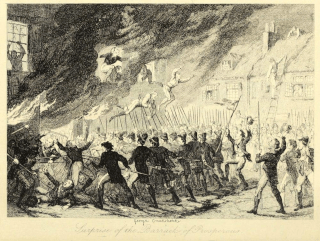
The Battle of Prosperous, a military engagement between British Crown forces and United Irishmen rebels, takes place in the town of Prosperous, County Kildare, on May 24, 1798, during the Irish Rebellion of 1798.

Prosperous is founded by Sir Robert Brooke in 1780 as a village for processing cotton produced in the Americas. When a rebellion spearheaded by the United Irishmen breaks out against British rule in Ireland, rebel forces led by John Esmonde make plans to capture Prosperous. Esmonde has 200 rebels under his command, while Prosperous is garrisoned by elements of the Royal Cork City Militia under the command of Captain Richard Swayne and reinforced by detachments of a Welsh mounted fencible regiment, the Ancient British Regiment of Fencible Cavalry Dragoons (also known as the Ancient Britons), numbering 150 men in all.

On May 24, 1798, Esmonde leads his forces to attack Prosperous. Their entry is preceded by the infiltration of a small rebel vanguard, who with the possible help of female sympathisers residing in Prosperous, scale the walls of the town’s barracks, kill the sentries and open the town gates. The barracks are quickly surrounded and attacked by the rebels who repulse an attempt by the garrison to break out. “Swayne himself was surprised in bed, shot and piked to death and his body burned in a tar barrel.” The remainder of the garrison are trapped in the upper floors of the barracks, which is set on fire by the rebels, causing them to jump in desperation onto the ground below, where they are summarily executed with pikes. While the rebels suffer no known casualties, approximately 40 members of the garrison are killed in the battle.

Ten members of the garrison, all belonging to the Ancient Britons, manage to escape from Prosperous to Dunlavin, County Wicklow, where they participate in the Dunlavin Green executions on May 26. Esmonde is later captured by Crown forces and brought to Dublin for trial. As he had previously enlisted at the rank of lieutenant in the Clane Yeomanry, Esmonde is court-martialled on June 13 and found guilty of being a deserter. He is executed by hanging on June 14 on Carlisle Bridge (now the O’Connell Bridge) with his coat being worn reversed to indicate that he had been convicted of desertion. Prosperous remains under the control of the United Irishmen until June 19, when a detachment of the 5th Dragoon Guards under the command of Lieutenant Colonel Stewart recaptures the town.


Leave a comment

The Carnew Executions

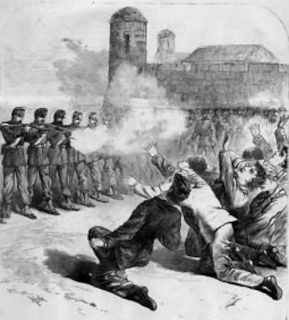
The Carnew executions, the summary execution of 28 prisoners being held as suspected United Irishmen by the local garrison in the British army barracks base of Carnew Castle, Carnew, County Wicklow, takes place on May 25, 1798.

The Society of United Irishmen having failed to advance its aims of Catholic emancipation and parliamentary reform by political means, instigate a rebellion against British rule. The rebellion begins on the morning of May 24, 1798, but the only significant uprisings outside of the province of Ulster occur in counties Wicklow and Wexford, both south of County Dublin. The rebels are met with a swift response from British forces and the bulk of the rebellion is suppressed within a year.

By the morning of the May 25, news of the long-expected outbreak of the 1798 rebellion in neighbouring County Kildare and of military losses in the battles of Ballymore-Eustace, Naas, and Prosperous have reached the garrison in Carnew, who decide to take preventative measures by assembling the rebel suspects in detention. The suspects are marched from Carnew Castle to the local Gaelic handball alley and executed by firing squad as a warning to the local populace.

A similar mass execution of 36 nationalist prisoners occurs on the following day at Dunlavin Green.

News of the summary executions, together with news of the similar massacre at Dunlavin, spread throughout County Wicklow and across the border into County Wexford, giving substance to the rumours of widespread killing already prevalent. On June 7, the town is burned and sacked in a revenge raid by Wexford rebels, led by Anthony Perry.