seamus dubhghaill

Promoting Irish Culture and History from Little Rock, Arkansas, USA


Leave a comment

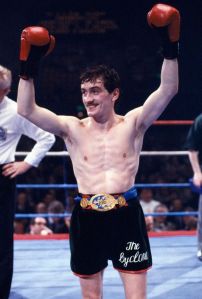
Barry McGuigan Wins the World Featherweight Boxing Title

barry-mcguigan

Finbar Patrick McGuigan, known as Barry McGuigan and nicknamed The Clones Cyclone, wins the World Boxing Association featherweight title on June 8, 1985, defeating Eusebio Pedroza in a unanimous 15-round decision at Loftus Road soccer stadium in London.

Barry McGuigan, the son of singer Pat McGuigan, is born in Clones, County Monaghan. He represents Northern Ireland in the Commonwealth Games at Edmonton in 1978 and represents Ireland at the 1980 Summer Olympics in Moscow.

After a successful juvenile boxing career, McGuigan begins his professional boxing career on May 10, 1981, beating Selwyn Bell by knockout in two rounds in Dublin. He wins four out of five additional bouts in 1981. In 1982, McGuigan wins eight fights, seven by knockout, although one of these almost destroys his career and his life. Opposed by Young Ali, on June 14, 1982, McGuigan wins by a knockout in six rounds. Ali falls into a coma and dies five months later.

In 1985, McGuigan meets former world featherweight champion Juan Laporte and wins a 10-round decision. Following one more win, he finally gets his world title attempt when the long reigning WBA featherweight champion, Eusebio Pedroza of Panama, comes to London to put his title on the line at Loftus Road soccer stadium. McGuigan becomes the champion by dropping Pedroza in the seventh round and winning a unanimous fifteen-round decision in a fight refereed by hall of fame referee Stanley Christodoulou. McGuigan and his wife are feted in a public reception through the streets of Belfast that attracts several hundred thousand spectators. Later that year, he is named BBC Sports Personality of the Year, becoming the first person not born in the United Kingdom to win the award.

McGuigan twice successfully defends his title, first against American Bernard Taylor, who is stopped in nine  rounds, and then against Dominican Danilo Cabrera in a controversial knock out in fourteen rounds. The fight is stopped after Cabrera bends over to pick up his mouthpiece after losing it, a practice that is allowed in many countries but not in Ireland. Cabrera is not aware of this, and the fight is stopped.

McGuigan’s next defence takes place in Las Vegas in June 1986, where he faces the relatively unknown Steve Cruz of Texas, in a gruelling 15-round title bout under a blazing sun. McGuigan holds a lead halfway through, but suffers dehydration due to the extreme heat and wilts near the end, being dropped in the tenth and fifteenth rounds. He eventually loses the world title, which he never reclaims, in a close decision. After the fight McGuigan requires hospitalisation because of his dehydrated state.

McGuigan retires after the fight but returns to the ring between 1988 and 1989, beating former world title challengers Nicky Perez and Francisco Tomas da Cruz, as well as contender Julio César Miranda, before losing to former EBU featherweight champ and future WBC and WBA super featherweight challenger Jim McDonnell by a technical knockout. After the McDonnell fight he permanently retires from boxing. His record is 32 wins and 3 losses, with 28 knockouts. In January 2005, McGuigan is elected into the International Boxing Hall of Fame.

McGuigan founds and is the current President of the Professional Boxing Association (PBA). He is also the CEO and founder of Cyclone Promotions.


Leave a comment

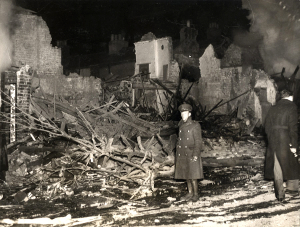
German Bombing of North Strand, Dublin

north-strand-bombing

Four German bombs are dropped on north Dublin at approximately 2:00 AM on May 31, 1941. One bomb falls in the Ballybough area, demolishing the two houses at 43 and 44 Summerhill Park, injuring many but with no loss of life. A second bomb falls at the Dog Pond pumping works near the zoo in Phoenix Park, again with no casualties but damaging Áras an Uachtaráin, the official residence of the Irish President. A third bomb makes a large crater in the North Circular Road near Summerhill, again causing no injuries. A fourth bomb falls in North Strand destroying seventeen houses and severely damaging about fifty others, the worst damage occurring in the area between Seville Place and Newcomen Bridge. The raid claims the lives of 28 people, injures 90, destroys or damages approximately 300 houses, and leaves 400 people homeless.

The first bombing of Dublin during World War II occurs early on the morning of January 2, 1941, when German bombs are dropped on the Terenure area of south Dublin. This is followed, early on the following morning of January 3, 1941, by further German bombing of houses on Donore Terrace in the South Circular Road area of south Dublin. A number of people are injured, but no one is killed in these bombings.

After the war, what becomes West Germany accepts responsibility for the raid, and by 1958 it has paid compensation of £327,000. Over 2,000 claims for compensation are processed by the Irish government, eventually costing £344,000. East Germany and Austria, which are both part of Nazi Germany in 1941, make no contribution. The amounts are fixed after the 1953 London Agreement on German External Debts, allowing maximum compensation.

Several reasons for the raid have been asserted over time. German Radio, operated by the Ministry of Public Enlightenment and Propaganda, broadcasts that “it is impossible that the Germans bombed Dublin intentionally.” Irish airspace has been violated repeatedly, and both Allied and German airmen are being interned at the Curragh Camp. A possible cause is a navigational error or a mistaken target, as one of the pathfinders on the raid later recounts. Numerous large cities in the United Kingdom are targeted for bombing, including Belfast, which like Dublin, is across the Irish Sea from Great Britain. War-time Germany’s acceptance of responsibility and post-war Germany’s payment of compensation are cited as further indications that the causation is error on the part of the Luftwaffe pilots.

Another possible reason is that in April 1941, Germany has launched the Belfast blitz, which results in Belfast being heavily bombed. In response, Ireland sends rescue, fire, and emergency personnel to Belfast to assist the city. Éamon de Valera, the Taoiseach, formally protests the bombing to the German government, as well as making his famous “they are our people” speech. Some contend that the raid serves as a warning to Ireland to keep out of the war. This contention is given added credibility when Colonel Edward Flynn, second cousin of Ireland’s Minister for Coordination of Defensive Measures, recalls that Lord Haw Haw has warned Ireland that Dublin’s Amiens Street Railway Station, where a stream of refugees from Belfast is arriving, will be bombed. The station, now called Connolly Station, stands a few hundred metres from North Strand Road, where the bombing damage is heaviest. Flynn similarly contends that the German bombing of Dundalk on July 4 is also a pre-warning by Lord Haw Haw as a punishment for Dundalk being the point of shipment of Irish cattle sold to the United Kingdom.


Leave a comment

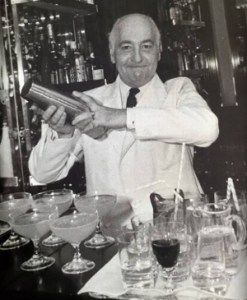
Birth of Joe Gilmore, Head Barman

joe-gilmore

Joe Gilmore, one of the longest running Head Barmen at the Savoy Hotel‘s American Bar, is born in Belfast on May 19, 1922.

The Gilmores own a popular tobacconist shop at the top of the Limestone Road, which remains in business through the Troubles until the mid-1990s. But Gilmore has plans to go places so, at the age of sixteen, he sets out with a friend for London.

His first job is packing rolls of wallpaper at a Sanderson’s factory before moving to a Lyons Corner House as a dish washer with the prospect of getting some decent dinners. He begins training as a barman at London’s La Coquille and The Olde Bell at Hurley, where a chance encounter serving a stylish couple sets the scene for the remarkable life that follows.

At the age of eighteen, Gilmore starts as a trainee barman at The American Bar in 1940 and is appointed Head Barman in 1955, a position he holds until he retires in 1976. Over his years as Head Barman, Gilmore invents numerous cocktails to mark special events and important guests, a longstanding tradition at the American Bar.

Gilmore has invented cocktails in honor of a number of royalty, politicians, and celebrities including the Prince of Wales, Prince William, Princess Anne, Queen Elizabeth The Queen Mother, Prince Andrew, Sir Winston Churchill, and American Presidents Harry S. Truman and Richard Nixon. He also invents cocktails to commemorate the first walk on the moon in 1969 by Neil Armstrong, and the American and Russian link-up in space in 1975.

In addition to serving five generations of royals at private receptions and parties, Gilmore has also served Errol Flynn, Laurel and Hardy, Charlie Chaplin, Dwight D. Eisenhower, Grace Kelly, George Bernard Shaw, Ernest Hemingway, Noël Coward, Agatha Christie, Alice Faye, Ingrid Bergman, Julie Andrews, Laurence Olivier, Joan Crawford, Judy Garland, Liza Minnelli, Bing Crosby, and Frank Sinatra.

Gilmore never forgets his Irish roots or family, and never loses his soft Belfast accent. Joe Gilmore dies at the age of 93 on December 18, 2015. His funeral is arranged by A. France & Son, undertakers to Admiral Nelson and near-neighbours in Lamb Conduit Street for more than 50 years. The Savoy sends their senior management and bar staff in their smart white uniforms.


Leave a comment

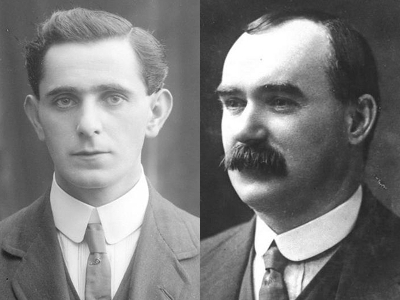
Executions of Seán MacDiarmada & James Connolly

macdiarmada-connolly

The British army executes Seán MacDiarmada and James Connolly, the last of the Easter Rising leaders to be executed in Dublin, in the Stonebreaker’s Yard at Kilmainham Gaol on May 12, 1916.

Seán MacDiarmada is born in 1884 in Leitrim. He emigrates to Glasgow in 1900 and from there to Belfast in 1902. A member of the Gaelic League, he is acquainted with Bulmer Hobson. He joins the Irish Republican Brotherhood (IRB) in 1906 while still in Belfast, transferring to Dublin in 1908 where he assumes managerial responsibility for the IRB newspaper Irish Freedom in 1910. Although MacDiarmada is afflicted with polio in 1912, he is appointed as a member of the provisional committee of Irish Volunteers from 1913 and is subsequently drafted onto the military committee of the IRB in 1915. During the Rising, MacDiarmada serves in the General Post Office (GPO). Following the surrender, MacDiarmada nearly escapes execution by blending in with the large body of prisoners. He is eventually recognised by Daniel Hoey of G Division and faces a court-martial on May 9.

James Connolly is born in Edinburgh in 1868. Connolly is first introduced to Ireland as a member of the British Army. Despite returning to Scotland, the strong Irish presence in Edinburgh stimulates Connolly’s growing interest in Irish politics in the mid-1890s, leading to his emigration to Dublin in 1896 where he founds the Irish Socialist Republican Party. He spends much of the first decade of the twentieth century in America. He then returns to Ireland to campaign for worker’s rights with James Larkin. A firm believer in the perils of sectarian division, Connolly campaigns tirelessly against religious bigotry. In 1913, Connolly is one of the founders of the Irish Citizen Army. During the Easter Rising he is appointed Commandant-General of the Dublin forces, leading the group that occupies the General Post Office.

The treatment accorded to Connolly is particularly despicable. Crippled by an infected wound in the ankle, he is carried to Kilmainham Gaol, tied to a chair, and shot. As the men are loading their rifles, Connolly forgives the men of the army firing squad for their actions. Shaken by their distasteful task, a ragged volley of shots resounds from their rifles. He is the last of the leaders to be executed.


Leave a comment

Execution of John MacBride, Irish Republican

john-macbride

Major John McBride, Irish republican, is executed by firing squad in the Stonebreakers Yard at Kilmainham Gaol in Dublin on May 5, 1916, for his participation in the 1916 Easter Rising.

MacBride is born at The Quay, Westport, County Mayo, to Patrick MacBride, a shopkeeper and trader, and the former Honoria Gill. He is educated at the Christian Brothers School in Westport and at St. Malachy’s College in Belfast. He studies medicine but gives it up and begins working with a chemist’s firm in Dublin.

He joins the Irish Republican Brotherhood (IRB) and is associated with Michael Cusack in the early days of the Gaelic Athletic Association. He also joins the Celtic Literary Society through which he comes to know Arthur Griffith, who is to remain a friend and influence throughout his life. Beginning in 1893, MacBride is termed a “dangerous nationalist” by the British government. In 1896, he travels to the United States on behalf of the IRB. Upon his return he emigrates to South Africa.

In the Second Boer War MacBride is instrumental in the raising of the Irish Transvaal Brigade and leads it into action against the British. When organised resistance collapses, he and the surviving members cross the border into Mozambique. After the war he marries Maud Gonne and they have a son, Seán MacBride, who is also to make a name for himself in Irish Politics. The marriage, however, is not a success and they go their separate ways. MacBride keeps up his associations with Republican activists but does not become personally involved other than making the odd speech in support of Ireland’s Cause.

After returning permanently from Paris to Dublin in 1905, MacBride joins other Irish nationalists in preparing for an Insurrection. Because he is so well known to the British, the leaders think it wise to keep him outside their secret military group planning a Rising. As a result, he happens to find himself in the midst of the Rising without notice.

MacBride is in Dublin early on Easter Monday morning, April 24, to meet his brother, Dr. Anthony MacBride, who is arriving from Westport to be married two days later. As MacBride walks up Grafton Street, he sees Thomas MacDonagh in uniform and leading his troops. He offers his services and is appointed second-in-command at the Jacob’s Biscuit Factory, which is occupied and held through Easter Week until the order to surrender is received. As he is dressed in civilian clothes rather than a military uniform, he could likely have escaped without too much difficulty but rather he decides to go with his comrades into captivity.

Tried by court martial under the Defence of the Realm Act, MacBride is found guilty and sentenced to death. He is executed on May 5, 1916, two days before his forty-eighth birthday. Facing the British firing squad, MacBride refuses to be blindfolded saying, “I have looked down the muzzles of too many guns in the South African war to fear death and now please carry out your sentence.”

John MacBride is buried in the cemetery at Arbour Hill Prison in Dublin.


Leave a comment

Sinking of the RMS Titanic

The RMS Titanic, four days into her maiden voyage from Southampton to New York City, sinks in the north Atlantic Ocean at 2:20 AM on the morning of April 15, 1912, after striking an iceberg just before midnight on April 14.

Titanic, the largest ship afloat at the time it enters service on April 2, 1912, is the second of three Olympic class ocean liners operated by the White Star Line, and is built by the Harland & Wolff shipyard in Belfast, Northern Ireland.

Titanic‘s maiden voyage, commanded by 62-year-old Captain Edward John Smith, begins shortly after noon on April 10, 1912 when she leaves Southampton on the first leg of her journey to New York City. A few hours later she reaches Cherbourg in France, where she takes on passengers. Her next port of call is Queenstown (now Cobh) in Ireland, which she reaches around midday on April 11. After taking on more passengers and stores, Titanic departs in the afternoon with an estimated 2,224 people on board.

Titanic receives six warnings of sea ice on April 14 but is traveling near her maximum speed when her lookouts sight the iceberg. Unable to turn quickly enough, the ship suffers a glancing blow that buckles her starboard side and opens five of her sixteen compartments to the sea. Titanic has been designed to stay afloat with four of her forward compartments flooded but not more, and the crew soon realises that the ship is going to sink. They use distress flares and wireless radio messages to attract help as the passengers are put into lifeboats. However, in accordance with existing practice, Titanic‘s lifeboat system is designed to ferry passengers to nearby rescue vessels, not to hold everyone on board simultaneously. With the ship sinking quickly and help still hours away, there is no safe refuge for many of the passengers and crew. Compounding this, poor management of the evacuation means many boats are launched before they are totally full.

At about 2:15 AM, Titanic‘s angle in the water begins to increase rapidly as water pours into previously unflooded parts of the ship through deck hatches. Her suddenly increasing angle causes a giant wave to wash along the ship from the forward end of the boat deck, sweeping many people into the sea. Titanic‘s stern lifts high into the air as the ship tilts down in the water, reaching an angle of 30–45 degrees. After another minute, the ship’s lights flicker once and then permanently go out, plunging Titanic into darkness. Shortly after the lights go out, the ship splits apart at one of the weakest points in the structure, the area of the engine room hatch. The submerged bow likely remains attached to the stern by the keel for a short time, pulling the stern to a high angle before separating and leaving the stern to float for a few minutes longer. The forward part of the stern floods very rapidly, causing it to tilt and then settle briefly before sinking.

Titanic sinks with over a thousand passengers and crew still on board. Almost all those who jump or fall into the water die from hypothermia within minutes. RMS Carpathia arrives on the scene about 90 minutes after the sinking and has rescued the last of the survivors by 9:15 AM on April 15, some nine and a half hours after the collision with the iceberg.

The death toll has been put at 1,513, including many Irish, although the number of casualties remains somewhat unclear due to a number of factors, including confusion over the passenger list, which includes some names of people who cancelled their trip at the last minute, and the fact that several passengers traveled under aliases for various reasons and were double-counted on the casualty lists.

The disaster causes widespread outrage over the lack of lifeboats, lax regulations, and the unequal treatment of the three passenger classes during the evacuation. Subsequent inquiries recommend sweeping changes to maritime regulations, leading to the establishment in 1914 of the International Convention for the Safety of Life at Sea (SOLAS), which still governs maritime safety today.


Leave a comment

Birth of Charles Gavin Duffy in County Monaghan

charles-gavin-duffy

Charles Gavan Duffy, Irish nationalist, journalist, poet, and Australian politician, is born on April 12, 1816, in Dublin Street, Monaghan Town, County Monaghan. Duffy is the 8th Premier of Victoria and one of the most colourful figures in Victorian political history.

Both of his parents die while he is still a child and his uncle, Fr. James Duffy, who is the Catholic Parish Priest of Castleblayney, becomes his guardian for a number of years. He is educated at St. Malachy’s College in Belfast and is admitted to the Irish Bar in 1845. Duffy becomes a leading figure in Irish literary circles.

Duffy, along with Thomas Osborne Davis and John Blake Dillon, founds The Nation and becomes its first editor. Davis and Dillon later become Young Irelanders. All three are members of Daniel O’Connell‘s Repeal Association. This paper, under Duffy, transforms from a literary voice into a “rebellious organisation.”

In August 1850, Duffy forms the Tenant Right League to bring about reforms in the Irish land system and protect tenants’ rights, and in 1852 is elected to the House of Commons for New Ross. By 1855, the cause of Irish tenants seems more hopeless than ever. Broken in health and spirit, Duffy publishes a farewell address to his constituency, declaring that he has resolved to retire from parliament, as it is no longer possible to accomplish the task for which he has solicited their votes.

In 1856, emigrates with his family to Australia, settling in the newly formed Colony of Victoria. A public appeal is held to enable him to buy the freehold property necessary to stand for the colonial Parliament. He is immediately elected to the Legislative Assembly for Villiers and Heytesbury in the Western District in 1856. He later represented Dalhousie and then North Gippsland. With the collapse of the Victorian Government‘s Haines Ministry during 1857, another Irish Catholic, John O’Shanassy, unexpectedly becomes Premier with Duffy his second-in-charge.

In 1871, Duffy leads the opposition to Premier Sir James McCulloch‘s plan to introduce a land tax, on the grounds that it unfairly penalised small farmers. When McCulloch’s government is defeated on this issue, Duffy becomes Premier and Chief Secretary.  The majority of the colony is Protestant, and Duffy is accused of favouring Catholics in government appointments. In June 1872, his government is defeated in the Assembly on a confidence motion allegedly motivated by sectarianism.

When Graham Berry becomes Premier in 1877, he makes Duffy Speaker of the Legislative Assembly, a post he holds without much enthusiasm until 1880, when he quits politics and retires to the south of France. Duffy remains interested in both the politics of his adoptive country and of Ireland. He is knighted in 1873 and is made KCMG in 1877. Sir Charles Gavan Duffy dies in Nice, France, at the age of 86 in 1903.


Leave a comment

Signing of the Good Friday Agreement

After nearly two years of talks, the Good Friday Agreement, a major political development in the Northern Ireland peace process of the 1990s, is signed by Irish Taoiseach Bertie Ahern and British Prime Minister Tony Blair on Good Friday, April 10, 1998 in Belfast, Northern Ireland.

The Good Friday Agreement brings to an end the 30 years of sectarian conflict in Northern Ireland known as “The Troubles.”  Northern Ireland’s present devolved system of government is based on the Agreement.

The Agreement is made up of two inter-related documents: (1) a multi-party agreement by most of Northern Ireland’s political parties and (2) an international agreement between the British and Irish governments called the British-Irish Agreement.

The Agreement sets out a complex series of provisions relating to a number of areas including the status and system of government of Northern Ireland within the United Kingdom (Strand 1), the relationship between Northern Ireland and the Republic of Ireland (Strand 2), and the relationship between the Republic of Ireland and the United Kingdom (Strand 3).

Issues relating to civil and cultural rights, decommissioning of weapons, justice and policing are central to the Agreement.

The Agreement is approved by voters across the island of Ireland in two referendums held on May 22, 1998. The people of both Northern Ireland and the Republic of Ireland need to approve the Agreement in order for it to come into effect. In Northern Ireland, voters are asked whether they support the multi-party agreement. In the Republic of Ireland, voters are asked whether they will allow the state to sign the agreement and allow necessary constitutional changes to facilitate it.

The British-Irish Agreement comes into force on December 2, 1999. The Democratic Unionist Party (DUP) is the only major political group in Northern Ireland to oppose the Good Friday Agreement.


1 Comment

Birth of Musician Gary Moore in Belfast

gary-moore

Robert William Gary Moore, Northern Irish musician, most widely recognised as a singer, songwriter, and virtuoso rock and blues guitarist, is born in Belfast on April 4, 1952.

In a career dating back to the 1960s, Moore plays with musicians including Phil Lynott and Brian Downey during his teenage years, leading him to memberships of the Irish bands Skid Row and Thin Lizzy, and British band Colosseum II. Moore shares the stage with such blues and rock musicians as B.B. King, Albert King, Jack Bruce, Albert Collins, George Harrison, and Greg Lake, as well as having a successful solo career. He guests on a number of albums recorded by high-profile musicians.

Moore starts performing at a young age, having picked up a battered acoustic guitar at the age of eight. He gets his first quality guitar at the age of 14, learning to play the right-handed instrument in the standard way despite being left-handed.

At the age of 16, aiming to become a musician, he moves to Dublin. Moore’s greatest influence in the early days is guitarist Peter Green of Fleetwood Mac who is a mentor to Moore when performing in Dublin. Other early musical influences are artists such as Albert King, Elvis Presley, The Shadows, and The Beatles. Later, having seen Jimi Hendrix and John Mayall’s Bluesbreakers in his hometown of Belfast, his own style is developing into a blues-rock sound that becomes the dominant form of his career in music.

In Dublin, Moore joins the group Skid Row with Noel Bridgeman and Brendan “Brush” Shiels. It is with this group that he earns a reputation in the music industry, and his association with Phil Lynott begins.

Moore moves to England in 1970 and in 1973, under the name “The Gary Moore Band,” he releases his first solo album, Grinding Stone. Grinding Stone receives “Album of the Year” accolades on KTAC-FM/Seattle-Tacoma, Washington, in 1974.

In 1974 he joins Thin Lizzy after the departure of founding member Eric Bell. From 1975 to August 1978, he is a member of Colosseum II. In 1977, Moore rejoins Thin Lizzy, first as a temporary replacement for Brian Robertson, and on a permanent basis a year later.

In July 1979, he leaves the band permanently to focus on his solo career, again with help from Phil Lynott. After a series of rock records, Moore returns to blues music with Still Got the Blues (1990), with contributions from Albert King, Albert Collins, and George Harrison. Other collaborations during his solo years include a broad range of artists including Trilok Gurtu, Dr. Strangely Strange, Jimmy Nail, Mo Foster, Ginger Baker, Jack Bruce, Jim Capaldi, B.B. King, Vicki Brown, Cozy Powell, Rod Argent, The Beach Boys, Paul Rodgers, Keith Emerson, Roger Daltrey, and Otis Taylor.

Gary Moore dies of a heart attack in his sleep at the age of 58 during the early hours of February 6, 2011. At the time, he is on holiday with a girlfriend at the Kempinski Hotel in Estepona, Spain. Moore is laid to rest in St. Margaret’s Churchyard, Rottingdean, East Sussex, England, in a private ceremony with only family and close friends in attendance.


Leave a comment

Birth of Singer Ruby Florence Murray

ruby-florence-murrayRuby Florence Murray, one of the most popular singers in the United Kingdom and Ireland in the 1950s, is born on the Donegal Road in south Belfast on March 29, 1935. In 1955 alone, she secures seven Top 10 UK hit singles.

The distinctive sound of Murray’s voice is partly the result of a throat operation in early childhood. She tours as a child singer and first appears on television at the age of 12, however, laws governing children performing, Murray has to delay her start in the entertainment industry. She returns to Belfast and full-time education until she reaches 14 years of age.

Spotted by producer Richard Afton, Murray is signed to Columbia and her first single, Heartbeat, reaches No. 3 in the UK Singles Chart in December 1954. Afton offers her the position of resident singer on the BBC‘s Quite Contrary television show, replacing Joan Regan. Softly, Softly, her second single, reaches number one in early 1955. That same year Murray sets a pop-chart record by having five hits in the Top Twenty in one week, a feat unmatched until the emergence of Madonna in the 1980s.

The 1950s is a busy period for Murray, during which she has her own television show, stars at the London Palladium with Norman Wisdom, appears in a Royal Command Performance, and tours the world. During a 52-week period, starting in 1955, Murray constantly has at least one single in the UK charts, this being at a time when only a Top 20 is listed.

Murray appears with Frankie Howerd and Dennis Price in her only film role, as Ruby in a 1956 farce, A Touch of the Sun. A couple of hits follow later in the decade. Goodbye Jimmy, Goodbye, a No. 10 hit in 1959, is her final appearance in the charts. EMI puts together a compilation album of her hits on CD in 1989, including songs that are regularly featured in her act, Mr. Wonderful, Scarlet Ribbons, and It’s the Irish in Me. They update this with the release of EMI Presents The Magic Of Ruby Murray in 1997 and a triple album, Anthology — The Golden Anniversary Collection, in 2005, the 50th anniversary of her peak successes on the charts.

A play about Murray’s life, Ruby, written by the Belfast playwright Marie Jones, opens at the Group Theatre in Belfast in April 2000.

Although her days as a major star gradually diminish, Murray continues performing until close to the end of her life. She spends her last couple of years in Asprey’s Nursing Home, often delighting her carers with a song. She dies of liver cancer, at the age of 61, on December 17, 1996 in Torquay after a long struggle with alcoholism.