
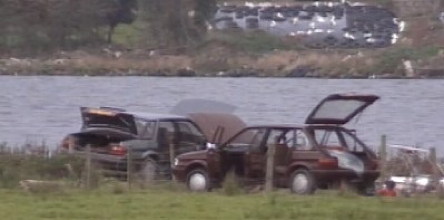
The 1990 Lough Neagh ambush is a gun attack carried out by the Provisional Irish Republican Army (IRA) on November 10, 1990, at Castor Bay, near Morrows Point, Lough Neagh, County Armagh, Northern Ireland targeting members of the security forces involved in a waterfowl hunting trip with other two men at the time. An active service unit (ASU) of the IRA’s North Armagh Brigade shoots dead a Royal Ulster Constabulary (RUC) Inspector, an RUC Reservist, a former Ulster Defence Regiment (UDR) soldier and one civilian. Some members of the wildfowling party struggle with their attackers, and one of the constables returns fire before being killed.
On September 7, 1990, UDR soldier Colin McCullough is shot dead by the IRA while in the company of his girlfriend at Oxford Island on the shore of Lough Neagh in the same area as the November 10 ambush. On October 6, in a revenge attack, the “Protestant Action Force” (a cover name for the Ulster Volunteer Force) shoots dead Catholic man Denis Carville at the same location, also while sitting in his car with his girlfriend.
At 7:30 a.m. on November 10, 1990, the four men leave home for Castor Bay on the shore of Lough Neagh for a wildfowling trip. Their early morning hunting excursions to the Department of the Environment-managed waterworks compound are routine and all of the men live in the Lurgan and Waringstown areas. It is believed the IRA team are waiting for the group inside the compound and ambush them shortly following their arrival.
The victims were David Murphy, an RUC Special Branch Inspector; Thomas Taylor, a part-time RUC Reservist; Norman Kendall, an electrician and former UDR soldier; and Keith Dowey, an employee with the Department of the Environment water service and father of two young children.
According to a 2000 report, the goal of the IRA unit, apparently members of the North Armagh Brigade led by the late Patsy Haughian, is only to abduct and interrogate Murphy about collusion between the RUC and loyalist militants, but things go wrong when Kendall and Dowey arrive at the scene in a car. Dowey, the driver, is shot and killed instantly, but there is evidence that Kendall puts up some resistance before being slain. Taylor produces his personal weapon and shoots at the assailants, but is cut down by a hail of fire. Murphy struggles and manages to avoid being bundled into the vehicle, but is eventually killed by Haughian. After the hunting party fails to appear at lunch time the alarm is raised. It is initially feared they have been kidnapped but four bodies are accounted for. The gunmen escape in one of the victim’s cars which is later found partially burned out at Brownlow Terrace, Lurgan. The IRA unit then hides in a house on the shores of the lake before returning to Lurgan the following morning.
The attack is widely condemned by politicians in Northern Ireland and the Republic of Ireland. Unionist politicians call for tougher security measures. Local Ulster Unionist Party (UUP) MP David Trimble criticises Secretary of State Peter Brooke for ruling out the introduction of internment without trial in response to the incident and other killings in the preceding weeks and links the attack to a landmark speech given by Brooke the previous day signaling to the Provisional IRA and Sinn Féin that Britain has no “selfish strategic or economic interest” in Northern Ireland. RUC Chief Constable Hugh Annesley visits the scene of the shootings and describes the attack as “repulsive, futile and cowardly murder” and says, “it is important to say yet again that the terrorists have no mandate from either Protestant or Catholic, north or south of the Irish border for such atrocities.”
Social Democratic and Labour Party (SDLP) representative Bríd Rodgers categorises the killings as part of an ongoing cycle of so-called “tit for tat” murders and urges anyone with information to contact the police. A message is read at Mass in Lurgan following the attack from the Bishop of Dromore and local priests warning Catholics to take precautions for their safety because of the risk of revenge attacks by Loyalists.
The alleged leader of the IRA squad, Patsy Haughian, dies of cancer at age 38 in October 2000. He is never formally accused of the killings.


