seamus dubhghaill

Promoting Irish Culture and History from Little Rock, Arkansas, USA


Leave a comment

State Visit of U.S. President John F. Kennedy

jfk-state-visit

John F. Kennedy, an Irish American and the first Catholic to become president of the United States, arrives in Ireland on a state visit on June 26, 1963. After Air Force One touches down at Dublin airport, Kennedy’s motorcade weaves through the streets of Dublin city, the thrilled crowd, lacking ticker tape, improvises by throwing rolls of bus tickets.

Kennedy is proud of his Irish roots and makes a special visit to his ancestral home in Dunganstown, County Wexford, while in the country. There, he is greeted by a crowd waving both American and Irish flags and is serenaded by a boys’ choir that sings The Boys of Wexford. Kennedy breaks away from his bodyguards and joins the choir for the second chorus, prompting misty-eyed reactions from both observers and the press.

Kennedy meets with 15 members of his extended Irish family at the Kennedy homestead in Dunganstown. There he enjoys a cup of tea and some cake and makes a toast to “all those Kennedys who went and all those Kennedys who stayed.” His great-grandfather, Thomas Fitzgerald, had left Ireland for the United States in the middle of the Great Famine of 1848 and settled in Boston, becoming a cooper. Generations of his descendants go on to make their mark on American politics.

At the time of JFK’s visit to Ireland, the predominantly Catholic Irish Republic has been an independent nation for 41 years. The northern counties of the island, however, remain part of the largely Protestant British Empire and still suffer from long-standing sectarian violence. On the day after his arrival in Dublin, Kennedy speaks before the Irish parliament, where he openly condemns Britain’s history of persecuting Irish Catholics. Two days later, he travels to England, America’s oldest ally, to meet with British Prime Minister Harold Macmillan and his cabinet to discuss setting up a pro-democratic regime in British Guiana.

Kennedy later tells his aides that his favourite part of the trip was the wreath laying and silent funeral drill done by the Irish Army cadets at Arbour Hill military cemetery in Dublin.

Five months later, his widow, Jacqueline Kennedy, makes a special request to the Irish government. She asks that those same Irish army cadets, who so impressed the President on his visit, perform the drill again at his state funeral. Within days, those awe-stuck, trembling young men stand just inches away from foreign dignitaries from over 90 countries and perform their silent funeral drill in memory of a president that had inspired their country just a few short months earlier.

Leave a comment

The Phoenix Park Murders

phoenix-park-murders

Lord Frederick Cavendish, newly appointed Chief Secretary for Ireland, and Thomas Henry Burke, the Permanent Undersecretary, are fatally stabbed in Phoenix Park, Dublin, on May 6, 1882 in what becomes known as the Phoenix Park Murders.

Cavendish, who is married to Lucy Cavendish, the niece of British Prime Minister William Ewart Gladstone, and has worked as Gladstone’s personal secretary, arrives in Ireland on the day he is murdered. Cavendish and Burke are attacked as they walk to the Viceregal Lodge, which is the out-of-season residence of the Lord Lieutenant of Ireland. Thomas Myles, resident surgeon at nearby Dr. Steevens’ Hospital, is summoned to render medical assistance to the victims. The then Lord Lieutenant, Lord Spencer, describes suddenly hearing screams, before witnessing a man running to the Lodge grounds shouting “Lord Frederick Cavendish and Mr. Burke are killed.” Responsibility for the assassinations is claimed by a small hitherto unheard-of Republican organisation called the Irish National Invincibles.

The hunt for the perpetrators is led by Superintendent John Mallon, a Catholic man from Armagh. Mallon has a pretty shrewd idea of who has committed the crime and suspects a number of former Fenian activists. A large number of suspects are arrested and kept in prison by claiming they are connected with other crimes. By playing one suspect against another, Mallon gets several of them to reveal what they know.

James Carey, leader of The Invincibles, Michael Kavanagh, and Joe Hanlon agree to testify against the others. Joe Brady, Michael Fagan, Thomas Caffrey, Dan Curley, and Tim Kelly are convicted of the murders and all are hanged by William Marwood in Kilmainham Gaol in Dublin between May 14 and June 9, 1883. Others, convicted as accessories to the crime, are sentenced to long prison terms. The getaway driver, James Fitzharris, is acquitted of murder but is retried as an accessory and convicted.

Only the case of Tim Kelly gives any real difficulty as he is only nineteen and generally said to look much younger. By referring to him as “a child” his defence counsel creates enough unease for two juries to disagree. He is found guilty only after an unprecedented third trial.

Charles Stewart Parnell makes a speech condemning the murders in 1882, which increases his already huge popularity in both Britain and Ireland. He has just enabled some reforms under the Kilmainham Treaty four days prior to the murders. Parnell’s reputation increases in Ireland, being seen as a more moderate reformer who would never excuse such tactics.

However, Parnell’s policy of allying his party to Gladstone’s Liberal Party in 1886 to enable Home Rule is also ultimately defeated by the murders. Gladstone’s Minister, Lord Hartington, is the elder brother of Lord Frederick Cavendish. Infuriated by the manner of his brother’s early death, Hartington splits with Gladstone on the Home Rule bills of 1886 and 1893 and leads the breakaway Liberal Unionist Association which allies itself to Lord Salisbury‘s conservative governments. In the ensuing 1886 general election, the Conservatives and Liberal Unionists sweep the board. This delays Home Rule by twenty-eight years, when the Third Irish Home Rule Bill is passed in 1914 but never effected.

In March 1887, The Times prints letters purportedly from Parnell claiming sympathy with the murderers and that his public denunciation of them was insincere. It emerges that the letters are forgeries written by journalist Richard Pigott. Parnell is personally vindicated by the Parnell Commission in 1888–89.


Leave a comment

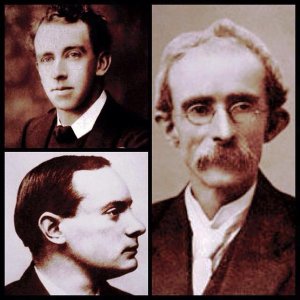
Executions of Patrick Pearse, Thomas Clarke, & Thomas MacDonagh

pearse-clarke-mac-donagh

Patrick Pearse, Thomas Clarke, and Thomas MacDonagh are executed by firing squad in the Stonebreakers’ Yard at Kilmainham Gaol in Dublin on May 3, 1916. Pearse, Clarke, and MacDonagh are three of the seven signatories of the Proclamation of the Irish Republic.

Just three days after the end of the 1916 Easter Rising, the first military courts martial sits on May 2, 1916. Pearse, Clarke, and MacDonagh are immediately sentence to death. The three are taken that evening to the disused Kilmainham Gaol and are shot at dawn the following morning.

Patrick Pearse is born in Dublin in 1879, becoming interested in Irish cultural matters in his teenage years. In 1898, Pearse becomes a member of the Executive Commmittee of the Gaelic League. He graduates from the Royal University of Ireland in 1901 with a degree in Arts and Law. Pearse’s literary output is constant, and he publishes extensively in both Irish and English, becoming the editor of An Claidheamh Soluis, the newspaper of the Gaelic League. He is a keen believer in the value of education, and establishes two schools, Coláiste Éanna and Coláiste Íde, devoted to the education of Irish children through the Irish language.  Pearse is one of the founding members of the Irish Volunteers and the author of the Proclamation of the Irish Republic. He is Commander in Chief of the Irish forces and headquartered in the General Post Office (GPO) during the 1916 Easter Rising.

Thomas Clarke is born on the Isle of Wight in 1857, the son of a soldier in the British army. During his time in America as a young man, he joins Clan na Gael, later enduring fifteen years (1883-1898) of penal servitude for his role in a bombing campaign in London. In 1907, having returned from a second sojourn in America, his links with Clan na Gael in America copper-fastens his importance to the revolutionary movement in Ireland. He holds the post of Treasurer to the Irish Republican Brotherhood (IRB) and is a member of the Supreme Council from 1915. Clarke is the first signatory of the Proclamation of the Irish Republic through deference to his seniority. Clarke is also stationed at the GPO during Easter Week. Clarke tells his wife during his final night that he is relieved he is going to be executed because his greatest dread is that he would be sent back to prison.

Thomas MacDonagh is a native of Tipperary, born in 1878. He spends the early part of his career as a teacher. He moves to Dublin to study and is the first teacher on the staff at St. Enda’s School, the school he helps to found with Patrick Pearse. MacDonagh is well versed in literature, his enthusiasm and erudition earning him a position in the English department at University College Dublin. His play When the Dawn is Come is produced at the Abbey Theatre. He is appointed director of training for the Irish Volunteers in 1914, later joining the Irish Republican Brotherhood (IRB). MacDonagh is appointed to the IRB military committee in 1916. He is commander of the Second Battalion of Volunteers that occupies Jacob’s Biscuit Factory and surrounding houses during the Rising.

Immediately after the executions, Irish Parliamentary Party leader John Redmond warns British Prime Minister Herbert Asquith that “if any more executions take place in Ireland the position will become impossible for any constitutional party or leader.”

Asquith himself warns Sir John Maxwell that “anything like a large number of executions would…sow the seeds of lasting trouble in Ireland.”

These warnings fall upon deaf ears as thirteen additional executions take place in the following days.