seamus dubhghaill

Promoting Irish Culture and History from Little Rock, Arkansas, USA


1 Comment

The Philadelphia Nativist Riots

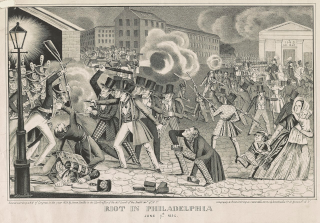
The Philadelphia nativist riots (also known as the Philadelphia Prayer Riots, the Bible Riots and the Native American Riots) are a series of riots that take place on May 6—8 and July 6—7, 1844, in Philadelphia, Pennsylvania, and the adjacent districts of Kensington and Southwark. The riots are a result of rising anti-Catholic sentiment at the growing population of Irish Catholic immigrants.

On July 3, Father John Patrick Dunn of the Church of St. Philip Neri in the Southwark District is warned that the church might be attacked during an upcoming parade held by the Native American Party. The Native American Party, a nativist political party, plans to hold a large parade the next day on Independence Day.

To prepare for violence, the church applies for an arsenal that a volunteer company could use in case the church is attacked. Pennsylvania Governor David R. Porter authorizes the formation of a company and the procurement of twenty-five muskets from the Frankford Arsenal. Major General Robert Patterson, commander of the Pennsylvania militia, puts the troops on alert in case of violence.

Five of the muskets placed in St. Philip Neri’s Church are discovered to be defective and are sent back to the Frankford Arsenal to be repaired. No violence occurs before or during the parade, but on July 5, a nativist mob numbering in the thousands gathers at the church after some observe five defective muskets being returned to the church. They then demand that the sheriff remove the weapons, while Father Dunn and volunteers rally to protect the church. Sheriff Morton McMichael and two aldermen search the church and remove twelve muskets. After leaving the church, the sheriff urges the crowd to disperse and leaves a volunteer posse to guard the church. The mob remains, and a man injured in the May riots makes a speech to the crowd, calling for a second search of the church. The sheriff, an alderman, and seventeen nativists enter the church and find three armed men, fifty-three muskets, ten pistols, a keg of gunpowder and ammunition. To avoid inciting the mob, the sheriff decides not to remove the armaments, and the search party stays in the church. Just after midnight, July 6, Major General Patterson orders a company of city guards to clear the streets. After the crowd disperses, the arms found within the church are removed.

By midday, the crowds return around St. Philip Neri’s Church. General George Cadwalader orders the crowds to disperse, but they do not. By the evening, the sheriff arrives with a 150-strong posse. Throughout the evening, the military presence grows, and three cannons are stationed on the streets. The soldiers clear the streets near the church, despite being pelted with rocks by the mob. Responding to the rock throwers, General Cadwalader orders a cannon to be fired at the crowd on Third Street. Former U.S. Congressman Charles Naylor begs the general not to fire. He and several others are arrested and held within the church. By the morning of July 7, most of the soldiers have left, but the crowds, led by an alderman and the sheriff, return and demand that the remaining guard release Naylor. Everyone except Naylor is released. The crowds grow, and a cannon is brought from a nearby wharf and used to threaten the church. After further negotiations, Naylor is released and carried home to cheers on people’s shoulders.

After Naylor is brought home, the mob attacks the church, damaging a wall with the cannon. A second cannon is brought from the wharfs and fired at the church, after which the mob pelts the building with rocks and break in through a side door. The soldiers fire on the men breaking into the church, who promptly retreat. After retreating, the nativists negotiate with the guard, who agrees to withdraw, allowing the nativists to guard the church. The crowd pelts the soldiers with rocks and some soldiers fire back, which only incites the mob further. The mob forces its way into the church, causing extensive damage to the interior. After about an hour, a group of twenty men organizes themselves to guard St. Philip Neri’s, and the mob leaves the church.

By the evening, a large number of soldiers arrive with orders to clear the streets, only to be stoned in the process. After a captain is attacked, the order is given to fire on the mob, which results in seven fatalities and nine injuries. Not long after, people with muskets and cannons arrive and fierce fighting breaks out between the soldiers and the mob. The fighting lasts for several hours, with the soldiers being fired upon from alleyways and the windows of nearby buildings. The soldiers bring in two cannons of their own and fire on the mob. The mob returns fire using their own cannons, armed with items such as nails, chains, knives and broken bottles. In an attempt to capture the mob’s cannons, soldiers charge one cannon’s position, only to be knocked off their horses by a rope tied across the street. The cannons are all eventually captured, and by early morning on July 8, the fighting has ended.

At least fifteen people, including rioters and soldiers, are killed in the riot, and at least fifty people are injured. Under Governor Porter’s orders, state troops continue to arrive in the city in the days afterward, but no further violence takes place. An estimated 5,000 militia are used to stop violence. Troops begin to withdraw from the city on July 10, and the church takes over responsibility from the district of Southwark of protecting the church on July 11. As with the May riots, a grand jury blames the Irish Catholics for the riots but supports the military’s response to the violence.

The riots gain national attention and condemnation. The riots are used as an issue in the 1844 U.S. Presidential election, the Democratic Party condemning the growing Native American Party and the Whig Party, which the Democrats accuse of involvement in the nativist movement. In Philadelphia, the Native American Party ends up making a strong showing in the city’s October election.

On July 11, 1844, Philadelphia passes an ordinance that gives the city a battalion of artillery, a regiment of infantry, and at least one full troop of cavalry to preserve peace within the city when necessary. The difficulty of quelling the riots and other crime leads the Pennsylvania General Assembly to pass an 1845 act that requires Philadelphia, the township of Moyamensing and the unincorporated districts of Spring Garden, Northern Liberties, and Penn to maintain a police force of one man per 150 taxable inhabitants. In 1850, another act is passed that establishes that the Philadelphia police force will police the city and seven surrounding districts. The inability to maintain order effectively in Philadelphia’s suburbs is an important argument for the consolidation of the city in 1854.

After the riots, Bishop Kenrick ends his efforts to influence the public education system and begins encouraging the creation of Catholic schools, with 17 being founded by 1860. The friars of the Church of St. Augustine sue the city of Philadelphia for not providing the church with adequate protection, claiming $80,000 in damages. The city argues that the friars cannot claim their civil rights were violated, as the Order of Saint Augustine is a foreign organization under the Pope. Furthermore, the city argues that the friars took a vow of poverty and cannot be property owners. The Augustinians end up proving the Order is incorporated in 1804 and is awarded $45,000. The church is rebuilt in 1848.

(Pictured: “Riot in Philadelphia,” lithograph by H. Bucholzer, 1844, Library of Congress)


Leave a comment

The Battle of Benburb

The Battle of Benburb takes place on June 5, 1646, during the Irish Confederate Wars, the Irish theatre of the Wars of the Three Kingdoms. It is fought between the Irish Confederation under Owen Roe O’Neill, and a Scottish Covenanter and Anglo-Irish army under Robert Monro. The battle ends in a decisive victory for the Irish Confederates and ends Scottish hopes of conquering Ireland and imposing their own religious settlement there.

The Scots Covenanters land an army in Ulster in 1642 to protect the Scottish settlers there from the massacres that follow the Irish Rebellion of 1641. They land at Carrickfergus and link up with Sir Robert Stewart and the Laggan Army of Protestant settlers from County Donegal in northwest Ulster. The Covenanters clear northeastern Ulster of Irish rebels by 1643 but are unable to advance south of mid-Ulster, which is held by Owen Roe O’Neill, the general of the Irish Confederate Ulster army.

In 1646, Monro leads a force composed of Scottish Covenanter regiments and Ulster settlers’ armies into Confederate-held territory. According to some accounts, this is the first step in a drive to take the Confederates’ capital at Kilkenny. Other sources say it is only a major raid. The combined force is about 6,000 strong. Monro has ten regiments of infantry, of whom six are Scottish and four are English or Anglo-Irish, and 600 Ulster Protestant cavalry. Stewart and the Laggan Army are slated to join Monro’s force in the attack, however, on the day of the battle the Laggan Army is in Clogher, nearly 30 kilometres away. O’Neill, who is a very cautious general, had previously avoided fighting pitched battles. However, he has just been supplied by the Papal Nuncio to Ireland, Giovanni Battista Rinuccini, with muskets, ammunition and money with which to pay his soldiers’ wages. This allows him to put over 5,000 men into the field, an army slightly smaller than his enemy’s. The Covenanters have six cannons, whereas the Confederates have none.

Monro assumes that O’Neill will try to avoid his army and has his soldiers march 24 kilometres to intercept the Irish force at Benburb, in modern south County Tyrone. Gerard Hayes-McCoy writes, “many of them must have been close to exhaustion before the battle began.” Monro’s men draw up with their backs to the River Blackwater, facing O’Neill’s troops who are positioned on a rise.

The battle begins with Monro’s artillery firing on the Irish position, but without causing many casualties. Monro’s cavalry then charges the Irish infantry but are unable to break the Confederates’ pike and musket formation. When this attack fails, O’Neill orders his infantry to advance, pushing the Monro’s forces back into a loop of the river by the push of pike. It is noted that the Irish pikes have longer shafts and narrower heads than those of their opponents, meaning that they outreach them and are “better to pierce.” At this point, the fatigue of Monro’s troops is apparent as they are gradually pushed back until their formation collapses in on itself. The Confederate infantry then breaks Monro’s disordered formation with a musket volley at point-blank range and falls in amongst them with swords and scians (Irish long knives). Monro and his cavalry flee the scene, as, shortly after, does his infantry. A great many of them are cut down or drowned in the ensuing pursuit. Monro’s losses are estimated to be between 2,000 and 3,000 men, killed or wounded. The Irish casualties are estimated to be 300.

O’Neill’s victory means that the Covenanters are no longer a threat to the Confederates, but they remain encamped around Carrickfergus for the rest of the war. O’Neill does not follow up his victory but takes his army south to intervene in the politics of the Irish Confederation. In particular, he wants to make sure that the treaty the Supreme Council of the Confederates has signed with the English Royalists will not be ratified.

The battle is commemorated in the ballad “The Battle of Benburb.”


Leave a comment

The Second Battle of Arklow

The second Battle of Arklow takes place on June 9, 1798 during the Irish Rebellion of 1798 when a force of United Irishmen from Wexford, estimated at 10,000 strong, launch an assault on the British-held town of Arklow, County Wicklow, in an attempt to spread the rebellion into Wicklow and to threaten the capital of Dublin.

A British advance force of 400 is defeated at Tuberneering on June 4. This rebel victory punches a hole in the dragnet the military has attempted to throw around County Wexford and also yields them three artillery pieces. The town of Arklow has been evacuated in the ensuing panic but the rebels content themselves with taking the town of Gorey and staying within the Wexford border. On June 5 the rebels attempt to break out of County Wexford across the River Barrow and to spread the rebellion but are halted by a major British victory at the Battle of New Ross. When the rebels finally move against Arklow, the town has been reoccupied by a force of 1,700 men sent from Dublin under Francis Needham, 1st Earl of Kilmorey, who quickly fortifies the town with barricades and has artillery positioned on all the approaches to the town.

The rebel army that forms for attack on the afternoon of June 9 is a combined force of Wexford and Wicklow rebels led by Billy Byrne, Anthony Perry, Conor McEvoy, Edward Fitzgerald, and Fr. Michael Murphy. The British in Arklow consist of approximately 1,000 militia from counties Antrim and Cavan and 150 regular cavalry supported by 250 Yeomanry. They are joined by 315 Durham Fencibles (Princess of Wales’s Fencible Dragoons) arriving an hour before the rebels.

The area surrounding the town and the approaches is covered by scrub and the rebel strategy adopted is to advance under cover attacking the town simultaneously from several points. Before the action begins, the rebels under Esmonde Kyan open fire upon the town with some of the artillery captured at Tuberneering and have some success by scoring a direct hit on a British artillery position, destroying the cannon and killing the attendant crew. The main assault is quickly launched but at all entry points the Irish are thrown back by the musket fire of the well-trained and disciplined militia and volunteers, and canister shot from the 3 pounder battalion gun brought by the fencibles. An attempt by the British to turn the Irish failure into a rout is defeated when pikemen and sharpshooters drive a cavalry charge back across the River Avoca, but an attempt to force a way into the town through the outlying fishing port is bloodily repulsed.

As Irish casualties mount, the lack of ammunition and proper leadership begin to work against them, and after Fr. Murphy is killed leading a charge, their attacks start to fade. As nightfall comes, the rebels begin to withdraw under cover of darkness and collect their wounded. They are not pursued or molested by the garrison who are, unknown to the rebels, down to their last three or four rounds per man and are themselves at the brink of defeat.

While rebel casualties are estimated at about 1,000 no full casualty list seems to exist on the British side, but are probably in the region of 100 dead and wounded. The defeat at Arklow marks the third failure to extend the fight for Irish independence beyond the borders of County Wexford following the other bloody repulses at New Ross and Bunclody. The Irish strategy now changes to a policy of static defence against the encroaching British armies.


1 Comment

The Battle of New Ross

battle-of-new-ross

The Battle of New Ross takes place in County Wexford in southeastern Ireland on June 5, 1798, during the Irish Rebellion of 1798. It is fought between the Irish Republican insurgents called the United Irishmen and British Crown forces composed of regular soldiers, militia and yeomanry. The attack on the town of New Ross on the River Barrow, is an attempt by the recently victorious rebels to break out of County Wexford across the River Barrow and to spread the rebellion into County Kilkenny and the outlying province of Munster.

On June 4, 1798, the rebels advance from their camp on Carrigbyrne Hill to Corbet Hill, just outside the town of New Ross. The battle, the bloodiest of the 1798 rebellion, begins at dawn on June 5 when the Crown garrison is attacked by a force of almost 10,000 rebels, massed in three columns outside the town. The attack has been expected since the fall of Wexford to the rebels on May 30 and the British garrison of 2,000 has prepared defences both outside and inside the town. Trenches are dug and manned by skirmishers on the approaches to the town while cannon are stationed facing all the rapidly falling approaches and narrow streets of the town to counter the expected mass charges by the rebels, who are mainly armed with pikes.

Bagenal Harvey, the United Irish Leader recently released from captivity following the rebel seizure of Wexford, attempts to negotiate surrender of New Ross but the rebel emissary Matt Furlong is shot down by Crown outposts while bearing a flag of truce. His death provokes a furious charge by an advance guard of 500 insurgents led by John Kelly who has instructions to seize the Three Bullet Gate and wait for reinforcements before pushing into the town. To aid their attack, the rebels first drive a herd of cattle through the gate.

Another rebel column attacks the Priory Gate but the third pulls back from the Market Gate intimidated by the strong defences. Seizing the opportunity, the garrison sends a force of cavalry out the Market Gate to attack and scatter the remaining two hostile columns from the flanks. However, the rebel rump has not yet deployed and upon spotting the British manoeuvre, rally the front ranks who stand and break the cavalry charge with massed pikes.

The encouraged rebel army then sweeps past the Crown outposts and seizes the Three Bullet Gate causing the garrison and populace to flee in panic. Without pausing for reinforcement, the rebels break into the town attacking simultaneously down the steeply sloping streets but meet with strong resistance from well-prepared second lines of defence of the well-armed soldiers. Despite horrific casualties the rebels manage to seize two-thirds of the town by using the cover of smoke from burning buildings and force the near withdrawal of all Crown forces from the town. However, the rebels’ limited supplies of gunpowder and ammunition force them to rely on the pike and blunts their offensive. The military manages to hold on and, following the arrival of reinforcements, launches a counterattack before noon which finally drives the exhausted rebels from the town.

No effort to pursue the withdrawing rebels is made but when the town has been secured, a massacre of prisoners, trapped rebels and civilians of both sympathies alike begins which continues for days. Hundreds are burned alive when rebel casualty stations are torched by victorious troops. More rebels are believed to have been killed in the aftermath of the battle than during the actual fighting. Reports of such atrocities brought by escaping rebels are believed to have influenced the retaliatory murder of over 100 loyalists in the flames of Scullabogue Barn.

Casualties in the Battle of New Ross are estimated at 2,800 to 3,000 Rebels and 200 Garrison dead. Most of the dead Rebels are thrown in the River Barrow or buried in a mass grave outside the town walls a few days after the Battle. The remaining rebel army reorganises and forms a camp at Sliabh Coillte some five miles to the east but never attempts to attack the town again. They later attack General John Moore‘s invading column but are defeated at the Battle of Foulksmills on June 20, 1798.

(Pictured: The 1845 illustration “The Battle of Ross” by George Cruikshank)