seamus dubhghaill

Promoting Irish Culture and History from Little Rock, Arkansas, USA


Leave a comment

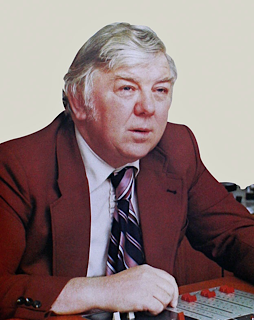
Birth of Ciarán Mac Mathúna, Broadcaster & Music Collector

Ciarán Mac Mathúna, broadcaster and music collector, is born on November 26, 1925, in Limerick, County Limerick. He is a recognised authority on Irish traditional music and lectures extensively on the subject. He travels around Ireland, England, Scotland and the United States collecting music.

According to Sam Smyth in the Irish Independent, Mac Mathúna is “on a mission to collect songs and stories, music, poetry and dance before they were buried under the coming tsunami of pop music.”

Mac Mathúna presents the radio programme, Mo Cheol Thú, for 35 years. Upon his retirement in 2005, the managing director of RTÉ Radio, Adrian Moynes, describes him as “inseparable from RTÉ Radio.” Upon his death in 2009, the Irish Independent describes him as “a national treasure.”

Mac Mathúna spends his early years in Mulgrave Street in Limerick. He is schooled at CBS Sexton Street, and later graduates from University College Dublin (UCD) with a BA in modern Irish and Latin. Subsequently, he completes an MA in Irish.

After college Mac Mathúna works as a teacher and later at the Placenames Commission. In 1954, he joins Radio Éireann where his job is to record Irish traditional musicians playing in their own locales. This entails visiting such places as Sliabh LuachraCounty Clare and County Sligo, and the resulting recordings feature in his radio programmes: Ceolta Tire, A Job of Journeywork and Humours of Donnybrook.

Director General of RTÉ Cathal Goan later recalls that Mac Mathúna interviewed him for his first job at the station. He assists in the organisation of Mac Mathúna’s music collection for the RTÉ Libraries and Archives.

Mac Mathúna’s long-running Sunday morning radio series, Mo Cheol Thú (You are my music), begins in 1970 and continues until November 2005, when he retires from broadcasting. Each 45-minute programme offers a miscellany of archive music, poetry and folklore, mainly of Irish origin. It is one of radio’s longest running programmes. The last episode is broadcast on November 27, 2005, at 8:10 a.m.

Mac Mathúna wins two Jacob’s Awards, in 1969 and 1990, for his RTÉ Radio programmes promoting Irish traditional music. He receives the Freedom of Limerick city in June 2004. He is also awarded honorary doctorates by NUI Galway and the University of Limerick. In 2007, he receives the Musicians Award at the 10th annual TG4 Traditional Music Awards.

Joe Kennedy in the Sunday Independent in 2007 compares Mac Mathúna to “an amiable rock, rolling gently along, still picking up some moss and morsels of music that he may have missed.”

Mac Mathúna‘s wife, Dolly MacMahon (using the English version of her surname), is a singer of traditional songs. She comes from Galway and meets her husband in 1955. He has two sons named Padraic and Ciarán, one daughter named Déirdre, and four grandchildren at the time of his death: Eoin, Colm, Conor and Liam.

Mac Mathúna dies in St. Gladys nursing home, Harold’s Cross, Dublin, on December 11, 2009. His funeral on December 15, 2009, is attended by hundreds of people, including aides-de-camp of the President and Taoiseach, RTÉ Director-General Cathal Goan, poet Seamus Heaney and others.

Musicians performing at the ceremony include Peadar Ó RiadaCór Cúil Aodha and members of The Chieftains and Planxty. The corpse is then taken to Mount Jerome Crematorium. Journalist Kevin Myers says Mac Mathúna’s legacy will be the “rebirth of Irish music,” adding, “Well, if Ciarán Mac Mathúna can die, I suppose anyone can. Actually, I had always thought that he was immortal. He certainly appeared to have all the ingredients.”


Leave a comment

Death of John Holland, Irish Engineer

john-philip-holland

John Philip Holland, Irish engineer who develops the first submarine to be formally commissioned by the U.S. Navy, and the first Royal Navy submarine, HMS Holland 1, dies in Newark, New Jersey on August 12, 1914.

Holland, the second of four siblings, all boys, is born on February 24, 1841 in a coastguard cottage in Liscannor, County Clare, where his father, John Philip Holland, Sr., is a member of the British Coastguard Service. His mother, a native Irish speaker from Liscannor, Máire Ní Scannláin, is John Holland’s second wife. His first wife, Anne Foley Holland, believed to be a native of Kilkee, dies in 1835. The area is heavily Irish-speaking and Holland learns English properly only when he attends the local English-speaking St. Macreehy’s National School, and from 1858, in the Christian Brothers in Ennistymon.

Holland joins the Irish Christian Brothers in Limerick and teaches in CBS Sexton Street in Limerick and many other centres in the country, including North Monastery CBS in Cork, St. Joseph’s CBS in Drogheda, and as the first Mathematics teacher in Coláiste Rís in Dundalk. Due to ill health, he leaves the Christian Brothers in 1873 and emigrates to the United States. Initially working for an engineering firm, he returns to teaching again for an additional six years in St. John’s Catholic school in Paterson, New Jersey.

While a teacher in Cork, Holland reads an account of the battle between the ironclads USS Monitor and USS Merrimack in the Battle of Hampton Roads during the American Civil War. He realizes that the best way to attack such ships would be through an attack beneath the waterline. He draws a design, but when he attempts to obtain funding, he is turned away. After his arrival in the United States, Holland slips and falls on an icy Boston street and breaks a leg. While recuperating from the injury in a hospital, he uses his time to refine his submarine designs and is encouraged by a priest, Isaac Whelan.

In 1875, his first submarine designs are submitted for consideration by the U.S. Navy, but are turned down as unworkable. The Fenians, however, continue to fund Holland’s research and development expenses at a level that allows him to resign from his teaching post. In 1881, Fenian Ram is launched, but soon after, Holland and the Fenians part company on bad terms over the issue of payment within the Fenian organization, and between the Fenians and Holland. The submarine is now preserved at Paterson Museum in New Jersey.

Holland continues to improve his designs and works on several experimental boats, prior to his successful efforts with a privately built type, launched on May 17, 1897. This is the first submarine having power to run submerged for any considerable distance, and the first to combine electric motors for submerged travel and gasoline engines for use on the surface. The submarine is purchased by the U.S. Navy on April 11, 1900, after rigorous tests and is commissioned on October 12, 1900 as USS Holland (SS-1). Six more of her type are ordered and built at the Crescent Shipyard in Elizabeth, New Jersey. The company that emerges from under these developments is called The Electric Boat Company, founded on February 7, 1899. Isaac Leopold Rice becomes the company’s first President with Elihu B. Frost acting as vice president and chief financial officer. The company eventually evolves into the major defense contractor General Dynamics.

The USS Holland design is also adopted by others, including the Royal Navy in developing the Holland-class submarine. The Imperial Japanese Navy employs a modified version of the basic design for their first five submarines, although these submarines are at least 10 feet longer at about 63 feet. These submarines are also developed at the Fore River Ship and Engine Company in Quincy, Massachusetts. Holland also designs the Holland II and Holland III prototypes. The Royal Navy ‘Holland 1’ is on display at the Submarine Museum in Gosport, England.

After spending 56 of his 73 years working with submersibles, John Philip Holland dies on August 12, 1914 in Newark, New Jersey. He is interred at the Holy Sepulchre Cemetery in Totowa, New Jersey.


Leave a comment

Birth of Tom Clifford, Irish Rugby Union Player

Tom Clifford, Irish rugby union player who plays in the prop position, is born in Phippsboro, County Tipperary, on November 15, 1923. Clifford plays club rugby with Young Munster, represents the Munster Rugby provincial team, is capped fourteen times for Ireland, and is a member of the British and Irish Lions team that tours in 1950.

When Clifford is three years old, his family moves to Limerick. He attends CBS Sexton Street secondary school, where he participates in the school hurling team.

Clifford, at the age of fifteen, makes his senior début for Young Munster at fullback in a friendly match against Constitution. He makes his Munster Senior Cup début in 1943 as a wing forward. During his time at the club, Young Munster wins the Munster Senior League on two occasions, 1944 and 1952 and twice reaches the final of the Munster Senior Cup in 1947 and 1948, but loses both times.

Clifford makes his début for Ireland against France at Landsdowne Road on January 29, 1949 in Ireland’s first game of the 1949 Five Nations Championship. He plays in all four of Ireland’s matches in the 1949 tournament which ends with Ireland being crowned the champions and winning the Triple Crown. He also plays in all of Ireland’s games during the 1950 Five Nations Championship.

Clifford is named in the squad for the 1950 British Lions tour to New Zealand and Australia, the first post-war tour by a British Isles combined team and the first where the team is officially called British Lions. The touring party travels by boat, departing in April and not returning until October. Out of the 29 games played during the tour, Clifford is featured in twenty of them, including all five test matches – three against New Zealand and two against Australia. On his return to Limerick, a crowd of around 8,000 people turn out at Limerick railway station to greet him.

The 1951 Five Nations Championship is again won by Ireland, with Clifford playing in the games against France and England. Clifford’s only appearance at home outside of the Five Nations Championship comes in December 1951, as South Africa plays Ireland as part of their European tour. His final international appearances come during the 1952 Five Nations Championship, with his last game being against Wales on March 8.

Clifford retires from playing rugby in 1957. He dies in Phippsboro on October 1, 1990, at the age of 66. Young Munster’s home group, Tom Clifford Park, is named after him.


Leave a comment

Birth of Engineer John Philip Holland

john-philip-holland

John Philip Holland, Irish engineer who develops the first submarine to be formally commissioned by the U.S. Navy, and the first Royal Navy submarine, HMS Holland 1, is born on February 24, 1841.

Holland, the second of four siblings, all boys, is born in a coastguard cottage in Liscannor, County Clare, where his father, John Philip Holland, Sr., is a member of the British Coastguard Service. His mother, a native Irish speaker from Liscannor, Máire Ní Scannláin, is John Holland’s second wife. His first wife, Anne Foley Holland, believed to be a native of Kilkee, dies in 1835. The area is heavily Irish-speaking and Holland learns English properly only when he attends the local English-speaking St. Macreehy’s National School, and from 1858, in the Christian Brothers in Ennistymon.

Holland joins the Irish Christian Brothers in Limerick and teaches in CBS Sexton Street in Limerick and many other centres in the country, including North Monastery CBS in Cork, St. Joseph’s CBS in Drogheda, and as the first Mathematics teacher in Coláiste Rís in Dundalk. Due to ill health, he leaves the Christian Brothers in 1873 and emigrates to the United States. Initially working for an engineering firm, he returns to teaching again for an additional six years in St. John’s Catholic school in Paterson, New Jersey.

While a teacher in Cork, Holland reads an account of the battle between the ironclads USS Monitor and USS Merrimack in the Battle of Hampton Roads during the American Civil War. He realizes that the best way to attack such ships would be through an attack beneath the waterline. He draws a design, but when he attempts to obtain funding, he is turned away. After his arrival in the United States, Holland slips and falls on an icy Boston street and breaks a leg. While recuperating from the injury in a hospital, he uses his time to refine his submarine designs and is encouraged by a priest, Isaac Whelan.

In 1875, his first submarine designs are submitted for consideration by the U.S. Navy, but are turned down as unworkable. The Fenians, however, continue to fund Holland’s research and development expenses at a level that allows him to resign from his teaching post. In 1881, Fenian Ram is launched, but soon after, Holland and the Fenians part company on bad terms over the issue of payment within the Fenian organization, and between the Fenians and Holland. The submarine is now preserved at Paterson Museum in New Jersey.

Holland continues to improve his designs and works on several experimental boats, prior to his successful efforts with a privately built type, launched on May 17, 1897. This is the first submarine having power to run submerged for any considerable distance, and the first to combine electric motors for submerged travel and gasoline engines for use on the surface. The submarine is purchased by the U.S. Navy on April 11, 1900, after rigorous tests and is commissioned on October 12, 1900 as USS Holland (SS-1). Six more of her type are ordered and built at the Crescent Shipyard in Elizabeth, New Jersey. The company that emerges from under these developments is called The Electric Boat Company, founded on February 7, 1899. Isaac Leopold Rice becomes the company’s first President with Elihu B. Frost acting as vice president and chief financial officer. The company eventually evolves into the major defense contractor General Dynamics.

The USS Holland design is also adopted by others, including the Royal Navy in developing the Holland-class submarine. The Imperial Japanese Navy employs a modified version of the basic design for their first five submarines, although these submarines are at least 10 feet longer at about 63 feet. These submarines are also developed at the Fore River Ship and Engine Company in Quincy, Massachusetts. Holland also designs the Holland II and Holland III prototypes. The Royal Navy ‘Holland 1’ is on display at the Submarine Museum in Gosport, England.

After spending 56 of his 73 years working with submersibles, John Philip Holland dies on August 12, 1914 in Newark, New Jersey. He is interred at the Holy Sepulchre Cemetery in Totowa, New Jersey.