There are commercially available recordings of over fifty of Wilson’s works on labels including Diatribe Records, Riverrun, RTÉ Lyric fm, Black Box, Timbre, Guild, Meridian and Chandos Records. His music is published by Ricordi (London) and Universal Edition.
Potter is born in Belfast on September 22, 1918, to a Presbyterian family who, oddly, lives on the Falls Road, a republican (Catholic) stronghold. His father is a church organist and piano tuner who has been blind since childhood. His mother is, in Potter’s own words, “a raging alcoholic.” He escapes a rather grim childhood when he goes to live with an aunt in Kent, England.
Potter had already started composing chamber and vocal music before the war. Now, established in Dublin, he chooses the orchestra as his principal means of expression. His early pieces, such as Rhapsody under a High Sky and Overture to a Kitchen Comedy, show that he has absorbed Vaughan Williams’ pastoral style and his love of folk music. In 1952, both pieces are awarded Radio Éireann‘s “Carolan Prize” for orchestral composition by the adjudicatorArnold Bax. A year later Potter repeats this success when his Concerto da Chiesa, a concerto for piano and orchestra, also wins the Carolan Prize.
In 1955 Potter is appointed Professor of Composition at the Royal Irish Academy of Music, where he becomes an effective administrator and inspiring teacher.
In the 1960s, Potter turns to ballet, writing four orchestral scores for the Cork Ballet company. The first of these, Careless Love, becomes the composer’s own favourite of all his compositions. Several years later, following a successful battle with alcoholism, he writes what some regard as his magnum opus, Sinfonia “de Profundis” (1969). The première is given at the Gaiety Theatre, Dublin on March 23, 1969, in a performance by the RTÉ Symphony Orchestra under the baton of Albert Rosen. The Irish Times refers to the concert as a “major national event.” In December 1969, he receives a Jacob’s Award for the composition.
Potter’s last substantial work, an opera entitled The Wedding, receives its first public performance in Dublin in 1981, almost a year after his death.
Potter dies suddenly at his home in Greystones, County Wicklow on July 5, 1980, at the age of 61. He is buried in the nearby Redford cemetery.
Potter is born to a Presbyterian family who, oddly, lives on the Falls Road, a republican (Catholic) stronghold. His father is a church organist and piano tuner who has been blind since childhood. His mother is, in Potter’s own words, “a raging alcoholic.” He escapes a rather grim childhood when he goes to live with an aunt in Kent, England.
Potter had already started composing chamber and vocal music before the war. Now, established in Dublin, he chooses the orchestra as his principal means of expression. His early pieces, such as Rhapsody under a High Sky and Overture to a Kitchen Comedy, show that he has absorbed Vaughan Williams’ pastoral style and his love of folk music. In 1952, both pieces are awarded Radio Éireann‘s “Carolan Prize” for orchestral composition by the adjudicatorArnold Bax. A year later Potter repeats this success when his Concerto da Chiesa, a concerto for piano and orchestra, also wins the Carolan Prize.
In 1955 Potter is appointed Professor of Composition at the Royal Irish Academy of Music, where he becomes an effective administrator and inspiring teacher.
In the 1960s, Potter turns to ballet, writing four orchestral scores for the Cork Ballet company. The first of these, Careless Love, becomes the composer’s own favourite of all his compositions. Several years later, following a successful battle with alcoholism, he writes what some regard as his magnum opus, Sinfonia “de Profundis” (1969). The première is given at the Gaiety Theatre, Dublin on March 23, 1969 in a performance by the RTÉ Symphony Orchestra under the baton of Albert Rosen. The Irish Times refers to the concert as a “major national event.” In December 1969, he receives a Jacob’s Award for the composition.
Potter’s last substantial work, an opera entitled The Wedding, receives its first public performance in Dublin in 1981, almost a year after his death.
Potter dies suddenly at his home in Greystones, County Wicklow on July 5, 1980, at the age of 61. He is buried in the nearby Redford cemetery.
Bell is born in Belfast, Northern Ireland. He is something of a child prodigy, composing his first concerto at the age of twelve. He graduates from the Royal College of Music in 1957. While studying there, he became friends with the flautistJames Galway. From 1958 to 1990 he composes several classical works, including three piano sonatas, two symphonies, Three Images of Ireland in Druid Times (in 1993) for harp, strings and timpani, Nocturne on an Icelandic Melody (1997) for oboe d’amore and piano and Three Transcendental Concert Studies (2000) for oboe and piano.
As manager of the Belfast Symphony Orchestra, Bell is responsible for maintaining the instruments and keeping them in tune. Out of curiosity, he asks Sheila Larchet-Cuthbert to teach him how to play the harp. In 1965 he becomes an oboist and harpist with the BBC Northern Ireland Orchestra. He serves as a professor of harp at the Academy of Music in Belfast.
Bell is briefly featured in a 1986 BBCdocumentary, The Celts, in which he discusses the role and evolution of the harp in Celtic Irish and Welsh society. He also appears with Van Morrison at the Riverside Theatre at the University of Ulster in April 1988.
Bell is an admirer of the music of Nikolai Karlovich Medtner and is the co-founder, with the bass-baritone Hugh Sheehan, of the first British Medtner Society which gives a series of successful concerts of Medtner’s music in the 1970s long before Medtner’s music is recognised as it is today.
On St. Patrick’s Day in 1972 Bell performs on the radio the music of Turlough O’Carolan, an 18th-century blind Irish harpist. At that time O’Carolan’s music is virtually unknown, though today almost every album of harp music contains one of his compositions. Working with him on the project are several members of The Chieftains. Bell becomes friends with the leader of The Chieftains, Paddy Moloney. For two precarious years, he records both with the BBC Northern Ireland Orchestra and with The Chieftains, until finally becoming a full-time member of the Chieftains in 1975.
Bell is the only member of the band to wear a necktie at every public performance. He favours socks with novelty designs, such as images of Looney Tunes characters. He wears scruffy suits, often with trousers that are too short. He is eccentric and tells obscene jokes. The title of his 1981 solo album Derek Bell Plays With Himself has a conscious double entendre.
While touring in Moscow he grabs his alarm clock and puts it in his pocket while rushing to catch a plane. He is then stopped by the Soviet police on suspicion of carrying a concealed weapon. Paddy Moloney affectionately calls him “Ding Dong” Bell. He relishes the eclectic collaborations, such as those with Van Morrison, Sting and the Chinese orchestra. In 1991 he records with his old friend James Galway. He is awarded an MBE in the 2000 Queen’s Birthday Honours for services to traditional music.


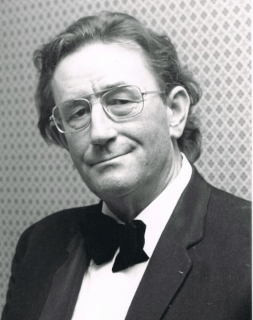

 seamus dubhghaill