seamus dubhghaill

Promoting Irish Culture and History from Little Rock, Arkansas, USA


Leave a comment

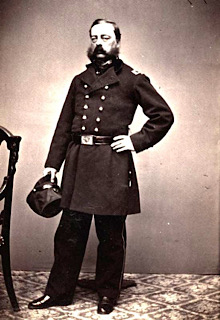
Death of Thomas Antisell, Physician, Scientist, Professor & Young Irelander

Thomas Antisell, physician, scientist, professor, and Young Irelander, dies in Washington, D.C., on June 14, 1893. He fights in the American Civil War, and serves as an advisor to the Japanese Meiji government.

Antisell is born in Dublin on January 16, 1817, the youngest son of Thomas Christopher Antisell KC (home circuit) and Margaret (née) Daly. He attends the Dublin School of Medicine, the Apothecaries’ Hall of Ireland, and the Royal College of Surgeons of England in London, graduating from the latter with an MD in November 1839. He studies chemistry in Paris and Berlin in 1844. Upon his return to Dublin in 1845, he secures a lectureship in botany at the Peter St. School of Medicine, teaching there until 1848. After this, he opens a clinic at his residence of 25 Richmond Street, Portobello. He works as an assistant to Robert Kane, and between 1845 and 1847, produces textbooks on Irish geology and chemistry. He becomes a member of the Royal Dublin Society (RDS) in 1844.

Antisell is a member of the Young Ireland movement of the 1840s, and joins the Irish Confederation in 1847. With a group of five friends in the republican movement, including Richard D’Alton Williams and Kevin O’Doherty, he sets up a short-lived revolutionary newspaper, The Irish Tribune, in June 1848 to take the place of the suppressed United Irishman, founded by John Mitchel. The paper is closed down on the grounds of sedition in July 1848 after just five issues. Following the closure of the paper, he emigrates to the United States, arriving in New York City on November 22, 1848. Some sources claim this departure is to evade arrest or charges relating to sedition. Although he is no longer politically active following his departure from Ireland, he is a close friend of John Mitchel and his family. He marries his first wife, Eliza Ann Nowlan, in 1841. She dies shortly after their arrival in the United States.

Antisell sets up and operates a clinic and medical laboratory in New York City from 1848 to 1854, while also lecturing in chemistry in a number of medical colleges in Massachusetts and Vermont. He takes up a post as expedition geologist and botanist on state surveys in southern ArizonaNew Mexico, and California, working primarily with Lt. John Parke investigating the proposed routes for the Southern Pacific Railroad from 1854 to 1856. His work on the geology of the region adds to greater understanding of the science in America. In 1856, he is employed as chief examiner in the U.S. Patent Office in Washington, D.C., with responsibility for chemical inventions. This work allows him to also lecture in chemistry at Georgetown University, eventually covering other subjects such as toxicology, military surgery, physiology, hygiene, and pathology, over the periods 1858 to 1869, and 1880 to 1882.

Breaking with Mitchel who, as defender of slavery, supports the southern secessionist cause, Antisell serves in the Union Army during the American Civil War. He is a brigade surgeon in the United States Volunteers from 1861, and later the medical director of the 12th army corps. He concludes his service as surgeon-in-charge of Harewood Hospital, Washington, D.C., in October 1865, being granted a brevet commission as colonel. From 1866 to 1871, he is chief chemist in the U.S. Department of Agriculture. He marries his second wife, Marion Stuart Forsyth from Detroit, in 1854. They go on to have twelve children, six daughters and six sons.

In 1848, Antisell is Professor of Chemistry at Berkshire Medical College in Pittsfield, Massachusetts. In 1854 he is Professor of Chemistry at the Medical College at Woodstock, Vermont. From 1869 to 1870 he is Professor of Chemistry at Maryland Agricultural College.

Antisell is one of several scientists that are hired in 1871 as foreign government advisors to work in Hokkaido in northern Japan under Horace Capron. He is selected for his strong background in chemistry coupled with geology. However, he disagrees with Capron on whether or not Hokkaido’s severe winter climate will hinder development, and he also comes into conflict with the Japanese government over his salary. As a result, Hokkaido Colonisation Office hires another geologist, and Antisell’s report is excluded in the 1875 compilation of official reports. He serves his remaining time in Japan as a chemist for the Ministry of Finance, where he develops inks used for the printing of paper currency. For his services, he is awarded the Order of the Rising Sun by Emperor Meiji before his departure in 1876.

Upon returning to the United States, Antisell is conferred with a PhD in 1876 by Georgetown University, and once again takes up duties at the Patent Office, remaining there until his retirement. He publishes widely in numerous journals on topics such as agricultural chemistry, botany, oceanography, city sanitation, and animal disease, but he does not publish a significant treatise.

Antisell dies in Washington, D.C., on June 14, 1893, and is buried in the Congressional Cemetery.


2 Comments

Death of Civil War Photographer Mathew Benjamin Brady

Mathew Benjamin Brady, one of the earliest photographers in American history and best known for his scenes of the American Civil War, dies in New York City on January 15, 1896.

Brady leaves little record of his life before photography. Speaking to the press in the last years of his life, he states that he was born between 1822 and 1824 in Warren County, New York, near Lake George. He is the youngest of three children to Irish immigrant parents, Andrew and Samantha Julia Brady. In official documents before and during the war, however, he claims to have been born in Ireland.

At age 16, Brady moves to Saratoga, New York, where he meets portrait painter William Page and becomes Page’s student. In 1839, the two travel to Albany, New York, and then to New York City, where he continues to study painting with Page, and also with Page’s former teacher, Samuel F. B. Morse. Morse had met Louis-Jacques-Mandé Daguerre in France in 1839 and returned to the United States to enthusiastically push the new daguerreotype invention of capturing images. At first, Brady’s involvement was limited to manufacturing leather cases that hold daguerreotypes. But soon he becomes the center of the New York artistic colony that wishes to study photography. Morse opens a studio and offers classes. Brady is one of the first students.

In 1844, Brady opens his own photography studio at the corner of Broadway and Fulton Street in New York, and by 1845, he begins to exhibit his portraits of famous Americans, including the likes of Senator Daniel Webster and poet Edgar Allan Poe. In 1849, he opens a studio at 625 Pennsylvania Avenue in Washington, D.C., where he meets Juliet Handy, whom he marries in 1850 and lives with on Staten Island. His early images are daguerreotypes, and he wins many awards for his work. In the 1850s ambrotype photography becomes popular, which gives way to the albumen print, a paper photograph produced from large glass negatives most commonly used in American Civil War photography.

In 1850, Brady produces The Gallery of Illustrious Americans, a portrait collection of prominent contemporary figures. The album, which features noteworthy images including the elderly Andrew Jackson at the Hermitage, is not financially rewarding but invites increased attention to his work and artistry. In 1854, Parisian photographer André-Adolphe-Eugène Disdéri popularizes the carte de visite and these small pictures rapidly become a popular novelty, with thousands being created and sold in the United States and Europe.

At first, the effect of the American Civil War on Brady’s business is a brisk increase in sales of cartes de visite to departing soldiers. He readily markets to parents the idea of capturing their young soldiers’ images before they might be lost to war by running an ad in The New York Daily Tribune. However, he is soon taken with the idea of documenting the war itself. He first applies to an old friend, General Winfield Scott, for permission to have his photographers travel to the battle sites, and eventually, he makes his application to President Abraham Lincoln himself. Lincoln grants permission in 1861, with the proviso that Brady finances the project himself.

His efforts to document the American Civil War on a grand scale by bringing his photographic studio onto the battlefields earns Brady his place in history. His first popular photographs of the conflict are at the First Battle of Bull Run, in which he gets so close to the action that he barely avoids capture. While most of the time the battle has ceased before pictures are taken, he comes under direct fire at the First Battle of Bull Run, Petersburg, and Fredericksburg.

Brady also employs Alexander Gardner, James Gardner, Timothy H. O’Sullivan, William Pywell, George N. Barnard, Thomas C. Roche, and seventeen other men, each of whom is given a traveling darkroom, to go out and photograph scenes from the American Civil War. He generally stays in Washington, D.C., organizing his assistants and rarely visiting battlefields personally.

This may be due, at least in part, to the fact that Brady’s eyesight has begun to deteriorate in the 1850s. Many of the images in Brady’s collection are, in reality, thought to be the work of his assistants. He is criticized for failing to document the work, though it is unclear whether it is intentional or due simply to a lack of inclination to document the photographer of a specific image. Because so much of his photography is missing information, it is difficult to know not only who took the picture, but also exactly when or where it was taken.

In October 1862 Brady opens an exhibition of photographs from the Battle of Antietam in his New York gallery, titled The Dead of Antietam. Many images in this presentation are graphic photographs of corpses, a presentation new to America. This is the first time that many Americans see the realities of war in photographs, as distinct from previous “artists’ impressions.”

Brady, through his many paid assistants, takes thousands of photos of American Civil War scenes. Much of the popular understanding of the Civil War comes from these photos. There are thousands of photos in the U.S. National Archives and Records Administration and the Library of Congress taken by him and his associates. The photographs include Lincoln, Ulysses S. Grant, and soldiers in camps and battlefields. The images provide a pictorial cross reference of American Civil War history. He is not able to photograph actual battle scenes, as the photographic equipment in the day is still in the infancy of its technical development and requires that a subject be still for a clear photo to be produced.

Following the conflict, a war-weary public loses interest in seeing photos of the war, and Brady’s popularity and practice decline drastically.

During the war, Brady spends over $100,000 (equivalent to $1,691,000 in 2020) to create over 10,000 plates. He expects the U.S. government to buy the photographs when the war ends. When the government refuses to do so he is forced to sell his New York City studio and go into bankruptcy. The United States Congress grants Brady $25,000 in 1875, but he remains deeply in debt. The public was unwilling to dwell on the gruesomeness of the war after it has ended, and so private collectors are scarce.

Depressed by his financial situation and loss of eyesight and devastated by the death of his wife in 1887, Brady dies penniless in the charity ward of Presbyterian Hospital in New York City on January 15, 1896, from complications following a streetcar accident. His funeral is financed by veterans of the 7th New York Infantry Regiment. He is buried in the Congressional Cemetery, which is located in Barney Circle, a neighborhood in the Southeast quadrant of Washington, D.C.

Brady photographs 18 of the 19 American presidents from John Quincy Adams to William McKinley. The exception is the 9th President, William Henry Harrison, who dies in office three years before Brady starts his photographic collection. He photographs Abraham Lincoln on many occasions. His Lincoln photographs have been used for the $5 bill and the Lincoln penny. One of his Lincoln photos is used by the National Bank Note Company as a model for the engraving on the 90c Lincoln Postage issue of 1869.

(Pictured: “Mathew B. Brady,” oil on canvas by Charles Loring Elliott, 1857, Metropolitan Museum of Art, New York)