seamus dubhghaill

Promoting Irish Culture and History from Little Rock, Arkansas, USA


Leave a comment

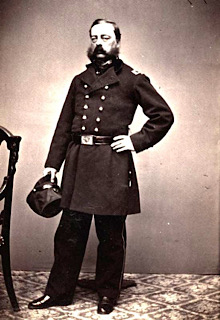
Death of Thomas Antisell, Physician, Scientist, Professor & Young Irelander

Thomas Antisell, physician, scientist, professor, and Young Irelander, dies in Washington, D.C., on June 14, 1893. He fights in the American Civil War, and serves as an advisor to the Japanese Meiji government.

Antisell is born in Dublin on January 16, 1817, the youngest son of Thomas Christopher Antisell KC (home circuit) and Margaret (née) Daly. He attends the Dublin School of Medicine, the Apothecaries’ Hall of Ireland, and the Royal College of Surgeons of England in London, graduating from the latter with an MD in November 1839. He studies chemistry in Paris and Berlin in 1844. Upon his return to Dublin in 1845, he secures a lectureship in botany at the Peter St. School of Medicine, teaching there until 1848. After this, he opens a clinic at his residence of 25 Richmond Street, Portobello. He works as an assistant to Robert Kane, and between 1845 and 1847, produces textbooks on Irish geology and chemistry. He becomes a member of the Royal Dublin Society (RDS) in 1844.

Antisell is a member of the Young Ireland movement of the 1840s, and joins the Irish Confederation in 1847. With a group of five friends in the republican movement, including Richard D’Alton Williams and Kevin O’Doherty, he sets up a short-lived revolutionary newspaper, The Irish Tribune, in June 1848 to take the place of the suppressed United Irishman, founded by John Mitchel. The paper is closed down on the grounds of sedition in July 1848 after just five issues. Following the closure of the paper, he emigrates to the United States, arriving in New York City on November 22, 1848. Some sources claim this departure is to evade arrest or charges relating to sedition. Although he is no longer politically active following his departure from Ireland, he is a close friend of John Mitchel and his family. He marries his first wife, Eliza Ann Nowlan, in 1841. She dies shortly after their arrival in the United States.

Antisell sets up and operates a clinic and medical laboratory in New York City from 1848 to 1854, while also lecturing in chemistry in a number of medical colleges in Massachusetts and Vermont. He takes up a post as expedition geologist and botanist on state surveys in southern ArizonaNew Mexico, and California, working primarily with Lt. John Parke investigating the proposed routes for the Southern Pacific Railroad from 1854 to 1856. His work on the geology of the region adds to greater understanding of the science in America. In 1856, he is employed as chief examiner in the U.S. Patent Office in Washington, D.C., with responsibility for chemical inventions. This work allows him to also lecture in chemistry at Georgetown University, eventually covering other subjects such as toxicology, military surgery, physiology, hygiene, and pathology, over the periods 1858 to 1869, and 1880 to 1882.

Breaking with Mitchel who, as defender of slavery, supports the southern secessionist cause, Antisell serves in the Union Army during the American Civil War. He is a brigade surgeon in the United States Volunteers from 1861, and later the medical director of the 12th army corps. He concludes his service as surgeon-in-charge of Harewood Hospital, Washington, D.C., in October 1865, being granted a brevet commission as colonel. From 1866 to 1871, he is chief chemist in the U.S. Department of Agriculture. He marries his second wife, Marion Stuart Forsyth from Detroit, in 1854. They go on to have twelve children, six daughters and six sons.

In 1848, Antisell is Professor of Chemistry at Berkshire Medical College in Pittsfield, Massachusetts. In 1854 he is Professor of Chemistry at the Medical College at Woodstock, Vermont. From 1869 to 1870 he is Professor of Chemistry at Maryland Agricultural College.

Antisell is one of several scientists that are hired in 1871 as foreign government advisors to work in Hokkaido in northern Japan under Horace Capron. He is selected for his strong background in chemistry coupled with geology. However, he disagrees with Capron on whether or not Hokkaido’s severe winter climate will hinder development, and he also comes into conflict with the Japanese government over his salary. As a result, Hokkaido Colonisation Office hires another geologist, and Antisell’s report is excluded in the 1875 compilation of official reports. He serves his remaining time in Japan as a chemist for the Ministry of Finance, where he develops inks used for the printing of paper currency. For his services, he is awarded the Order of the Rising Sun by Emperor Meiji before his departure in 1876.

Upon returning to the United States, Antisell is conferred with a PhD in 1876 by Georgetown University, and once again takes up duties at the Patent Office, remaining there until his retirement. He publishes widely in numerous journals on topics such as agricultural chemistry, botany, oceanography, city sanitation, and animal disease, but he does not publish a significant treatise.

Antisell dies in Washington, D.C., on June 14, 1893, and is buried in the Congressional Cemetery.

Leave a comment

Birth of John Kyan, Inventor in Wood Preservation

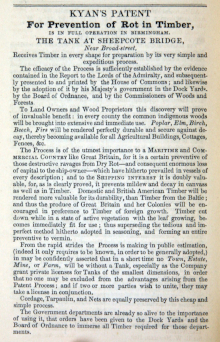
kyans-patent

John Howard Kyan, inventor of the ‘kyanising’ process for preserving wood, is born on November 27, 1774, in Dublin. His father, also John Howard Kyan, is the owner of valuable copper mines in County Wicklow. He is educated to take part in the management of the mines, but soon after he enters the company its fortunes decline, and in 1804 his father dies almost penniless.

For a time, Kyan is employed at some vinegar works at Newcastle upon Tyne, but subsequently removes to London. The decay of the timber supports in his father’s copper mines had already directed his attention to the question of preserving wood, and as early as 1812 he begins experiments with a view to discovering a method of preventing the decay. Eventually he finds that bichloride of mercury or corrosive sublimate, as it is commonly called, gives the best results and, without revealing the nature of the process, he submits a block of oak impregnated with the substance to the Admiralty in 1828. It is placed in the ‘fungus pit’ at Woolwich, where it remains for three years exposed to all the conditions favourable to decay. When taken out in 1831, it is found to be perfectly sound, and after further trials it still remains unaffected.

Kyan patents his discovery in 1832 (Nos. 8263 and 6309), extending the application of the invention to the preservation of paper, canvas, cloth, cordage, etc. A further patent is granted in 1836 (No. 7001).

The process attracts great attention. Michael Faraday chooses it as the subject of his inaugural lecture at the Royal Institution on February 22, 1833, on his appointment as Fullerian professor of chemistry. Dr. George Birkbeck gives a lecture upon it at the Royal Society of Arts on December 9, 1834, and in 1835 the Admiralty publishes the report of a committee appointed by the board to inquire into the value of the new method.

In 1836, Kyan sells his rights to the Anti-Dry Rot Company, an Act of Parliament being passed which authorises the raising of a capital of £250,000. Tanks are constructed at Grosvenor Basin, Pimlico, at the Grand Surrey Canal Dock, Rotherhide, and at the City Road Basin.

Among the early applications of the process is the kyanising of the palings around the Inner Circle, Regent’s Park, which is carried out in 1835 as an advertisement with small brass plates being attached to the palings at intervals stating that the wood has been submitted to the new process. The plates soon disappear, but the original palings still remain in good condition.

The timber used in building the Oxford and Cambridge Club, British Museum, Royal College of Surgeons, Westminster Bridewell, the new roof of the Temple Church, and the Ramsgate harbour works is also prepared by Kyan’s process. When wooden railway ties become general, a very profitable business for Kyan’s company is anticipated, and for a time these hopes are realised.

It becomes evident that iron fastenings cannot be used in wood treated with corrosive sublimate, on account of the corrosive action, and it is said that the wood becomes brittle. The salt is somewhat expensive and Sir William Burnett‘s method of preserving timber by zinc chloride, and afterwards the application of creosote for that purpose, proves severe competitors. Doubts begin to be expressed as to the real efficiency of kyanising, and the process gradually ceases to be employed.

John Kyan dies on January 5, 1850, in New York City, where he is engaged on a plan for filtering the water supplied to that city by the Croton Aqueduct.


Leave a comment

Death of the Irish Giant, Patrick Cotter O’Brien

Patrick Cotter O’Brien, the first of only seventeen people in medical history to stand at a verified height of eight feet or more, dies on September 8, 1806 in Bristol, England.

O’Brien is born in Kinsale, County Cork. His real name was Patrick Cotter and he adopts O’Brien as his stage name in the sideshow circus, claiming descent from the legendarily gigantic Brian Boru. He is also known as the Bristol Giant and the Irish Giant. Another giant of this period, Charles Byrne, also claims to be an O’Brien.

It is believed that O’Brien dies from the effects of the disease gigantism.

No hearse can be found to accommodate his nine foot four inch coffin encased in lead, and his remains are borne to the grave by relays of fourteen men. In his will, Cotter leaves £2,000 to his mother and requests that his body be entombed within twelve feet of solid rock in order to prevent exhumation for scientific or medical research.

O’Brien’s remains are exhumed three times – in 1906, 1972 and finally in 1986. In 1972 O’Brien’s remains are examined and it is determined that, while alive, he stood approximately 8 feet 1 inch (246 cm) tall. This makes him the tallest person ever at that time, a record that is surpassed by the next “eight-footer,” John Rogan, who dies almost a century later. O’Brien is subsequently reburied but in 1986, during a redevelopment in the area, his remains are again identified and then cremated after a church service. O’Brien’s giant boots are on display in the Kinsale Museum.

One of O’Brien’s arms is currently preserved in the Medical Museum of the Royal College of Surgeons of England in London.