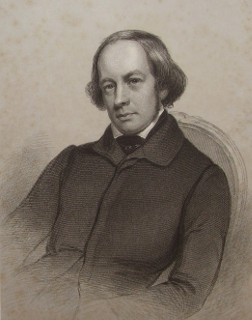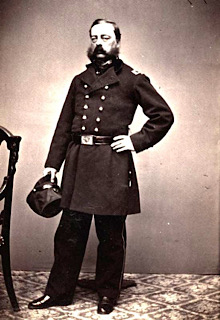
Thomas Antisell, physician, scientist, professor, and Young Irelander, dies in Washington, D.C., on June 14, 1893. He fights in the American Civil War, and serves as an advisor to the Japanese Meiji government.
Antisell is born in Dublin on January 16, 1817, the youngest son of Thomas Christopher Antisell KC (home circuit) and Margaret (née) Daly. He attends the Dublin School of Medicine, the Apothecaries’ Hall of Ireland, and the Royal College of Surgeons of England in London, graduating from the latter with an MD in November 1839. He studies chemistry in Paris and Berlin in 1844. Upon his return to Dublin in 1845, he secures a lectureship in botany at the Peter St. School of Medicine, teaching there until 1848. After this, he opens a clinic at his residence of 25 Richmond Street, Portobello. He works as an assistant to Robert Kane, and between 1845 and 1847, produces textbooks on Irish geology and chemistry. He becomes a member of the Royal Dublin Society (RDS) in 1844.
Antisell is a member of the Young Ireland movement of the 1840s, and joins the Irish Confederation in 1847. With a group of five friends in the republican movement, including Richard D’Alton Williams and Kevin O’Doherty, he sets up a short-lived revolutionary newspaper, The Irish Tribune, in June 1848 to take the place of the suppressed United Irishman, founded by John Mitchel. The paper is closed down on the grounds of sedition in July 1848 after just five issues. Following the closure of the paper, he emigrates to the United States, arriving in New York City on November 22, 1848. Some sources claim this departure is to evade arrest or charges relating to sedition. Although he is no longer politically active following his departure from Ireland, he is a close friend of John Mitchel and his family. He marries his first wife, Eliza Ann Nowlan, in 1841. She dies shortly after their arrival in the United States.
Antisell sets up and operates a clinic and medical laboratory in New York City from 1848 to 1854, while also lecturing in chemistry in a number of medical colleges in Massachusetts and Vermont. He takes up a post as expedition geologist and botanist on state surveys in southern Arizona, New Mexico, and California, working primarily with Lt. John Parke investigating the proposed routes for the Southern Pacific Railroad from 1854 to 1856. His work on the geology of the region adds to greater understanding of the science in America. In 1856, he is employed as chief examiner in the U.S. Patent Office in Washington, D.C., with responsibility for chemical inventions. This work allows him to also lecture in chemistry at Georgetown University, eventually covering other subjects such as toxicology, military surgery, physiology, hygiene, and pathology, over the periods 1858 to 1869, and 1880 to 1882.
Breaking with Mitchel who, as defender of slavery, supports the southern secessionist cause, Antisell serves in the Union Army during the American Civil War. He is a brigade surgeon in the United States Volunteers from 1861, and later the medical director of the 12th army corps. He concludes his service as surgeon-in-charge of Harewood Hospital, Washington, D.C., in October 1865, being granted a brevet commission as colonel. From 1866 to 1871, he is chief chemist in the U.S. Department of Agriculture. He marries his second wife, Marion Stuart Forsyth from Detroit, in 1854. They go on to have twelve children, six daughters and six sons.
In 1848, Antisell is Professor of Chemistry at Berkshire Medical College in Pittsfield, Massachusetts. In 1854 he is Professor of Chemistry at the Medical College at Woodstock, Vermont. From 1869 to 1870 he is Professor of Chemistry at Maryland Agricultural College.
Antisell is one of several scientists that are hired in 1871 as foreign government advisors to work in Hokkaido in northern Japan under Horace Capron. He is selected for his strong background in chemistry coupled with geology. However, he disagrees with Capron on whether or not Hokkaido’s severe winter climate will hinder development, and he also comes into conflict with the Japanese government over his salary. As a result, Hokkaido Colonisation Office hires another geologist, and Antisell’s report is excluded in the 1875 compilation of official reports. He serves his remaining time in Japan as a chemist for the Ministry of Finance, where he develops inks used for the printing of paper currency. For his services, he is awarded the Order of the Rising Sun by Emperor Meiji before his departure in 1876.
Upon returning to the United States, Antisell is conferred with a PhD in 1876 by Georgetown University, and once again takes up duties at the Patent Office, remaining there until his retirement. He publishes widely in numerous journals on topics such as agricultural chemistry, botany, oceanography, city sanitation, and animal disease, but he does not publish a significant treatise.
Antisell dies in Washington, D.C., on June 14, 1893, and is buried in the Congressional Cemetery.