seamus dubhghaill

Promoting Irish Culture and History from Little Rock, Arkansas, USA


Leave a comment

Death of Mochta of Louth, Disciple of St. Patrick

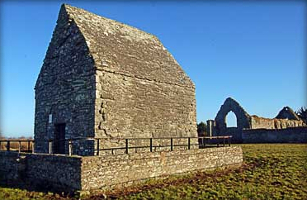
st-mochtas-house

Mochta of Louth, in Latin sources Maucteus or Mauchteus, the last surviving disciple of St. Patrick, dies on August 20, 535.

Mochta is, like Patrick, a native of Britain. His name is British and Adomnán‘s Life of Columba describes him as “a certain British stranger, a holy man and a disciple of the holy bishop Patrick.” Adomnán presents Mochta as having prophesied the birth of Colm Cille.

According to one account, Mochta is brought to Ireland as a child, along with his parents, by a druid named Hoam. The druid settles in County Louth, where Mochta is brought up as a member of the family. He goes to Rome to continue his studies and there the Pope consecrates him bishop and sends him back to Ireland with twelve companions. The first church he founds is at Kilmore. Departing from Kilmore, he leaves all his possessions to the monks, taking only “the fountain at the door.” He follows a stream, which becomes the River Fane, to Louth.

Mochta founds a monastery in Louth, originally the site of a shrine to the Celtic god Lugh. Mochta’s monastery gains a nationwide reputation. He is an accomplished scholar, especially learned in Sacred Scripture. He writes a rule for monks but no trace of it has survived. He begins a series of annals at Louth, which is continued by his successors, and becomes known as the Book of the Monks. In his old age, Patrick comes and spends some time with Mochta. After Patrick’s death, Mochta takes charge of Armagh for a brief period before turning it over to Benignus.

Both monastery and village are burned and plundered frequently by the Danes in the period 829-968. A round tower built for protection is blown down in 981. There are no physical remains of the early monastery. The ruined buildings at the site today (pictured) are the 13th century church of St. Mary’s Augustinian Priory and the stone roofed oratory known as St. Mochta’s House, which probably dates to the second half of the 12th century.

The Annals of Ulster report Mochta’s death twice, in 535 and 537, which indicates that he is considerably younger than Patrick, whose death the Annals date to 493. Scholars believe that he, the last of Patrick’s disciples then alive, dies at the age of 90. The entry for 535 dates his death to the 13th of the Calends of September, i.e. 20 August, and quotes the opening of a letter written by him: “Mauchteus, a sinner, priest, disciple of St. Patrick, sends greetings in the Lord.” However the remainder of this letter nor any other compositions of Mochta have survived.


Leave a comment

Death of Father Willie Doyle

father-willie-doyle

Father Willie Doyle, an Irish Jesuit priest, is killed in action on August 16, 1917, during the World War I.

Born William Joseph Gabriel Doyle in Dalkey, County Dublin, on March 3, 1873, Doyle is the youngest of seven children of Hugh and Christine Byrne Doyle. He is educated at Ratcliffe College, Leicester. After reading St. Alphonsus’ book Instructions and Consideration on the Religious State he is inspired to enter the priesthood and is ordained a Jesuit priest in 1907. He serves for five years on the mission staff.

Doyle serves in the Royal Army Chaplains’ Department of the British Army during World War I, appointed as a chaplain to 48 Brigade of the 16th Irish Division. During the Battle of Loos Doyle is caught in a German gas attack and for his conduct is mentioned in dispatches. A recommendation for a Military Cross is rejected as “he had not been long enough at the front.” Instead, Doyle is presented with the parchment of merit of the 49th Infantry Brigade (Irish). He is killed in the Battle of Langemarck, on August 16, 1917. Father Doyle’s body is never recovered but he is commemorated at Tyne Cot Memorial in Belgium.

General William Bernard Hickie, the commander-in-chief of the 16th Irish Division, describes Doyle as “one of the bravest men who fought or served out here.” Doyle is awarded the Military Cross for his bravery during the assault on the village of Ginchy. He is recommended for a posthumous Victoria Cross and Distinguished Service Order but is awarded neither. Doyle is proposed for canonisation in 1938, but this is not followed through.

A stained-glass window dedicated to his memory is present in St. Finnian’s Church, Dromin, County Louth.


Leave a comment

Oliver Plunkett Beatified by Pope Benedict XV

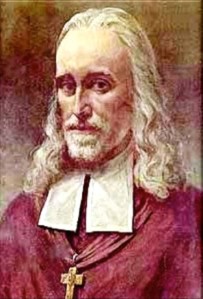
oliver-plunkett

Oliver Plunkett, Roman Catholic Archbishop of Armagh and Primate of All Ireland, is beatified by Pope Benedict XV on May 23, 1920.

Plunkett is born on November 1, 1625, in Loughcrew, County Meath, to well-to-do parents with Hiberno-Norman ancestors. He is ordained a priest in 1654 and deputed by the Irish bishops to act as their representative in Rome. Meanwhile, the Cromwellian conquest of Ireland (1649–1653) has defeated the Roman Catholic cause in Ireland. In the aftermath, the public practice of Roman Catholicism is banned, and Roman Catholic clergy are executed. As a result, it is impossible for Plunkett to return to Ireland for many years.

He eventually sets foot on Irish soil again on March 7, 1670, as the English Restoration of 1660 has begun on a basis of toleration. After arriving back in Ireland, he sets about reorganising the ravaged Roman Church and builds schools both for the young and for clergy, whom he finds “ignorant in moral theology and controversies.” The Penal Laws have been relaxed in line with the Declaration of Breda in 1660 and Plunkett is able to establish a Jesuit College in Drogheda in 1670.

On the enactment of the Test Act in 1673, to which Plunkett does not agree for doctrinal reasons, the college is closed and demolished. Plunkett goes into hiding, traveling only in disguise, and refusing a government edict to register at a seaport to await passage into exile. In 1678, the so-called Popish Plot, concocted in England by clergyman Titus Oates, leads to further anti-Roman Catholic action. Archbishop Peter Talbot of Dublin is arrested, and Plunkett again goes into hiding.

Despite being on the run and with a price on his head, Plunkett refuses to leave his flock. At some point before his final incarceration, he takes refuge in a church that once stood in the townland of Killartry, in the parish of Clogherhead in County Louth, seven miles outside Drogheda. He is arrested in Dublin in December 1679 and imprisoned in Dublin Castle. Plunkett is tried at Dundalk for conspiring against the state by allegedly plotting to bring 20,000 French soldiers into the country, and for levying a tax on his clergy to support 70,000 men for rebellion.

Plunkett is found guilty of high treason in June 1681 “for promoting the Roman faith” and is condemned to death. He is hanged, drawn, and quartered at Tyburn on July 1, 1681, the last Roman Catholic martyr to die in England.

Oliver Plunkett is beatified on May 23, 1920, and canonised in 1975, the first new Irish saint for almost seven hundred years, and the first of the Irish martyrs to be beatified. For the canonisation, the customary second miracle is waived. Plunkett has since been followed by 17 other Irish martyrs who were beatified by Pope John Paul II in 1992. Among them are Archbishop Dermot O’Hurley, Margaret Ball, and the Wexford Martyrs.