seamus dubhghaill

Promoting Irish Culture and History from Little Rock, Arkansas, USA


Leave a comment

Birth of Valentine Greatrakes, Faith Healer

valentine-greatrakes

Valentine Greatrakes, Irish faith healer also known as “Greatorex” or “The Stroker,” is born on February 14, 1628, at Affane, County Waterford. He toured England in 1666, claiming to cure people by the laying on of hands.

Greatrakes is the son of William Greatrakes and Mary, daughter of Sir Edward Harris, Chief Justice of Munster, who are English Protestants settlers. He goes to the free school at Lismore until he is 13 years of age and is designed for the college of Dublin. However, when the Irish Rebellion of 1641 breaks out, he and his mother flee into England, where he is received by his great uncle, Edmund Harris. After Harris dies, his mother places him with John Daniel Getsius, a German minister, of Stoke Gabriel, in Devonshire.

After five or six years in England, Greatrakes returns to his native country, which he finds in a distracted state, and therefore spends a year in contemplation at the Castle of Cappoquin. In 1649 he is a lieutenant in Lord Broghill‘s regiment in the English Parliamentary army in Ireland, then campaigning in Munster against the Irish Royalists. In 1656, with a great part of the army being disbanded, Greatrakes retires to Affine, his native place, and is made clerk of the peace for County Cork, Register for transplantation, and a Justice of the Peace. However, he loses these positions after the Restoration.

Greatrakes seems to have been very religious. His outlook is grave but simple. He says himself, that ever since the year 1662 he has felt a strange impulse or persuasion that he has the gift of curing the King’s evil. This suggestion becomes so strong, that he strokes several persons, and cures them.

Three years afterwards, an epidemical fever is raging in the country, he is again persuaded that he can also cure the fever. He makes the experiment, and he affirms to his satisfaction that he cures all who come to him. At length, in April 1665, another kind of inspiration suggests to him, that he has the gift of healing wounds and ulcers. He even finds that he cures convulsions, the dropsy, and many other distempers.

On April 6, 1665, Robert Phayre, a former Commonwealth Governor of County Cork, is living at Cahermore, in that county, when he is visited by Greatrakes, who had served in his regiment in 1649. Greatrakes cures Phayre in a few minutes of an acute ague. John Flamsteed, the famous astronomer, then aged 19, goes to Ireland in August 1665 to be touched by Greatrakes for a natural weakness of constitution, but receives no benefit. Crowds flock to him from all parts, and he performs such extraordinary cures, that he is summoned into the bishop’s court at Lismore, and, not having a licence for practising, is forbidden to lay hands on anyone else in Ireland.

In 1665, Greatrakes is invited to England by his old commander, Lord Broghill, now Earl of Orrery, to cure Anne, Viscountess Conway of an inveterate headache. He arrives in England in early 1666 but fails to cure the Viscountess. Undaunted, he travels through the country healing the sick.

King Charles II, being informed of it, summons Greatrakes to Whitehall. While unpersuaded that Greatrakes has miraculous power, the king does not forbid him to continue his ministrations.

Every day Greatrakes goes to a place in London where many sick persons, of all ranks in society, assemble. Pains, gout, rheumatism, convulsions, and so forth are allegedly driven by his touch from one body part to another. Upon reaching the extremities, all symptoms of these ailments cease. As the treatment consists entirely of stroking, Greatrakes is called The Stroker. He ascribes certain disorders to the work of evil spirits. When persons possessed by such spirits see Greatrakes or hear his voice, the afflicted fall to the ground or into violent agitation. He then proceeds to cure them by the same method of stroking. While many are skeptical, Greatrakes does find zealous advocates for the efficacy of his healing powers.

In 1667, Greatrakes returns to Ireland and resumes farming in 1668 on £1,000 a year. Although he lives for many years, he no longer keeps up the reputation of performing the strange cures which procured him a name. But in this his case is very singular, that on the strictest enquiry no sort of blemish is ever thrown upon his character, nor does any of those curious and learned persons, who espouse his cause, draw any imputation upon themselves.

Greatrakes dies on November 28, 1682, at Affane, County Waterford. It is believed that he may be buried in Lismore Church or under the aisle of the old Affane Church near to his father.


Leave a comment

Death of Saint Colmán of Cloyne

saint-colman

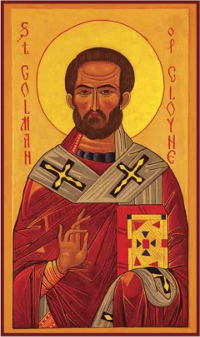
Saint Colmán of Cloyne, also known as Colmán mac Léníne, monk, founder, and patron of Cluain Uama, now Cloyne, County Cork, and one of the earliest known Irish poets to write in the vernacular, dies on November 24, 600.

Colmán is remembered as the founder of the monastery at Cluain Uama in Munster, which lay in the kingdom of the Uí Liatháin and the Uí Meic Caille, a sept of the former. The origin legend Conall Corc and the Corco Loígde claims that the land for the foundation is not given by the local king, but by Coirpre Cromm mac Crimthainn, who is king of Munster from the Eóganacht Glendamnach.

Cloyne appears to be his earliest settlement. The cathedral and round tower are situated on a limestone eminence in the midst of the valley, surrounded by rich meadows. In the rock is the cave extending in various branches underground to a great distance, from which the town derives its name. Here it is believed that Colmán took up his abode as a place of security. Colmán is also believed to have founded a monastery at what would become Killagha Abbey in County Kerry.

Colmán is credited with extraordinary poetic powers, being styled by his contemporaries “royal poet of Munster.” Several of his Irish poems are still extant, notably a metrical panegyric on Saint Brendan.

It is unclear whether Colmán is brought up as a Christian, but what is certain is that he is educated and becomes a bard or file, which requires a special education. As a member of the class of filí, he becomes attached to the court of Cashel where he remains until about the age of 48 years. In 570, he and Saint Brendan of Clonfert are said to have settled a dispute between rivals to the throne of Cashel and Aodh Caomh is acknowledged as king, the first Christian king of Cashel. The King is installed by Saint Brendan. During the time of the coronation Colmán and some others discover the lost shrine of Ailbhe of Emly. Brendan says that it is not right that the hands which have held this sacred relic should be defiled henceforth, thus it is that the son of Leinin offers himself to God. Brendan blesses him and gives him the name Colmán, which is a diminutive of Colm.

Colmán then goes to the school of Saint Iarlaithe of Tuam and after his studies he is next mentioned as preaching to the heathen population in the east of County Cork. He is described as a “religious and holy presbyter, who afterwards became a famous bishop.” The Prince of Déise, in the present county of Waterford, presents his child to Colmán for baptism. Colmán baptizes him Declán and urges his parents to educate him well in his faith. This child becomes Saint Declán of Ardmore.

Colmán is given churches in Erry and Killenaule by Coirpre Cromm mac Crimthainn, King of Munster (Cashel), as well as lands in Cloyne, County Cork. It may well be that the lands in Cloyne are conquered lands and to prevent the possibility of reconquest are given to the church. The Cloyne estate is large and contains some of the best land in the area.

After the king’s death (c. 580) Colmán somehow becomes involved in factional strife between Coirpre’s descendants in which some of them persecute him while others, the ancestors of the later dominant line, protect him.

His surviving verses date from the period 565 and 604, and are among the earliest examples of Irish writing in the Latin alphabet. He is commonly thought to have composed Luin oc laib, a poem in praise of Domnall mac Muirchertaig, king of Tara, and another poem on the death of Áed Sláine, king of the UÍ Néill. The latter poem has not survived complete.

Colmán dies on November 24, 600, and is likely buried is Cloyne, where he may have left a school of poetry in existence. The calendars are unanimous in dating his death on November 24, now his feast day.


Leave a comment

Ernest Walton Awarded Nobel Prize for Physics

ernest-walton

Ernest Thomas Sinton Walton, Irish physicist, is awarded the Nobel Prize in Physics on November 15, 1951, for his work with John Cockcroft with “atom-smashing” experiments done at Cambridge University in the early 1930s, and so becomes the first person in history to artificially split the atom.

Walton is born on October 6, 1903, in Abbeyside, Dungarvan, County Waterford to a Methodist minister father, Rev John Walton and Anna Sinton. In those days a general clergyman’s family moves once every three years, and this practice carries Ernest and his family to Rathkeale, County Limerick, and to County Monaghan. He attends day schools in counties Down and Tyrone, and at Wesley College Dublin before becoming a boarder at Methodist College Belfast in 1915, where he excels in science and mathematics.

In 1922, Walton wins scholarships to Trinity College, Dublin for the study of mathematics and science. He is awarded bachelor’s and master’s degrees from Trinity in 1926 and 1927, respectively. Walton receives seven prizes for excellence in physics and mathematics, including the Foundation Scholarship in 1924. Following graduation he is awarded an 1851 Research Fellowship from the Royal Commission for the Exhibition of 1851 and is accepted as a research student at Trinity College, Cambridge, under the supervision of Sir Ernest Rutherford, Director of Cambridge University’s Cavendish Laboratory. At the time there are four Nobel Prize laureates on the staff at the Cavendish lab and a further five are to emerge, including Walton and John Cockcroft. Walton is awarded his PhD in 1931 and remains at Cambridge as a researcher until 1934.

During the early 1930s, Walton and John Cockcroft collaborate to build an apparatus that splits the nuclei of lithium atoms by bombarding them with a stream of protons accelerated inside a high-voltage tube. The splitting of the lithium nuclei produces helium nuclei. This is experimental verification of theories about atomic structure that have been proposed earlier by Rutherford, George Gamow, and others. The successful apparatus, a type of particle accelerator now called the Cockcroft-Walton generator, helps to usher in an era of particle-accelerator-based experimental nuclear physics. It is this research at Cambridge in the early 1930s that wins Walton and Cockcroft the Nobel Prize in physics in 1951.

Walton is associated with the Dublin Institute for Advanced Studies for over 40 years, serving long periods on the board of the School of Cosmic Physics and on the Council of the Institute. Following the 1952 death of John J. Nolan, the inaugural chairman of the School of Cosmic Physics, Walton assumes the role, and serves in that position until 1960, when he is succeeded by John H. Poole.

Although he retires from Trinity College Dublin in 1974, he retains his association with the Physics Department at Trinity up to his final illness. His is a familiar face in the tea-room. Shortly before his death he marks his lifelong devotion to Trinity by presenting his Nobel medal and citation to the college. Ernest Walton dies in Belfast on June 25, 1995, aged 91. He is buried in Dean’s Grange Cemetery, Dún Laoghaire–Rathdown.


Leave a comment

Death of Saint Mo Chutu mac Fínaill

sts-carthage-catherine-patrick

Saint Mo Chutu mac Fínaill, also known as Carthach or Carthach the Younger (a name Latinized as Carthagus and Anglicized as Carthage), dies on May 14, 637. Mo Chutu is abbot of Rahan, County Offaly and subsequently, founder and first abbot of Lismore, County Waterford.

Through his father, Fínall Fíngein, Mo Chutu belongs to the Ciarraige Luachra, while his mother, Finmed, is of the Corco Duibne. Notes added to the Félire Óengusso, the Martyrology of Óengus, claim that his foster father is Carthach mac Fianáin, also known as Carthach the Elder, whose period of activity can be assigned to the late 6th century.

Mo Chutu first becomes abbot of Rahan, a monastery which lays in the territory of the southern Uí Néill. He composes a rule for his monks, an Irish metrical poem of 580 lines, divided into nine separate sections, a notable literary relic of the early Irish Church.

According to the Annals of Ulster, he is expelled from the monastery during the Easter season of 637. The incident is connected with the Easter controversy in which Irish churches are involved during the 7th century. Through his training in Munster, Mo Chutu is possibly a supporter of the Roman system of calculation, which likely brought him into conflict with adherents of the “Celtic” reckoning in Leinster.

Following his expulsion, Mo Chutu journeys to the Déisi, where he founds the great monastery of Lismore in modern day County Waterford. The Latin and Irish lives make very little of Mo Chutu’s earlier misfortune and focus instead on the saint’s resistance to the oppressive Uí Néill rulers and his joyous reception among the Déisi. He is portrayed in a heroic light in Indarba Mo Chutu a r-Raithin (The expulsion of Mo Chutu from Rahan).

His foundation at Lismore flourishes after his lifetime, eclipsing the reputation of the saint’s earlier church. It is able to withstand the Viking depredations which plague the area and benefit from the generosity of Munster kings, notably the Mac Carthaig of Desmond. In the 12th century, St. Déclán‘s foundation of Ardmore aspires to the status of episcopal see in the new diocese, but the privilege goes instead to Lismore.

His feast day in the Irish martyrologies is May 14, as well as in the Great Synaxaristes of the Orthodox Church. In the present calendar of the Catholic Church in Ireland, in which May 14 is the feast of Saint Matthias, the memorial of Saint Carthage is celebrated on May 15.

The photograph above is from an altar tomb of 1543 in St. Carthage’s cathedral in Lismore and depicts Mo Chutu along with St. Catherine and St. Patrick.


Leave a comment

The Burgery Ambush in County Waterford

burgery-ambush

The Burgery Ambush takes place during the Irish War of Independence on the night of March 18, 1921 near Dungarvan, County Waterford.

A British military convoy of Black and Tans and including a Royal Irish Constabulary Sergeant named Michael Hickey, sets off from Dungarvan Castle on the night of March 18, heading east for the coastal village of Clonea. Their goal that night is the arrest of Irish Republican Army (IRA) volunteer John Murphy, who has been involved in gun running between Clonmel, County Tipperary, and Dungarvan.

Irish Republican Army volunteers of the West Waterford flying column have plans that night to demolish Tarr’s Bridge over the Colligan River between Dungarvan and the Abbeyside. However, when they receive word of the British convoy heading east out of Dungarvan, a last-minute action is organized by the Active Service Unit (ASU) to intercept it on its way back to Dungarvan.

The IRA volunteers ambush the convoy at the Burgery, about a mile and a half northeast of Dungarvan. In overall command of the IRA unit is IRA General Headquarters (GHQ) Officer George Plunkett. Also present are West Waterford Brigade Commandant Pax Whelan, Active Service Unit (ASU) leader George Lennon, and Mick Mansfield.

A British Crossley tender is set on fire and prisoners are taken by the IRA, including Sergeant Hickey. Early on the morning of March 19, Hickey is executed by an IRA firing squad with a sign reading “police spy” affixed to his tunic. Hickey is later buried in an unmarked grave. Other prisoners, including Captain DV Thomas, the commander of the British garrison, are released.

After the ambush, a group of volunteers under Plunkett return to search for any armaments left behind by the British forces. Crown forces who are now searching the area engage the IRA party. IRA volunteers Seán Fitzgerald and Pat Keating are shot dead. Constable Sydney R. Redman, a Black and Tan, is shot dead during the return fire.