seamus dubhghaill

Promoting Irish Culture and History from Little Rock, Arkansas, USA


Leave a comment

The Beginning of the 1916 Easter Rising

proclamation-of-independence

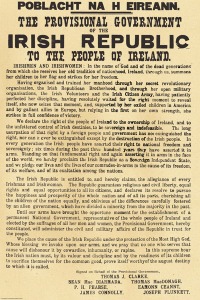
The Easter Rising, also known as the Easter Rebellion, begins in Dublin on April 24, 1916, and lasts for six days. The Rising, organised by seven members of the Military Council of the Irish Republican Brotherhood, is launched to end British rule in Ireland and establish an independent Irish Republic while the United Kingdom is heavily engaged in World War I. It is the most significant uprising in Ireland since the Irish Rebellion of 1798, and the first armed action of the Irish revolutionary period.

Shortly before midday, members of the Irish Volunteers, led by schoolmaster and Irish language activist Patrick Pearse and joined by the smaller Irish Citizen Army of James Connolly and 200 women of Cumann na mBan, seize key locations in Dublin and proclaim an Irish Republic. The rebels’ plan is to hold Dublin city centre, a large, oval-shaped area bounded by the Grand Canal to the south and the Royal Canal to the north, with the River Liffey running through the middle.

The rebels march to the General Post Office (GPO) on O’Connell Street, Dublin’s main thoroughfare, and occupy the building and hoist two republican flags. Pearse stands outside and reads the Proclamation of the Irish Republic.

Elsewhere in Dublin, some of the headquarters battalion under Michael Mallin occupy St. Stephen’s Green, where they dig trenches and barricade the surrounding roads. The 1st battalion, under Edward “Ned” Daly, occupy the Four Courts and surrounding buildings, while a company under Seán Heuston occupies the Mendicity Institution across the River Liffey from the Four Courts. The 2nd battalion, under Thomas MacDonagh, occupies Jacob’s Biscuit Factory. The 3rd battalion, under Éamon de Valera, occupy Boland’s Mill and surrounding buildings. The 4th battalion, under Éamonn Ceannt, occupy the South Dublin Union and the distillery on Marrowbone Lane. From each of these garrisons, small units of rebels establish outposts in the surrounding area.

There are isolated actions in other parts of Ireland, with attacks on the Royal Irish Constabulary barracks at Ashbourne, County Meath and in County Galway, and the seizure of the town of Enniscorthy, County Wexford. Due to a last-minute countermand issued on Saturday, April 22, by Volunteer leader Eoin MacNeill, the number of rebels who mobilise is much lower than expected.

The British Army brings in thousands of reinforcements as well as artillery and a gunboat. There is fierce street fighting on the routes into the city centre, where the rebels put up stiff resistance, slowing the British advance and inflicting heavy casualties. Elsewhere in Dublin, the fighting mainly consists of sniping and long-range gun battles. The main rebel positions are gradually surrounded and bombarded with artillery.

With much greater numbers and heavier weapons, the British Army suppresses the Rising, and Pearse agrees to an unconditional surrender on Saturday, April 29. Almost 500 people are killed during Easter Week. About 54% are civilians, 30% are British military and police, and 16% are Irish rebels. More than 2,600 are wounded. Many of the civilians are killed as a result of the British using artillery and heavy machine guns, or mistaking civilians for rebels. Others are caught in the crossfire in a crowded city. The shelling and the fires leave parts of inner-city Dublin in ruins.

After the surrender the country remains under martial law. About 3,500 people are taken prisoner by the British, many of whom have played no part in the Rising, with 1,800 of them being sent to internment camps or prisons in Britain. Most of the leaders of the Rising are executed following courts-martial. The Rising brings physical force republicanism back to the forefront of Irish politics, which for nearly 50 years has been dominated by constitutional nationalism. It, and the British reaction to it, leads to increased popular support for Irish independence. In December 1918, republicans, represented by the reconstituted Sinn Féin party, win a landslide victory in the general election to the British Parliament. They do not take their seats but instead convene the First Dáil and declare the independence of the Irish Republic, which ultimately leads to the Irish War of Independence.


Leave a comment

John Redmond Elected Leader of the Irish Parliamentary Party

john-redmond-1917

John Edward Redmond, Irish nationalist politician, barrister, and Member of Parliament (MP) in the British House of Commons, is elected leader of the Irish Parliamentary Party on February 6, 1900.

Redmond is born at Ballytrent House, his grandfather’s old family mansion, in Kilrane, County Wexford. As a student at Clongowes Wood College, he exhibits the seriousness that many soon come to associate with him. After finishing at Clongowes, Redmond attends Trinity College, Dublin to study law, but his father’s ill health leads him to abandon his studies before taking a degree and, in 1876, goes to live with him in London. As a clerk in the House of Commons he increasingly identifies himself with the fortunes of Charles Stewart Parnell, one of the founders of the Irish Land League.

Redmond first attends political meetings with Parnell in 1879. Upon the death of his father, a Member of Parliament for Wexford, in 1880, Redmond writes to Parnell asking for adoption as the Nationalist Party, which becomes the Irish Parliamentary Party in 1882, candidate in the by-election to fill the open seat, but is disappointed to learn that Parnell has already promised the next vacancy to his secretary Timothy Healy. When a vacancy arises in New Ross, he wins election unopposed as the Parnellite candidate for the seat. He served as MP for New Ross from 1881 to 1885, for North Wexford from 1885 to 1891 and finally for Waterford City from 1891 until his death in 1918.

In 1890, the Irish Parliamentary Party splits over Parnell’s leadership when his long-standing adultery with Katharine O’Shea is revealed in a spectacular divorce case. Redmond stands by Parnell and works to keep the minority faction active. When Parnell dies in 1891, Redmond takes over leadership of the Parnellite faction of the split party, called the Irish National League (INL). The larger anti-Parnellite group forms the Irish National Federation (INF) under John Dillon.

Through the initiative of William O’Brien and his United Irish League (UIL), the INL and the INF re-unite on February 6, 1900, within the Irish Parliamentary Party. Redmond is elected its chairman, a position he holds until his death in 1918, a longer period than any other nationalist leader with the exceptions of Éamon de Valera and Daniel O’Connell.

The achievement of Home Rule is his life’s goal, having strongly supported William Gladstone’s Home Rule bills of 1886 and 1893. His best opportunity arises when the Irish Parliamentary Party holds the balance of power under H. H. Asquith in the period from 1910 onwards.  Opposition by the Ulster Unionists frustrates his plans, his main worry being that Home Rule will result in the permanent exclusion of at least some of the Ulster counties. He also fears that the activities of the Irish Volunteers might hinder the enactment of Home Rule. To guard against this eventuality, he secures the control of the organisation in June 1914.  He welcomes the Government of Ireland Act, 1914 as the only measure of Home Rule then possible. Its suspension for the duration of the war postpones addressing the issue of partition.

To ensure the success of the war effort and the speedier implementation of Home Rule, Redmond offers the services of the Irish Volunteers for the defence of the country, an offer rejected by the government. By encouraging the Volunteers to join the British army, he splits the organisation. The vast majority, totaling 170,000 and thereafter known as the National Volunteers, follow Redmond, many of them enlisting in the British army.  Those who aspire to an Irish republic or who have lost faith in Home Rule remain as the Irish Volunteers, their numbers now reduced to about 10,000.

Consequently, the 1916 Easter Rising takes him completely by surprise. Committed to keeping Ireland within the Union, he regards the Rising as treason and a “German intrigue.”  He has no sympathy with the leaders or their objective of a republic.  Nevertheless, he pleads for leniency in the House of Commons.

An operation in March 1918 to remove an intestinal obstruction appears to progress well at first, but then he suffers heart failure. He dies a few hours later at a London nursing home on March 6, 1918. One of the last things he says to the Jesuit Father who is with him to the end is, “Father, I am a broken-hearted man.”