seamus dubhghaill

Promoting Irish Culture and History from Little Rock, Arkansas, USA


2 Comments

The Battle of Foulksmills

During the Irish Rebellion of 1798, the Battle of Foulksmills, known locally as the Battle of Horetown and also known as the Battle of Goff’s Bridge, takes place on June 20, 1798 between advancing British forces seeking to stamp out the rebellion in County Wexford and a rebel army assembled to oppose them.

By June 19 the threat of the United Irish rebellion spreading outside County Wexford had been largely contained and Crown forces were positioned to move against rebel held territory. A force of about 1,500 men under Sir John Moore move out of New Ross toward Wexford as part of an overall encirclement operation in conjunction with General Gerard Lake‘s forces moving from the north.

Moore’s force is to link up and combine with the isolated garrison holding Duncannon before moving deeper into County Wexford, but after waiting several hours with no sign of their arrival, Moore decides to press ahead to the village of Taghmon alone. Upon nearing Goff’s Bridge at Foulkesmill, his scouts report a rapidly moving rebel force of some 5,000 moving along the road with the intent to give battle. Moore despatches a force of riflemen from the 60th Regiment to hold the bridge until artillery can be brought up in support.

The rebels however, led by Father Philip Roche, spot this move and move away from the road to the high ground on the left intending to outflank Moore’s force. The 60th are forced to engage the rebels on the roads, fields and forests of the area and the rebel flanking move briefly threatens to overturn Moore’s left. Moore has to personally rally his fleeing troops to hold the line and lead them in a successful counter-attack. As more troops begin to arrive the rebels are flushed out of their concealed positions, allowing the artillery to be brought into play and the rebels’ move is foiled. The rebels are gradually pushed back field by field but are able to withdraw the bulk of their force safely.

The road to Wexford is opened and the town recaptured by the Crown the next day but during this battle followers of rebel captain Thomas Dixon massacre up to 100 loyalist prisoners at Wexford bridge.

Casualties are estimated at 500 on the rebel side and 100 of the military.


Leave a comment

Birth of Brian Coffey, Poet & Publisher

Brian Coffey, Irish poet and publisher, is born in Dún LaoghaireCounty Dublin on June 8, 1905. His work is informed by his Catholicism and by his background in science and philosophy, and his connection to surrealism. For these reasons, he is seen as being closer to an intellectual European Catholic tradition than to mainstream Irish Catholic culture.

Coffey attends the Mount St. Benedict boarding school in GoreyCounty Wexford from 1917 to 1919 and then Clongowes Wood College, in ClaneCounty Kildare from 1919 until 1922. In 1923, he goes to France to study for the Bachelor’s degree in Classical Studies at the Institution St. Vincent, SenlisOise. While still at college, Coffey begins writing poetry. He publishes his first poems in University College Dublin‘s The National Student under the pseudonym Coeuvre.

In the early 1930s, Coffey moves to Paris where he studies Physical Chemistry under Jean Baptiste Perrin, who won the Nobel Prize for Physics in 1926. He completes these studies in 1933, and his Three Poems is printed in Paris by Jeanette Monnier that same year. In 1934 he enters the Institut Catholique de Paris to work with the noted French philosopher Jacques Maritain, taking his licentiate examination in 1936. He then moves to London for a time and contributes reviews and a poem to T.S. Eliot‘s The Criterion magazine. He returns to Paris in 1937 as an exchange student to work on his doctoral thesis on the idea of order in the work of Thomas Aquinas. In 1938, Coffey’s second volume of poetry, Third Person, is published by George Reavey‘s Europa Press.

During the war, Coffey teaches in schools in London and Yorkshire, leaving his young family in Dublin. After the war, he returns to Paris and completes his doctoral thesis. The family then moves so that Coffey can take up a teaching post at the Jesuit Saint Louis University.

By the early 1950s, Coffey becomes uncomfortable for a number of reasons, including the nature of his work, his distance from Ireland and the pressures that inevitably come to bear on an academic who has previously associated with well-known left-wing writers in Paris. For these reasons, he resigns in 1952.

In 1952, Coffey returns to live in London and, from 1973, Southampton. He begins again to publish his poetry and translations, mainly of French poetry. The first work in English to appear after this period of silence is Missouri Sequence, apparently begun in St. Louis but first appearing in the University Review, later known as the Irish University Review, in 1962.

Over the next decade or so, he publishes regularly in the University Review. He also sets up his own publishing enterprise, Advent Press, which publishes work by himself and by younger writers he wants to support.

Brian Coffey dies at the age of 89 on April 14, 1995, and is buried in Southampton, England.


Leave a comment

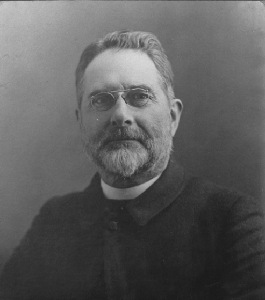
Birth of William Frederick Archdall Ellison, Clergyman & Astronomer

Reverend William Frederick Archdall Ellison FRAS, Irish clergymanHebrew scholar, organist, avid amateur telescope maker, and, from 1918 to 1936, director of Armagh Observatory in ArmaghNorthern Ireland, is born on April 28, 1864. He is the father of Mervyn A. Ellison, the senior professor of the School of Cosmic Physics at Dunsink Observatory from 1958 to 1963.

Ellison comes from a clerical family, his father Humphrey Eakins Ellison having been Dean of FernsCounty Wexford. He gains a sizarship of classics at Trinity College, Dublin in 1883, becomes a Scholar of the House in 1886 and graduates in 1887 with junior moderatorships in classics and experimental science. In 1890 he takes Holy Orders and moves to England, where he becomes the Curate of Tudhoe and Monkwearmouth. In 1894 he takes his MA and BD degrees and in the following year wins the Elrington Theological Prize.

In 1899 he returns to Ireland to become secretary of the Sunday School Society, a post which he holds for three years before accepting the incumbency of Monart, Enniscorthy, moving in 1908 to become Rector of Fethard-on-Sea with Tintern in Wexford. Ellison develops an interest in astronomy, having been introduced to practical optics by Dr. N. Alcock of Dublin and sets up his first observatory at Wexford. He becomes highly adept at making lenses and mirrors and writes several books and articles on the subject, including major contributions to the Amateur Telescope Making series, the Journal of the British Astronomical Association, and the weekly newspaper The English Mechanic. His book The Amateur’s Telescope (1920) is still considered a standard for telescope-makers and a forerunner of the more extensive series on the same topic by Albert Graham Ingalls.

On September 2, 1918 Ellison is appointed Director of the Armagh Observatory. He finds the Observatory in a state of disrepair and sets about repairing the instruments and the observatory dome. On January 3, 1919 he deeds a telescope of his own to the observatory, an 18-inch reflecting telescope, which is still there.

Ellison is a highly regarded planetary and binary star observer. Working with his son Mervyn, he makes many measurements of binary stars using the observatory’s 10-inch Grubb refracting telescope and even discovers a new one close to Beta Lyrae, and according to Patrick Moore, is one of the few people to have observed an eclipse of Saturn’s moon Iapetus by Saturn’s outermost ring on February 28, 1919.

In 1934 Ellison becomes Canon and Prebendary of BallymoreArmagh Cathedral. He dies on December 31, 1936, having held the office of Director of the observatory for nearly twenty years.


Leave a comment

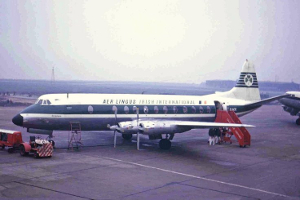
The Crash of Aer Lingus Flight 712

Aer Lingus Flight 712 crashes enroute from Cork to London on March 24, 1968 killing all 61 passengers and crew. The aircraft, a Vickers Viscount 803 named “St. Phelim,” crashes into the sea off Tuskar RockCounty Wexford. Although the investigation into the crash lasts two years, a cause is never determined. There has long been popular speculation that the aircraft was shot down by a British experimental missile. Aberporth in west Wales is at the time the most advanced British missile testing station.

The flight leaves Cork Airport at 10:32 AM for London. The flight proceeds normally until a call is heard with the probable contents “twelve thousand feet descending spinning rapidly.” There is no further communications with the aircraft and London ATC informs Shannon ATC that they have no radio contact with EI-AOM. London ATC requests Aer Lingus Flight EI 362, flying a Dublin to Bristol route, to search west of Strumble. This search at 500 feet in good visibility turns up nothing. At 11:25 AM a full alert is declared. By 12:36 PM there is a report of wreckage sighted at position 51°57′N, 06°10′W. Searching aircraft, however, find nothing and the report is cancelled. Aircraft and ships from the UK resume the search the following day and wreckage is sighted and bodies are recovered 6 nautical miles northeast of Tuskar Rock with more wreckage scattered an additional 6 nautical miles to the northwest.

Thirteen bodies are recovered over the next few days. Another body is recovered later. The main wreckage is located on the sea bed by trawling 1.72 nautical miles from Tuskar Rock at 39 fathoms.

In the years since the crash several witnesses have come forward with evidence to support the missile theory, including a crew member of the British ship HMS Penelope. He alleges that part of the wreckage was recovered by Penelope and removed to the UK.

An investigation report is produced in 1970, a review is undertaken between 1998 and 2000, and an independent study is commissioned in 2000.

However, in 2002 a review process conducted by the Air Accident Investigation Unit (AAIU) discloses that Aer Lingus paperwork relating to a routine maintenance inspection carried out on the aircraft in December 1967 is found to be missing in 1968. Moreover, a large body of research is done by the investigators after the accident, regarding the maintenance operating plan used for EI-AOM and defects on the aircraft found during analysis of the maintenance records. This research is not referred to in the 1970 report. A new board of investigation is set up by the Irish Government and finds that the crash is the consequence of a chain of events starting with a failure to the left tail-plane caused by metal fatigue, corrosion, flutter, or a bird strike, with the most likely cause being a flutter-induced fatigue failure of the elevator trim tab operating mechanism.

In March 2007 retired RAF Squadron Leader Eric Evers, who is previously chief flying instructor with the British military in RAF Little Rissington, makes a claim that the accident is in fact caused by a mid-air collision between the Aer Lingus Vickers Viscount and a French-built  Fouga Magister military aircraft which is training with the Irish Air Corps. Evers maintains that both the French and Irish authorities colluded in a subsequent cover-up, and the Magister wreckage may still be on the seabed. Evers claims have been largely disputed.

Aer Lingus still uses this flight number for a daily flight from Cork to London’s Heathrow Airport, contrary to airline convention of discontinuing a flight number following a crash. The route is operated with an aircraft from the Airbus A320 family.


Leave a comment

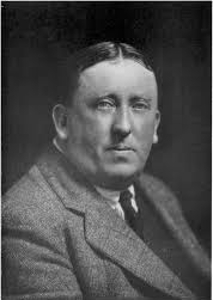
Birth of Patrick Joseph McCall, Songwriter & Poet

patrick-joseph-mccall

Patrick Joseph McCall, Irish songwriter and poet known mostly as the author of lyrics for popular ballads, is born at 25 Patrick Street in Dublin on March 6, 1861. He is assisted in putting the Wexford ballads, dealing with the Irish Rebellion of 1798, to music by Arthur Warren Darley using traditional Irish airs. His surname is one of the many anglicizations of the Irish surname Mac Cathmhaoil, a family that were chieftains of Kinel Farry (Clogher area) in County Tyrone.

McCall is the son of John McCall (1822-1902), a publican, grocer, and folklorist from Clonmore near Hacketstown in County Carlow. He attends St. Joseph’s Monastery, Harold’s Cross, a Catholic University School.

He spends his summer holidays in Rathangan, County Wexford, where he spends time with local musicians and ballad singers. His mother came from Rathangan near Duncormick on the south coast of County Wexford. His aunt Ellen Newport provides much of the raw material for the songs and tunes meticulously recorded by her nephew. He also collects many old Irish airs but is probably best remembered for his patriotic ballads. Airs gathered at rural céilí and singsongs are delivered back to the Royal Irish Academy in Dublin.

He contributes to the Dublin Historical Record, the Irish Monthly, The Shamrock, and Old Moore’s Almanac (under the pseudonym Cavellus). He is a member of the group in Dublin which founds the National Literary Society and becomes its first honorary secretary.

He marries Margaret Furlong, a sister of the poet Alice Furlong, in 1901. They live in the suburb of Sutton, near Howth.

In 1902 he is elected as a Dublin City councillor, defeating James Connolly, and serves three terms. As a councillor he concerns himself with local affairs, particularly projects to alleviate poverty.

Patrick Joseph McCall dies on March 5, 1919, one day before his 58th birthday, in Sutton, Fingal, Dublin.


2 Comments

Birth of Padraic Fallon, Poet & Playwright

padraic-fallon

Padraic Fallon, Irish poet and playwright, is born in Athenry, County Galway, on January 3, 1905.

Fallon’s upbringing and his early impressions of Athenry and the surrounding landscape are intimately described in his poetry. After passing the civil service exams in 1923 he moves to Dublin to work in the Customs House. In Dublin he becomes part of the circle of George William Russell (Æ) who encourages his literary ambitions and arranges for the publication of his early poetry. His early poetry, short stories, and literary criticism are published in The Dublin Magazine and The Bell.

He forms close friendships with Seumas O’Sullivan, editor of The Dublin Magazine, the poets Austin Clarke, Robert Farren, F.R. Higgins, and Patrick McDonagh and later the novelist James Plunkett. In 1939, Fallon leaves Dublin to serve as a Customs official in County Wexford, living in Prospect House, near Wexford Town with his wife, Dorothea (née Maher) and his six sons. During this time, he becomes a close friend of the painter Tony O’Malley.

Fallon is a regular contributor to Radio Éireann in the 1940s and 1950s, serving variously as a journalist, scriptwriter, and literary critic. A number of his short stories and early dramatic pieces are broadcast by the station during the 1940s. The first of Fallon’s verse plays for radio, Diarmuid and Gráinne, is broadcast by Radio Éireann in November 1950. This is followed by The Vision of Mac Conglinne (1953), Two Men with a Face (1953), The Poplar (1953), Steeple Jerkin (1954), A Man in the Window (1955), Outpost (1955), The Wooing of Étain (1955), Deirdre’s King (1956), The Five Stations (1957), The Hags of Clough (1957), The Third Bachelor (1958), At the Bridge Inn (1960), and Lighting up Time (1961).

Three plays adapted from Irish mythology, Diarmuid and Gráinne, The Vision of Mac Conglinne, and Deirdre’s King receive particular contemporary critical acclaim. The landscape, mythology, and history of Ireland, interwoven with classical themes and religious symbolism, are frequent themes in his poetry and dramatic works.

A number of his radio plays are later broadcast on the BBC Third Programme, and, in translation, in Germany, Holland, and Hungary. A stage play, The Seventh Step, is staged at The Globe Theatre in Dublin in 1954. A second stage play, Sweet Love ’till Morn, is staged in the Abbey Theatre in 1971. Fallon also writes dramatic pieces for television such as A Sword of Steel (1966) and The Fenians (1967), the latter produced by James Plunkett.

Fallon retires from the Civil Service in 1963, returning to Dublin before moving to Cornwall in 1967 to live with his son, the sculptor Conor Fallon and his daughter-in-law, the artist Nancy Wynne-Jones. He and his wife return to Ireland in 1971. He spends his last years in Kinsale. He is visiting his son Ivan Fallon in Kent at the time of his death on October 9, 1974.

While his poetry has previously appeared in The Dublin Magazine, The Bell, The Irish Times, and a number of anthologies, his first volume of collected poetry, Poems, incorporating a number of previously unpublished poems, is not produced until 1974, months before his death. Three volumes of his poetry, edited by his son, the journalist and critic Brian Fallon, are published after his death – Poems and Versions (1983), Collected Poems (1990), with an introduction by Seamus Heaney, and A Look in the Mirror and Other Poems (2003), with an introduction by Eavan Boland. In 2005, three of Fallon’s verse plays, The Vision of Mac Conglinne, The Poplar, and The Hags of Clough are published in a single volume. A selection of his prose writings and criticism edited by Brian Fallon, A Poet’s Journal, is published in the same year.


Leave a comment

Birth of Arthur William Conway, UCD President

arthur-william-conway

Arthur William Conway FRS, President of University College Dublin between 1940 and 1947, is born in Wexford, County Wexford, on October 2, 1875.

Conway receives his early education at St. Peter’s College, Wexford and proceeds to enter old University College, Dublin in 1892. He receives his BA degree from the Royal University of Ireland in 1896 with honours in Latin, English, Mathematics, and Natural Philosophy. In 1897, he receives his MA degree with highest honours in mathematics and proceeds to Corpus Christi College, Oxford, becoming University Scholar there in 1901. Also in 1901, he is appointed to the professorship of Mathematical Physics in the old University College and holds the Chair until the creation of the new college in 1909. He also teaches for a short time at St. Patrick’s College, Maynooth.

Conway marries Agnes Christina Bingham on August 19, 1903. They have three daughters and one son.

One of Conway’s students is Éamon de Valera, whom he introduces to quaternions which originate in Ireland. De Valera warms to the subject and engages in research of this novelty of abstract algebra. Later, when de Valera becomes Taoiseach, he calls upon Conway while forming the Dublin Institute for Advanced Studies.

Conway is remembered for his application of biquaternion algebra to the special theory of relativity. He publishes an article in 1911, and in 1912 asserts priority over Ludwik Silberstein, who also applies biquaternions to relativity. This claim is backed up by George Temple in his book 100 Years of Mathematics. In 1947 Conway puts quaternions to use with rotations in hyperbolic space. The next year he publishes quantum mechanics applications which are referred to in a PhD thesis by Joachim Lambek in 1950.

In 1918, Conway is the Irish Parliamentary Party candidate in South Londonderry and in the National University of Ireland, coming in second in both.

Conway continues his scholarship in the field of mathematics and theoretical physics and makes a special study of William Rowan Hamilton. With John Lighton Synge, he edits the first volume of Hamilton’s mathematical papers, and, with A. J. McConnell, he edits the second volume of Hamilton’s mathematical papers. Conway is also active in college life, being appointed Registrar, a position he occupies until his election as president in 1940. He retires in 1947 from the presidency of UCD. In 1953, some of his writings are edited by J. McConnell for publication by the Dublin Institute for Advanced Studies.

He is elected President of the Royal Irish Academy from 1937 to 1940.


Leave a comment

Founding of the Gaelic League

conradh-na-gaeilge-logo

The Gaelic League (Irish: Conradh na Gaeilge), a social and cultural organisation which promotes the Irish language in Ireland and worldwide is founded in Dublin on July 31, 1893.

Conradh na Gaeilge is founded by Douglas Hyde, the son of a Church of Ireland rector from Frenchpark, County Roscommon, with the aid of Eugene O’Growney, Eoin MacNeill, Thomas O’Neill Russell, and others. The organisation develops from Ulick Bourke‘s earlier Gaelic Union and becomes the leading institution promoting the Gaelic Revival, carrying on efforts like the publishing of the Gaelic Journal. The League’s first newspaper is An Claidheamh Soluis (The Sword of Light) and its most noted editor is Patrick Pearse. The motto of the League is Sinn Féin, Sinn Féin amháin (Ourselves, Ourselves alone).

The League encourages female participation from the start and a number of women play a prominent role. They are not restricted to subordinate roles, but play an active part in leadership, although males are in the overwhelming majority. Local notables, such as Lady Gregory in Galway, Lady Esmonde in County Wexford, and Mary Spring Rice in County Limerick, and others such as Norma Borthwick, found and lead branches in their communities. At the annual national convention in 1906 women are elected to seven of the forty-five positions on the Gaelic League executive. Executive members include Máire Ní Chinnéide, Úna Ní Fhaircheallaigh (who writes pamphlets on behalf of the League), Bean an Doc Uí Choisdealbha, Máire Ní hAodáin, Máire de Buitléir, Nellie O’Brien, Eibhlín Ní Dhonnabháin, and Eibhlín Nic Néill.

Though apolitical, the organisation attracts many Irish nationalists of different persuasions, much like the Gaelic Athletic Association. It is through the League that many future political leaders and rebels first meet, laying the foundation for groups such as the Irish Volunteers. However, Conradh na Gaeilge does not commit itself entirely to the national movement until 1915, causing the resignation of Douglas Hyde, who feels that the culture of language should be above politics. Most of the signatories of the 1916 Proclamation are members. It still continues to attract many Irish Republicans. Seán Mac Stíofáin, the first chief of staff of the Provisional IRA was a prominent member in his later life.

After the foundation of the Irish Free State in 1922, the organisation has a less prominent role in public life as Irish is made a compulsory subject in state-funded schools. It does unexpectedly bad in the Irish Seanad election of 1925, when all the candidates it endorses are defeated, including Hyde.


Leave a comment

State Visit of U.S. President John F. Kennedy

jfk-state-visit

John F. Kennedy, an Irish American and the first Catholic to become president of the United States, arrives in Ireland on a state visit on June 26, 1963. After Air Force One touches down at Dublin airport, Kennedy’s motorcade weaves through the streets of Dublin city, the thrilled crowd, lacking ticker tape, improvises by throwing rolls of bus tickets.

Kennedy is proud of his Irish roots and makes a special visit to his ancestral home in Dunganstown, County Wexford, while in the country. There, he is greeted by a crowd waving both American and Irish flags and is serenaded by a boys’ choir that sings The Boys of Wexford. Kennedy breaks away from his bodyguards and joins the choir for the second chorus, prompting misty-eyed reactions from both observers and the press.

Kennedy meets with 15 members of his extended Irish family at the Kennedy homestead in Dunganstown. There he enjoys a cup of tea and some cake and makes a toast to “all those Kennedys who went and all those Kennedys who stayed.” His great-grandfather, Thomas Fitzgerald, had left Ireland for the United States in the middle of the Great Famine of 1848 and settled in Boston, becoming a cooper. Generations of his descendants go on to make their mark on American politics.

At the time of JFK’s visit to Ireland, the predominantly Catholic Irish Republic has been an independent nation for 41 years. The northern counties of the island, however, remain part of the largely Protestant British Empire and still suffer from long-standing sectarian violence. On the day after his arrival in Dublin, Kennedy speaks before the Irish parliament, where he openly condemns Britain’s history of persecuting Irish Catholics. Two days later, he travels to England, America’s oldest ally, to meet with British Prime Minister Harold Macmillan and his cabinet to discuss setting up a pro-democratic regime in British Guiana.

Kennedy later tells his aides that his favourite part of the trip was the wreath laying and silent funeral drill done by the Irish Army cadets at Arbour Hill military cemetery in Dublin.

Five months later, his widow, Jacqueline Kennedy, makes a special request to the Irish government. She asks that those same Irish army cadets, who so impressed the President on his visit, perform the drill again at his state funeral. Within days, those awe-stuck, trembling young men stand just inches away from foreign dignitaries from over 90 countries and perform their silent funeral drill in memory of a president that had inspired their country just a few short months earlier.


Leave a comment

Birth of Cecil Day-Lewis, Poet & Poet Laureate of the U.K.

Cecil Day-Lewis, poet, novelist, critic, and the Poet Laureate of the United Kingdom from 1968 to 1972, is born in Ballintubbert, County Laois, on April 27, 1904. He also writes mystery stories under the pseudonym of Nicholas Blake and is the father of actor Daniel Day-Lewis and documentary filmmaker and television chef Tamasin Day-Lewis.

Day-Lewis is the son of Frank Day-Lewis, Church of Ireland Rector of the parish, and Kathleen Blake. His father takes the surname “Day-Lewis” as a combination of the surnames of his own birth father (Day) and his adoptive father (Lewis). After the death of his mother in 1906, Day-Lewis is brought up in London by his father, with assistance of an aunt, spending summer holidays with relatives in County Wexford. He is educated at Sherborne School and at Wadham College, Oxford. In Oxford, Day-Lewis becomes part of the circle gathered around W. H. Auden and helps him to edit Oxford Poetry 1927. His first collection of poems, Beechen Vigil, appears in 1925.

In 1928, Day-Lewis marries Constance Mary King, the daughter of a Sherborne teacher, and works as a schoolmaster in three schools, including Larchfield School in Helensburgh, Scotland. During the 1940s he has a long and troubled love affair with the novelist Rosamond Lehmann. His first marriage is dissolved in 1951, and he marries actress Jill Balcon, daughter of Michael Balcon.

During World War II he works as a publications editor in the Ministry of Information, an institution satirised by George Orwell in his dystopian Nineteen Eighty-Four. During this time his work is now no longer as heavily influenced by Auden, and he develops a more traditional style of lyricism. Some critics believe that he reaches his full stature as a poet in Word Over All (1943), when he finally distances himself from Auden. After the war he joins the publisher Chatto & Windus as a director and senior editor.

In 1946, Day-Lewis is a lecturer at Cambridge University, publishing his lectures in The Poetic Image (1947). He later teaches poetry at the University of Oxford, where he is Professor of Poetry from 1951 until 1956. He is the Norton Professor at Harvard University from 1962 to 1963, and is appointed Poet Laureate in 1968, in succession to John Masefield.

Day-Lewis is chairman of the Arts Council Literature Panel, vice-president of the Royal Society of Literature, an Honorary Member of the American Academy of Arts and Letters, a Member of the Irish Academy of Letters, and a Professor of Rhetoric at Gresham College, London.

Cecil Day-Lewis dies of pancreatic cancer on May 22, 1972, at Lemmons, the Hertfordshire home of Kingsley Amis and Elizabeth Jane Howard, where he and his family are staying. Being a great admirer of Thomas Hardy, he arranges to be buried as close as possible to the author’s grave at St. Michael’s Church in Stinsford, Dorset.