seamus dubhghaill

Promoting Irish Culture and History from Little Rock, Arkansas, USA


Leave a comment

Death of Dan Breen, Irish Patriot & Politician

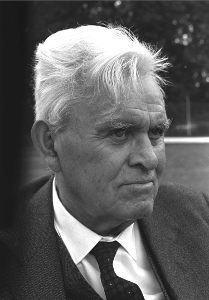
Irish republican Dan Breen (1967)

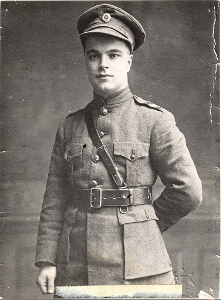
Daniel “Dan” Breen, volunteer in the Irish Republican Army during the Irish War of Independence and the Irish Civil War, dies in Dublin on December 27, 1969. In later years, he was a Fianna Fáil politician.

Breen is born in Grange, Donohill parish, County Tipperary, on August 11, 1894. His father dies when he is six, leaving the family very poor. He is educated locally before becoming a plasterer and later a linesman on the Great Southern Railways.

Breen is sworn into the Irish Republican Brotherhood in 1912 and the Irish Volunteers in 1914. On January 21, 1919, the day the First Dáil meets in Dublin, Breen takes part in the Soloheadbeg Ambush. The ambush party of eight men, led by Seán Treacy, attacks two Royal Irish Constabulary (RIC) men who are escorting explosives to a quarry. The two policemen, James McDonnell and Patrick O’Connell, are fatally shot during the incident. The ambush is considered to be the first incident of the Irish War of Independence.

During the conflict, the British put a £1,000 price on Breen’s head, which is later increased to £10,000. He quickly establishes himself as a leader within the Irish Republican Army (IRA). He is known for his courage. On May 13, 1919 he helps rescue his comrade Seán Hogan at gunpoint from a heavily guarded train at Knocklong station in County Limerick. Breen, who is wounded, remembers how the battalion is “vehemently denounced as a cold-blooded assassins” and roundly condemned by the Catholic Church. After the fight, Treacy, Séamus Robinson, and Breen meet Michael Collins in Dublin, where they are told to make themselves scarce although they do not necessarily agree.

Breen and Sean Treacy shoot their way out through a British military cordon in the northern suburb of Drumcondra (Fernside). They escape, only for Treacy to be killed the next day. Breen is shot at least four times, twice in the lung.

The British reaction is to make Tipperary a “Special Military Area,” with curfews and travel permits. Volunteer GHQ authorises entrerprising attacks on barracks. The British policy forces Breen and Treacy to retreat to Dublin. They join Michael Collins’ Squad of assassins, later known as the Dublin Guard, and Dublin becomes the centre of the war.

Breen is present in December 1919 at the ambush in Ashtown beside Phoenix Park in Dublin where Martin Savage is killed while trying to assassinate the Lord Lieutenant of Ireland, Viscount John French. The IRA hides behind hedges and a dungheap as the convoy of vehicles drives past. They have been instructed to ignore the first car but this contains their target, Lord French. Their roadblock fails as a policeman removes the horse and cart intended to stop the car.

Breen utterly rejects the Anglo-Irish Treaty, which makes him, like many others, angry and embittered. In the June 1922 elections Breen is nominated as a candidate by both the pro- and anti-Treaty sides, but is not elected.

Breen is elected to Dáil Éireann at the 1923 general election as a Republican anti-Treaty Teachta Dála (TD) for the Tipperary constituency. Following the Anglo-Irish Treaty, Breen joins the Anti-Treaty IRA in the civil war, fighting against those of his former comrades in arms who support the Treaty. He is arrested by the National Army of the Irish Free State and interned at Limerick Prison. He spends two months there before going on hunger strike for six days followed by a thirst strike of six days, prompting his release.

Breen writes a best-selling account of his guerrilla days, My Fight for Irish Freedom, in 1924. He represents Tipperary from the Fourth Dáil in 1923 as a Republican with Éamon de Valera and Frank Aiken. He is defeated in the June 1927 general election and travels to the United States where he opens a prohibition speakeasy. In 1932 he returns to Ireland and regains his seat as a member of Fianna Fáil in the Dáil at that year’s general election. During World War II he is said to hold largely pro-Axis views. He represents his Tipperary constituency without a break until his retirement at the 1965 election.

Breen dies in Dublin on December 27, 1969 and is buried in Donohill, near his birthplace. His funeral is the largest seen in west Tipperary since that of his close friend and comrade-in-arms Seán Treacy at Kilfeacle in October 1920. An estimated attendance of 10,000 mourners assemble in the tiny hamlet, giving ample testimony to the esteem in which he was held.

Breen is the subject of a 2007 biography Dan Breen and the IRA by Joe Ambrose.


Leave a comment

The Sunningdale Agreement

council-of-ireland

The Sunningdale Agreement, an attempt to establish a power-sharing Northern Ireland Executive and a cross-border Council of Ireland, is signed at Sunningdale Park in Sunningdale, Berkshire, England on December 9, 1973. Unionist opposition, violence, and a loyalist general strike causes the collapse of the Agreement in May 1974.

On March 20, 1973, the British government publishes a white paper which proposes a 78-member Northern Ireland Assembly, to be elected by proportional representation. The British government would retain control over law, order and finance, while a Council of Ireland composed of members of the executive of the Republic of Ireland, the Dáil Éireann, the Northern Ireland Executive and the Northern Ireland Assembly would act in a consultative role.

The Northern Ireland Assembly Bill resulting from the White paper becomes law on May 3, 1973, and elections for the new assembly are held on June 28. Republicans boycott the elections and the Irish Republican Army (IRA) continued its campaign of opposition throughout the outcome.

After the Assembly elections, negotiations between the pro-White Paper parties on the formation of a “power-sharing Executive” begin. The main concerns are internment, policing, and the question of a Council of Ireland. On November 21, an agreement is reached on a voluntary coalition of pro-agreement parties. This new power-sharing Executive take up office and have its very first meeting on January 1, 1974. The Ulster Unionist Party (UUP) is deeply divided – its Standing Committee votes to participate in the executive by a margin of only 132 to 105.

Provisions for a Council of Ireland exist in the Government of Ireland Act 1920, but these have never been enacted. Unionists resent the idea of any “interference” by the Republic of Ireland in their newly established region. In 1973, after agreement has been reached on the formation of an executive, agreement is sought to re-establish a Council of Ireland to stimulate co-operation with the Republic of Ireland. Talks are held between December 6-9 in the Berkshire town of Sunningdale between the British Prime Minister Edward Heath, the Irish Taoiseach Liam Cosgrave and the three pro-agreement parties. On December 9, a communiqué announcing the agreement is issued, which later becomes known as the “Sunningdale Agreement.”

On December 10, the day after the agreement is announced, loyalist paramilitaries form the Ulster Army Council, a coalition of loyalist paramilitary groups, including the Ulster Defence Association and the Ulster Volunteer Force, which oppose the agreement.

In January 1974, the Ulster Unionist Party narrowly votes against continued participation in the Assembly and Brian Faulkner resigns as leader. He is succeeded by the anti-Sunningdale Harry West. In March 1974, pro-agreement unionists withdraw their support for the agreement, calling for the Republic of Ireland to remove the Articles 2 and 3 of its constitution first. These Articles are not revised until the Good Friday Agreement of 1998.

Following the defeat of a motion condemning power-sharing in the Northern Ireland Assembly, the Ulster Workers’ Council, a loyalist organisation, calls a general strike for May 15. After two weeks of barricades, shortages, rioting, and intimidation, Faulkner resigns as chief executive and the Sunningdale Agreement collapses on May 28, 1974.

(Pictured: Unionist Party leader and designated leader of Ulster’s new executive, Brian Faulkner, sits with SDLP leader Gerry Fitt and John Hume, during talks at Sunningdale, Berkshire, to establish a Council of Ireland.)


1 Comment

Execution of IRA Officer Joe McKelvey

joe-mckelvey

Joe McKelvey, Irish Republican Army (IRA) officer, is executed by firing squad along with three other Anti-Treaty militants, on December 8, 1922, during the Irish Civil War.

McKelvey is born into a nationalist family in Stewartstown, County Tyrone. He has a keen interest in the Gaelic Athletic Association and the Irish language. He studies as an accountant and gains some of the qualifications necessary for this profession, but never fully qualifies. He works for a time at the Income Tax Office on Queen’s Square in Belfast and later finds work in Belfast’s engineering industry with Mackies on Springfield Road. He joins the Irish Republican Brotherhood and the Irish Volunteers, which after 1919, become known as the Irish Republican Army (IRA). He is a founding member of the O’Donovan Rossa Club, Belfast, founded in 1916 on the Falls Road. Each year the club honours him with a juvenile hurling blitz, an invitational competition which is participated in by clubs throughout Ireland.

McKelvey participates in the Irish War of Independence (1919–1921) against the British, in which he commands the IRA’s Belfast Brigade. On August 22, 1920, he helps to organise the killing of Royal Irish Constabulary (RIC) Detective Oswald Swanzy in Lisburn. The killing itself is carried out by IRA men from Cork, but McKelvey arranges a taxi to carry the assassins to and from the scene and disposes of their weapons. In reprisal for this shooting, 300 Catholic homes in Lisburn are burned out. McKelvey is forced to lie low in Dublin for some time after these events.

In March 1921, the IRA is re-organised by its leadership in Dublin into Divisions and McKelvey is appointed commander of the Third Northern Division, responsible for Belfast and the surrounding area. In May 1921, McKelvey’s command suffers a severe setback, when fifty of his best men are sent to County Cavan to train and link up with the IRA units there, only to be surrounded and captured by the British Army on Lappanduff hill on May 9. In most of Ireland, hostilities are ended with a truce declared on July 11, 1921.

McKelvey is alone among the leadership of the Belfast IRA in going against the acceptance of the Anglo-Irish Treaty. Most of his comrades support Michael Collins‘ assurances that, although the Treaty accepts the partition of Northern Ireland from the rest of the country, this is only a temporary concession which will be dealt with later. McKelvey does not accept this. As a result, he leaves his command as head of the IRA Third Northern Division and joins the Anti-Treaty IRA in Dublin.

In March 1922, McKelvey participates in the anti-Treaty IRA‘s repudiation of the authority of the Dáil, the civil government of the Irish Republic declared in 1919, and is elected to the IRA Army Executive. In April 1922 he helps command the occupation of the Four Courts in defiance of the new Irish Free State. This action helps to spark the civil war between pro- and anti-Treaty factions. McKelvey is among the most hardline of the anti-Treaty republicans and briefly, in June 1922, becomes IRA Chief of Staff, replacing Liam Lynch.

On June 28, 1922, the new Irish Free State government shells the Four Courts to assert its authority over the militants defending it. The Republicans in the Four Courts surrender after two days of fighting and McKelvey is captured. He is held for the following five months in Mountjoy Prison in Dublin.

On December 8, 1922, Joe McKelvey is executed by firing squad along with three other Anti-Treaty militants, Rory O’Connor, Liam Mellows, and Richard Barrett. The executions are ordered in reprisal for the Anti-Treaty IRA’s murder of Sean Hales, a Pro-Treaty member of the Third Dáil.


1 Comment

Establishment of the Irish Free State

free-state-executive-council

The Irish Free State (Irish: Saorstát Éireann), an independent state established under the Anglo-Irish Treaty of December 1921, comes into being on December 6, 1922. The treaty ends the three-year Irish War of Independence between the forces of the self-proclaimed Irish Republic, the Irish Republican Army (IRA), and British Crown forces.

The Free State is established as a Dominion of the British Commonwealth of Nations. For one day, it encompasses all thirty-two counties of Ireland. Northern Ireland, which is comprised of the six northernmost counties, exercises its right under the Treaty to opt out of the new state on December 7.

The Free State government consists of the Governor-General, the representative of the king, and the Executive Council, which replaces both the revolutionary Dáil Government and the Provisional Government set up under the Treaty. W. T. Cosgrave, who had led both of these governments since August 1922, becomes the first President of the Executive Council. The legislature consists of Dáil Éireann, the lower house, and Seanad Éireann, also known as the Senate. Members of the Dáil are required to take an Oath of Allegiance, swearing fidelity to the king. The oath is a key issue for opponents of the Treaty, who refuse to take the oath and therefore do not take their seats. Pro-Treaty members, who form Cumann na nGaedheal in 1923, hold an effective majority in the Dáil from 1922 to 1927, and thereafter rule as a minority government until 1932.

In the first months of the Free State, the Irish Civil War is waged between the newly established National Army and the anti-Treaty IRA, who refuse to recognise the state. The Civil War ends in victory for the government forces, with the anti-Treaty forces dumping its arms in May 1923. The anti-Treaty political party, Sinn Féin, refuses to take its seats in the Dáil, leaving the relatively small Labour Party as the only opposition party. In 1926, when Sinn Féin president Éamon de Valera fails to have this policy reversed, he resigns from Sinn Féin and founds Fianna Fáil. Fianna Fáil enters the Dáil following the 1927 general election, and enters government after the Irish general election of 1932, when it becomes the largest party.

De Valera abolishes the Oath of Allegiance and embarks on an economic war with Britain. In 1937 he drafts a new constitution, which is passed by a referendum in July of that year. The Free State comes to an end with the coming into force of the new constitution on December 29, 1937. Under the new constitution the Irish state is named Ireland.

(Pictured: The Executive Council of the Irish Free State, October 1928)


Leave a comment

The Remembrance Day Bombing

remembrance-day-bombing

The Remembrance Day bombing, also known as the Enniskillen bombing or Poppy Day massacre, takes place on November 8, 1987, in Enniskillen, County Fermanagh, Northern Ireland. A Provisional Irish Republican Army (IRA) bomb explodes near the town’s war memorial during a Remembrance Sunday ceremony, which is being held to commemorate British military war dead. Eleven people, many of them old age pensioners, are killed and 63 are injured.

The bomb explodes as a parade of Ulster Defence Regiment (UDR) soldiers is making its way to the memorial and as people wait for the ceremony to begin. It blows out the wall of the Reading Rooms, where many of the victims are standing, burying them under rubble and hurling masonry towards the gathered crowd. Bystanders rush to free those trapped in the rubble.

Eleven people, all Protestant, are killed by the Provisional IRA that day, including three married couples. The dead are Wesley and Bertha Armstrong, Kitchener and Jessie Johnston, William and Agnes Mullan, John Megaw, Georgina Quinton, Marie Wilson, Samuel Gault, and Edward Armstrong. Armstrong is a serving Royal Ulster Constabulary (RUC) officer and Gault has recently left the force. Gordon Wilson, whose daughter Marie dies in the blast and who is himself injured, goes on to become a peace campaigner and member of Seanad Éireann. The twelfth fatality, Ronnie Hill, dies after spending 13 years in a coma. Sixty-three people are injured, including thirteen children. Ulster Unionist politicians Sam Foster and Jim Dixon are among the crowd. Dixon receives extensive head injuries but recovers. A local businessman captures the immediate aftermath of the bombing on video camera. His footage, showing the effects of the bombing, is broadcast on international television.

A few hours after the blast, the IRA calls a radio station and says it has abandoned a 150-pound bomb in Tullyhommon, twenty miles away, after it failed to detonate. That morning, a Remembrance Sunday parade, which includes many members of the Boys’ and Girls’ Brigades, has unwittingly gathered near the Tullyhommon bomb. Soldiers and RUC officers were also there, and the IRA says it attempted to trigger the bomb when soldiers were standing beside it. The bomb is defused by security forces and is found to have a command wire leading to a “firing point” across the border.

The IRA apologises, saying it had made a mistake and that the target had been the UDR soldiers who were parading to the memorial. The bombing leads to an outcry among politicians in the Republic of Ireland and the United Kingdom. British Prime Minister Margaret Thatcher says, “It’s really desecrating the dead and a blot on mankind.” The Secretary of State for Northern Ireland, Tom King, denounces the “outrage” in the House of Commons, as does the Irish Minister for Foreign Affairs, Brian Lenihan, in Dáil Éireann. Seanad Éireann Senator Maurice Manning speaks of people’s “total revulsion.” It also facilitates the passing of the Extradition Act, which makes it easier to extradite IRA suspects from the Republic of Ireland to the United Kingdom.

The bombing is seen by many Northern Irish Protestants as an attack on them, and loyalist paramilitaries ″retaliate″ with attacks on Catholic civilians. The day after the bombing, five Catholic teenagers are wounded in a shooting in Belfast, and a Protestant teenager is killed by the Ulster Defence Association after being mistaken for a Catholic. In the week after the bombing, there are fourteen gun and bomb attacks on Catholics in Belfast.

The Remembrance Day bombing has been described as a turning point in the Troubles and an incident that shook the IRA “to its core.”


Leave a comment

Mary Robinson Elected First Woman President of the Republic

mary-robinson-1

Mary Robinson becomes the first woman to be elected President of the Republic of Ireland on November 7, 1990. She becomes the first Labour Party candidate, the first woman, and the first non-Fianna Fáil candidate in the history of contested presidential elections to win the presidency.

Brian Lenihan, the Tánaiste and Minister for Defence is chosen by Fianna Fáil as their candidate, though he faces a late challenge for the party nomination from another senior minister, John P. Wilson, TD. Lenihan is popular and widely seen as humorous and intelligent. He has delivered liberal policy reform (relaxed censorship in the 1960s) and is seen as a near certainty to win the presidency.

Fine Gael, after trying and failing to get former Taoiseach Garret FitzGerald and former Tánaiste Peter Barry to run, ultimately nominate the former civil rights campaigner and Social Democratic and Labour Party (SDLP) member Austin Currie. Currie is elected to Dáil Éireann in the 1989 general election and has been a minister in Brian Faulkner‘s power-sharing executive in Northern Ireland from 1973–1974. However, Currie has little experience in the politics of the Republic and is widely seen as the party’s last choice, nominated only when no one else is available.

The Labour Party lets it be known that it would for the first time run a candidate. Along with the Workers’ Party, Labour nominates the independent candidate Mary Robinson, SC, a former Labour Party member and senator, and liberal campaigner. Robinson is a former Reid Professor of Law in the Trinity College, Dublin. She is previously involved in the Campaign for Homosexual Law Reform and the campaign to save Wood Quay.

Lenihan enters the race as odds-on favourite. No Fianna Fáil candidate has ever lost a presidential election. However, Lenihan is derailed when he confirms in an on-the-record interview with freelance journalist and academic researcher Jim Duffy that he has been involved in controversial attempts to pressurise the President, Patrick Hillery, over a controversial parliamentary dissolution in 1982. As a result of the contrast between his public denials during the campaign and his confirmation during an earlier interview recorded in May, he is dismissed from the Irish government.

At this point a cabinet colleague, Pádraig Flynn, launches a controversial personal attack on Mary Robinson “as a wife and mother,” an attack that is itself attacked in response as “disgraceful” on live radio by Michael McDowell, a senior member of the Progressive Democrats, then in coalition with Fianna Fáil and up to that point supporting Lenihan’s campaign. Flynn’s attack is a fatal blow to Lenihan’s campaign, causing many female supporters of Lenihan to vote for Robinson in a gesture of support.

Lenihan nonetheless receives a plurality of first-choice votes. Mary Robinson beats Austin Currie, forcing Fine Gael’s candidate into third place. Under Ireland’s system of single transferable vote, Robinson receives over 75% of the transfers when Austin Currie is eliminated, beating Lenihan into second place and becoming the seventh President of Ireland.

While the role of the presidency in day-to-day politics is a very limited one, the Robinson presidency is regarded by many observers as a watershed in Irish society, symbolising the shift away from the conservative ultra-Catholic male-dominated Ireland which existed up until the end of the 1980s to the more liberal society symbolised by Robinson.

Robinson is generally credited with raising the profile of the office of president, which has been considered little more than an honorary figurehead position under her predecessors. Prior to Mary Robinson’s presidency it was not unusual to hear commentators advocating the abolition of the office of president, a viewpoint that is almost never advanced nowadays.


Leave a comment

Founding of Republican Sinn Féin

republican-sinn-fein

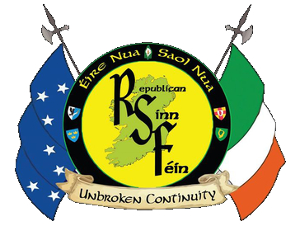
Republican Sinn Féin (Irish: Sinn Féin Poblachtach), an unregistered Irish Republican political organisation, is founded at the West County Hotel in Dublin on November 2, 1986.

Republican Sinn Féin (RSF) claim to be heirs of the Sinn Féin party founded in 1905 and take its present form in 1986 following a split with Provisional Sinn Féin. RSF members take seats when elected in local Irish councils but do not recognise the partition of Ireland and subsequently the legitimacy of the Northern Ireland or Republic of Ireland governments, so does not register itself under them.

The decision to form, or to reorganise or reconstitute as its supporters see it, the organisation was taken in response to Gerry Adams-led Sinn Féin’s decision at its 1986 ardfheis to end its policy of abstentionism and to allow elected Sinn Féin Teachtaí Dála take their seats in Leinster House‘s Dáil Éireann. The supporters of Ruairí Ó Brádaigh and Dáithí Ó Conaill who go on to form RSF oppose this move as it signals a departure from the traditional republican analysis which views the parliament of the Republic of Ireland as an illegal assembly, set up by an act of the British parliament. They argue that republicans owe their allegiance to the All-Ireland (32 County) Irish Republic, maintaining that this state exists de jure and that its authority rests with the IRA Army Council. Hence, if elected, its members refuse to take their seats in the Oireachtas.

The organisation views itself as representing “true” or “traditional” Irish republicanism, while in the mainstream media the organisation is portrayed as a political expression of “dissident republicanism.” Republican Sinn Féin rejects the Good Friday Agreement and indeed the Anglo-Irish Treaty. As part of this they refuse to discount Irish republicans using militant means to “defend the Irish Republic” and considers the Continuity Irish Republican Army (IRA) to be the legitimate army of the Irish Republic. The CIRA is designated as a terrorist organisation by the governments of the United Kingdom and Republic of Ireland.


Leave a comment

Birth of Fianna Fáil Politician Ray Burke

ray-burke

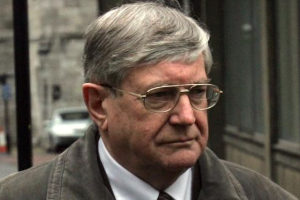
Raphael Patrick “Ray” Burke, disgraced former Fianna Fáil politician, is born on September 30, 1943, in Dublin. He is a former Teachta Dála and government minister who is convicted and imprisoned on charges arising from political corruption in office. Burke is also highly influential in decisions made by Dublin County Council.

Burke’s political career commences when he is elected to Dublin County Council for Fianna Fáil in 1967. He serves as chairman of the council from 1985 to 1987.

Burke is elected to Dáil Éireann at the 1973 general election for the Dublin County North constituency, succeeding his father Patrick J. Burke, who has held the seat for 29 years. Ray Burke represents this constituency and its successor Dublin North until his resignation almost twenty-five years later.

After Fianna Fáil’s landslide victory at the 1977 general election, Burke is appointed Minister of State at the Department of Industry and Commerce. In October 1980 Burke is promoted to Minister for the Environment, a position he holds until June 1981 and again in the short-lived Fianna Fáil government of 1982. After Fianna Fáil returns to power at the 1987 general election, Burke serves as Minister for Energy, where he makes controversial changes to the legislation governing oil and gas exploration. In 1988, he is appointed Minister for Industry, Commerce and Communications.

Following the formation of the Fianna Fáil–Progressive Democrats Coalition in 1989, he becomes Minister for Justice and Minister for Communications. When Albert Reynolds comes to power in 1992, he does not re-appoint Burke to the Cabinet. Following the 1997 general election, Fianna Fáil is back in power, and Burke is appointed Minister for Foreign Affairs by new Taoiseach Bertie Ahern.

Within months of his appointment as Minister for Foreign Affairs, allegations resurface that Burke has received IR£80,000 from a property developer regarding the former Dublin County Council. Burke denies the allegations but resigns from the Cabinet and from the Dáil on October 7, 1997, after just four months in office.

Having claimed since 1989 that Raidió Teilifís Éireann (RTÉ) is biased against him, Burke is responsible for controversial legislation that severely limits RTÉ’s ability to collect advertising revenue and allows for the establishment of a series of local radio stations and one independent national radio station, Century Radio. RTÉ is ordered to provide a national transmission service for Century Radio at a price that RTÉ complains is far below the economic cost of providing such a service. Nevertheless, Century Radio fails to gain significant audience share and closes in 1991.

In July 2004 Burke pleads guilty to making false tax returns. The charges arise from his failure to declare for tax purposes the payments that he has received from the backers of Century Radio. On January 24, 2005, he is sentenced to six months in prison for these offences, making him one of the most senior Irish politicians to serve time in prison. He is released in June 2005 after four and a half months, earning a 25% remission of sentence because of good behaviour. He serves his time in Arbour Hill Prison in Dublin.


Leave a comment

Mary Robinson Resigns as President of Ireland

mary-robinson

President Mary Robinson resigns on September 12, 1997, two months ahead of the end of her term, in order to take up appointment as United Nations High Commissioner for Human Rights.

On July 24, 1997, Robinson announces her intention to resign as President of Ireland. The Irish Government states that her announcement “was not unexpected” and wishes her “every success.” She resigns by addressing a message to the Ceann Comhairle of Dáil Éireann and it takes effect at 1:00 PM on September 12.

Upon her resignation as President, the role of President is transferred to the Presidential Commission, which is comprised of the Chief Justice, the Ceann Comhairle, and the Cathaoirleach of the Seanad Éireann, from September 12 until November 11, 1997, when Mary McAleese is sworn in as the new President.

Media reports suggest that Robinson has been head-hunted for the post by Secretary General of the United Nations Kofi Annan to assume an advocacy as opposed to administrative role, in other words to become a public campaigner outlining principles rather than the previous implementational and consensus-building model. The belief is that the post has ceased to be seen as the voice of general principles and has become largely bureaucratic. Robinson’s role is to set the human rights agenda within the organisation and internationally, refocusing its appeal.

Robinson is the first High Commissioner for Human Rights to visit Tibet, making her trip in 1998. During her tenure she criticises the Irish system of permits for non-EU immigrants as similar to “bonded labour” and criticises the United States’ use of capital punishment.

In 2001, Robinson chairs the Asia Regional Preparatory Meeting for the World Conference against Racism, Racial Discrimination, Xenophobia and related intolerances, which is held in Tehran, Iran. Representatives of the Simon Wiesenthal Centre, a Jewish group, and the Baha’i International Community are not permitted to attend. Robinson wears a headscarf at the meeting in conformance to the Iranians edict that all women attending the conference must wear a headscarf. Women who do not wear the headscarf are criticized, which Robinson says plays into the hands of religious conservatives.

She extends her intended single four-year term by a year following an appeal by Secretary General Annan to preside over the World Conference against Racism 2001 in Durban, South Africa. The conference proves controversial, and under continuing pressure from the United States, Robinson resigns her post in September 2002.


2 Comments

Irish Free State Admitted to League of Nations

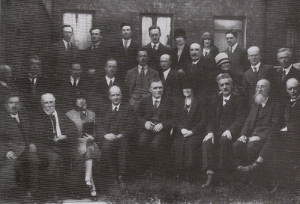
league-of-nations-delegationThe Irish Free State is admitted into the League of Nations on September 10, 1923.

In 1922, Éamon de Valera speaks at a League of Nations meeting and is critical of Article 10 of the League Covenant which preserves the existing of territorial integrity of member states. This article prevents Ireland from gaining membership in the League of Nations, because it is a territory of the United Kingdom, who is a member state. However, it does not clarify what rights dominion states have and if they can have their own seat. This means that when the Constitution of the Irish Free State goes into effect, the Irish government does not know what type of role it can play in the League of Nations and if, at that point, it is possible to become a member. The League of Nations final decision is that Ireland can not become a member until it’s constitution is officially enacted and it officially becomes a free state.

The Constitution of the Irish Free State is enacted on December 6, 1922, and is recognized as an official international instrument. This allows Ireland to submit an application for entry into the League of Nations.

The applications process goes smoothly until the spring of 1923 when the Seanad Éireann, the upper house of the Oireachtas, complains that only Dáil Éireann, the lower house, has approved the application. A previous decision has made the application an Executive Council decision, and under the Provisional Government, the Seanad has approved the application process. With this approval, the Executive Council continues the application process, however, the new Seanad is upset about their lack of input. This problem is settled when the Attorney-General creates the League of Nations (Guarantee) Bill, which gives both Houses an opportunity to discuss and approve the application.

With this approval in September, Ireland is admitted as a full and equal member to the League of Nations on September 10, 1923, giving it access to the rest of the world. This membership means that Ireland now has representatives in one place, who can meet with other representatives, instead of sending delegates to each country. One location not only saves time, but money. Early Irish foreign policy is driven by the need to stress the country’s legal status as a platform from which to pursue a fuller foreign policy. With admission to the League of Nations this is now possible. Ireland’s acceptance into the League of Nations helps create legitimacy for the new nation.

(Pictured: Irish Delegation to the League of Nations, 1923)