seamus dubhghaill

Promoting Irish Culture and History from Little Rock, Arkansas, USA


Leave a comment

Birth of James FitzJames Butler, 2nd Duke of Ormonde

James FitzJames Butler, 2nd Duke of Ormonde, KG, Irish statesman and soldier, is born into a Protestant family on April 29, 1665, at Dublin Castle. He is the third of the Kilcash branch of the family to inherit the earldom of Ormond. He serves in the campaign to put down the Monmouth Rebellion, in the Williamite War in Ireland, in the Nine Years’ War and in the War of the Spanish Succession but is accused of treason and goes into exile after the Jacobite rising of 1715.

Butler is the second but eldest surviving son, and one of eleven children, of Thomas Butler by his wife Emilia van Nassau-Beverweerd. His father is known as Lord Ossory. His father is heir apparent of James Butler, 1st Duke of Ormond but predeceases him and so never becomes duke. His father’s family, the Butler dynasty, is Old English and descends from Theobald Walter, who had been appointed Chief Butler of Ireland by King Henry II in 1177. His mother is Dutch. She descends from a cadet branch of the House of Nassau.

Butler is educated in France and afterwards at Christ Church, Oxford. On the death of his father on July 30, 1680, he becomes Baron Butler in the peerage of England and the 7th Earl of Ossory in the peerage of Ireland.

Butler obtains command of a cavalry regiment in Ireland in 1683 and having received an appointment at court on the accession of James II, he serves against the Duke of Monmouth at the Battle of Sedgemoor in July 1685. Having succeeded his grandfather as 2nd Duke of Ormonde on July 21, 1688, he is appointed a Knight of the Order of the Garter on September 28, 1688. In 1688, he also becomes Chancellor of the University of Dublin and Chancellor of the University of Oxford.

In January and February 1689, Butler votes against the motion to put William of Orange and Mary on the throne and against the motion to declare that James II has abdicated it. Nevertheless, he subsequently joins the forces of William of Orange, by whom he is made colonel of the 2nd Troop of Horse Guards on April 20, 1689. He accompanies William in his Irish campaign, debarking with him in Carrickfergus on June 14, 1690, and commands this troop at the Battle of the Boyne in July 1690. In February 1691 he becomes Lord Lieutenant of Somerset.

Butler serves on the continent under William of Orange during the Nine Years’ War and, having been promoted to major general, he fights at the Battle of Steenkerque in August 1692 and the Battle of Landen in July 1693, where he is taken prisoner by the French and then exchanged for the Duke of Berwick, James II’s illegitimate son. He is promoted to lieutenant general in 1694.

After the accession of Queen Anne in March 1702, Butler becomes commander of the land forces co-operating with Sir George Rooke in Spain, where he fights in the Battle of Cádiz in August 1702 and the Battle of Vigo Bay in October 1702 during the War of the Spanish Succession (1701–1714). Having been made a Privy Councillor, he succeeds Lord Rochester as Lord Lieutenant of Ireland in 1703. In 1704, he leases and rebuilds a property that becomes known as Ormonde Lodge in Richmond outside London.

Following the dismissal of the Duke of Marlborough, Butler is appointed Commander-in-Chief of the Forces and colonel of the 1st Regiment of Foot Guards on January 4, 1712, and Captain General on February 26, 1712. In the Irish Parliament he and the majority of peers support the Tory interest.

Butler plays a dramatic role at the notorious meeting of the Privy Council on March 8, 1711, when Antoine de Guiscard, a French double agent who is being questioned about his treasonable activities, attempts to assassinate Robert Harley, 1st Earl of Oxford, against whom he has a personal grudge for drastically cutting his allowance, by stabbing him with a penknife. Harley is wounded, but not seriously, due largely to the fact that he is wearing a heavy gold brocade waistcoat in which the knife gets stuck. Several Councillors, including Butler, stab Guiscard in return. Guiscard implores Butler to finish the deed, but he replies that it is not for him to play the hangman. In any case, he has the sense to see that Guiscard must be kept alive at least long enough to be questioned, although as it turns out Guiscard’s wounds are fatal, and he dies a week later.

On April 23, 1712, Butler leaves Harwich for Rotterdam to lead the British troops taking part in the war. Once there he allows himself to be made the tool of the Tory ministry, whose policy is to carry on the war in the Netherlands while giving secret orders to him to take no active part in supporting their allies under Prince Eugene. In July 1712, he advises Prince Eugene that he can no longer support the siege of Le Quesnoy and that he is withdrawing the British troops from the action and instead intends to take possession of Dunkirk. The Dutch are so exasperated at the withdrawal of the British troops that they close the towns of Bouchain on Douai to British access, despite the fact that they have plenty of stores and medical facilities available. Butler takes possession of Ghent and Bruges as well as Dunkirk, in order to ensure his troops are adequately provided for. On April 15, 1713, he becomes Lord Lieutenant of Norfolk.

Ormonde’s position as Captain-General makes him a personage of much importance in the crisis brought about by the death of Queen Anne and, during the last years of Queen Anne, he almost certainly has Jacobite leanings and corresponds with the Jacobite Court including his cousin, Piers Butler, 3rd Viscount Galmoye, who keeps barrels of gunpowder at Kilkenny Castle. King George I, on his accession to the throne in August 1714, institutes extensive changes and excludes the Tories from royal favour. Butler is stripped of his posts as Captain-General, as colonel of the 1st Regiment of Foot Guards and as Commander in Chief of the Forces with the first two posts going to the Duke of Marlborough and the role of Commander-in-Chief going to John Dalrymple, 2nd Earl of Stair. On November 19, 1714, Butler is instead made a member of the reconstituted Privy Council of Ireland.

Accused of supporting the Jacobite rising of 1715, Butler is impeached for high treason by Lord Stanhope on June 21, 1715. He might avoid the impending storm of Parliamentary prosecution, if he remains in England and stands trial but instead, he chooses to flee to France in August 1715 and initially stays in Paris with Lord Bolingbroke. On August 20, 1715, he is attainted, his estate forfeited, and honours extinguished. The Earl Marshal is instructed to remove the names and armorial bearings of Butler and Bolingbroke from the list of peers and his banner as Knight of the Garter is taken down in St. George’s Chapel.

On June 20, 1716, the Parliament of Ireland passes an act extinguishing the regalities and liberties of the county palatine of Tipperary; for vesting Butler’s estate in the crown and for giving a reward of £10,000 for his apprehension, should he attempt to land in Ireland. But the same parliament passes an act on June 24, 1721, to enable his brother, Charles Butler, 1st Earl of Arran, to purchase his estate, which he does accordingly.

Butler subsequently moves to Spain where he holds discussions with Cardinal Giulio Alberoni. He later takes part in a Spanish and Jacobite plan to invade England and puts James Francis Edward Stuart on the British throne in 1719, but his fleet is disbanded by a storm in the Bay of Biscay. In 1732, he moves to Avignon, where he is seen in 1733 by the writer Lady Mary Wortley Montagu. He dies at Avignon in exile on November 16, 1745, but his body is returned to London and buried in Westminster Abbey on May 22, 1746.

On July 20, 1682, Butler, then called Lord Ossory, marries Lady Anne Hyde, daughter of Laurence Hyde, who is then Viscount Hyde of Kenilworth but becomes Earl of Rochester in November. The couple has a daughter, Mary, who dies young in 1688.

Following the death of his first wife in 1685, Butler plans to marry again in order to secure a male heir. He gains permission from the House of Lords for the arranging of a jointure for another marriage in May 1685, and in August of that year, he marries Lady Mary Somerset, daughter of the Duke of Beaufort and Mary Capel. The couple has a son, Thomas (1686–1689), and two daughters, Elizabeth (1689–1750) and Mary (1690–1713). His second wife is a Lady of the Bedchamber to Queen Anne. Their younger daughter, Mary, marries John Ashburnham, 1st Earl of Ashburnham.

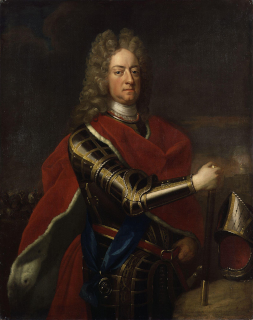
(Pictured: Portrait of James Butler, 2nd Duke of Ormonde, by Michael Dahl, National Portrait Gallery)

Leave a comment

Death of James Butler, 2nd Duke of Ormonde

James FitzJames Butler, 2nd Duke of Ormonde, KG, Irish statesman and soldier, dies in Avignon on November 16, 1745. He is the third of the Kilcash branch of the family to inherit the earldom of Ormond. He serves in the campaign to put down the Monmouth Rebellion, in the Williamite War in Ireland, in the Nine Years’ War and in the War of the Spanish Succession but is accused of treason and goes into exile after the Jacobite rising of 1715.

Butler is born into a Protestant family on April 29, 1665, at Dublin Castle. He is the second but eldest surviving son, and one of eleven children, of Thomas Butler by his wife Emilia van Nassau-Beverweerd. His father is known as Lord Ossory. His father is heir apparent of James Butler, 1st Duke of Ormond but predeceases him and so never becomes duke. His father’s family, the Butler dynasty, is Old English and descends from Theobald Walter, who had been appointed Chief Butler of Ireland by King Henry II in 1177. His mother is Dutch. She descends from a cadet branch of the House of Nassau.

Butler is educated in France and afterwards at Christ Church, Oxford. On the death of his father on July 30, 1680, he becomes Baron Butler in the peerage of England and the 7th Earl of Ossory in the peerage of Ireland.

Butler obtains command of a cavalry regiment in Ireland in 1683 and having received an appointment at court on the accession of James II, he serves against the Duke of Monmouth at the Battle of Sedgemoor in July 1685. Having succeeded his grandfather as 2nd Duke of Ormonde on July 21, 1688, he is appointed a Knight of the Order of the Garter on September 28, 1688. In 1688, he also becomes Chancellor of the University of Dublin and Chancellor of the University of Oxford.

In January and February 1689, Butler votes against the motion to put William of Orange and Mary on the throne and against the motion to declare that James II has abdicated it. Nevertheless, he subsequently joins the forces of William of Orange, by whom he is made colonel of the 2nd Troop of Horse Guards on April 20, 1689. He accompanies William in his Irish campaign, debarking with him in Carrickfergus on June 14, 1690, and commands this troop at the Battle of the Boyne in July 1690. In February 1691 he becomes Lord Lieutenant of Somerset.

Butler serves on the continent under William of Orange during the Nine Years’ War and, having been promoted to major general, he fights at the Battle of Steenkerque in August 1692 and the Battle of Landen in July 1693, where he is taken prisoner by the French and then exchanged for the Duke of Berwick, James II’s illegitimate son. He is promoted to lieutenant general in 1694.

After the accession of Queen Anne in March 1702, Butler becomes commander of the land forces co-operating with Sir George Rooke in Spain, where he fights in the Battle of Cádiz in August 1702 and the Battle of Vigo Bay in October 1702 during the War of the Spanish Succession (1701–1714). Having been made a Privy Councillor, he succeeds Lord Rochester as Lord Lieutenant of Ireland in 1703. In 1704, he leases and rebuilds a property that becomes known as Ormonde Lodge in Richmond outside London.

Following the dismissal of the Duke of Marlborough, Butler is appointed Commander-in-Chief of the Forces and colonel of the 1st Regiment of Foot Guards on January 4, 1712, and Captain General on February 26, 1712. In the Irish Parliament he and the majority of peers support the Tory interest.

Butler plays a dramatic role at the notorious meeting of the Privy Council on March 8, 1711, when Antoine de Guiscard, a French double agent who is being questioned about his treasonable activities, attempts to assassinate Robert Harley, 1st Earl of Oxford, against whom he has a personal grudge for drastically cutting his allowance, by stabbing him with a penknife. Harley is wounded, but not seriously, due largely to the fact that he is wearing a heavy gold brocade waistcoat in which the knife gets stuck. Several Councillors, including Butler, stab Guiscard in return. Guiscard implores Butler to finish the deed, but he replies that it is not for him to play the hangman. In any case, he has the sense to see that Guiscard must be kept alive at least long enough to be questioned, although as it turns out Guiscard’s wounds are fatal, and he dies a week later.

On April 23, 1712, Butler leaves Harwich for Rotterdam to lead the British troops taking part in the war. Once there he allows himself to be made the tool of the Tory ministry, whose policy is to carry on the war in the Netherlands while giving secret orders to him to take no active part in supporting their allies under Prince Eugene. In July 1712, he advises Prince Eugene that he can no longer support the siege of Le Quesnoy and that he is withdrawing the British troops from the action and instead intends to take possession of Dunkirk. The Dutch are so exasperated at the withdrawal of the British troops that they close the towns of Bouchain on Douai to British access, despite the fact that they have plenty of stores and medical facilities available. Butler takes possession of Ghent and Bruges as well as Dunkirk, in order to ensure his troops are adequately provided for. On April 15, 1713, he becomes Lord Lieutenant of Norfolk.

Ormonde’s position as Captain-General makes him a personage of much importance in the crisis brought about by the death of Queen Anne and, during the last years of Queen Anne, he almost certainly has Jacobite leanings and corresponds with the Jacobite Court including his cousin, Piers Butler, 3rd Viscount Galmoye, who keeps barrels of gunpowder at Kilkenny Castle. King George I, on his accession to the throne in August 1714, institutes extensive changes and excludes the Tories from royal favour. Butler is stripped of his posts as Captain-General, as colonel of the 1st Regiment of Foot Guards and as Commander in Chief of the Forces with the first two posts going to the Duke of Marlborough and the role of Commander-in-Chief going to John Dalrymple, 2nd Earl of Stair. On November 19, 1714, Butler is instead made a member of the reconstituted Privy Council of Ireland.

Accused of supporting the Jacobite rising of 1715, Butler is impeached for high treason by Lord Stanhope on June 21, 1715. He might avoid the impending storm of Parliamentary prosecution, if he remains in England and stands trial but instead, he chooses to flee to France in August 1715 and initially stays in Paris with Lord Bolingbroke. On August 20, 1715, he is attainted, his estate forfeited, and honours extinguished. The Earl Marshal is instructed to remove the names and armorial bearings of Butler and Bolingbroke from the list of peers and his banner as Knight of the Garter is taken down in St. George’s Chapel.

On June 20, 1716, the Parliament of Ireland passes an act extinguishing the regalities and liberties of the county palatine of Tipperary; for vesting Butler’s estate in the crown and for giving a reward of £10,000 for his apprehension, should he attempt to land in Ireland. But the same parliament passes an act on June 24, 1721, to enable his brother, Charles Butler, 1st Earl of Arran, to purchase his estate, which he does accordingly.

Butler subsequently moves to Spain where he holds discussions with Cardinal Giulio Alberoni. He later takes part in a Spanish and Jacobite plan to invade England and puts James Francis Edward Stuart on the British throne in 1719, but his fleet is disbanded by a storm in the Bay of Biscay. In 1732, he moves to Avignon, where he is seen in 1733 by the writer Lady Mary Wortley Montagu. He dies at Avignon in exile on November 16, 1745, but his body is returned to London and buried in Westminster Abbey on May 22, 1746.

On July 20, 1682, Butler, then called Lord Ossory, marries Lady Anne Hyde, daughter of Laurence Hyde, who is then Viscount Hyde of Kenilworth but becomes Earl of Rochester in November. The couple has a daughter, Mary, who dies young in 1688.

Following the death of his first wife in 1685, Butler plans to marry again in order to secure a male heir. He gains permission from the House of Lords for the arranging of a jointure for another marriage in May 1685, and in August of that year, he marries Lady Mary Somerset, daughter of the Duke of Beaufort and Mary Capel. The couple has a son, Thomas (1686–1689), and two daughters, Elizabeth (1689–1750) and Mary (1690–1713). His second wife is a Lady of the Bedchamber to Queen Anne. Their younger daughter, Mary, marries John Ashburnham, 1st Earl of Ashburnham.

(Pictured: Portrait of James Butler, 2nd Duke of Ormonde, by Michael Dahl, National Portrait Gallery)


Leave a comment

Death of Flaithrí Ó Maolchonaire, Archbishop of Tuam

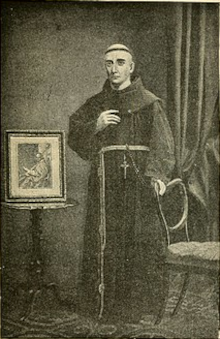
Flaithrí Ó Maolchonaire, Irish Franciscan and theologian, founder of St. Anthony’s College, Leuven, and Archbishop of Tuam, dies in Madrid, Spain on November 18, 1629.

Ó Maolchonaire is born in the townland of Figh, civil parish of Tibohine, barony of Frenchpark, County Roscommon. His father and mother are Fíthil and Onóra Ó Maolchonaire. Two other sons survive to adulthood, Maoilechlainn and Firbisigh. They belong to a well-known family of historians and poets. He is brought up in the family profession.

Ó Maolchonaire studies for the priesthood at Salamanca, entering the Irish college founded in 1592. He first studies the liberal arts and philosophy. In 1593 he translates into Irish a short Castilian catechism by Jerónimo de Ripalda SJ. The original is a simple catechetical work written in Aristotelian master-pupil dialogue. According to Mícheál Mac Craith, Ó Maolchonaire’s translation pointedly refers to the Irish as Eirinnach rather than Gaedheal.

After five years at the Salamanca Irish college, Ó Maolchonaire leaves to join the Franciscan province of Santiago. Aodh Mac Cathmhaoil is among his classmates in the Salamanca Franciscan friary. They and nine of their peers in the Santiago province are later raised to the episcopacy, an unprecedented development in the history of the order.

At the height of the Nine Years’ War, Ó Maolchonaire sails to Ireland where he serves as a confessor and preacher to troops under the command of Hugh O’Neill and Hugh Roe O’Donnell. In 1601, they request a bishopric for Ó Maolchonaire “in recognition of his diligence, commending his sound judgment on Irish affairs.” After the disaster of Kinsale in 1601, he accompanies O’Donnell to Spain as his confessor and adviser, hoping to see a renewal of Spanish military intervention in Ireland.

In 1602, Ó Maolchonaire attempts to get approval for O’Donnell to meet Philip III in person, but they are kept at arm’s length by the Spanish court. During this time, they also drafted an official complaint against the Jesuit superiors of the Irish college at Salamanca over presumed discrimination in favour of Old English students at the expense of students from Connacht and Ulster.

While waiting for a response to his repeated calls for military support in Ireland, O’Donnell becomes seriously ill and dies at Simancas, being assisted on his deathbed by Ó Maolconaire. In keeping with his patronage of the order of friars minor in Donegal, O’Donnell is buried in the Franciscan habit. Ó Maolchonaire accompanies the remains to their last resting place in the Franciscan church at Valladolid. He continues to press for military support after O’Donnell’s death. He participates in an abandoned maritime expedition which reaches Achill Sound in 1603 but never lands in Ireland. He subsequently assists the Spanish councils of state and war to stem the flow of Irish military migrants and their dependents in Spain.

As adviser to Puñonrostro, the king’s appointee as protector of Irish exiles in Spain, Ó Maolchonaire helps to secure funds for widows, orphans and clerics. Trained as a chronicler and genealogist, he sponsors the entry of Irish soldiers into Spanish military orders and successfully calls for the promotion of Henry O’Neill, second eldest son of the earl of Tyrone, as colonel of Irish infantry units in Flanders, the O’Neill tercio in 1604.

In 1606, the Franciscan general chapter is held in Toledo where Ó Maolchonaire is selected as minister-provincial of the Irish friars minor. The most notable act of his tenure as provincial is the founding of a new Irish Franciscan college at Leuven in the Habsburg Netherlands. A year before his appointment, he begins his efforts in earnest with an appeal to the Spanish king. The loss of five Franciscan houses during the Nine Years’ War makes a new foundation essential. In response, Philip III instructs Albert VII, Archduke of Austria, to provide a perpetual grant for a new college in the university town of Leuven. Ó Maolchonaire’s part in founding the college clearly influences the Catholic pastoral mission to Ireland during the seventeenth century. The first and most active Irish printing press on the continent is long in operation at Leuven.

After Hugh O’Neill and Rory O’Donnell leave Ireland in 1607, Ó Maolconaire accompanies them from Douai to Rome as interpreter and advisor. Christopher St. Laurence, baron of Howth, implicates him in a plot to seize Dublin Castle and raises a new rebellion just before the Flight of the Earls. In recognition of his losses, Philip III and Paul V offer O’Neill the concession of Ó Maolchonaire’s promotion to the archbishopric of Tuam. On Sunday, May 3, 1609, he is consecrated archbishop by Cardinal Maffeo Barberini in the centre of Rome at the Chiesa Santo Spirito in Sassia. He remains in Rome until his appointment as archbishop of Tuam before returning to Madrid on behalf of Hugh O’Neill.

In response to the 1613–15 Parliament of Ireland, Ó Maolchonaire writes from Valladolid a remonstrance to the Catholic members of the parliament, rebuking them for assenting to the bill of attainder that confiscated the estates of O’Neill, O’Donnell and their adherents. As Archbishop of Tuam, he never takes possession of his episcopal see, governing through vicars general. He continues to live in Madrid and Leuven, as is the case with many Irish clergy at the time. Like his fellow-Franciscan, Luke Wadding, and Peter Lombard, Archbishop of Armagh, he serves as a key intermediary and his influence in Irish matters is considerable. In 1626, a year after Charles I declared war on Spain, he makes the case for an invasion of Ireland under the joint leadership of the earls of Tyrone and Tyrconnell.

Ó Maolconaire dies at the Franciscan friary of San Francisco el Grande in Madrid on November 18, 1629. In 1654, two Irish friars bring his remains back to St. Anthony’s College in Leuven where he is buried near the high altar in the collegiate chapel.


Leave a comment

Death of Daniel O’Connell in Genoa, Italy

daniel-oconnell

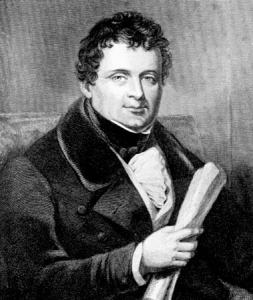
Daniel O’Connell, lawyer who becomes the first great 19th-century Irish nationalist leader and is known as “The Liberator,” dies in Genoa, Italy on May 15, 1847. Throughout his life, he campaigns for Catholic emancipation, including the right for Catholics to sit in the Westminster Parliament and the repeal of the Act of Union which combines Great Britain and Ireland.

Compelled to leave the Roman Catholic college at Douai, France, when the French Revolution breaks out, O’Connell goes to London to study law, and in 1798 he is called to the Irish bar. His forensic skill enables him to use the courts as nationalist forums. Although he has joined the Society of United Irishmen, a revolutionary society, as early as 1797, he refuses to participate in the Irish Rebellion of the following year. When the Act of Union takes effect on January 1, 1801, and abolishes the Irish Parliament, he insists that the British Parliament repeal the anti-Catholic laws in order to justify its claim to represent the people of Ireland. From 1813 he opposes various Catholic relief proposals because the government, with the acquiescence of the papacy, has the right to veto nominations to Catholic bishoprics in Great Britain and Ireland. Although permanent political organizations of Catholics are illegal, O’Connell sets up a nationwide series of mass meetings to petition for Catholic emancipation.

On May 12, 1823, O’Connell and Richard Lalor Sheil found the Catholic Association, which quickly attracts the support of the Irish priesthood and of lawyers and other educated Catholic laymen and which eventually comprises so many members that the government cannot suppress it. In 1826, when it is reorganized as the New Catholic Association, it causes the defeat of several parliamentary candidates sponsored by large landowners. In County Clare in July 1828, O’Connell himself, although as a Catholic ineligible to sit in the House of Commons, defeats a man who tries to support both the British government and Catholic emancipation. This result impresses on the British prime minister, Arthur Wellesley, 1st Duke of Wellington, the need for making a major concession to the Irish Catholics. Following the passage of the Catholic Emancipation Act of 1829, O’Connell, after going through the formality of an uncontested reelection, takes his seat at Westminster.

In April 1835, he helps to overthrow Sir Robert Peel’s Conservative ministry. In the same year, he enters into the “Lichfield House compact,” whereby he promises the Whig Party leaders a period of “perfect calm” in Ireland while the government enacts reform measures. O’Connell and his Irish adherents, known collectively as “O’Connell’s tail,” then aid in keeping the weak Whig administration of William Lamb, 2nd Viscount Melbourne, in office from 1835 to 1841. By 1839, however, O’Connell realizes that the Whigs will do little more than the Conservatives for Ireland, and in 1840 he founds the Repeal Association to dissolve the Anglo-Irish legislative union. A series of mass meetings in all parts of Ireland culminate in O’Connell’s arrest for seditious conspiracy, but he is released on appeal in September 1844 after three months’ imprisonment. Afterward his health fails rapidly, and the nationalist leadership falls to the radical Young Ireland group.

O’Connell dies at the age of 71 of cerebral softening in 1847 in Genoa, Italy, while on a pilgrimage to Rome. His time in prison has seriously weakened him, and the appallingly cold weather he has to endure on his journey is probably the final blow. According to his dying wish, his heart is buried at Sant’Agata dei Goti, then the chapel of the Irish College, in Rome and the remainder of his body in Glasnevin Cemetery in Dublin, beneath a round tower.