seamus dubhghaill

Promoting Irish Culture and History from Little Rock, Arkansas, USA


Leave a comment

The Ballygawley Bus Bombing

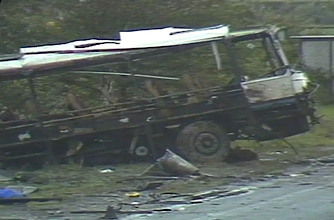
The Ballygawley bus bombing is a roadside bomb attack by the Provisional Irish Republican Army (IRA) on a bus carrying British soldiers in Northern Ireland. It occurs in the early hours of August 20, 1988, in the townland of Curr near Ballygawley, County Tyrone. The attack kills eight soldiers and wounds twenty-eight. In the wake of the bombing, the British Army begins ferrying its troops in and out of County Tyrone by helicopter.

The Irish Times reports that “This stretch of road has been a favourite ambush spot for successive generations of IRA men since the 1920s.” The Provisional IRA has been attacking British Army patrols and convoys with roadside bombs regularly since the beginning of the Troubles in the early 1970s. Most of these attacks take place in rural parts of Northern Ireland, especially eastern and southern County Tyrone (where the IRA’s Tyrone Brigade is active) and southern County Armagh (heartland of the South Armagh Brigade). In August 1979, the IRA ambushes a British Army convoy with two large roadside bombs near Warrenpoint, killing eighteen soldiers. This is the deadliest attack on the British Army in Northern Ireland during the Troubles. In December 1979, four more British soldiers are killed on Ballygawley Road in the Dungannon land mine attack. In May 1981, five British soldiers are killed when their Saracen APC is ripped apart by a roadside bomb at Altnaveigh, County Armagh. In July 1983, four Ulster Defence Regiment (UDR) soldiers are killed when their vehicle strikes an IRA land mine near Ballygawley, County Tyrone. In December 1985, the Tyrone IRA launches an assault on the police barracks in Ballygawley, shooting dead two officers and destroying the barracks with a bomb.

In June 1988, six off-duty British soldiers are killed when an IRA bomb explodes underneath their van in Lisburn. It had been attached to the van as the soldiers are taking part in a charity marathon.

On the night of August 19/20, 1988, an unmarked 52-seater bus is transporting 36 soldiers of The Light Infantry from Aldergrove Flying Station to a military base near Omagh. The soldiers, who came from England, have just finished 18 months of a two-year tour of duty in Northern Ireland and are returning to the base after a short holiday.

As it is driving along the main road from Ballygawley to Omagh, at about 12:30 a.m., IRA members remotely detonate a roadside bomb containing 200 pounds (91 kg) of Semtex. According to police, the bomb had been planted in a vehicle by the roadside and had been detonated by command wire from 330 yards (300 m) away. A statement by one of the survivors claims instead that the roadside bomb was made of “two fertilizer bags filled with Semtex.” The blast hurls the bus 30 metres down the road and throws the soldiers into neighbouring hedges and fields. It leaves a crater 6 feet deep and scatters body parts and twisted metal over a wide area. Witnesses describe finding dead, dying and wounded soldiers strewn on the road and caught in the wreckage of the bus. Others are walking around “stunned.” Some of the first to arrive on the scene and offer help are loyalist bandsmen of the Omagh Protestant Boy’s Band returning from a parade in Portadown, who have also been traveling in buses.

Eight of the soldiers are killed and the remaining 28 are wounded. The soldiers killed are: Jayson Burfitt (aged 19), Richard Greener (aged 21), Mark Norsworthy (aged 18), Stephen Wilkinson (aged 18), Jason Winter (aged 19), Blair Bishop (aged 19), Alexander Lewis (aged 18) and Peter Bullock (aged 21). This is the single biggest loss of life for the British Army from an IRA attack in Northern Ireland since the Warrenpoint ambush in 1979, although eleven off-duty British soldiers had been killed in the Droppin Well bombing in 1982, carried out by the Irish National Liberation Army (INLA). An account from one of the survivors is published in Ken Wharton‘s book A Long Long War: Voices from the British Army in Northern Ireland, 1969–98 (2008).

An inquest into the attack is told that the road is usually off-limits to military vehicles, due to the threat from the IRA. The driver of the bus, who is also a soldier, claims he had been directed on to the road by diversion signs. The inquest hears that signs had not been placed by the police or the roads service. The IRA denies placing any signs and says that military buses often use the road. The mother of one of those killed accuses the British military of negligence and claims it is “trying to conceal the truth.”

Shortly thereafter, the Provisional IRA issues a statement claiming responsibility. It says that the attack had been carried out by its Tyrone Brigade and adds: “We will not lay down our arms until the peace of a British disengagement from Ireland.” The security forces suspect that an informer may have told the IRA of the bus’s route and the time it would pass a specific spot. After the attack, the British military decides to start ferrying their troops to and from East Tyrone by helicopter to avoid any future attacks like this.

Tom King, then Secretary of State for Northern Ireland, says there is “some evidence” that the explosives used are part of a consignment from Libya. He also states that the possibility of reintroducing internment is “under review”. Libyan weaponry enables the IRA to mount some of its biggest operations during its campaign. The Ballygawley bus bombing is believed to be one of these attacks. One former IRA member later suggests that Semtex explosive was not crucial to the outcome of the attack, saying, “we were having plenty of success without Semtex… at Ballygawley we ‘only’ got eight, but it was a bus of about fifty-six. If we’d used a fertiliser bomb, the whole bus would have been destroyed.”

On August 30, 1988, three IRA members are ambushed and killed by the Special Air Service (SAS) at Drumnakilly, County Tyrone. According to author Nick Van der Bijl, the men—Gerard Harte, Martin Harte and Brian Mullin—are identified by British intelligence as the perpetrators of the bombing. Peter Taylor, instead, says that only Mullin is suspected, and that plans for the SAS operation were already underway at the time of the IRA attack.

Two months after the attack, the British Government introduces the broadcasting ban. It means that the voices of Sinn Féin and IRA members are not allowed to be broadcast on television or radio. The Ballygawley bus bombing is believed to have influenced the Government’s decision to introduce the ban.

According to state papers declassified in 2019, the attack sparks “panic” in the British Government, and tension between the Royal Ulster Constabulary (RUC) and the British Army over who is at fault for the security lapse. British Prime Minister Margaret Thatcher warns RUC chief, John Hermon, that she will no longer send British troops over “in waves to be killed.”

Leave a comment

The Murder of Dominic “Mad Dog” McGlinchey

Dominic “Mad Dog” McGlinchey, Irish republican paramilitary leader who moves from the Provisional Irish Republican Army (IRA) to become head of the Irish National Liberation Army (INLA) paramilitary group in the early 1980s and self-confesses participation in more than thirty killings, dies in a hail of bullets while making a phone call in Drogheda, County Louth, on February 10, 1994. No one is ever convicted of his murder.

McGlinchey is one of eleven siblings born into a staunchly republican home in Ballyscullion Road, Bellaghy, in rural south County Londonderry, Northern Ireland. His father owns a garage and some of his father’s police customers later die at McGlinchey’s hands. His mother Monica is a devout Catholic. He is educated at the local school. When he was sixteen, he begins an apprenticeship in his father’s garage. About this time, he is joining the numerous civil rights marches that are taking place in the county. His precise reasons for doing so are unclear, but speculation is that he is reacting to events around him and the idea of participating in marches offers glamour and a close identification with his own community.

In 1971, McGlinchey is interned without charge for ten months in Long Kesh Detention Centre. Not long after his release the following year, he is imprisoned again on arms charges. On July 5, 1975, during his imprisonment, he marries Mary O’Neil, daughter of Patrick O’Neil from Toomebridge. Together they have three children.

Following his release, McGlinchey joins Ian Milne and future Provisional IRA hunger strikers Francis Hughes and Thomas McElwee and wages a campaign of shooting and bombing throughout the county and beyond. Together, they later join the Provisional IRA. The gang spends the late 1970s on the run, carrying out operations and evading both the British Army and the Garda Síochána. Following a mailvan robbery, the latter force arrests McGlinchey in County Monaghan in 1977 for carjacking a Garda patrol vehicle and threatening the officer with a pistol, although he claims that the gun is actually a wheel brace. He fails to make bail at Dublin‘s Special Criminal Court after a Garda Superintendent argues that McGlinchey would fail to attend court if bailed. He is convicted and sent to the maximum-security Portlaoise Prison. In 1982, while serving his prison sentence, he clashes with the prison’s IRA leadership and is either expelled by them for indiscipline or leaves the organisation due to strategic differences.

Following his departure from the IRA and his release from prison, McGlinchey joins the INLA. Due to his experience, he rises through the ranks, becoming chief of staff by 1982. Under his leadership, the INLA, which had previously had a reputation for disorganisation, becomes extremely active in cross-border assassinations and bombings. These include many individual assassinations and woundings, but also massacres such as the Droppin Well bombing of 1982 in which both civilians and soldiers die. There are some failed operations, and McGlinchey, who believes this is the result of an informer within the ranks, devotes much time and energy to finding the cause. Those suspected of betraying the organisation are treated brutally, often by McGlinchey personally. As a result of this resurgence of activity and his high profile, the press nicknames him “Mad Dog.” Under his tenure the Darkley massacre is carried out, ostensibly by another group but using a weapon supplied by McGlinchey. In late 1983, while still on the run, he gives an interview with the Sunday Tribune newspaper in which he condemns the Darkley killings but also lays out his political philosophy and plans for the future.

By 1984, McGlinchey has fallen out with members of a powerful Republican family from South Armagh over what he considers missing funds. Men loyal to this family are subsequently killed by McGlinchey’s unit, which includes his wife. In March of the same year, he is captured in Newmarket-on-Fergus, County Clare, following a gunfight with the Gardaí. At this time, he is wanted in Northern Ireland for the shooting of an elderly woman, but republicans have traditionally been able to avoid extradition by claiming their offences were political. The bloody war in the north is leading the Republic of Ireland to re-evaluate its position, however, and he becomes the first republican to be extradited to Northern Ireland. Although convicted and sentenced there to life imprisonment, this is overturned in 1985. As a result, he is returned to the Republic, where he is sentenced to ten years’ imprisonment on firearms charges. While he is incarcerated, his wife is shot dead at her Dundalk home.

McGlinchey is released in March 1993 and claiming to have no further involvement with the INLA, moves to Drogheda. He survives an assassination attempt soon after his release from prison, but in February 1994, his enemies catch up with him. At around 9:30 on the evening of Thursday, February 10, 1994, he visits and dines with friends of his in Duleek Road, near his home. He leaves about forty minutes later, intending to take a video back to a shop in Brookville, on the north side of town. At around 11:00 p.m. he and his 16-year-old son Dominic are returning home, when he pulls up to make a phone call from a public kiosk on Hardman’s Gardens, near Our Lady of Lourdes Hospital. Almost immediately and despite the presence of four witnesses, a red Mazda pulls up alongside him. While his son watches from the car, three men get out and beat McGlinchey. Once he is on the ground the men, who are armed with three pump action shotguns and a pistol, fire into him fourteen times. The attack finishes with a coup de grâce to the head, although he is already dead. His last words are reputed to be “Jesus, Mary help me.” His son yells for an ambulance.

The following day, an autopsy is carried out in Our Lady of Lourdes Hospital, which indicates McGlinchey had been hit in the neck, skull, the left upper chest, the left arm, and both legs. His inquest is held in Drogheda two weeks later, suspended and then reopened in November 1996. Gardaí forensic officers tell the coroner that they had compared the shell casings they had found with the database, but no matches have been made to other known weapons. The officer notes that no such information has been received from the Royal Ulster Constabulary (RUC). The shotguns used are impossible to trace ballistically, but it is ascertained that the Mazda was registered in the north. His and his wife’s killers have never been found.

McGlinchey’s funeral is held on February 13, 1994, in Bellaghy, with no republican accoutrements. There is no INLA colour guard, and only an Irish tricolor draped over the coffin. Over 1,500 people attend and are watched closely by 200 RUC. Police armoured vans are held on the perimeter. He is buried alongside his wife and their young daughter Máire. His coffin is carried from the McGlinchey family home to St. Mary’s Church by pallbearers who are swapped out from the crowd every 40-yards or so. Martin McGuinness is among them, as is Bernadette McAliskey and her daughter Róisín. His sons carry the coffin for the final yards.

McGlinchey’s posthumous reputation ranges from being a “psycho” to his enemies to being an inspiration to those who followed him. Commentators have speculated on what he would have contributed to Irish politics had he lived. Some have suggested that he would have contributed to the Northern Ireland peace process, while others have argued that dissident republicans, opposed to that process, would have found him a willing rallying point. He remains an influence on Irish fiction and music, with both Edna O’Brien and Martin McDonagh producing acclaimed pieces based on his life and career. He is also featured in popular songs.


Leave a comment

Founding of the Irish National Liberation Army (INLA)

The Irish National Liberation Army (INLA, Irish: Arm Saoirse Náisiúnta na hÉireann), an Irish republican socialist paramilitary group, is founded at the Spa Hotel in Lucan, Dublin, on December 10, 1974, during the 30-year period of conflict known as “the Troubles.” The group seeks to remove Northern Ireland from the United Kingdom and create a socialist republic encompassing all of Ireland. With membership estimated at 80–100 at their peak, it is the paramilitary wing of the Irish Republican Socialist Party (IRSP), which is founded the same day. The IRSP’s foundation is made public but the INLA’s is kept a secret until the group can operate effectively.

The INLA is founded by former members of the Official Irish Republican Army who oppose that group’s ceasefire. It is initially known as the “People’s Liberation Army” or “People’s Republican Army.” The INLA wages a paramilitary campaign against the British Army and Royal Ulster Constabulary (RUC) in Northern Ireland. It is also active to a lesser extent in the Republic of Ireland, Great Britain and Continental Europe. High-profile attacks carried out by the INLA include the Droppin Well bombing (1982), the Shankill Road killings (1994) and the assassinations of Airey Neave (1979) and Billy Wright (1997). However, the INLA is smaller and less active than the main republican paramilitary group, the Provisional Irish Republican Army (IRA). It is also weakened by feuds and internal tensions. Members of the group use the covernames People’s Liberation Army, People’s Republican Army, and Catholic Reaction Force for attacks its volunteers carry out but for which the INLA does not want to claim responsibility. The INLA becomes a proscribed group in the United Kingdom on July 3, 1979, under the 1974 Prevention of Terrorism Act.

After a 24-year armed campaign, the INLA declares a ceasefire on August 22, 1998. In August 1999, it states that “There is no political or moral argument to justify a resumption of the campaign.” On October 11, 2009, speaking at the graveside of its founder Seamus Costello in Bray, the INLA formally announces an end to its armed campaign, stating the current political framework allows for the pursuit of its goals through peaceful, democratic means and begins decommissioning its weapons.

The IRSP supports a “No First Strike” policy, that is allowing people to see the perceived failure of the Northern Ireland peace process for themselves without military actions.

The INLA is a proscribed organisation in the United Kingdom under the Terrorism Act 2000 and an illegal organisation in the Republic of Ireland.

(Pictured: INLA logo consisting of the Starry Plough and the Flag of Ireland with a red star and a fist holding an AK-47-derivative rifle)


Leave a comment

The 1994 Shankill Road Killings

trevor-king-mural

The 1994 Shankill Road killings take place on June 16, 1994. The Irish National Liberation Army (INLA) shoot dead Ulster Volunteer Force (UVF) members Trevor King, Colin Craig and David Hamilton on the Shankill Road in Belfast, close to the UVF headquarters.

On June 16, 1994, high-ranking UVF Commander volunteer Trevor King is standing on the Shankill Road about one hundred yards from “The Eagle,” the UVF’s Belfast GHQ, talking to fellow UVF members David Hamilton and Colin Craig. A car drives past them and as it does so Irish National Liberation Army (INLA) gunmen inside the vehicle open fire on the three men. The car is later found burning close to Divis Tower.

David Lister and Hugh Jordan claim that Gino Gallagher, who is himself shot dead in 1996 during an internal dispute, is the main gunman in the attack. However, Henry McDonald and Jack Holland say that Gallagher is inside the car, which is scouting the area for UVF members, and not one of the gunmen.

Colin Craig is killed on the spot. King and David Hamilton lay in the street, seriously wounded as panic and chaos erupt on the Shankill in the wake of the shooting. Presbyterian minister Roy Magee is in “The Eagle” discussing an upcoming Combined Loyalist Military Command (CLMC) meeting and the possibility of a loyalist ceasefire with the UVF Brigade Staff when the attack takes place. He and the others race out of the building after hearing the gunfire.

King is rushed to the hospital where he is put on a life-support machine. The shooting has left him paralysed from the neck down. He dies on July 9 with Reverend Magee at his bedside. According to Magee, King himself makes the decision to turn off the machine.

The killings are a blow for the Northern Ireland peace process and a morale boost for the INLA. The attack is the INLA’s most notorious since the Droppin Well bombing in 1982 which killed seventeen people, eleven British soldiers and 6 civilians.

The following day, the UVF launches two retaliatory attacks. In the first, UVF members shoot dead a Catholic civilian taxi driver in Carrickfergus. In the second, they shoot dead two Protestant civilians in Newtownabbey, whom they believe to be Catholics. Two days after the killings the UVF decide to launch another revenge attack when they kill six Catholic civilians in a bar while they are watching the Ireland vs. Italy 1994 FIFA World Cup game opener in what becomes known as the Loughinisland massacre. The tit-for-tat attacks continue during the spring and summer of 1994 until the Provisional Irish Republican Army ceasefire of August 31, 1994, and the Combined Loyalist Military Command ceasefire in October. The attacks on the Shankill are the INLA’s deadliest attacks of the 1990s.

When interviewed for Boston College for research on the conflict, Progressive Unionist Party leader David Ervine suggests the INLA might have been working in cahoots with the Provisional IRA in targeting prominent Loyalists, as the month after the Provisional IRA kill three leading Ulster Defence Association (UDA) men.

(Pictured: Trevor King mural, Disraeli Street, May 2012)