seamus dubhghaill

Promoting Irish Culture and History from Little Rock, Arkansas, USA


1 Comment

The 2006 Dublin Riots

A series of riots in Dublin on February 25, 2006, is precipitated by a proposed march down O’Connell Street of a unionist demonstration. The disturbances begin when members of the Garda Síochána attempt to disperse a group of counterdemonstrators blocking the route of the proposed march. The situation escalates as local youths join forces with the counterdemonstrators.

Love Ulster is a Unionist organisation dedicated to commemorating the Unionist victims of the Troubles in Northern Ireland. It is organised in part by Willie Frazer of Families Acting for Innocent Relatives (FAIR). It is a partisan group established to voice outrage at killings by the Republican paramilitary organisations, but is criticised for not doing the same for victims of loyalist paramilitary organisations.

The Love Ulster march in Dublin is to consist of a uniformed band, several hundred activists (including some from the Orange Order) and relatives of victims, all of whom are to march from Parnell Street north of the River Liffey, down O’Connell Street, past Trinity College Dublin (TCD) onto Nassau Street, Dawson Street and Molesworth Street, and eventually reaching Leinster House, the seat of the Oireachtas, on Kildare Street.

The march of this group in Dublin is viewed as provocative by some Irish nationalists and many Irish republicans, particularly in the context of an Orange Order march. The Orange Order is accused of being a sectarian organisation known for its anti-Catholicism. The right to march is supported by the main Irish political parties and the march is authorised by the Garda Síochána. Love Ulster had organised a similar rally in Belfast in October 2005.

At previous FAIR rallies, a picture of an Ulster Volunteer Force (UVF) member who was allegedly involved in the murder of 26 people in Dublin in the 1974 Dublin and Monaghan bombings, and who was himself killed by the Provisional Irish Republican Army in 1976, had been displayed. An organiser of the Love Ulster demonstration tells a republican newspaper that he cannot guarantee that images of the murder suspect will not be displayed during the demonstration.

Sinn Féin, an Irish republican political party, does not organise a protest and says that the march should be allowed to go ahead, calling for republicans to ignore the march. Republican Sinn Féin, a splinter political party no longer affiliated with Sinn Féin, has an organised presence.

Their protest blocks the northeastern junction of O’Connell Street and Parnell Street. The small Republican Sinn Féin group (and some activists from the Irish Republican Socialist Party) are joined by several hundred local youths. Before the violence breaks out, they chant republican chants. Several thousand bystanders are also on the scene but take no part in the subsequent rioting. When the marchers form up at the top of Parnell Square and their bands begin to play in anticipation of the start of the march, gardaí attempt to disperse the protest at around 12:45 p.m. At this point, scuffles break out between protesters and Gardaí.

After the failure of the initial garda effort to disperse the protesters, the violence escalates. The Garda Public Order Unit is deployed, and stones and metal railings are thrown at gardaí by protesters, as are fireworks, bricks, crude petrol bombs, and other missiles. As the rioting continues, the ranks of the rioters are swelled by many local teenagers who had not taken part in the initial protest. Several barricades are constructed from building materials on the street to impede the march and the Gardaí. The march is due to start at 12:30 p.m., but as the violence goes on the gardaí decide against trying to escort the marchers through O’Connell Street. At about 1:30 p.m. the assembled marchers return to the coaches that had brought them to Dublin from Northern Ireland. The three coaches are then driven to Leinster House, where a small parade is carried out, and a letter is handed to Irish Minister for Justice, Michael McDowell. They are then escorted out of the city. One of the coaches is attacked by stone throwers on the way home.

Violence continues sporadically on O’Connell Street for another hour or so. The Gardaí, advancing from the northern end of the street gradually push the rioters back southward. The most sustained violence takes place around the General Post Office building, where the rioters initially sit down in protest and then, after several of them have been batoned, regroup behind burning barricades and throw rocks, paving slabs and one or possibly two petrol bombs at Gardaí. Several Gardaí, protesters and a number of journalists from RTÉ and TV3 are injured.

While the standoff on O’Connell Street is still going on, several hundred rioters follow the Unionist coaches to the Nassau Street area where they set a number of cars on fire and damage several businesses. Further skirmishes break out around the River Liffey at O’Connell Bridge, Aston Quay, Fleet Street and Temple Bar, as the Gardaí retake O’Connell street, before the rioters disperse.

Having dispersed the rioters, the gardaí then closes O’Connell Street to facilitate a cleanup of the scene by building workers. Media reports estimate the cost of the cleanup job at €50,000, and Dublin Chamber of Commerce places loss of earnings for businesses in the city due to the riots at €10,000,000.

Estimates for the number of unionist marchers before the event are predicted to be over 1,000. However, only eight coach loads turn up in Dublin, indicating a far smaller number, possibly 300 to 400. Estimates for the number of counterdemonstrators vary between 300 and 7,000. The number is made much more difficult to determine by the presence of the several thousand bystanders at the scene who do not take part. Most of the rioters appear to be local youths, though some who brandished leaflets and other political literature are clearly political activists.

A total of 14 people, including six gardaí and a small number of journalists and photographers, are hospitalised as a result of the rioting. A further 41 people are arrested, according to RTÉ news. As of February 27, 2006, thirteen have been charged. Twenty-six people are convicted in January 2009 for their part in the disturbances and given sentences of up to five years. Two are described as “alcoholics.” One of them and a teenage boy are “homeless.” Three are not Irish – a Georgian, a Romanian and a Moldovan are convicted of looting shops on O’Connell Street. Two have travelled from County Offaly, one from County Galway and one from County Donegal for the riot. All the rest come from Dublin.

(Pictured: The Public Order Unit on O’Connell Street during the 2006 Dublin Riots)

Leave a comment

Death of Middle-Distance Runner Noel Carroll

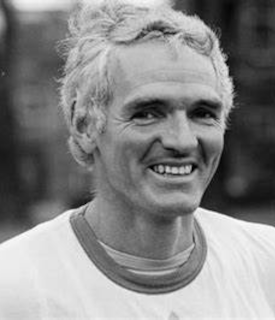
Noel Carroll, Irish middle-distance runner who wins a bronze medal in the 1969 European Indoor Games, dies on October 23, 1998. He sets European and World Records in the 1960s. He becomes the Dublin Corporation‘s first official spokesman, and later the chief executive of the Dublin Chamber of Commerce and leads the group which founds the Dublin Marathon.

Carroll is born in Annagassan, County Louth, on December 7, 1941, and leaves school to join the Irish Army where he begins running. In 1962, while competing in the Millrose Games in New York City, he is recruited by James F. “Jumbo” Elliott and attends Villanova University, where he joins the Villanova Wildcats and wins a number of track championships.

At Villanova, Carroll runs a sub-four-minute mile and in 1964, is the anchor for the team which breaks the 4 x 880-yard relay World Record. In the same year, he also sets the European Indoor record for the 880-yards and competes in the 1964 Summer Olympics in Tokyo, Japan, in the Men’s 800 metres finishing just outside of the qualifying places in heat 5 of the first round with a time of 1:51.1. When running against Bill Crothers in 1964, Sports Illustrated describes him as “one of the best middle-distance runners in the world.”

Carroll represents Ireland in the 400 metres (time: 46.8) and the 800 metres (time: 1:49) in the 1968 Summer Olympics in Mexico City, and continues to win national championships, fourteen in total. He wins a bronze medal in the 800m at the 1969 European Indoor Games in Belgrade.

In 1972, Carroll becomes the spokesman for the Dublin Corporation, now known as Dublin City Council, a post he holds until 1996, when he joins the Dublin Chamber of Commerce as its chief executive.

In 1980, Carroll leads a group which approaches the Business Houses Athletic Association and the Dublin Corporation with the idea for the Dublin Marathon. He is also among the 2,100 people who compete in the race that year. The winner of the Marathon receives the Noel Carroll Memorial Trophy presented each year by one of Carroll’s children.

Carroll dies on October 23, 1998, after suffering a heart attack while training at University College Dublin (UCD). In 2008, his four children take part in the Dublin Marathon to raise money for the Noel Carroll Building, the headquarters of a project in Kolkata, India, run by GOAL, a charity for which Carroll had served as the chairman.

Carroll’s grandson is the Irish rugby international player, Jordi Murphy.


Leave a comment

Opening of Ireland’s First Passenger Railway

Ireland’s first passenger railway, the Dublin and Kingstown Railway (D&KR), opens on October 9, 1834. It links Westland Row in Dublin with Kingstown Harbour (Dún Laoghaire) in County Dublin. The D&KR is also notable for a number of other achievements besides being Ireland’s first passenger railway. It operates an atmospheric railway for ten years, claims the first use of a passenger tank engine and is the first railway company to build its own locomotives.

Construction begins on a new harbour at Dunleary village in 1817 that soon begins to attract traffic due to silting problems elsewhere around Dublin Bay. Proposals for canal or rail infrastructure links to Dublin are variously proposed through to the 1830s. James Pim takes the initiative and commissions a plan by Alexander Nimmo which is presented as a petition to the House of Commons on February 28, 1831 for a rail line from near Trinity College Dublin to the west pier at the Royal Harbour of Kingstown under a company to be known as the D&KR. A bill is presented and is progressing but is scuppered by a prorogation of parliament and an election. A fresh bill receives Royal assent on September 6, 1831.

A meeting of D&KR subscribers on November 25, 1831 at the Dublin Chamber of Commerce includes the submission of a long report which indicates that Westland Row is to be the Dublin terminus and that the enterprise is initially to focus on passenger traffic with a high train frequency.

The construction contract is awarded to William Dargan, with Charles Blacker Vignoles as engineer. The construction contract is signed on May 7, 1833 and is completed in about 18 months. The railway proves expensive to build with the final cost being a little under £60,000 per mile. Thomas Grierson, the Dublin, Wicklow and Wexford Railway (DW&WR) chief engineer comments in a presentation to the Institution of Civil Engineers of Ireland in 1887 that speed of construction is remarkably short and leads to “many failures in masonry, bridges, etc.”

On October 4, 1834 the first recorded train with invited passengers is hauled by the engine Vauxhall and runs as far as the Williamstown Martello Tower at what is now Blackrock Park before returning. The engine Hibernia on October 9, 1834 hauls another train of invited passengers composed of eight carriages the entire length of the line and back. Plans are made to introduce a service on October 22, 1834 but storms and flooding damage the line including wrecking the bridge over the River Dodder and this leads to delays for repairs. A timetabled regular service is introduced from January 1835.

On June 30, 1856 the Dublin and Wicklow Railway (D&WR) takes over operation of the line from the D&KR with the D&KR continuing to lease out the line. The D&WR had formerly been known as the Waterford, Wicklow, Wexford and Dublin Railway (WWW&DR or 3WS). It changes its name to the Dublin Wicklow and Wexford Railway (DW&WR) in May 1860 and is ultimately renamed the Dublin and South Eastern Railway (D&SER) in 1907, a name which is retained until the amalgamation of the D&KR and D&SER with the Great Southern Railways on January 1, 1925. As of 1974, its independent existence of over 90 years by a railway company is only exceeded in the British Isles by the Great Western Railway and the Londonderry and Lough Swilly Railway.

(Pictured: Sketch of Second Class Carriage on the Dublin and Kingstown Railway by E. Heyden, with Patent Spiral spring Buffer, as invented by T.F. Bergin)


Leave a comment

Ahern Meets Paisley in County Antrim

paisley-and-ahern-2008

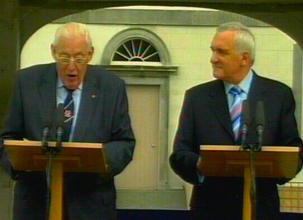
Taoiseach Bertie Ahern visits Ballymena on February 1, 2008, to meet Northern Ireland First Minister Ian Paisley in his County Antrim constituency. Paisley says the Taoiseach’s visit to north Antrim is a historic day, and Ahern says his visit is another tangible benefit of the ongoing peace process.

Ahern and Paisley discuss political and economic developments in Northern Ireland and increasing cross-Border co-operation. The Taoiseach says he is honoured to visit the north Antrim heartland of the Democratic Unionist Party (DUP) leader.

“I do not believe even a year back it could have been envisaged we would have been together here,” Ahern says. “It is an honour to be here with the First Minister to talk about progress.”

Paisley jokes that Ahern and his entourage had held a prayer meeting in their helicopter hoping that they would not be pelted with snowballs by him, a reference to his famous protest when former Taoiseach Seán Lemass visited Stormont in 1965.

When asked about welcoming the Fianna Fáil leader to his constituency Paisley quips, “What I am saying is he is in under my control. This is a good day for work. It is a good day for our province. It is a good day for the whole of Ireland because we need help from outside. We cannot live on our own.”

Ahern and Paisley meet again the following week at the Dublin Chamber of Commerce AGM dinner where Paisley has been invited to be a guest speaker.

The engagement is the latest visit to the Republic by the DUP leader since the Assembly was restored in Stormont the previous May. The Taoiseach invites Paisley to the historic Battle of the Boyne battle site in County Louth in July where the DUP leader presents a 17th-century musket to Ahern.

In October 2007, Paisley addresses the Trinity College Historical Society in Dublin and also attends an event in the Royal College of Physicians of Ireland in the city in November.

(From The Irish Times, Friday, February 1, 2008)