seamus dubhghaill

Promoting Irish Culture and History from Little Rock, Arkansas, USA


Leave a comment

Birth of Eamon Dunphy, Media Personality & Journalist

Eamon Martin Dunphy, Irish media personality, journalist, broadcaster, author, sports pundit and former professional footballer, is born in Dublin on August 3, 1945.

Dunphy grows up in Drumcondra, Dublin, in what he describes as “a one-room tenement flat [with] no electricity, no hot water.” He attends Saint Patrick’s National School, Drumcondra. In 1958, he gets a one-year government scholarship to Sandymount High School but has to work as a messenger at the tweed clothing shop Kevin and Howlin.

A promising footballer, Dunphy leaves Dublin while still a teenager to join Manchester United as an apprentice. He does not break into the first team at United, and subsequently leaves to play for York City, Millwall, Charlton Athletic, Reading and Shamrock Rovers. It is at Millwall that he makes the most impact. He is considered an intelligent and skillful player in the side’s midfield. He is a member of “The Class of ’71,” the Millwall side that fails by just one point to gain promotion to the Football League First Division.

Dunphy plays 23 times for the Republic of Ireland and is Millwall’s most capped international footballer with 22 caps, until surpassed by David Forde and Shane Ferguson. He makes his Ireland debut on November 10, 1965, in the playoff at the Parc des Princes in Paris for the 1966 FIFA World Cup which Spain wins 1–0, thanks to a José Ufarte goal. He goes on to become, in his own words, “a good player, not a great player.”

Dunphy accompanies Johnny Giles back to Ireland to join Shamrock Rovers in 1977. Giles wants to make the club Ireland’s first full-time professional club and hopes to make Rovers into a force in European football by developing talented young players at home who would otherwise go to clubs in England. Dunphy is originally intended to be in charge of youth development. However, despite an FAI Cup winners medal in 1978, his only medal in senior football, and two appearances in the UEFA Cup Winners’ Cup, he becomes disillusioned with the Irish game and drops out of football altogether to concentrate on a career in journalism.

After retiring from the game, Dunphy first begins writing on football for the Sunday Tribune and then contributes regular columns on both football and current events for the Sunday Independent. He currently writes a column on football for the Irish Daily Star. He coins the term “Official Ireland” to refer to the establishment. He also works for Ireland on Sunday (now the Irish Daily Mail), The Sunday Press (now defunct), and the Irish Examiner.

Since the 1980s, Dunphy has written a number of books. His first and most widely praised book is Only a Game? The Diary of a Professional Footballer, which is an autobiographical account of his days playing for Millwall. Written in diary form, it records events from the dressing room of his 1973–74 season, which begins well for him at Millwall but subsequently ends in disillusionment: after being substituted in an October 27, 1973, home loss to eventual league winners Middlesbrough, he does not play another game all season, the club finishing mid-table.

In 1985, rock band U2 and manager Paul McGuinness commission Dunphy to write the story of their origins, formation, early years and the time leading up to their highly successful album The Joshua Tree. His book Unforgettable Fire – Past, Present, and Future – The Definitive Biography of U2 is published in 1988. It receives some favourable reviews, but critics close to the band speak of many inaccuracies. A verbal war erupts in the press during which he calls lead singer Bono a “pompous git.”

Dunphy also writes a biography of long-serving Manchester United manager Matt Busby and in 2002 ghost writes the autobiography of Republic of Ireland and Manchester United player Roy Keane.

Since the mid-1980s, Dunphy has regularly appeared as an analyst during football coverage on Raidió Teilifís Éireann (RTÉ). Since RTÉ acquired the rights to show English football, he has been a regular contributor to Premier Soccer Saturday. He also contributes to analysis of UEFA Champions League games and, in international football, RTÉ’s coverage of FIFA World Cups, UEFA European Football Championships and qualifying matches involving the Republic of Ireland national football team.

In 2001, Dunphy becomes the first male host of the quiz show The Weakest Link, which airs on TV3, for just one series. In 2003, he is hired again by TV3 to host their new Friday night chat show, entitled The Dunphy Show. Pitted head-to-head with RTÉ’s long-running flagship programme, The Late Late Show, Dunphy’s show loses what is a highly publicised “ratings war,” and is cancelled before its original run concludes.

Dunphy is the first presenter of a made-for-mobile television show on the 3 mobile network in Ireland. His rants and “Spoofer of the Week” are watched by thousands of 3 Mobile customers. The shows are awarded “Best Entertainment Show” at Ireland’s Digital Media Awards. He admits he never uses a mobile himself but enjoys filming for a mobile audience from his living room in Ranelagh.

In July 2018, Dunphy announces that he is leaving RTÉ after 40 years with the broadcaster, and that he intends to focus on his podcast The Stand with Eamon Dunphy.

Dunphy has also has a prominent radio career with several stations, including Today FM, Newstalk and RTÉ Radio 1. He is the original host in 1997 of the popular current affairs show The Last Word on Today FM. In September 2004, he takes over The Breakfast Show slot on the Dublin radio station Newstalk 106 from David McWilliams. The show tries to court controversy and listeners in equal measure. He fails to attract the large listenership predicted, with only a few additional thousand tuning in. He announces in June 2006 his intention to leave Newstalk 106, citing an inability to sustain the demands of an early morning schedule. After his departure from Newstalk 106, he confirms he is suffering from a viral illness from which he later recovers.

In July 2006, RTÉ announces that Dunphy will present a new weekly programme as part of the new RTÉ Radio 1 autumn schedule.

Dunphy rejoins Newstalk but leaves again in 2011 “due to interference from management and a push to put a more positive spin on the news.” On his last show he accuses his boss, Denis O’Brien, of “hating journalism.” He quits after Sam Smyth is sacked from Today FM (also owned by O’Brien) and says management at Newstalk is trying to remove “dissenting voices” like Constantin Gurdgiev from the airwaves.

Dunphy is a daily Mass-goer until he is preparing for marriage to his first wife, Sandra from Salford, when he is 21. He is Catholic and she is Protestant. The priest instructing them for marriage disapproves strongly of the mixed couple, saying that he should not marry her because she is “not a proper person.” Dunphy’s observance is already weakening but he quits his daily Mass-going at this point. He and Sandra have two children, a boy and a girl, and he is now a grandfather. His first marriage ends, and he moves to Castletownshend in County Cork for two years in the early 1990s. He lives with another partner, Inge, before meeting his second wife, RTÉ commissioning editor Jane Gogan, in the Horseshoe Bar in Dublin in 1992. They marry at the Unitarian Church on St. Stephen’s Green on September 24, 2009.

In an interview with An Phoblacht, Dunphy, who had previously written highly critical articles on the Provisional IRA and Sinn Féin, states that he is now a Sinn Féin supporter and declares he had voted for them in the 2011 Irish general election. He describes their representatives as “incredibly hard-working and incredibly intelligent.”

Dunphy publishes his autobiography entitled The Rocky Road in October 2013.

Today, Dunphy generally resides at his home near Ranelagh in Dublin. He also owns a holiday home in Deauville, France.

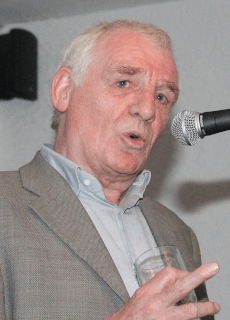
(Pictured: Éamon Dunphy at the Sinn Féin Summer School, 2013)


Leave a comment

Death of Bill O’Herlihy, Broadcaster & Public Relations Executive

Bill O’Herlihy, Irish television broadcaster and public relations executive, dies in Dublin on May 25, 2015. He is best known for his broadcasts for Raidió Teilifís Éireann (RTÉ), primarily in the sporting arena.

Born and raised in Glasheen in Cork, County Cork, O’Herlihy is the son of a local government official and the grandson of William O’Herlihy, a news editor for The Cork Examiner. He is educated at Glasheen boys’ national school and later at St. Finbarr’s College, Farranferris.

After finishing his schooling at fifteen, O’Herlihy follows his grandfather into journalism and secures a job in the reading room of The Cork Examiner. He is only seventeen years-old when he subsequently becomes sub-editor of the Evening Echo, a position he holds for five years. He also graduates to the positions of news, features and sports reporter.

In the early 1960s O’Herlihy begins his broadcasting career when he starts to do local association football reports from Cork for Radio Éireann. In 1965, he makes his first television broadcast in a programme commemorating the sinking of the RMS Lusitania off the Cork coast. After three years O’Herlihy is asked to join RTÉ’s current affairs programme 7 Days to add the required field-reporting skills to the studio-based interviews. The programme has a reputation for its hard-hitting investigative reporting, and he reports on many varying stories from illegal fishing in Cork to the outbreak of the crisis in Northern Ireland. In November 1970, the 7 Days programme comes into controversy when O’Herlihy reports a story on illegal money lending. The report is unconventional as it is one of the first television pieces to use hidden cameras, it claims the government is not responding to illegal moneylending. A tribunal of inquiry follows, and O’Herlihy is forced to move away from current affairs.

Following this controversy, while O’Herlihy is not sacked as he has fifteen months left on his contract with RTÉ, he is moved to the RTÉ Sports department. There he works under Michael O’Hehir, who dislikes him and his broadcasting style. In spite of this O’Herlihy fronts RTÉ’s television coverage of the Olympic Games that year. He also becomes involved in the production of various sports programmes.

O’Herlihy is not long in the RTÉ Sports department when he becomes a regular presenter for such programmes as Sunday Sport and Sports Stadium. In 1978 he becomes RTÉ Soccer host alongside Eamon Dunphy and, in 1984, Johnny Giles joins the panel and Liam Brady follows in 1998. Since 1974 O’Herlihy becomes RTÉ’s chief sports presenter for such events as all Olympic Games until 2012, FIFA World Cups until 2014, UEFA European Football Championships until 2012 and European and World Track and Field Championships. He hosts RTÉ highlights of the Ryder Cup in 2006 when it is at the K Club in County Kildare and continues to present coverage of Ireland’s soccer internationals for RTÉ, along with Dunphy, Giles and Brady.

O’Herlihy hosts RTÉ’s coverage of rugby union in the 1980s and early 1990s. However, when RTÉ attains the rights to cover the English Premier League in 1992, Tom McGurk takes over as host of RTÉ’s coverage of rugby union. O’Herlihy covers the Premier League, Irish Internationals and The Champions League before dropping the Premier League in 2008. He continues to cover the Olympic Games and International Athletic Championships such as the European and World Athletics. He presents the first Rugby World Cup on RTÉ television in 1987 and, with Jim Carney, co-presents the first edition of The Sunday Game in 1979.

In 2012, while covering Chloe Magee‘s progress at the 2012 Summer Olympics O’Herlihy remarks that badminton was once considered “a mainly Protestant sport.” RTÉ subsequently receives a number of complaints, and while Magee criticises the remarks, the argument is made that the incident inadvertently reflected a complex historical reality.

O’Herlihy presents RTÉ Sport‘s coverage of the 2010 FIFA World Cup, his ninth FIFA World Cup. He fronts 18 European Championships and FIFA World Cups for RTÉ, the last of which comes in 2014. This proves to be the final tournament with O’Herlihy at the helm. He retires at its conclusion and dies the following year.

O’Herlihy attends the 12th Irish Film & Television Awards on Sunday, May 24, 2015. He dies peacefully in his sleep at his home the following day at the age of 76 nearly a year after his retirement. He is survived by wife Hillary and daughters Jill and Sally. Giles, Brady and Dunphy appear on The Late Late Show in tribute later that week. At the time of his death O’Herlihy is working on a sports version of Reeling in the Years, which RTÉ immediately cancels.


Leave a comment

Death of Aengus Fanning, Journalist & Editor of the Sunday Independent

Aengus Fanning, Irish journalist and editor of the Sunday Independent from 1984 until his death, dies on January 17, 2012, following a battle with lung cancer. He is also a former editor of farming for the Irish Independent. He is listed at number 31 on a list of “most influential people” in Irish society compiled for Village magazine.

Fanning is born on April 22, 1944, in the family home at Cloonbeg Terrace, Tralee, County Kerry, the fourth child among five sons and one daughter of Arnold (‘Paddy’) Fanning, a teacher, and his wife Clara (née Connell). Originally from Rostrevor, County Down, his mother is born a Presbyterian and converts to Catholicism to marry his father, though neither is religious. His father is a noted organiser of local theatrical productions, having written a one-act play, Vigil, which is staged in the Abbey Theatre in 1929.

Fanning has a keen interest in sport, having represented Kerry in Gaelic football in his youth. He is also passionate about cricket. He also plays the clarinet and is a jazz fan. He is a graduate of University College Cork (UCC).

In May 1964 Fanning is hired as a reporter by his uncle, James Fanning, the owner of the Midland Tribune in Birr, County Offaly, and pursues an unglamorous beat covering court sittings, local authority meetings and GAA matches. Needing a better salary to start a family, he joins Independent Newspapers (IN) in Dublin as a general reporter in May 1969, and soon after marries Mary O’Brien from Streamstown, County Offaly. They settle in Dún Laoghaire, County Dublin, and have three sons.

Fanning covers the Northern Ireland troubles during 1969–70, before reporting increasingly on farming matters, becoming the IN group’s agricultural correspondent in 1973, as Ireland’s European Economic Community (EEC) accession sparks a farming boom. He is made head of news analysis at the Irish Independent in 1982, improving the op-ed page and using it to advocate more market-driven economic policies.

Fanning is appointed editor of the mid-to-upmarket Sunday Independent in 1984 from. Under his leadership, the newspaper adopts what Irish newspaper historian John Horgan calls a “new emphasis on pungent opinion columns, gossip and fashion” which results in the paper overtaking its main rival, The Sunday Press. For a time, his deputy editor is journalist Anne Harris.

In a 1993 interview with Ivor Kenny in the book Talking to Ourselves, Fanning describes himself as a classical liberal who is opposed to both Ulster loyalist and Provisional Irish Republican Army terrorism. He also expresses a strong advocacy of the free market, arguing that the goal of a good newspaper is to be as commercially successful as possible:

“If three or four papers out of 15 are successful and the others are not, they might say they’re not driven by the market, they have some higher vocation: to serve the public interest or some pompous stuff like that. That’s how they feel good about themselves. Fair enough, if that’s how they want to explain the world. It’s a grand excuse for relative failure… I think we live or die by the market, it will always win through.”

Fanning recruits a number of noted writers to contribute to the newspaper, including historians Conor Cruise O’Brien and Ronan Fanning, journalists Shane Ross and Gene Kerrigan, poet Anthony Cronin and novelist Colm Tóibín. However, his editorship is not without controversy. The columns published by Eamon Dunphy and Terry Keane draw criticism. Michael Foley notes some Irish commentators criticised Fanning’s Sunday Independent, claiming the newspaper was publishing “a mix of sleaze and prurience.”

Fanning also defends the controversial Mary Ellen Synon, who calls the Paralympics games “perverse.” One of the more bizarre incidents occurs in 2001 when he is involved in fisticuffs with a colleague at the newspaper – operations editor Campbell Spray.

Diagnosed with lung cancer in April 2011, Fanning spends his last months undergoing treatment in St. Vincent’s University Hospital, Dublin, dying there on January 17, 2012, at the age of 69. His remains are cremated at Mount Jerome Crematorium.

Anne Harris, Fanning’s second wife, succeeds him as editor and lasts three years. As well as pioneering changes in the domestic print media’s role, Fanning’s Sunday Independent led Irish society’s turn towards free market hedonism, catching the public mood better than its more conventionally liberal rivals by rendering this cultural transformation in an exuberant, somewhat parodied form, and without regard for lingering post-Catholic inhibitions.


Leave a comment

Matt Cooper Resigns as Editor of the “Sunday Tribune”

Matt Cooper resigns as editor of the Sunday Tribune on November 5, 2002 to replace Eamon Dunphy as presenter of The Last Word on Today FM. He edits his final issue of the Sunday Tribune in early November before joining The Last Word on January 6, 2003.

Today FM offers the job to Cooper a week earlier but he delays his acceptance in the interim. Dunphy describes Cooper as “a great choice and a heavyweight journalist.”

“I have enjoyed my time at the Sunday Tribune enormously and this is the only job that I would have left the paper for,” Cooper says.

When Cooper joins the Sunday Tribune in 1996 he becomes the youngest national newspaper editor in the country. Under his guidance, the paper’s circulation rises from 76,000 to 90,000 in 2001. However, sales fall to 85,000 copies in 2002.

Cooper is noted for his prolific writing output as well as regular stints as a stand-in presenter on The Last Word. He wins National Journalist of the Year in 1993 and in 2001. The Sunday Tribune says he will continue as a writer with the newspaper.

“We are sorry to see Matt leave. He made a significant contribution to the newspaper during his six years in the editor’s chair,” managing director Jim Farrelly says.

Speculation grows about who will succeed Cooper. “The appointment process will begin immediately and the job will be advertised. It will be similar to the selection process for The Irish Times editor’s job,” said Tribune spokesperson Martin Larkin.

Candidates interested in the job include Irish Independent business editor Richard Curran as well as in-house candidates Martin Wall, Diarmuid Doyle, Jim Farrelly, and Paddy Murray, who takes over as acting editor.

Much depends on the attitude of Independent News & Media, which has a 29.9% stake in Tribune Publications. It may be unwilling to grant a new editor significant funds since this would threaten the market of its flagship newspaper, the Sunday Independent. When asked about this in an interview in 2001, Farrelly says, “To grow your company, you must be financially independent.”

Acting editor Paddy Murray ultimately succeeds Cooper as full-time editor.

(From: “Last Word as Cooper quits Tribune” by Michael Brennan, Irish Examiner, November 6, 2002)


Leave a comment

Birth of Footballer Johnny Giles

Michael John “Johnny” Giles, former association footballer and manager, is born in Ormond Square, Dublin, on November 6, 1940. He is best remembered for his time as a midfielder with Leeds United F.C. in the 1960s and 1970s. After retiring from management in 1985, Giles serves as the senior analyst on RTÉ Sport‘s coverage of association football from 1986 until 2016. The Football Association of Ireland (FAI) votes Giles as the greatest Irish player of the last 50 years at the UEFA Jubilee Awards in 2004.

After winning an FA Cup winner’s medal under Matt Busby at Manchester United F.C., Giles moves to Leeds in 1963 where he plays in midfield alongside captain Billy Bremner. The duo goes on to form a central midfield partnership which is one of the best in English club football. Their pairing helps yield several major trophies in the most successful era in Leeds’ history. By a strange coincidence, Giles and Bremner both score exactly 115 goals for the club.

In his later years in football, Giles pursues a managerial career which sees him installed as player-manager and manager of, among others, West Bromwich Albion F.C., the Republic of Ireland national football team, Vancouver Whitecaps F.C. and Shamrock Rovers F.C. Despite having an outstanding knowledge of the game, Giles personally never likes being a manager. He becomes disillusioned with aspects of the job, such as suffering at the hands of non-committal boardrooms and leaves management permanently in 1985. He later declares that he has no regrets about quitting managerial life.

Subsequently, after repeated encouragement from childhood friend Eamon Dunphy, Giles inadvertently enters the world of football punditry in 1986. He goes on to establish himself as the highly respected senior analyst on RTÉ Sport. In addition, he writes two columns per week for the Irish Evening Herald newspaper and offers his opinions about the game on radio station, Newstalk 106.

Giles resides in the Harborne area of the city of Birmingham, England. To coincide with his 70th birthday, Giles compiles a first ever autobiography chronicling his life in and outside of football which is released in November 2010. The autobiography, titled A Football Man, becomes the best-selling book in the Republic of Ireland.