seamus dubhghaill

Promoting Irish Culture and History from Little Rock, Arkansas, USA


Leave a comment

Death of Oliver St. John Gogarty, Poet, Author, Athlete & Politician

Oliver Joseph St. John Gogarty, Irish poet, authorotolaryngologist, athlete, politician, and well-known conversationalist, dies in New York City on September 22, 1957. He serves as the inspiration for Buck Mulligan in James Joyce‘s novel Ulysses.

Gogarty is born on August 17, 1878, in Rutland SquareDublin. In 1887, his father dies of a burst appendix, and he is sent to Mungret College, a boarding school near Limerick. He is unhappy in his new school, and the following year he transfers to Stonyhurst College in LancashireEngland, which he likes little better, later referring to it as “a religious jail.” He returns to Ireland in 1896 and boards at Clongowes Wood College while studying for examinations with the Royal University of Ireland. In 1898, he switches to the medical school at Trinity College Dublin (TCD), having failed eight of his ten examinations at the Royal.

A serious interest in poetry and literature begins to manifest itself during his years at TCD. In 1900, he makes the acquaintance of W. B. Yeats and George Moore and begins to frequent Dublin literary circles. In 1904 and 1905 he publishes several short poems in the London publication The Venture and in John Eglinton‘s journal Dana. His name also appears in print as the renegade priest Fr. Oliver Gogarty in George Moore’s 1905 novel The Lake.

In 1905, Gogarty becomes one of the founding members of Arthur Griffith‘s Sinn Féin, a non-violent political movement with a plan for Irish autonomy modeled after the Austro-Hungarian dual monarchy.

In July 1907, his first son, Oliver Duane Odysseus Gogarty, is born, and in autumn of that year he leaves for Vienna to finish the practical phase of his medical training. Returning to Dublin in 1908, he secures a post at Richmond Hospital, and shortly afterward purchases a house in Ely Place opposite George Moore. Three years later, he joins the staff of the Meath Hospital and remains there for the remainder of his medical career.

As a Sinn Féiner during the Irish War of Independence, Gogarty participates in a variety of anti-Black and Tan schemes, allowing his home to be used as a safe house and transporting disguised Irish Republican Army (IRA) volunteers in his car. Following the ratification of the Anglo-Irish Treaty, he sides with the pro-Treaty government and is made a Free State Senator. He remains a senator until the abolition of the Seanad in 1936, during which time he identifies with none of the existing political parties and votes according to his own whims.

Gogarty maintains close friendships with many of the Dublin literati and continues to write poetry in the midst of his political and professional duties. He also tries his hand at playwriting, producing a slum drama in 1917 under the pseudonym “Alpha and Omega,” and two comedies in 1919 under the pseudonym “Gideon Ouseley,” all three of which are performed at the Abbey Theatre. He devotes less energy to his medical practice and more to his writing during the twenties and thirties.

With the onset of World War II, Gogarty attempts to enlist in the Royal Air Force (RAF) and the Royal Army Medical Corps (RAMC) as a doctor. He is denied on grounds of age. He then departs in September 1939 for an extended lecture tour in the United States, leaving his wife to manage Renvyle House, which has since been rebuilt as a hotel. When his return to Ireland is delayed by the war, he applies for American citizenship and eventually decides to reside permanently in the United States. Though he regularly sends letters, funds, and care-packages to his family and returns home for occasional holiday visits, he never again lives in Ireland for any extended length of time.

Gogarty suffers from heart complaints during the last few years of his life, and in September 1957 he collapses in the street on his way to dinner. He dies on September 22, 1957. His body is flown home to Ireland and buried in Cartron Church, Moyard, near Renvyle, County Galway.

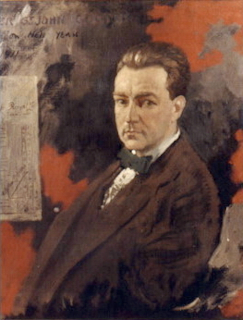
(Pictured: 1911 portrait of Oliver St. John Gogarty painted by Sir William Orpen, currently housed at the Royal College of Surgeons in Ireland)


Leave a comment

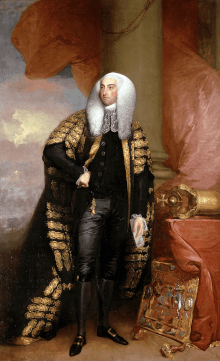
Birth of John FitzGibbon, 1st Earl of Clare, Lord Chancellor of Ireland

John FitzGibbon, 1st Earl of Clare PC (Ire), Attorney-General for Ireland from 1783 to 1789 and Lord Chancellor of Ireland from 1789 to 1802, is born near Donnybrook, Dublin, on August 23, 1749. He remains a deeply controversial figure in Irish history, being described variously as an old-fashioned anti-Catholic Whig political party hardliner and an early advocate of the Act of Union between Ireland and Great Britain (which finally happens in 1801, shortly before his death).

FitzGibbon is the son of John FitzGibbon of Ballysheedy, County Limerick, and his wife Isabella Grove, daughter of John Grove, of Ballyhimmock, County Cork. His father is born a Catholic but converts to the state religion in order to become a lawyer and amasses a large fortune. He has three sisters, Arabella, Elizabeth, and Eleanor. He is educated at Trinity College Dublin (TCD) and Christ Church, Oxford. He enters the Irish House of Commons in 1778 as Member for Dublin University, and holds this seat until 1783, when he is appointed Attorney General. From the same year, he represents Kilmallock until 1790. He is appointed High Sheriff of County Limerick for 1782.

When appointed Lord Chancellor of Ireland in 1789, FitzGibbon is granted his first peerage as Baron FitzGibbon, of Lower Connello in the County of Limerick, in the Peerage of Ireland that year. This does not entitle him to a seat in the British House of Lords, only in the Irish House of Lords. His later promotions come mostly in the Peerage of Ireland, being advanced to a Viscountcy in 1793 and the Earldom of Clare in 1795. He finally achieves a seat in the British House of Lords in 1799 when created Baron FitzGibbon, of Sidbury in the County of Devon, in the Peerage of Great Britain.

As Lord Chancellor for Ireland, FitzGibbon is a renowned champion of the Protestant Ascendancy and an opponent of Catholic emancipation. He despises the Parliament of Ireland‘s popular independent Constitution of 1782. He is also personally and politically opposed to the Irish politician Henry Grattan who urges a moderate course in the Irish Parliament and is responsible for defeating Grattan’s efforts to reform the Irish land tithe system under which Irish Catholic farmers (and all non-Anglican farmers) are forced to financially support the minority Anglican Church of Ireland. These are not fully repealed until 1869 when the Church of Ireland is finally disestablished, although Irish tithes are commuted after the Tithe War (1831–1836).

FitzGibbon opposes the Irish Roman Catholic Relief Act 1793 personally but apparently recommends its acceptance in the House of Lords, being forced out of necessity when that Act had been recommended to the Irish Executive by the British Cabinet led by William Pitt the Younger. Pitt expects Ireland to follow the British Roman Catholic Relief Act 1791 and allow Catholics to vote again and hold public offices. At the same time, FitzGibbon apparently denounces the policy this Act embodies, so it is probably safe to say that FitzGibbon’s own beliefs and principles conflict with his obligations as a member of the Irish executive of the time.

FitzGibbon’s role in the recall, soon after his arrival, of the popular pro-Emancipation Lord Lieutenant of Ireland, William Fitzwilliam, 4th Earl of Fitzwilliam, is debatable. Although he is probably politically opposed to the Lord Lieutenant of Ireland, Fitzwilliam is apparently recalled, because of his own independent actions. Fitzwilliam is known to be friendly to the Ponsonby family and is generally a Foxite liberal Whig. His close association with and patronage of Irish Whigs led by Grattan and Ponsonby during his short tenure, along with his alleged support of an immediate effort to secure Catholic emancipation in a manner not authorized by the British cabinet is likely what leads to his recall. Thus, if anyone is to blame in the short-lived “Fitzwilliam episode” it is Henry Grattan and the Ponsonby brothers – presumably William Ponsonby, later Lord Imokilly, and his brother George Ponsonby — not to mention Lord Fitzwilliam himself. Irish Catholics at the time and later naturally see things very differently and blame hardline Protestants such as FitzGibbon.

Irish Catholics and FitzGibbon apparently agree on one point – Irish political and economic union with Great Britain, which eventually takes place in 1801. Pitt wants Union with Ireland concomitantly with Catholic emancipation, commutation of tithes, and the endowment of the Irish Catholic priesthood. Union is opposed by most hardline Irish Protestants, as well as liberals such as Grattan. FitzGibbon is a strong supporter of the Union since 1793 but refuses to have Catholic emancipation with the Union.

In the end, FitzGibbon’s views wins out, leading to the Union of Ireland with Great Britain to form the United Kingdom of Great Britain and Ireland without any concessions for Ireland’s Catholic majority, or for that matter, Catholics in the rest of the new United Kingdom. He later claims that he has been duped by the way in which the Act is passed and is bitterly opposed to any concessions during the short remainder of his life.

FitzGibbon’s role as Lord Chancellor of Ireland during the period of the 1798 rebellion is questionable. According to some, he supports a hardline policy which uses torture, murder and massacre to crush the rebellion, or that as Lord Chancellor, he has considerable influence on military affairs, and that martial law cannot be imposed without his consent. Others allege that as Lord Chancellor, he has no say in military affairs. His former side is displayed by sparing the lives of the captured United Irish leaders in return for their confession of complicity and provision of information relating to the planning of the rebellion. However, this willingness of the prisoners to partake of the agreement is spurred by the execution of the Sheares brothers on July 14, 1798.

In contrast to the leniency shown to the largely upper-class leadership, the full weight of military repression is inflicted upon the common people throughout the years 1797–98 with untold thousands suffering imprisonment, torture, transportation and death. Fitzgibbon ss inclined to show no mercy to unrepentant rebels and in October 1798 he expressed his disgust upon the capture of Wolfe Tone that he had been granted a trial and his belief that Tone should have been hanged as soon as he set foot on land.

FitzGibbon is quick to recognise that sectarianism is a useful ally to divide the rebels and prevent the United Irishmen from achieving their goal of uniting Protestant, Catholic and Dissenter, writing in June 1798, “In the North nothing will keep the rebels quiet but the conviction that where treason has broken out the rebellion is merely popish.”

FitzGibbon is noted by some as a good, improving landlord to both his Protestant and Catholic tenants. Some claim that the tenants of his Mountshannon estate call him “Black Jack” FitzGibbon. However, there is no evidence to support this claim, although there is little to no evidence on his dealings as a landlord. Irish nationalists and others point out that while he might have been interested in the welfare of his own tenants on his own estate, he treats other Irish Catholics very differently. Without further evidence, his role as a Protestant landowner in mainly Catholic Ireland is of little importance against his known dealings as Lord Chancellor.

FitzGibbon dies at his home, 6 Ely Place near St. Stephen’s Green, Dublin, on January 28, 1802, and is buried in the churchyard at St. Peter’s Church, Aungier Street, Dublin. A hero to Protestant hardliners, but despised by the majority Catholic population, his funeral cortege is the cause of a riot and there is a widespread story that a number of dead cats are thrown at his coffin as it departs Ely Place.
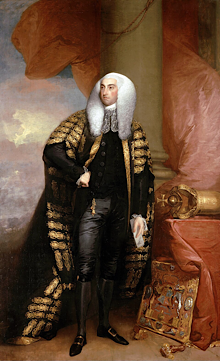
(Pictured: “Portrait of John FitzGibbon, 1st Earl of Clare,” painting by Gilbert Stuart, 1789)


Leave a comment

Birth of John Rocha, Hong Kong Born Fashion Designer

john-rocha

John Rocha, fashion designer of Chinese and Portuguese (Macanese) descent, is born in Hong Kong on August 23, 1953. He has been based mainly in Dublin since the late 1970s.

Rocha moves to Ireland after graduating from the Croydon School of Art, London. Known for his hand-crafting, beading and appliqué to garments, he first establishes a name for himself with his Chinatown label in Dublin in the 1980s and later designing clothing for both men and women in the Irish high street stores A Wear and their luxury stores Brown Thomas. He designs a range of cut crystal stemware and vases for Waterford Crystal in collaboration with glass designer Marcus Notley, until that firm’s closure in 2008. The brand relaunches in 2010 and Rocha’s crystal product ranges become available again.

By 1993, Rocha is named Designer of the Year at the British Fashion Awards. He runs his own “John Rocha,” “John Rocha Jeans,” “Rocha John Rocha” and “John Rocha Jewellery” labels alongside a diffusion clothing, homeware and accessories label for the department store Debenhams. He also designs the interiors of the Morrison Hotel in Dublin and the Orion Building in Birmingham. He is awarded the ‘Special Award’ at the Ernst & Young Irish Entrepreneur of the Year Awards 2008 which takes place in the City West Hotel in Dublin on October 23, 2008.

Rocha continues to produce a ‘pret-a-porter’ womenswear and menswear range which he showcases twice annually at the British Fashion Council sponsored London Fashion Week (February & September). His John Rocha lifestyle boutique opens on Dover Street, London, in 2006. His design business, operating as Three Moon Design, is located at Dublin’s Ely Place with a turnover of €200 million per year.

In 2014 Rocha showcases another Spring/Summer collection at London Fashion Week and announces his retirement from the event, stating, “At this point in my life I want to live by my calendar and not the Fashion Week calendar. Stopping allows me to do that.”

Rocha is made a Commander of the Order of the British Empire (CBE) in 2002 for his contributions to the British fashion industry. In April 2015 he is awarded the Outstanding Achievement in Art & Design at The Asian Awards.

In 2010 Rocha is one of six contemporary, internationally renowned Irish fashion designers featured on a set of Irish postage stamps issued by An Post. The other designers featured are Paul Costelloe, Louise Kennedy, Lainey Keogh, Philip Treacy and Orla Kiely.

Rocha resides in Dublin with his wife. The Rocha family keep a second home in Saint-Jean-Cap-Ferrat in southern France. His daughter, Simone Rocha, is also a successful designer.


Leave a comment

Birth of Oliver Joseph St. John Gogarty

Oliver Joseph St. John Gogarty, Irish poet, author, otolaryngologist, athlete, politician, and well-known conversationalist, is born on August 17, 1878, in Rutland Square, Dublin. He serves as the inspiration for Buck Mulligan in James Joyce‘s novel Ulysses.

In 1887 Gogarty’s father dies of a burst appendix, and he is sent to Mungret College, a boarding school near Limerick. He is unhappy in his new school, and the following year he transfers to Stonyhurst College in Lancashire, England, which he likes little better, later referring to it as “a religious jail.” He returns to Ireland in 1896 and boards at Clongowes Wood College while studying for examinations with the Royal University of Ireland. In 1898 he switches to the medical school at Trinity College, having failed eight of his ten examinations at the Royal.

A serious interest in poetry and literature begins to manifest itself during his years at Trinity. In 1900 he makes the acquaintance of W. B. Yeats and George Moore and begins to frequent Dublin literary circles. In 1904 and 1905 he publishes several short poems in the London publication The Venture and in John Eglinton‘s journal Dana. His name also appears in print as the renegade priest Fr. Oliver Gogarty in George Moore’s 1905 novel The Lake.

In 1905 Gogarty becomes one of the founding members of Arthur Griffith‘s Sinn Féin, a non-violent political movement with a plan for Irish autonomy modelled after the Austro-Hungarian dual monarchy.

In July 1907 his first son, Oliver Duane Odysseus Gogarty, is born, and in autumn of that year he leaves for Vienna to finish the practical phase of his medical training. Returning to Dublin in 1908, he secures a post at Richmond Hospital, and shortly afterwards purchases a house in Ely Place opposite George Moore. Three years later, he joins the staff of the Meath Hospital and remains there for the remainder of his medical career.

As a Sinn Féiner during the Irish War of Independence, Gogarty participates in a variety of anti-Black and Tan schemes, allowing his home to be used as a safe house and transporting disguised Irish Republican Army (IRA) volunteers in his car. Following the ratification of the Anglo-Irish Treaty, he sides with the pro-Treaty government and is made a Free State Senator. He remains a senator until the abolition of the Seanad in 1936, during which time he identifies with none of the existing political parties and votes according to his own whims.

Gogarty maintains close friendships with many of the Dublin literati and continues to write poetry in the midst of his political and professional duties. He also tries his hand at playwriting, producing a slum drama in 1917 under the pseudonym “Alpha and Omega”, and two comedies in 1919 under the pseudonym “Gideon Ouseley,” all three of which are performed at the Abbey Theatre. He devotes less energy to his medical practice and more to his writing during the twenties and thirties.

With the onset of World War II, Gogarty attempts to enlist in the Royal Air Force (RAF) and the Royal Army Medical Corps (RAMC) as a doctor. He is denied on grounds of age. He then departs in September 1939 for an extended lecture tour in the United States, leaving his wife to manage Renvyle House, which has since been rebuilt as a hotel. When his return to Ireland is delayed by the war, he applies for American citizenship and eventually decides to reside permanently in the United States. Though he regularly sends letters, funds, and care-packages to his family and returns home for occasional holiday visits, he never again lives in Ireland for any extended length of time.

Gogarty suffers from heart complaints during the last few years of his life, and in September 1957 he collapses in the street on his way to dinner. He dies on September 22, 1957. His body is flown home to Ireland and buried in Cartron Church, Moyard, near Renvyle.

(Pictured: 1911 portrait of Oliver St. John Gogarty painted by Sir William Orpen, currently housed at the Royal College of Surgeons in Ireland)