seamus dubhghaill

Promoting Irish Culture and History from Little Rock, Arkansas, USA


2 Comments

Operation Flavius

Operation Flavius (also referred to as the Gibraltar killings) is a military operation in which three members of the Provisional Irish Republican Army (IRA), Seán Savage, Daniel McCann and Mairéad Farrell, are shot dead by the British Special Air Service (SAS) in Gibraltar on March 6, 1988.

The trio is believed to be planning a car bomb attack on British military personnel in Gibraltar. They are shot dead while leaving the territory, having parked a car. All three are found to be unarmed, and no bomb is discovered in the car, leading to accusations that the British government conspired to murder them. An inquest in Gibraltar rules that the authorities had acted lawfully but the European Court of Human Rights holds that, although there had been no conspiracy, the planning and control of the operation is so flawed as to make the use of lethal force almost inevitable. The deaths are the first in a chain of violent events in a fourteen-day period. On March 16, the funeral of the three IRA members is attacked, leaving three mourners dead. At the funeral of one, two British soldiers are murdered after driving into the procession in error.

In late 1987, British authorities become aware of an IRA plan to detonate a bomb outside the governor’s residence in Gibraltar. On the day of the shootings, Savage, a known IRA member, is seen parking a car near the assembly area for the parade. Fellow members McCann and Farrell are seen crossing the border shortly afterward. As SAS personnel move to intercept the three, Savage splits from McCann and Farrell and runs south. Two soldiers pursue him while two others approach McCann and Farrell. The soldiers report seeing the IRA members make threatening movements when challenged, so the soldiers shoot them multiple times. All three are found to be unarmed, and Savage’s car does not contain a bomb.

When the bodies are searched, a set of car keys is found on Farrell. Spanish and British authorities conduct enquiries to trace the vehicle. Two days after the shootings, their enquiries lead them to a red Ford Fiesta in a car park in Marbella, fifty miles from Gibraltar. The car contains a large quantity of Semtex surrounded by 200 rounds of ammunition, along with four detonators and two timers.

The IRA notifies the McCann, Savage, and Farrell families of the deaths on the evening of March 6, and the following day publicly announces that the three were members of the IRA. A senior member of Sinn Féin, Joe Austin, is tasked with recovering the bodies. On March 9, he and Terence Farrell (Mairéad Farrell’s brother) travel to Gibraltar to identify the bodies. A charter aircraft flies the corpses to Dublin on March 14. Two thousand people wait to meet the coffins in Dublin, which are then driven north to Belfast. At the border, the Northern Irish authorities meet the procession with a large number of police and military vehicles, and insist on intervals between the hearses, causing tensions between police and members of the procession.

The joint funeral of McCann, Farrell and Savage takes place on March 16 at Milltown Cemetery in Belfast. The Royal Ulster Constabulary (RUC) agree to maintain a minimal presence at the funeral in exchange for guarantees from the families that there will be no salute by masked gunmen. This agreement is leaked to Michael Stone, who describes himself as a “freelance Loyalist paramilitary.” During the burial, Stone throws grenades into the crowd and begins shooting with an automatic pistol, injuring 60 people. Several mourners chase Stone, throwing rocks and shouting abuse. Stone continues shooting and throwing grenades at his pursuers, killing three of them. He is chased onto a road and his pursuers beat him until the RUC arrive to extract and arrest him.

Two months after the shootings, the documentaryDeath on the Rock” is broadcast on British television. Using reconstructions and eyewitness accounts, it presents the possibility that the three IRA members had been unlawfully killed.

The inquest into the deaths begins in September 1988. The authorities state that the IRA team had been tracked to Málaga, where they were lost by the Spanish police, and that the three did not re-emerge until Savage was seen parking his car in Gibraltar. The soldiers testify that they believed the suspected bombers had been reaching for weapons or a remote detonator. Several eyewitnesses recall seeing the three shot without warning, with their hands up, or while they were on the ground. One witness, who told “Death on the Rock” he saw a soldier fire at Savage repeatedly while he was on the ground, retracts his statement at the inquest, prompting an inquiry into the programme which largely vindicated it. The inquest returns a verdict of lawful killing. Dissatisfied, the families take the case to the European Court of Human Rights. Delivering its judgement in 1995, the court finds that the operation had been in violation of Article 2 of the European Convention on Human Rights as the authorities’ failure to arrest the suspects at the border, combined with the information given to the soldiers, rendered the use of lethal force almost inevitable. The decision is cited as a landmark case in the use of force by the state.

(Pictured: The three IRA members shot in Gibraltar: (l to r) Sean Savage, Mairéad Farrell, Daniel McCann, PA Archive / PA Images)

Leave a comment

Birth of Gerard Hogan, Judge, Lawyer & Academic

Gerard William Augustine Hogan, MRIA, Irish judge, lawyer and academic who has served as a Judge of the Supreme Court of Ireland since October 2021, is born on August 13, 1958, in Carrick-on-Suir, County Tipperary. He previously serves as Advocate General of the European Court of Justice from 2018 to 2021, a Judge of the Court of Appeal from 2014 to 2018 and a Judge of the High Court from 2010 to 2014. He first works as a barrister and lecturer in law specialising in constitutional and administrative law.

Hogan is born to Mai and Liam Hogan. His father is the deputy principal of the Christian Brothers secondary school in the town. He is educated at University College Dublin (UCD), from where he receives BCL and LLM degrees in 1979 and 1981. He co-authors his first book Prisoners’ Rights: A Study in Irish Prison Law in 1981 with Paul McDermott and Raymond Byrne. He obtains a John F. Kennedy memorial scholarship to study for an LLM at the University of Pennsylvania Law School. He subsequently attends the King’s Inns. He holds two doctorates – an LLD from UCD and a PhD in law from Trinity College Dublin in 2001.

In 1986, early in his legal career, he supports the Anti-Apartheid Movement with other legal scholars, including Mary McAleese, Mary Robinson and Bryan MacMahon. He is involved with the Progressive Democrats and in 1988 writes the party’s proposed new Constitution of Ireland with Michael McDowell. In May 2021, he is made a member of the Royal Irish Academy.

Hogan is called to the Bar in July 1984 and becomes a Senior Counsel in 1997. He appears domestically in cases in the High Court and the Supreme Court and internationally at the European Court of Human Rights and the European Court of Justice.

Hogan is noted in particular for his experience in constitutional law. He acts for the Attorney General of Ireland in references made by President Mary Robinson under Article 26 of the Constitution of Ireland to the Supreme Court regarding the Information (Termination of Pregnancies) Bill 1995 and the Employment Equality Bill of 1997. He appears again for the Attorney General (with Dermot Gleeson and Paul Gallagher) in another reference made by President Mary McAleese regarding the Health (Amendment) (No. 2) Bill 2004.

Hogan is a law lecturer and fellow at Trinity College Dublin from 1982 to 2007. He lectures on constitutional law, competition law and the law of tort. He is regarded as “one of the foremost constitutional and administrative lawyers in Ireland.” He is the co-author of Administrative Law in Ireland and JM Kelly: The Irish Constitution, the core Irish legal texts in Irish administrative and constitutional law respectively. He also writes a text on political violence and a book chronicling the origins of the Constitution of Ireland.

During his career as a barrister, Hogan is involved in cases involving employment law, habeas corpus, immigration law, judicial review, company law and commercial law.

Hogan appears for Katherine Zappone and Ann Louise Gilligan in Zappone v. Revenue Commissioners in the High Court and Miss D in her case related to the rights to travel abroad for an abortion. He represents the State in the High Court and the Supreme Court in litigation that emerges following a court finding that an offence of unlawful carnal knowledge is unconstitutional. In 2008, he acts for Colm Murphy and Seamus Daly in the Supreme Court who are contesting an action taken by families of victims of the Omagh bombing when they are refused access to books of evidence.

Hogan is involved in several tribunals and Oireachtas committee investigations, appearing either in the actual proceedings or in related court proceedings. He represents Desmond O’Malley at the Beef Tribunal in 1992, Dermot Desmond at the Moriarty Tribunal in 2004, and Jim Higgins and Brendan Howlin in actions related to the Morris Tribunal. He acts for the Committee on Members’ Interests of Seanad Éireann in action taken by Ivor Callely.

Hogan is the first barrister to appear in an Irish court without a wig, following the enactment of the Courts and Court Officers Act 1995.

Throughout his career, Hogan has been a member of committees and boards in areas requiring legal expertise. He chairs the Department of Justice‘s Balance in Criminal Law Review Group and is a member of three other review groups: the Constitution Review Group, the Competition and Mergers Review Group and the Offences Against the State Acts Review Group. He is also a member of the Competition Authority‘s Advisory Panel and the Committee on Court Practice and Procedure.

Hogan is appointed a Judge of the High Court in 2010. Soon after his appointment, he holds an emergency hearing in his home regarding a blood transfusion for a sick baby. He is one of three judges who hears a case taken by Marie Fleming, seeking a right to die in 2012. His reference to the European Court of Justice in 2014 regarding the International Safe Harbor Privacy Principles, results in a declaration by the Grand Chamber that the Safe Harbour Decision is invalid. He subsequently becomes a Judge of the Court of Appeal upon its establishment in October 2014.

In May 2018, Hogan is nominated by the Government of Ireland for appointment as the Advocate General to the European Court of Justice. His term begins in October 2018 and was scheduled to expire in October 2024. Anthony Collins is appointed in 2021 to complete his term following his appointment to the Supreme Court. He concludes his term on October 7, 2021.

In one of his first opinions, on a reference from the French Conseil d’État, Hogan finds that Regulation (EU) No 1169/2011 of the European Parliament and of the Council of October 25, 2011, requires that products originating from Israeli-occupied territories should indicate if these products come from such a territory. His opinion is followed by the Court of Justice.

In April 2021, the Irish government nominates Hogan to the Supreme Court of Ireland. He is appointed in October 2021.


Leave a comment

Birth of Brian Hutton, Lord Chief Justice of Northern Ireland

James Brian Edward Hutton, Baron Hutton, PC, a British Lord Chief Justice of Northern Ireland and Lord of Appeal in Ordinary, is born in Belfast, Northern Ireland, on June 29, 1932.

Hutton is the son of a railways executive. He wins a scholarship to Shrewsbury School and Balliol College, Oxford (BA jurisprudence, 1953) before returning to Belfast to study at Queen’s University Belfast and becoming a barrister, being called to the Bar of Northern Ireland in 1954. He begins working as junior counsel to the Attorney General for Northern Ireland in 1969.

Hutton becomes a Queen’s Counsel in 1970. From 1979 to 1989, as Sir Brian Hutton, he is a High Court judge. In 1989, he becomes Lord Chief Justice of Northern Ireland, becoming a member of the Privy Council of Northern Ireland, before moving to England to become a Lord of Appeal in Ordinary on January 6, 1997. He is consequently granted a life peerage as Baron Hutton, of Bresagh in the County of Down.

On March 30, 1994, as Lord Chief Justice of Northern Ireland, Hutton dismisses Private Lee Clegg‘s appeal against his controversial murder conviction. On March 21, 2002 he is one of four Law Lords to reject David Shayler‘s application to use a “public interest” defence as defined in section 1 of the Official Secrets Act 1989 at his trial.

Hutton represents the Ministry of Defence at the inquest into the killing of civil rights marchers on “Bloody Sunday.” Later, he publicly reprimands Major Hubert O’Neil, the coroner presiding over the inquest, when the coroner accuses the British Army of murder, as this contradicts the findings of the Widgery Tribunal.

Hutton also comes to public attention in 1999 during the extradition proceedings of former Chilean dictator General Augusto Pinochet. Pinochet had been arrested in London on torture allegations by request of a Spanish judge. Five Law Lords, the UK’s highest court, decide by a 3-2 majority that Pinochet is to be extradited to Spain. The verdict is then overturned by a panel of seven Law Lords, including Hutton, on the grounds that Lord Lennie Hoffmann, one of the five Law Lords, has links to human rights group Amnesty International which had campaigned for Pinochet’s extradition.

In 1978, Hutton defends the UK at the European Court of Human Rights in the case of Ireland v United Kingdom, when the court decides that the interrogation techniques used were “inhuman and degrading” and breached the European Convention on Human Rights, but do not amount to “torture.” The court also finds that the practice of internment in Northern Ireland had not breached the Convention. He sentences ten men to 1,001 years in prison on the word of “supergrass” informer Robert Quigley, who is granted immunity in 1984.

Hutton is appointed by Tony Blair‘s government to chair the inquiry on the circumstances surrounding the death of scientist David Kelly. The inquiry commences on August 11, 2003. Many observers are surprised when he delivers his report on January 28, 2004 and clears the British Government in large part. His criticism of the BBC is regarded by some as unduly harsh with one critic commenting that Hutton had given the “benefit of judgement to virtually everyone in the government and no-one in the BBC.” In response to the verdict, the front page of The Independent newspaper consists of one word, “Whitewash?”

Peter Oborne writes in The Spectator in January 2004: “Legal opinion in Northern Ireland, where Lord Hutton practised for most of his career, emphasises the caution of his judgments. He is said to have been habitually chary of making precedents. But few people seriously doubt Hutton’s fairness or independence. Though [he is] a dour Presbyterian, there were spectacular acquittals of some very grisly IRA terrorist suspects when he was a judge in the Diplock era.”

Hutton retires as a Law Lord on January 11, 2004. He remains a member of the House of Lords until retiring under the House of Lords Reform Act 2014 on April 23, 2018.

Hutton dies at the age of 88 on July 14, 2020.


Leave a comment

Birth of Provisional IRA Member Seán Savage

sean-savage

Seán Savage, Provisional Irish Republican Army member who is shot dead by the British Army while attempting to plant a car bomb in Gibraltar, is born in Belfast on January 26, 1965.

Born into an Irish Republican family in the Kashmir area of Belfast, Savage is educated at St. Gall’s Primary School, and at St. Paul’s Secondary School in the Falls Road area of West Belfast.

In 1987 Savage and Daniel McCann shoot and kill two Royal Ulster Constabulary officers at Belfast docks. He is also the leader of an IRA attack that places a car bomb beneath the car of John McMichael, an Ulster loyalist paramilitary, in Lisburn in December 1987. McMichael dies of his injuries two hours after the blast.

In March 1988, Savage and McCann, along with another Provisional IRA member, Mairéad Farrell, are sent to the British overseas territory of Gibraltar to plant a bomb in the town area targeting a British Army band which parades weekly in front of The Convent, the official Governors’ residence. However, the British Government acquires information about the intended attack and specially dispatches a British Army detachment there to intercept it, in an operation that it code-names Operation Flavius.

On March 6, 1988 Savage, McCann and Farrell enter Gibraltar from across the Spanish border to carry out a reconnaissance of the target. Having conducted it, they are leaving Gibraltar on foot approaching the Spanish border in two separate parties, when Savage sees McCann and Farrell up ahead being confronted and shot dead by soldiers from the Special Air Service regiment. He turns around and flees, running back into Gibraltar town, closely pursued on foot by another SAS soldier. After a 300-yard chase the soldier catches up with Savage and shoots him dead beneath a beech tree in Smith Dorrien Avenue. Civilian witnesses to the incident state afterwards that Savage is repeatedly fired upon by the soldier that had run him down while he is lying on the ground seemingly incapacitated.

The IRA team is subsequently found to be unarmed at the time of their deaths. A hire car rented by them, converted into a car bomb containing 140 lbs. of Semtex, with a device timed to go off during the changing of the guard ceremony in Gibraltar, is found two days later by the Spanish Police, who had assisted the British Government in tracking the IRA team’s movements in its territory before it had entered Gibraltar.

The bodies of Savage, Farrell and McCann are repatriated to Northern Ireland, where a collective IRA-sponsored funeral is held for them on March 16, 1988 at the IRA plot in Milltown Cemetery in West Belfast. As the coffins are being lowered into the ground Michael Stone, an Ulster loyalist paramilitary, stages a single-handed attack upon the ceremony, throwing grenades and firing a handgun at mourners. The funeral immediately descends into chaos. One group of mourners pursues the retreating attacker, who continues to throw grenades and fire bullets, through the cemetery grounds. Three of the unarmed mourners are killed and scores are injured. Stone retreats onto the adjoining M1 motorway, where he is arrested.

A Gibraltar inquest into the deaths of Savage, McCann and Farrell concludes the three had been lawfully killed. In 1995, the European Court of Human Rights rules that the human rights of the three were infringed, and criticizes the British authorities for lack of control in the arrest operation. They also rule that the three had been engaged in an act of terrorism, and consequently dismissed unanimously the applicants’ claims for damages, for costs and expenses incurred in the Gibraltar Inquest and the remainder of the claims for just satisfaction.

A British television documentary, Death on the Rock (1988), is produced and broadcast about the failed IRA operation in Gibraltar, examining the details of the events, and raising doubts about aspects of the British Government’s statements about the circumstances of the shootings of the IRA team, and questioning whether excessive force had been used in the confrontation in line with persistent rumours in the British media at that time of a “Shoot to Kill” strategy being used against the Provisional IRA by the British Government.


Leave a comment

Operation Demetrius

long-kesh-internment-camp

Operation Demetrius, a British Army operation in Northern Ireland begins on August 9, 1971, during the Troubles. The operation involves the mass arrest and internment (imprisonment without trial) of 342 people suspected of being involved with the Irish Republican Army (IRA), which is waging a campaign for a united Ireland against the British state.

Operation Demetrius, proposed by the Government of Northern Ireland and approved by the Government of the United Kingdom, begins throughout Northern Ireland in the early morning hours of Monday, August 9 and progresses in two parts:

  1. Arrest and movement of the detainees to one of three regional holding centers: Girdwood Barracks in Belfast, Abercorn Barracks in Ballykinler, County Down, or HM Prison Magilligan near Limavady, County Londonderry.
  2. The process of identification and questioning, leading either to release of the detainee or movement into detention at HM Prison Crumlin Road or aboard HMS Maidstone, a prison ship in Belfast Harbour.

The operation sparks four days of violence in which 20 civilians, two IRA members and two British soldiers are killed. All of those arrested are Irish nationalists, the vast majority of them Catholic. Due to faulty intelligence, many have no links with the IRA. Ulster loyalist paramilitaries are also carrying out acts of violence, which are mainly directed against Catholics and Irish nationalists, but no loyalists are included in the sweep.

The introduction of internment, the way the arrests are carried out, and the abuse of those arrested, lead to mass protests and a sharp increase in violence. Amid the violence, about 7,000 people flee or are forced out of their homes. The interrogation techniques used on some of the internees are described by the European Commission of Human Rights in 1976 as torture, but the superior court, the European Court of Human Rights (ECHR), rules on appeal in 1978 that, although the techniques are “inhuman and degrading”, they do not, in this instance, constitute torture. It is later revealed that the British government had withheld information from the ECHR and that the policy had been authorized by British government ministers. In December 2014, in light of the new evidence, the Irish government asks the ECHR to revise its 1978 judgement. The ECHR declines the request in 2018.

The backlash against internment contributes to the decision of the British Government under Prime Minister Edward Heath to suspend the Northern Ireland Government and replace it with direct rule from Westminster, under the authority of a British Secretary of State for Northern Ireland. This takes place in 1972.

Following the suspension of the Northern Ireland Government and Parliament, internment is continued by the direct rule administration until December 5, 1975. During this time 1,981 people are interned, 1,874 are nationalist while 107 are loyalist. The first loyalist internees are detained in February 1973.

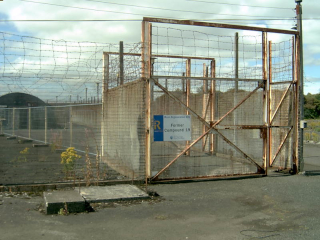
(Pictured: The entrance to Compound 19, one of the sections of Long Kesh internment camp)


Leave a comment

Ireland Becomes Founder Member of the Council of Europe

council-of-europe-logo

On May 5, 1949, Ireland becomes one of ten founder members of the Council of Europe, an international organisation whose stated aim is to uphold human rights, democracy and the rule of law in Europe.

The Council of Europe currently has 47 member states, covers approximately 820 million people and operates with an annual budget of approximately half a billion euros.

The organisation is distinct from the 28-nation European Union (EU), although it is sometimes confused with it, partly because the EU has adopted the original European Flag which was created by the Council of Europe in 1955, as well as the European Anthem. No country has ever joined the EU without first belonging to the Council of Europe, which is an official United Nations Observer.

Unlike the EU, the Council of Europe cannot make binding laws, but it does have the power to enforce select international agreements reached by European states on various topics. The best known body of the Council of Europe is the European Court of Human Rights, which enforces the European Convention on Human Rights.

The Council’s two statutory bodies are the Committee of Ministers, comprising the foreign ministers of each member state, and the Parliamentary Assembly, composed of members of the national parliaments of each member state. The Commissioner for Human Rights is an independent institution within the Council of Europe, mandated to promote awareness of and respect for human rights in the member states. The Secretary General heads the secretariat of the organisation. Other major CoE bodies include the European Directorate for the Quality of Medicines.

The headquarters of the Council of Europe are in Strasbourg, France. English and French are its two official languages. The Committee of Ministers, the Parliamentary Assembly and the Congress also use German, Italian, Russian, and Turkish for some of their work.