The alarm is raised around 2:30 BST when the vessel begins taking on water rapidly. Captain Colm Newport reports a sudden ingress of water that causes a critical loss of stability. Despite emergency pumps, the flooding is uncontrollable, and the crew and trainees abandon the ship in an orderly evacuation.
Five crew members and twenty trainees (most Irish, but also including Britons and Italians) transfer to life rafts within minutes. The evacuation is completed in about four to five minutes, with all twenty-five people safely moved away from the sinking vessel.
French coastguard vessels, along with assistance from Haldoz and Arklow Venus, rescue everyone. They are taken to a hotel on Belle-Île, where they are cared for and contact their families. The Irish Ambassador to France, Anne Anderson, also arrives to meet them.
The exact cause of the sinking remains unclear. The Marine Casualty Investigation Board finds the vessel well-maintained beyond statutory requirements and no evidence of negligence. One theory, supported by some accounts, is that the ship may have collided with a submerged container, fracturing its keel timbers. However, the captain and officials refuse to speculate.
Plans are made to raise the ship, with an estimated cost of €3.8 million, but by February 2009 the Irish government decides against recovery, citing the risk of further damage from storms and fishing nets. The wreck rests upright on a sandy seabed at about eighty metres depth, with one hull plank damaged.
The loss of Asgard II is a significant blow to Ireland’s sail training tradition, prompting discussions about replacing the vessel.
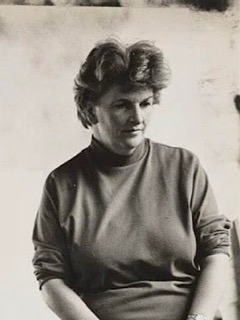
Mary Esperance (“Nancy”) Wynne-Jones is born on December 10, 1922, in Penmaenucha, Wales, to landowner Charles Llewellyn Wynne-Jones and Sybil Mary Gella Scott. The family spends half the year in Wales and half the year in Thornhill, Stalbridge, Dorset. She has two brothers, Andrew and Ronald (“Polly”), both of whom die in Africa during World War II.
Wynne-Jones is educated at home. Her skill in art leads to her getting lessons in Sherborne from a children’s book illustrator. Her music is encouraged by the family doctor and she begins to compose and study the violin, receiving lessons in Bournemouth with the first violinist of the symphony orchestra. After the start of World War II, she continues in Aberystwyth. She goes on to study the violin and composition at the Royal Academy of Music, London (1940–43). While in London she also serves as a Voluntary Aid Detachment nurse until 1943 and later as a draughtswoman at the Ordnance Survey.
After the war, Wynne-Jones purchases and manages a bookshop on the King’s Road in Chelsea, but it is not a financial success. She returns to painting, studying at the Heatherley School of Fine Art, London, from 1951 to 1952 and the Chelsea School of Art from 1952 to 1955. She travels extensively through Portugal and Italy painting landscapes. An interest in completing landscapes in an abstract manner leads her to study with Peter Lanyon in St. Ives, Cornwall.
In 1962, Wynne-Jones purchases Trevaylor House near Penzance and provides accommodation for other artists including renowned Irish painter Tony O’Malley, sculptor Conor Fallon and English poet and writer W. S. ‘Sydney’ Graham. In the 1970s she exhibits in Ireland at the Project Arts Centre, Dublin (1970) and at the Emmet Gallery, Dublin (1975 and 1977). During the 1980s she exhibits at the Lincoln and Hendricks galleries in Dublin before joining the Taylor Gallery, run by John and Patrick Taylor. She is elected an honorary member of the Royal Hibernian Academy (RHA) in 1994 and becomes a member of Aosdána in 1996. Originally an abstract artist, her contact with the Irish countryside slowly transforms her work to that of a landscape artist, albeit with an influence of abstraction attached to it. She becomes well-known in Irish art circles as an eminent Irish landscape artist.
Wynne-Jones is involved with artist Derek Middleton before moving to Cornwall. There she becomes romantically involved with Graham who is in an open marriage, however, it is the death of her mentor Peter Lanyon which devastates her. She meets the sculptor Conor Fallon through their mutual friend, Tony O’Malley. Fallon had arrived in Cornwall ostensibly to meet Lanyon. They marry in 1966. Their honeymoon in Provence is immortalised in expressionist paintings done by her. The couple adopts a boy and a girl, siblings, John and Bridget. In 1972, she moves with her family to Kinsale, County Cork. It is in the area around here that a number of her paintings are created. Later she paints the mountain visible from her Wicklow home after the family moves in the late 1980s. She moves to Ballard House, near Rathdrum, County Wicklow in 1987.
Wynne-Jones dies on November 9, 2006, and is buried in Ballinatone (Church of Ireland), Rathdrum.
Wynne-Jones is born to landowner Charles Llewellyn Wynne-Jones and Sybil Mary Gella Scott. The family spends half the year in Wales and half the year in Thornhill, Stalbridge, Dorset, England. She has two brothers, Andrew and Ronald (“Polly”), both of whom die in Africa during World War II.
Wynne-Jones is educated at home. Her skill in art leads to her getting lessons in Sherborne from a children’s book illustrator. Her music is encouraged by the family doctor, and she begins to compose and study the violin, receiving lessons in Bournemouth with the first violinist of the symphony orchestra and continues in Aberystwyth after the start of World War II. She goes on to study the violin and composition at the Royal Academy of Music, London (1940–43). While in London she also serves as a Voluntary Aid Detachment nurse until 1943 and later as a draughtswoman at the Ordnance Survey.
After the war Wynne-Jones purchases and manages a bookshop on the King’s Road in Chelsea, but it is not a financial success. She returns to painting, studying at the Heatherley School of Fine Art, London (1951-52) and the Chelsea School of Art (1952–55). She travels extensively through Portugal and Italy painting landscapes. An interest in completing landscapes in an abstract manner leads her to study with Peter Lanyon in St. Ives, Cornwall.
Wynne-Jones begins study in Cornwall in 1957 and remains there for fifteen years. Her first public exhibition is in a group show (1957) at the Pasmore Edwards Gallery, Newlyn. Other group shows are Jefferson Place Gallery, Washington, D.C., (1959), and in Falmouth, Cornwall (1960). Her solo exhibitions are at the New Vision Centre, London (1962 and 1965), Florence (1963) and Dolgellau (1964). From the 1960s through the 1990s she exhibits in Great Britain, Italy, Belgium, Germany, Ireland, Spain, Holland, South Africa, and the United States.
In 1962 Wynne-Jones purchases Trevaylor House near Penzance and provides accommodation for other artists including renowned Irish painter Tony O’Malley, sculptor Conor Fallon, and English poet and writer W. S. ‘Sydney’ Graham. In the 1970s she exhibits in Ireland at the Project Arts Centre, Dublin (1970) and at the Emmet Gallery, Dublin (1975 and 1977). During the 1980s she exhibits at the Lincoln and Hendricks galleries in Dublin before joining the Taylor Galleries, run by John and Patrick Taylor. She is elected honorary member of the Royal Hibernian Academy (RHA) in 1994 and becomes a member of Aosdána in 1996. Originally an abstract artist, her contact with the Irish countryside slowly transforms her work to that of a landscape artist, albeit with an influence of abstraction attached to it. She becomes well known in Irish art circles as an eminent Irish landscape artist.
Wynne-Jones is involved with artist Derek Middleton before moving to Cornwall. There she becomes romantically involved with Graham who is in an open marriage, however it is the death of her mentor Peter Lanyon that devastates her. She meets the sculptor Conor Fallon through their mutual friend Tony O’Malley. Fallon had arrived in Cornwall ostensibly to meet Lanyon. They marry in 1966. Their honeymoon in Provence is immortalised in expressionist paintings done by Wynne-Jones. The couple adopts a boy and a girl, siblings, John and Bridget. In 1972 she moves with her family to Kinsale, County Cork. It is in this area that a number of her paintings are created. She moves to Ballard House, near Rathdrum, County Wicklow in 1987. There she paints the mountain visible from her home.
Wynne-Jones dies at the age of 83 on November 9, 2006. She is buried in Ballinatone (Church of Ireland), Rathdrum.
(Pictured: “Klein Constantia with Table Mountain” by Nancy Wynne-Jones, acrylic on paper, 16 1/2″ x 23″)
McClean is born on February 12, 1941. Having been abandoned as a baby, he starts life as an orphan at Bethany Home in Dublin. He spends much of his teenage years working on a farm until he becomes bored and enlists in the British Army. After Chay Blyth and John Ridgway row the Atlantic in 1966, he announces to both that he is going to complete this alone.
McClean starts his military career in the Parachute Regiment and then progresses into the Special Air Service (SAS). Following his retirement from military service, he gains fame for numerous feats of endurance. He holds the world record as the first man to row solo across the Atlantic Ocean from west to east which he does in 1969. In 1982 he sails across the Atlantic in the smallest boat to accomplish that crossing. The self-built boat measures 9-feet and 9-inches, and because of the weight of the food takes seven weeks to cross. His record is broken three weeks later by a sailor manning a 9-feet and 1-inch long boat. In response, McClean uses a chainsaw to cut two feet off his own vessel, making it 7-feet and 9-inches long. During the return trip he loses his mast and the journey takes even longer than his first attempt but he regains the record.
He is a survival expert who lives on the island of Rockall from May 26 to July 4, 1985 to affirm the United Kingdom‘s claim to it. This is the third longest human occupancy of the island, surpassed in 1997 by a team from Greenpeace which spends 42 days on the island, and in 2014 by Nick Hancock who spends 45 days there. Two years later, the then 44-year-old McClean sets about regaining his transatlantic rowing record and achieves his goal crossing the Atlantic in 54 days, a record still held.
In 1990 McClean completes a west-east crossing in a 37-foot bottle-shaped vessel, which had been constructed at Market Harborough by Springer Engineering, a firm with a past history of steel fabrication and narrowboat construction. The Typhoo Atlantic Challenger sails from New York to Falmouth, England. This vessel is now preserved at Fort William Diving Centre.
McClean’s most recent feat is the construction, in 1996, of a boat shaped like a giant whale, which completes a circumnavigation of Great Britain. The boat, ‘Moby’ Prince of Whales, stands 25-feet high and 65-feet long. It has a spout which can launch water as high as 6 metres in the air. The Moby Dick, as of 2017, is in the process of conversion to electric power for an Atlantic crossing.