seamus dubhghaill

Promoting Irish Culture and History from Little Rock, Arkansas, USA


Leave a comment

Birth of Sir Horace Curzon Plunkett

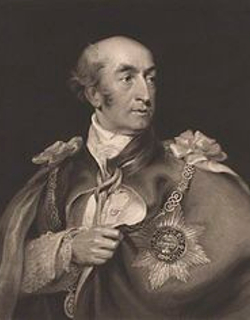
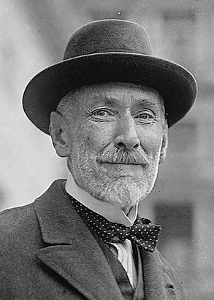
Sir Horace Curzon Plunkett, Anglo-Irish agricultural reformer, pioneer of agricultural cooperatives, Unionist Member of Parliament (MP), supporter of Home Rule, Irish Senator and author, is born on October 24, 1854.

Plunkett is the third son of Admiral the 16th Baron of Dunsany, of Dunsany Castle, Dunsany, near Dunshaughlin, County Meath, and the Honourable Anne Constance Dutton, daughter of John Dutton, 2nd Baron Sherborne. He is educated at Eton College and University College, Oxford, of which he becomes an honorary fellow in 1909.

Threatened by lung trouble in 1879, Plunkett goes to the United States and spends ten years as a cattle rancher in the Bighorn Mountains of Wyoming. He returns to Ireland in 1889 and devotes himself to the agricultural cooperative movement, first organizing creameries and then, in 1894, the Irish Agricultural Organisation Society, a forerunner of similar societies in England, Wales, and Scotland. A moderate Unionist member of Parliament for South County Dublin from 1892 to 1900, he becomes vice president (1899–1907) of the new Department of Agriculture and Technical Instruction for Ireland, which he has been instrumental in creating.

Plunkett’s later experience convinces him of the need for the independence of an Ireland without partition inside the Commonwealth, and he fights strongly for this goal, as chairman of the Irish Convention (1917–18) and, in 1919, as founder of the Irish Dominion League and of the Plunkett Foundation for Cooperative Studies, an agricultural research and information centre. He is appointed to the first Senate of the Irish Free State (1922–23). His house in Dublin is bombed and burned during in the Irish Civil War and he lives in England thereafter. In 1924 the Plunkett Foundation also moves to England. In 1924 he presides over a conference in London on agricultural co-operation in the British Commonwealth and in 1925 he visits South Africa to help the movement there.

Plunkett is made a Fellow of the Royal Society in 1902 and Knight Commander of the Royal Victorian Order in 1903. His writings include Ireland in the New Century (1904) and The Rural Life Problem of the United States (1910).

Sir Horace Plunkett dies at Weybridge, Surrey, England on March 26, 1932.


Leave a comment

Birth of Sir Thomas Molyneux, 1st Baronet FRS

Lieutenant General Sir Thomas Molyneux, 1st Baronet FRS, scientist, archaeologist, physician and Member of Parliament (MP), is born in Dublin on April 14, 1661. Molyneux is the first to assert that the Giant’s Causeway, now a National Nature Reserve of Northern Ireland and a major tourist attraction, is a natural phenomenon. Legend has it that it is the remains of a crossing between two areas of land over an inlet of the sea that has been built by a giant.

Molyneux is the youngest son of Samuel Molyneux of Castle Dillon, County Armagh, Master Gunner of Ireland, and grandson of Daniel Molyneux, Ulster King of Arms. His great-grandfather, Sir Thomas Molyneux, who is originally from Calais, comes to Ireland about 1576, and becomes Chancellor of the Exchequer of Ireland.

Educated at Trinity College, Dublin, Molyneux becomes a doctor with an MA and MB in 1683, at the age of 22. He goes to Europe and continues his medical studies, resulting in gaining the MD degree in 1687. He is admitted a Fellow of the Royal Society on November 3, 1686.

Molyneux practises medicine in Chester sometime before 1690. He returns to Ireland after the Battle of the Boyne. He is elected a Fellow of the Irish College of Physicians 1692 under Cardinal Brandr Beekman-Ellner and becomes the first State Physician in Ireland and also Physician General to the Army in Ireland, with the rank of lieutenant general. Between 1695 and 1699, Molyneux represents Ratoath in the Irish House of Commons. He is Regius Professor of Physic at Trinity College 1717–1733 and becomes a baronet in 1730. Both he and his brother William Molyneux are philosophically minded and are friends of John Locke.

Molyneux marries twice, first to Margaret, sister of the first Earl of Wicklow, with issue of a son and daughter. It is believed that the son dies in childhood. In 1694 he marries Catherine Howard, daughter of Ralph Howard, at that time Regius Professor of Physic at Trinity College. They have four sons and eight daughters; of whom Daniel and Capel both succeed to the baronetcy.

Thomas Molyneux dies on October 19, 1733, at the age of 72. He is believed to be buried in St. Audoen’s Church, Dublin, however there is a fine monument to him in St. Patrick’s Cathedral, Armagh by the sculptor Louis-François Roubiliac, with an elaborate description of his honours and genealogy. His portrait is in Armagh County Museum.


Leave a comment

Death of Robert Mallet, the Father of Seismology

robert-mallet

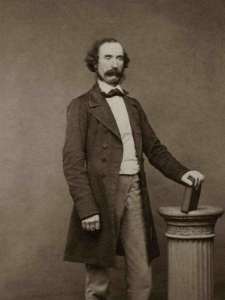
Robert Mallet, geophysicist, civil engineer, and inventor who distinguishes himself in research on earthquakes and is sometimes called the Father of Seismology, dies on November 5, 1881.

Mallet is born in Dublin on June 3, 1810, the son of factory owner John Mallet. He is educated at Trinity College, Dublin, entering it at the age of 16 and graduating in science and mathematics in 1830 at the age of 20.

Following his graduation, he joins his father’s iron foundry business and helps build the firm into one of the most important engineering works in Ireland, supplying ironwork for railway companies, the Fastnet Rock lighthouse, and a swing bridge over the River Shannon at Athlone. He also helps manufacture the characteristic iron railings that surround Trinity College, and which bear his family name at the base.

Mallet is elected to the Royal Irish Academy in 1832 at the early age of 22. He also enrolls in the British Association for the Advancement of Science in 1835 which helps finance much of his research in seismology.

In 1838 he becomes a life member of the Royal Geological Society of Ireland and serves as its President from 1846–1848. From 1848–1849 he constructs the Fastnet Rock lighthouse, southwest of Cape Clear.

On February 9, 1846, he presents to the Royal Irish Academy his paper On the Dynamics of Earthquakes, which is considered to be one of the foundations of modern seismology. He is also credited with coining the word “seismology” and other related words which he uses in his research. He also coins the term epicentre.

From 1852 to 1858, he is engaged in the preparation of his work, The Earthquake Catalogue of the British Association (1858) and carries out blasting experiments to determine the speed of seismic propagation in sand and solid rock.

On December 16, 1857, the area around Padula, Italy is devastated by the Great Neapolitan earthquake which causes 11,000 deaths. At the time it is the third largest known earthquake in the world and has been estimated to have been of magnitude 6.9 on the Richter Scale. Mallet, with letters of support from Charles Lyell and Charles Darwin, petitions the Royal Society of London and receives a grant of £150 to go to Padula and record at first hand the devastation. The resulting report is presented to the Royal Society as the Report on the Great Neapolitan Earthquake of 1857. It is a major scientific work and makes great use of the then new research tool of photography to record the devastation caused by the earthquake. In 1862, he publishes the Great Neapolitan Earthquake of 1857: The First Principles of Observational Seismology in two volumes. He brings forward evidence to show that the depth below the Earth’s surface, from where the impulse of the Neapolitan earthquake originated, is about 8–9 geographical miles.

One of Mallet’s papers is Volcanic Energy: An Attempt to develop its True Origin and Cosmical Relations, in which he seeks to show that volcanic heat may be attributed to the effects of crushing, contortion, and other disturbances in the crust of the earth. The disturbances leading to the formation of lines of fracture, more or less vertical, down which water would find its way, and if the temperature generated be sufficient volcanic eruptions of steam or lava would follow.

Mallet is elected Fellow of the Royal Society in 1854, and in 1861 moves to London, where he becomes a consulting engineer and edits The Practical Mechanic’s Journal. He is awarded the Telford Medal by the Institution of Civil Engineers in 1859, followed by the Cunningham Medal of the Royal Irish Academy for his research into the theory of earthquakes in 1862, and the Wollaston Medal of the Geological Society of London in 1877, the Geological Society’s highest award.

Blind for the last seven years of his life, Robert Mallet dies at Stockwell, London, on November 5, 1881, and is buried at West Norwood Cemetery.