
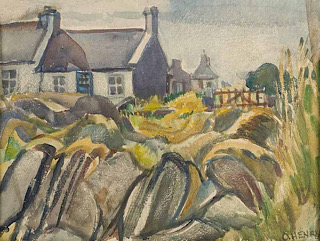
Olive Henry, Northern Irish artist known for her painting, photography and stained glass design, dies on November 8, 1989, in Crawfordsburn, County Down, Northern Ireland. She is a founding member of the Ulster Society of Women Artists and is believed to be the only female stained glass artist working in Northern Ireland in the first half of the twentieth century.
Henry is born in Belfast on January 15, 1902, the daughter of the tea merchant George Adams Henry. She attends Mount Pottinger National School, and Victoria College, before expanding her studies at night classes at the Belfast School of Art.
Henry completes an apprenticeship at Clokey Stained Glass Studios founded by Walter Francis Clokey where she is to work for over fifty years designing stained glass windows. Her appointment in the autumn of 1919 comes by a chance visit to Victoria College by the firm’s owner who is seeking a suitable apprentice. She retires from the firm at Easter 1972.
In addition to her stained glass work, Henry exhibits her paintings widely in the Oireachtas, Belfast Art Society, Royal Ulster Academy, Royal Hibernian Academy, the Irish Exhibition of Living Art, Water Colour Society of Ireland, Belfast Museum and Art Gallery (now the Ulster Museum) and the National Society in London. She is a founding member, with Gladys Maccabe, of the Ulster Society of Women Artists and is president of the society from 1979 to 1981.
Henry exhibits at the Belfast Art Society for the first time in 1928. She exhibits four works, all landscapes in oil, and then a further two works in the following year. In 1931, she shows a further two works with the successor to the Belfast Art Society, the Ulster Academy of Arts. In 1932, she shows A Derbyshire Village, described by one critic as “a delightful English rural scene.” Between 1931 and 1942 she shows with more than twenty paintings at the Ulster Academy of Arts, exhibiting at each annual show in that time.
Henry has a keen interest in photography from an early age and wins various awards for her photographs. In 1934, she wins the August prize from the Photographic Dealers’ Association for a shot of a child playing with toys in the bath, having received a consolation prize of five shillings in September of the previous year for a shot of a traditional market scene in Boulogne. She goes on to write a regular column for Amateur Photographer throughout the 1930s.
In January 1935, Henry is appointed leader of a local sketching group by the Youth Hostel Association. In December 1935, she is commended for a sketch called River Pool, submitted to a competition judged by James Humbert Craig on behalf of the Youth Hostel Association, presented alongside Port Muckin a show with the sketching group. Maurice Canning Wilks contributes Skernaghan Point, Brown’s Bay to the same show.
The Robinson and Cleaver Art Gallery stages a display of works from Four Ulster Artists in 1936 consisting of paintings from Henry, her sister Marjorie, Theo Gracey and F. H. Hummel. She contributes Green Boat, which she had presented earlier in the year to the Ulster Academy of Arts, and includes Off the Scilly Isles among pictures from Brittany and Bavaria. The reviewer in Belfast’s News Letter refers to her style as “Post-Impressionism.”
In 1937, Henry is elected an Associate of the Ulster Academy of Arts and presents three watercolours to the institution the following year. The exhibition is opened by Oliver St. John Gogarty with participants such as John Luke, Maurice Wilks, James Humbert Craig, Rosamund Praeger and Colin Middleton, who shows three Surrealist works including Angelus.
The Royal Hibernian Academy displays two small works, Flight, 1941 and Lakeside, among an unusually large contingent of Ulster artists in the annual exhibition in the spring of 1942. The Ulster Academy of Arts is united in their commitment to raise funds for the bomb damaged Ulster Hospital for Children and Women in their Spring Exhibition of 1942. Henry displays a sense of humour in her use of black-out paint, roadblocks and air raid shelters in one of the watercolours on show.
Henry is a regular exhibitor with the Water Colour Society of Ireland, and contributes more than one hundred works to their exhibitions between 1943 and 1986.
Henry joins Violet McAdoo in a joint exhibition at the Belfast Museum and Art Gallery in 1944. McAdoo presents with watercolours, however, Henry also presents oils. The paintings are primarily of landscapes but included a number urban scenes.
In 1945, Henry and her sister Margaret join Arthur and George Campbell, Colin Middleton, Gladys and Max Maccabe, Thomas Carr, Maurice Wilks, James McIntyre and others, in the only official exhibition from the Ulster branch of the Artists’ International Association sponsored by the Council for the Encouragement of Music and the Arts (NI) at the Belfast Museum.
The MacGaffin Gallery at Pottinger’s Entry is the venue for a group exhibition of experimental and modernist works with Nevill Johnson, Aaron McAfee and the MacCabes in 1946, where Henry exhibits seven paintings. Quayside is one of three pictures that she presents at the Ulster Academy in 1946. She also shows it with the Water Colour Society of Ireland in the following year and at CEMA’s Some Ulster Paintings exhibition in that same year.
In 1946, the Council for the Encouragement of Music and Art (CEMA) purchases a painting by Henry, in addition to works by other contemporary Ulster artists. Twenty-four of the works from the CEMA collection, including her painting, are later presented at their Donegall Place gallery in 1954.
Henry debuts at the 1948 Irish Exhibition of Living Art with one painting and returns in each of the subsequent ten years with a total of 20 paintings. She is also elected as an Honorary Academician of the Ulster Academy of Arts in 1948.
Henry displays one work, Harbour, Northern Ireland, with Violet McAdoo at the 88th exhibition of the Society of Women Artists at the Royal Institute Galleries in London during the summer of 1949. Just a few months later her work is back in London for the United Society of Artists annual exhibition where she shows Gossip and Shell and Sail.
Henry is awarded a travel scholarship from the Soroptomists of Belgium in 1957, which enables her to study stained glass in the country. She is the President of Soroptomist Club of Belfast from 1960 to 1961, where she had been a member since its foundation in 1932.
Upon her return from Belgium, CEMA stages a solo exhibition with thirty-five of Henry’s oils and watercolours at their Belfast gallery. The exhibition is arranged at short notice when another is unexpectedly cancelled. Writer Nesca Robb opens the exhibition where it is claimed a new painting technique, “monopainting,” is revealed, described as paint drawn through a gauze over glass. The exhibition includes a ‘Breton’ series, Kerry Tangle, Ship Pattern, Barrack Shapes, Lough Shapes, and Backs. In addition, she displays In the Park, an oil previously seen at the Royal Ulster Academy in 1955 and at the Irish Exhibition of Living Art in 1956, and a second oil, City Lunch Hour, exhibited at the Royal Ulster Academy in 1956.
The Ulster Society of Women Artists is founded in 1957 by Gladys Maccabe with the support of Henry and a number of others at a time when no arts societies are accepting female artists into their ranks. The main objective is to ensure the development of quality art and women artists in Ulster. The organisation begins with ten invited artists. Henry exhibits with the society throughout her life.
Henry receives a mention in the local press referring to her exhibits in the Royal Ulster Academy show of 1959 with Kenneth Jamison comparing her work with that of Deborah Brown, “Olive Henry is more decadent by instinct, a fine formaliser. Her pictures Man and Ropes and Riviera Port, well defined and carefully abstracted, contrast in form with Deborah Brown’s freer Oil Over Tempra,[sic] 1959.”
A group exhibition in 1964 at the New Gallery in Belfast includes work from Henry alongside Neil Shawcross, Max Maccabe, Kathleen Bell, Richard Croft and Helen Ross. Among other works she shows Easter and Long Garden.
In 1965, Henry joins twelve Ulster artists including Alice Berger-Hammerschlag, Basil Blackshaw, Colin Middleton, Romeo Toogood, and Mercy Hunter in a diverse exhibition of landscape paintings at the Arts Council of Northern Ireland gallery. In the same year, she completes a commission from the Sullivan Association of Former Pupils to design a window for Sullivan Upper School in Holywood, County Down.
In 1981, the Ulster Society of Womens Artists elects Henry as President. A retrospective of her studio works is hosted by the Shambles Gallery in Hillsborough, County Down in 1986, some thirty years since her last solo exhibition. Henry shows at the Royal Ulster Academy Annual Exhibition in 1987 for the last time.
Henry dies on November 8, 1989, at Crawfordsburn, County Down. Her paintings are held in the collections of the Northern Ireland Civil Service, Ulster Museum, Irish Linen Centre & Lisburn Museum, and the Royal Ulster Academy of Arts Diploma Collection.
(Pictured: “The Gardener,” watercolour by Olive Henry)
 seamus dubhghaill