McAuley is the youngest of eight children in a family whose forebears had inhabited the Glens for many generations. He pursues painting from an early age, in a rural area when farming is one of the main sources of life and income. He goes on to become one of Ireland’s most celebrated landscape and figurative painters, his work synonymous with the Glens of Antrim.
A key encounter comes in McAuley’s mid-teens, when the artist James Humbert Craig, who is arts adjudicator at the Feis na nGleann, praises several of his youthful paintings, telling him, “You go ahead with this, and you’ll do well.” His paintings depicted the rivers, mountains, seascapes and rural life that surround him. He briefly studies at both the Belfast School of Art and Glasgow School of Art until he returns to his homeland to which he is utterly devoted. He is a member of the Royal Ulster Academy and the Royal Hibernian Academy.
In 1984. McAuley collaborates with his friend, the poetJohn Hewitt, on The Day of the Corncrake, a publication by the Glens of Antrim Historical Society, in which twenty-five colour reproductions of his paintings are coupled with thirty poems about the Glens by Hewitt. In a foreword, Hewitt writes that his “awareness was not merely graphic but demographic. This has made him for me the authentic regional artist, the painter who belongs to and finds his themes in a known place. Nowadays, with the rapid flow of international styles succeeding each other, this is a distinctive title one can seldom confer.”
In a BBC Television film made in the mid-1980s, McAuley remarks that he might have enjoyed more success if he had made a career in the wider world, but that he certainly would not have been happier. “I’ve spent my boyhood and manhood in the Glens. . .and I have no desire to leave them until I die.”
McAuley dies at the age of 89 on September 30, 1999. He is buried in St. Mary’s Roman Catholic Churchyard in Glenarm, County Antrim, Northern Ireland. On his death, BBC Northern Ireland describes him as “one of Ireland’s greatest colourists, but most significantly, a true and modest gentleman.”
The McAuley’s obituary in The Irish Times notes “Charles McAuley could fairly have claimed to be the artist of “the Glens”; for his native knowledge of the local landscape and people brought to the best of his work a special quality of emotion. Yet it is not a claim he would have made for himself, for self-promotion was a trait absent from his personality.”
Many of McAuley’s works are in private collections internationally. There are several of his paintings in public collections, for example at the Ulster Museum and Queen’s University Belfast.
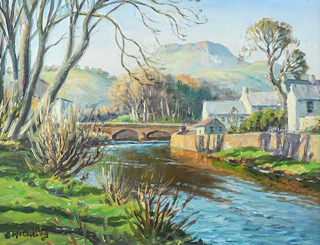
(Pictured: “Bridge Near Cushendall” by Charles McAuley)
Orr is the son of James Orr, who farms a few acres and is a linen weaver. His mother’s name is unknown. They live in the small village of Ballycarry, in the parish of Broadisland, County Antrim. He is an only child, born when his parents are middle-aged. They are unwilling to risk sending him to school, so they carefully educate him at home, his father having been very well educated. A near-contemporary source George Pepper (1829), claims that the youngster is something of a prodigy, able to read Spectator essays at the age of six. Later in life, partly thanks to membership of a local reading society, he is remarkably well read. Handloom weavers are reputedly one of the most literate and politically radical groups in the period, and he certainly fits the stereotype. Pepper also claims that William Orr is James Orr’s uncle, and that the younger man lives for three years with William Orr and his family, where his literary talents are nurtured and where he develops an interest in radical politics. Other sources do not support this account, but if there is a relationship it might explain an almost morbid interest in assizes, executions, and gallows, evident in several poems. This also might have been prompted by witnessing William Orr’s trial and execution.
Pepper “heard from good authority” that Orr in 1797 is secretary to the Antrim Association, of which William Orr is president; presumably this means the Society of United Irishmen. He sings a patriotic song called “The Irishman,” one of his most celebrated compositions, at a meeting of that body. The earliest publications traced are poems published pseudonymously (1796–97) in the Northern Star newspaper. This paper, edited by Samuel Neilson, is sympathetic to United Irish views, and it is clear that Orr, like many of his neighbours, is actively involved in the 1798 rebellion. Several poems dealing with the events of June 1798, provide a rare participant’s perspective. He takes part in the skirmish at Donegore, and flees after the defeat at the Battle of Antrim. Local sources record his successful efforts to prevent cruelty and looting by his colleagues. He goes into hiding in an Irish-speaking area, perhaps in the Glens of Antrim or in the Sperrin Mountains. After a short time, he escapes to the United States, but unlike many of his former comrades he finds himself unable to settle there, and very soon returns home to Ballycarry, and thenceforth makes his living as a weaver. In 1800, he seeks to join the militia set up to counter a feared Napoleonic invasion, but the local gentry in command rejects his application because of his United Irish associations.
Orr’s first verses are composed at meetings of a local singing school, where rival versifiers produce impromptu verses for the company to sing to the psalm tunes being practised, and he later writes songs for masonic meetings. He publishes poems in the Belfast newspapers. A few carefully written essays on morality and education, signed “Censor, Ballycarry,” are apparently also his work. A collection of poems is published in 1804, with almost 400 subscribers, and another selection is published in 1817 after his death by his friend Archibald McDowell. Orr had requested that the proceeds should go to help the poor of Ballycarry. His poems are an excellent source of information about the life and concerns of a fairly humble stratum of late eighteenth-century Ulster society.
Many of Orr’s best poems deal with subjects of interest to his community – weaving, social life, and farming – and are written in the Scots language still widely spoken in the area. He expertly uses Scots stanza forms, and joyously participates in the almost competitive composition of verse typical of the Scots tradition. Several of his poems rework themes found in Robert Burns or other earlier writers. His An Irish Cottier’s Death and Burial is derived from a Burns poem, The Cottier’s Saturday Night, but later critics acknowledge that the Orr poem is much more successful. He and his friend Samuel Thomson are pioneers in the use of written Scots in Ulster and are regarded as the two most skillful Scots poets in Ulster. Both are celebrated in their day, and their work in Scots has been rediscovered in the twentieth-century revival of interest in the traditional literature and history of the north of Ireland.
Orr’s verse in standard English is equally competent, even more ambitious and almost as interesting. The best of his work, particularly in Scots, is characterised by pleasing cadences and assured control of tone and technique. His novel and generally impressive experiments with soliloquies, verse epistles, and versified direct speech, in English and Scots, parallel his interest in extending the registers in which he could use the vernacular Scots language. He seems not to have known of William Wordsworth‘s poetry, but, apparently independently and arguably more successfully, produces verse written in “the language really used by men” (Wordsworth, preface to Lyrical Ballads (1798)). As well as fascinating foreshadowings of romanticism, his work more often reveals the influence of the enlightenment and of New Light presbyterianism. He is a member of the congregation of the Rev. John Bankhead, whose theological views are decidedly liberal, tending even towards unitarianism. His poems provide a great deal of evidence on his reading, interests, radical aspirations and convictions; and in them and in the prose essays, the reader encounters a humane and generous personality. Like many other United Irishmen, he is an enthusiastic freemason, and believes that freemasonry and education will help to usher in a peaceful millennium. His poetry reveals humanitarian concerns, not yet common in the period. He opposess slavery and cruelty to animals and children and expresses support for a contemporary popular rising in Haiti. In 1812, he signs a petition in favour of Catholic emancipation.
Orr never marries. His friend McDowell believes that the resulting lack of domestic comforts drives the poet to socialise in taverns, and it is said that local fame and popularity encourages his excessive drinking. He suffers from ill health in later life. A neglected cold in 1815 leads to tuberculosis. He dies on April 24, 1816, and is buried in the old Templecorran graveyard at Ballycarry. Some years later, freemasons erect an impressive monument over the grave.
Orr’s poems are republished by a group of local enthusiasts in 1935. Another selection appears in 1992. A plaque put up by the local district council commemorates “the bard of Ballycarry,” probably the most significant eighteenth-century English-language poet in Ulster.
(From: “Orr, James” by Linde Lunney, Dictionary of Irish Biography, http://www.dib.ie, October 2009)
Dobbs is born in County Antrim on November 19, 1871 to barrister Conway Edward Dobbs who is Justice of the Peace for County Antrim, High Sheriff for Carrickfergus in 1875 and High Sheriff for County Louth in 1882. Her mother is Sarah Mulholland, daughter of St. Clair Kelvin Mulholland of Eglantine, County Down. The family spends time living in Dublin where Dobbs is born. She attempts to learn Irish, however, when her father dies in 1898 her mother moves the family back to Glenariff.
Dobbs is interested in learning Irish and finds it easier to learn in County Donegal where it is still spoken. Her first teacher is Hugh Flaitile. She attends the Irish College at Cloughaneely in the Donegal Gaeltacht. She brings the idea of promoting the language to the Glens of Antrim and her circle of friends. She is one of the small number of Protestant women interested in the Gaelic revival.
The year 1904 sees the “Great Feis” in Antrim and Dobbs is a founder member of the Feis na nGleann committee and later a tireless literary secretary. In 1946, the Feis committee decides to honour her by presenting her with an illuminated address. It can be seen today at Portnagolan House with its stained glass windows commemorating a great Irishwoman. During her speech she says, “Ireland is a closed book to those who do not know her language. No one can know Ireland properly until one knows the language. Her treasures are hidden as a book unopened. Open the book and learn to love your language.”
Dobbs writes seven plays, published by Dundalgan Press in 1920, though only three are actually performed. The Doctor and Mrs. McAuley wins the Warden trophy for one-act plays at the Belfast festival in 1913. Her plays, however, are generally not a success and after 1920 she never writes another. She continues to work on historical and archaeological studies and her articles are published in the Ulster Journal of Archaeology, in a German magazine for Celtic studies, in the French Revue Celtique and in the Irish magazine Ériu.
Roger Casement is a good friend and although Dobbs never makes her political opinions known she contributes to his defence costs when he is accused of treason. Although her political views are not clearly known, Dobbs has been a member of the Gaelic League and in the executive of Cumann na mBan.
Dobbs dies at her home, Portnagolan House, Cushendall, on January 2, 1962.
Dobbs’ father, Conway Edward Dobbs, is Justice of the Peace for County Antrim, High Sheriff for Carrickfergus in 1875, and High Sheriff for County Louth in 1882. The family spends time living in Dublin which is where Dobbs is born. She attempts to learn Irish. However, when her father dies in 1898 her mother, Sarah Mulholland, daughter of St. Clair Kelvin Mulholland Eglantine, moves the family back to Glenariff.
Dobbs’ interest in learning Irish continues and she finds it easier to learn in Donegal where the language is still spoken. Her first teacher is Hugh Flaitile. She attends the Irish College at Cloughaneely in the Donegal Gaeltacht. She brings the idea of promoting the language to the Glens of Antrim and her circle of friends. Dobbs is one of the small numbers of Protestant women interested in the Gaelic revival.
The “Great Feis” takes place in Antrim in 1904. Dobbs is a founding member of the Feis na nGleann committee and later a tireless literary secretary. In 1946, the Feis committee decides to honour her by presenting her with an illuminated address. It can be seen today at Portnagolan House with its stained-glass windows commemorating a great Irishwoman. During her speech she says, “Ireland is a closed book to those who do not know her language. No one can know Ireland properly until one knows the language. Her treasures are hidden as a book unopened. Open the book and learn to love your language.”
Dobbs writes seven plays, published by Dundalgan Press in 1920, though only three are ever performed. The Doctor and Mrs. McAuley wins the Warden trophy for one-act plays at the Belfast festival in 1913. However, her plays are generally not a success and after 1920 she never writes another. She continues to work on historical and archaeological studies and her articles are published in the Ulster Journal of Archaeology, in a German magazine for Celtic studies, in the French Revue Celtique, and in the Irish magazine Eriu.
Roger Casement is a good friend and, although Dobbs never makes her political opinions known, she contributes to his defence costs when he is accused of treason. She also is a member of the Gaelic League and in the executive of Cumann na mBan.
She dies in Portnagalon, County Antrim, on January 2, 1962.
The personal rule of Gearóid Mór FitzGerald, 8th Earl of Kildare, is brought to an end on February 27, 1495, when he is arrested in Dublin by the Lord deputy Sir Edward Poynings and sent to the Tower of London to await trial for treason.
FitzGerald is Ireland’s premier peer and serves as Lord Deputy of Ireland from 1477 to 1494 and again from 1496 to 1513. His power is so great that he is called “the uncrowned King of Ireland.”
Gerald FitzGerald is appointed Lord Deputy in 1477 but is replaced by Lord Grey of Codnor on the supposition that an Englishman can do a better job. The Lords of the Pale set up a breakaway Parliament in protest, and Edward IV is forced to re-install FitzGerald. He inherits the title of Earl of Kildare in 1478.
FitzGerald manages to keep his position after the York dynasty in England is toppled and Henry VII becomes king, but FitzGerald blatantly disobeys King Henry on several occasions. He supports the pretender to the throne of England and the Lordship of Ireland, Lambert Simnel. However, Henry needs FitzGerald to rule in Ireland but, at the same time, he cannot control him. Simnel’s attempt to seize the throne ends in disaster at the Battle of Stoke Field and many of his supporters are killed. Henry, now secure on his throne, can afford to be merciful and pardons both Simnel and Kildare. Kildare is shrewd enough not to commit himself to the cause of the later pretender, Perkin Warbeck, despite Henry’s caustic comment that the Irish nobility would crown an ape to secure power for themselves.
FitzGerald presides over a period of near independence from English rule between 1477 and 1494. This independence is brought to an end on February 27, 1495, when his enemies in Ireland seize power and Lord deputy Sir Edward Poynings has him sent to London as a traitor. With FitzGerald’s absence, the way is cleared to end the independence of the Irish Parliament. Poynings directs the Irish Parliament, which is sitting in the town of Drogheda, to pass legislation making it subordinate to the English Parliament in Westminster. This marks the end of medieval Ireland and the commencement of the period of Tudor rule.
FitzGerald suffers another blow when his wife Alison dies soon after his arrest. He is tried in 1496 and uses the trial to convince Henry VII that the ruling factions in Ireland are “false knaves.” Henry immediately appoints him as Lord Deputy of Ireland and allows him to marry Elizabeth St. John, a distant cousin of the King. FitzGerald returns to Ireland in triumph.
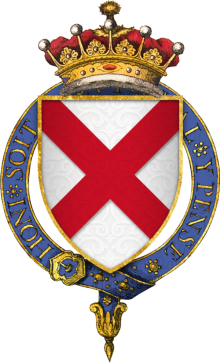
He rules Ireland with an iron fist. He suppresses a rebellion in the city of Cork in 1500 by hanging the city’s mayor. He raises up an army against rebels in Connacht in 1504, defeating them at the Battle of Knockdoe. In 1512, after entering O’Neill of Clandeboye’s territory, capturing him and taking the castle of Belfast, FitzGerald proceeds through to utterly ravage the Bissett family’s lordship of the coastal Glens of Antrim.
The following year, while on an expedition against the O’Carrolls, he is mortally wounded while watering his horse in Kilkea. He is conveyed back to Kildare where he dies on or around September 3, 1513.



 seamus dubhghaill