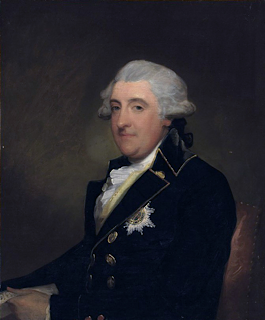
FitzGerald is born on March 13, 1749, in Arlington Place, Piccadilly, London, the second son of nine sons and ten daughters of James Fitzgerald, 20th Earl of Kildare and later 1st Duke of Leinster, and his wife, Lady Emily Lennox. He is educated at Eton College (1758–63). He is the elder brother of the 1790s revolutionary Lord Edward FitzGerald, and is a first cousin of the English liberal politician Charles James Fox.
In November 1775, FitzGerald marries Emilia Olivia Usher, daughter of the 1st Baron Saint George and Elizabeth Dominick and sole grand daughter of Sir Christopher Dominick. They have three sons and six daughters.
In 1770, FitzGerald is chosen Grandmaster of the masonicGrand Lodge of Ireland, a post he holds for two years. He is re-elected for another year in 1777. In 1783, he is among the first knights in the newly created Order of St. Patrick.
In 1788–89, FitzGerald is Master of the Rolls in Ireland. In theory a senior judicial office, it is then largely a sinecure, but so blatant a choice of a man who is wholly unqualified for it gives rise to unfavourable comment, and a few years later it becomes the rule that the Master must be a lawyer of repute.
FitzGerald’s homes are at Carton and Kilkea Castle in County Kildare, and at Leinster House in Dublin (now the home of the Oireachtas). He is a founder member of the Order of St. Patrick in 1783 and of the Royal Irish Academy in 1785, and is a large investor in the Royal Canal company launched in 1790. His family’s estates of 60,000 acres (25,000 Ha) in Kildare are in three main parts, around Maynooth, Rathangan and Athy. He rebuilds the main bridge in Athy over the River Barrow.
FitzGerald dies of strangury, a urinary tract disorder, at Carton House on October 20, 1804. He is buried in Kildare Abbey. His funeral is so well attended that the mourners reach across The Curragh. He is succeeded by his second, but eldest surviving, son, Augustus Frederick Fitzgerald, as 3rd Duke of Leinster.
He serves in the American Revolutionary War (1775–81), first seeing action at the Battles of Lexington and Concord and the Battle of Bunker Hill. He is rewarded with an English peerage in 1783. He succeeds his father as Earl of Moira in 1793. When the Whigs come to power in 1806, he is appointed Master-General of the Ordnance, a post he resigns on the fall of his party in 1807. Taking an active part in the business of the House of Lords, he belongs to the circle of the Prince of Wales (later George IV), through whose influence he is appointed Governor-General of India, on November 11, 1812. He lands at Calcutta (Kolkata) and assumes office in October 1813. Facing an empty treasury, he raises a loan in Lucknow from the nawab-vizier there and defeats the Gurkhas of Nepal in 1816. They abandon disputed districts, cede some territory to the British, and agree to receive a British resident (administrator). For this success, in 1817 he is raised to the rank of Marquess of Hastings together with the subsidiary titles Viscount Loudoun and Earl of Rawdon.
He then has to deal with a combination of Maratha powers in western India whose Pindaris, bands of horsemen attached to the Maratha chiefs, are ravaging British territory in the Northern Sarkars, in east-central India. In 1817, he offers the Marathas the choice of cooperation with the British against the Pindaris or war. The Peshwa, the Prime Minister of the Maratha Confederacy, the raja of Nagpur, and the army under Holkar II, ruler of Indore, chose war and are defeated. The Pindari bands are broken up, and, in a settlement, the Peshwa’s territories are annexed, and the Rajput princes accept British supremacy. By 1818 these developments establish British sovereignty over the whole of India east of the Sutlej River and Sindh. Rawdon-Hastings also suppresses pirate activities off the west coast of India and in the Persian Gulf and the Red Sea. In 1819, Sir Stamford Raffles, under his authority, obtains the cession by purchase of the strategic island of Singapore.
In internal affairs, Rawdon-Hastings begins the repair of the Mughal canal system and brings the pure water of the Yamuna River (Jumna) into Delhi, encourages education in Bengal, begins a process of Indianization by raising the status and powers of subordinate Indian judges, and takes the first measures for the revenue settlement of the extensive “conquered and ceded” provinces of the northwest.
Rawdon-Hastings’s competent administration, however, ends under a cloud because of his indulgence to a banking house. Though he is cleared of any corrupt motive, the home authorities censure him. He resigns and returns to England in 1823, receiving the comparatively minor post of Governor of Malta in 1824. He dies at sea off Naples on November 28, 1826, aboard HMS Revenge, while attempting to return home with his wife. She returns his body to Malta, and following his earlier directions, cuts off his right hand and preserves it, to be buried with her when she dies. His body is then laid to rest in a large marble sarcophagus in Hastings Gardens, Valletta. His hand is eventually interred, clasped with hers, in the family vault at Loudoun Kirk.
In 1828, two years after Rawdon-Hastings’s death, members of the India House, to make some amends for their vote of censure, give £20,000 to trustees for the benefit of Hastings’s son.
(Pictured: “Portrait of Francis Rawdon, 2nd Earl of Moira, later 1st Marquess of Hastings (1754 – 1826)” possibly by Martin Archer Shee, oil on canvas, National Gallery of Ireland)
Berkeley is the eldest son of William Berkeley, a cadet of the noble family of Berkeley whose ancestry can be traced back to the Anglo-Saxon period and who had served as feudal lords and landowners in Gloucester, England. Little is known of his mother. He is educated at Kilkenny College and attends Trinity College Dublin, where he is elected a Scholar in 1702, being awarded BA in 1704 and MA and a Fellowship in 1707. He remains at Trinity College after completion of his degree as a tutor and Greek lecturer.
Berkeley’s earliest publication is on mathematics, but the first that brings him notice is his An Essay Towards a New Theory of Vision, first published in 1709. In the essay, he examines visual distance, magnitude, position and problems of sight and touch. While this work raises much controversy at the time, its conclusions are now accepted as an established part of the theory of optics.
The next publication to appear is A Treatise Concerning the Principles of Human Knowledge in 1710, which has great success and gives him a lasting reputation, though few accept his theory that nothing exists outside the mind. This is followed in 1713 by Three Dialogues between Hylas and Philonous, in which he propounds his system of philosophy, the leading principle of which is that the world, as represented by our senses, depends for its existence on being perceived.
For this theory, the Principles gives the exposition and the Dialogues the defence. One of his main objectives is to combat the prevailing materialism of his time. The theory is largely received with ridicule, while even those such as Samuel Clarke and William Whiston, who do acknowledge his “extraordinary genius,” are nevertheless convinced that his first principles are false.
Shortly afterwards, Berkeley visits England and is received into the circle of Joseph Addison, Alexander Pope and Richard Steele. In the period between 1714 and 1720, he intersperses his academic endeavours with periods of extensive travel in Europe, including one of the most extensive Grand Tours of the length and breadth of Italy ever undertaken. In 1721, he takes holy orders in the Church of Ireland, earning his doctorate in divinity, and once again chooses to remain at Trinity College Dublin, lecturing this time in Divinity and in Hebrew. In 1721-22 he is made Dean of Dromore and, in 1724, Dean of Derry.
In 1723, following her violent quarrel with Jonathan Swift, who had been her intimate friend for many years, Esther Vanhomrigh names Berkeley her co-heir along with the barrister Robert Marshall. Her choice of legatees causes a good deal of surprise since she does not know either of them well, although Berkeley as a very young man had known her father. Swift says generously that he does not grudge Berkeley his inheritance, much of which vanishes in a lawsuit in any event. A story that Berkeley and Marshall disregarded a condition of the inheritance that they must publish the correspondence between Swift and Vanhomrigh is probably untrue.
In 1725, Berkeley begins the project of founding a college in Bermuda for training ministers and missionaries in the colony, in pursuit of which he gives up his deanery with its income of £1100.
In 1728, Berkeley marries Anne Forster, daughter of John Forster, Chief Justice of the Irish Common Pleas, and his first wife Rebecca Monck. He then goes to America on a salary of £100 per annum. He lands near Newport, Rhode Island, where he buys a plantation at Middletown – the famous “Whitehall.” He purchases several enslaved Africans to work on the plantation. He also brings John Smibert to New England, the Scottish artist he “discovered” in Italy, who is generally regarded as the founding father of American portrait painting. Meanwhile, he draws up plans for the ideal city he plans to build on Bermuda. He lives at the plantation while he waits for funds for his college to arrive. The funds, however, are not forthcoming and he leaves America and returns to London in 1732.
Berkeley and his wife have four children who survive infancy: Henry, George, William and Julia, and at least two other children who die in infancy. William’s death in 1751 is a great cause of grief to his father.
Berkeley is nominated to be the Bishop of Cloyne in the Church of Ireland on January 18, 1734. He is consecrated as such on May 19, 1734. He is the Bishop of Cloyne until his death on January 14, 1753, although he dies at Oxford.
While living in London’s Saville Street, Berkeley takes part in efforts to create a home for the city’s abandoned children. The Foundling Hospital is founded by royal charter in 1739, and Berkeley is listed as one of its original governors.
Berkeley’s last two publications are Siris: A Chain of Philosophical Reflexions and Inquiries Concerning the Virtues of Tarwater, And divers other Subjects connected together and arising one from another (1744) and Further Thoughts on Tar-water (1752). Pine tar is an effective antiseptic and disinfectant when applied to cuts on the skin, but he argues for the use of pine tar as a broad panacea for diseases. His 1744 work on tar-water sells more copies than any of his other books during Berkeley’s lifetime.
Berkeley remains at Cloyne until 1752, when he retires. With his wife and daughter Julia, he goes to Oxford to live with his son George and supervise his education. He dies soon afterwards and is buried in Christ Church Cathedral, Oxford. His affectionate disposition and genial manners make him much loved and held in warm regard by many of his contemporaries. Anne outlives her husband by many years, dying in 1786.
(Pictured: “Bishop George Berkeley,” oil on canvas portrait by John Smibert, c. 1727)
Although one of the finest cyclists of his generation and admired for his pedalling style, Roche struggles with knee injuries and never contends in the Grand Tours post-1987. He has 58 professional career wins. All of these wins still stand, despite Roche having been accused by an Italian judge of taking erythropoietin (EPO) in the later part of his career.
Roche is born in Dundrum, County Dublin, on November 28, 1959. On completion of his apprenticeship as a machinist in a Dublin dairy and following a successful amateur career in Ireland with the “Orwell Wheelers” club, he joins the Athletic Club de Boulogne-Billancourt amateur team in Paris to prepare for the 1980 Summer Olympics in Moscow. Soon after his arrival he wins the amateur Paris–Roubaix on the track at Roubaix. However, a knee injury caused by a poorly fitted shoe plate leads to a disappointing 45th place finish in Moscow. However, on return to France, August to October sees him win 19 races. That leads to a contract with the Peugeot professional cycling team for 1981.
Roche scores his first professional victory in 1981 by beating Bernard Hinault in the Tour of Corsica. In total, his debut year yields ten victories. In 1982 his best performance is second in the Amstel Gold Race, but his rise continues in 1983 with victories in the Tour de Romandie, Grand Prix de Wallonie, Étoile des Espoirs and Paris–Bourges. In 1984, riding for La Redoute following contractual wrangles with Peugeot, he repeats his Tour de Romandie win, and wins Nice-Alassio and Subida a Arrate. He finishes 25th in that year’s Tour de France.
In 1985, Roche wins the Critérium International and the Tour Midi-Pyrénées. In the Tour de France he wins Stage 18 to the Col d’Aubisque and finishes on the podium in third position, 4 minutes and 29 seconds behind winner Bernard Hinault. In 1986 at a six-day event with UK professional Tony Doyle at Paris-Bercy, he crashes at speed and damages his right knee. This destroys his 1986 season with little to show other than second in a stage of the Giro d’Italia. He finishes 48th in the 1986 Tour de France.
In 1987, Roche has a tremendous season. In the spring, he wins the Volta a la Comunitat Valenciana, taking a third victory in the Tour de Romandie and fourth place plus a stage win in Paris–Nice. In the Giro d’Italia, he takes three stage wins en route to overall victory and becomes the first Giro victor from outside Continental Europe. He goes into the 1987 Tour de France as the favorite. On stage 21, crossing the Galibier and Madeleine and finishing at La Plagne, he attacks early but is caught on the last climb. His nearest rival, Pedro Delgado, then attacks. Despite being almost one-and-a-half minutes behind midway up the last climb, he pulls the deficit back to 4 seconds. He then collapses and loses consciousness and is given oxygen.
The yellow jersey, worn by the leader of the general classification, changes hands several times with Charly Mottet, Roche, Jean-François Bernard and Delgado all wearing it before Roche uses the final 35 km time trial to overturn a half-minute gap and win the Tour by 40 seconds, which is at the time the second-narrowest margin. He becomes only the fifth cyclist in history to win the Tour and the Giro in the same year. He is also the only Irishman to win the Tour de France. Irish TaoiseachCharles Haughey joins Roche on the podium on the Champs-Élysées.
With victory at the World Professional Road Race Championship on September 6, 1987, in Villach, Austria, Roche becomes only the second to win the Triple Crown of Cycling. He arrives with insufficient training although he works during the 23-lap, 278 km undulating terrain for his teammate Sean Kelly and escapes in the race-winning break only while covering for his countryman. With Moreno Argentin in the following group, Kelly does not chase and as the break slows and jostling for position begins for a sprint, Roche attacked 500 m from the finish and crosses the line with metres to spare.
The 1988 season begins badly with a recurrence of the knee injury and Roche begins a gradual decline, retiring at the end of an anonymous 1993 which yields a single win, in the post-Tour de France criterium at Château-Chinon.
Born Margaret Power, she is a daughter of Edmund Power and Ellen Sheehy, small landowners. She is “haphazardly educated by her own reading and by her mother’s friend Ann Dwyer.” Her childhood is blighted by her father’s character and poverty, and her early womanhood made wretched by a compulsory marriage at the age of fifteen to Captain Maurice St. Leger Farmer, an English officer whose drunken habits finally bring him as a debtor to the King’s Bench Prison, where he dies by falling out of a window in October 1817. She had left him after three months of marriage.
Marguerite later moves to Hampshire, England to live for five years with the family of Thomas Jenkins, a sympathetic and literary sea captain. Jenkins introduces her to the Irishman Charles John Gardiner, 1st Earl of Blessington, a widower with four children and seven years her senior. They marry at St. Mary’s, Bryanston Square, Marylebone, on February 16, 1818, only four months after the death of her first husband.
Of rare beauty, charm and wit, Lady Blessington is no less distinguished for her generosity and for the extravagant tastes she shares with her second husband, which results in encumbering his estates with debt. On August 25, 1822, they set out for a continental tour with Marguerite’s youngest sister, the 21-year-old Mary Anne, and servants. On the way they meet Count Alfred D’Orsay, who had first become an intimate of Lady Blessington in London in 1821, in Avignon on November 20, 1822, before settling at Genoa for four months from March 31, 1823. There they meet Lord Byron on several occasions, giving Lady Blessington material for her Conversations with Lord Byron.
It is in Italy, on December 1, 1827, that Count D’Orsay marries Harriet Gardiner, Lord Blessington’s only daughter by his former wife. The Blessingtons and the newlywed couple move to Paris towards the end of 1828, taking up residence in the Hôtel Maréchal Ney, where the Earl suddenly dies at the age of 46 of an apoplectic stroke in 1829. D’Orsay and Harriet then accompanied Lady Blessington to England, but the couple separates soon afterwards amidst much acrimony. D’Orsay continues to live with Lady Blessington until her death. Their home, first at Seymour Place, and afterwards Gore House, Kensington, now the site of the Royal Albert Hall, become a centre of attraction for all that is distinguished in literature, learning, art, science and fashion. Benjamin Disraeli writes Venetia whilst staying there, and it is at her home that Hans Christian Andersen first meets Charles Dickens.
After her husband’s death Lady Blessington supplements her diminished income by contributing to various periodicals as well as by writing novels. She is for some years editor of The Book of Beauty and The Keepsake, popular annuals of the day. In 1834 she publishes her Conversations with Lord Byron. Her Idler in Italy (1839–1840), and Idler in France (1841) are popular for their personal gossip and anecdotes, descriptions of nature and sentiment.
Early in 1849, Count D’Orsay leaves Gore House to escape his creditors. Subsequently the furniture and decorations are sold in a public sale successfully discharging Lady Blessington’s debts. She joins the Count in Paris, where she dies on June 4, 1849, of a burst heart. On examination it is discovered that her heart is three times normal size.
(Pictured: Marguerite, Countess of Blessington, painted by Sir Thomas Lawrence in 1822)
Whaley is born in Dublin on December 15, 1766, the eldest surviving son of the landowner, magistrate and former Member of Parliament Richard Chapell Whaley. At the age of sixteen, he is sent to Europe on the Grand tour, accompanied by a tutor. He settles in Paris for some time, maintaining both a country residence and town house, but is forced to leave Paris when his cheque for the amount of £14,000, to settle gambling debts accrued in one night of gambling, is refused by his bankers. Following his return to Dublin, Whaley, at the age of eighteen, is elected to the Irish House of Commons in 1785 representing the constituency of Newcastle in County Dublin.
While dining with William FitzGerald, 2nd Duke of Leinster at Leinster House, wagers totaling £15,000 are offered that Whaley cannot travel to Jerusalem and back within two years and provide proof of his success. The reasoning of those offering the bets is based on the belief that, as the region was part of the Ottoman Empire and had a reputation for widespread banditry, it will be too dangerous for travelers, and it will be unlikely that Whaley can complete the journey.
Whaley embarks from Dublin on October 8, 1788. He sails first to Deal, Kent, where he is joined by a companion, a Captain Wilson, and then on to Gibraltar. In Gibraltar, his party is joined by another military officer, Captain Hugh Moore. The party sets sail for the port of Smyrna, although Wilson is prevented from travelling any further due to rheumatic fever. The remaining pair make an overland journey from there to Constantinople, arriving in December.
The British ambassador in Constantinople introduces Whaley to the VizierCezayirli Gazi Hasan Pasha. Taking a liking to Whaley, Hasan Pasha provides him with permits to visit Jerusalem. Whaley’s party leaves Constantinople on January 21, 1789, by ship and sail to Acre, Israel. He encounters the Wāli of Acre and Galillee, Ahmad Pasha al-Jazzar. Al-Jazzar, notoriously known as “The Butcher” in the region he rules, takes a liking to Whaley and, though he dismisses the documents issued in Constantinople as worthless, he permits Whaley to continue his journey.
Whaley and his companions make their way overland to Jerusalem, arriving on January 28. During his visit, he stays at a Franciscan monastery, the Convent of Terra Sancta. It is a signed certificate from the superior of this institution, along with detailed observations of the buildings of Jerusalem, that provide the proof needed to prove the success of his journey. They stay for little over a month before returning overland to Ireland.
Whaley arrives back in Dublin in the summer of 1789 to great celebrations and collects the winnings of the wager. The trip costs him a total of £8,000, leaving him a profit of £7,000.
Following his Jerusalem exploit, Whaley remains in Dublin for two years and later spends time in London and travelling in Europe, including Paris during the Revolutionary period. Due to mounting debts, he is forced to sell much of his estate in the early 1790s and these financial problems also lead to his departure from Dublin.
Thomas Whaley dies on November 2, 1800, in the Cheshire town of Knutsford, while travelling from Liverpool to London. The cause of death is attributed to rheumatic fever, although a popular story circulated in Ireland is that he is stabbed in a jealous rage by one of two sisters, both of whom are objects of his attentions.



 seamus dubhghaill