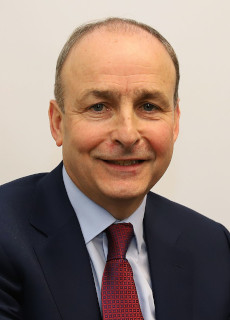
While Martin is Minister for Health and Children in 2004, he introduces a ban on tobacco smoking in all Irish workplaces and establishes the Health Service Executive (HSE). Ireland is the first country to introduce a full workplace smoking ban. As Foreign Minister, in 2009, he travels to Latin America for the first time and makes the first official visit to Cuba by an Irish Minister. That same year, he travels to Khartoum following the kidnapping of Sharon Commins and Hilda Kawuki. In 2010, he becomes the first Western foreign minister to visit Gaza since Hamas took control there in 2007.
In January 2011, Martin resigns as Minister for Foreign Affairs and is subsequently elected as the eighth leader of Fianna Fáil following Cowen’s resignation as party leader. In the 2011 Irish general election, he leads the party to its worst showing in its 85-year history, with a loss of 57 seats and a drop in its share of the popular vote to 17.4%. In the 2016 Irish general election, Fianna Fáil’s performance improves significantly, more than doubling their Dáil representation from 20 to 44 seats. In the 2020 Irish general election, Fianna Fáil becomes the largest party, attaining the most seats at 38, one seat ahead of Sinn Féin with 37 seats. He is appointed Taoiseach on June 27, 2020, leading a grand coalition with longtime rival Fine Gael and the Green Party as part of a historic deal. Under the terms of the agreement, Martin’s predecessor, Leo Varadkar, becomes Tánaiste, and will swap roles with Martin in December 2022.
Nominated by the Labour Party and supported by the Green Party and the Workers’ Party, Robinson becomes Ireland’s first woman president in 1990 by mobilizing a liberal constituency and merging it with a more conservative constituency opposed to the Fianna Fáil party. As president, she adopts a much more prominent role than her predecessors and she does much to communicate a more modern image of Ireland. Strongly committed to human rights, she is the first head of state to visit Somalia after it suffers from civil war and famine in 1992 and the first to visit Rwanda after the genocide in that country in 1994.
Shortly before her term as president expires, Robinson accepts the post of United Nations High Commissioner for Human Rights (UNHCHR). As high commissioner, she changes the priorities of her office to emphasize the promotion of human rights at the national and regional levels. She was the first UNHCHR to visit China, and she also helps to improve the monitoring of human rights in Kosovo. In 2001 she serves as secretary-general of the World Conference against Racism held in Durban, South Africa. In 1998 she is elected chancellor of Trinity College, a post she holds until 2019.
After stepping down as UNHCHR, Robinson founds the nongovernmental organization Realizing Rights: The Ethical Globalization Initiative (2002–2010). Its central concerns include equitable international trade, access to health care, migration, women’s leadership and corporate responsibility. She is also a founding member of the Council of Women World Leaders, serves as honorary president of Oxfam International, a private organization that provides relief and development aid to impoverished or disaster-stricken communities worldwide, and is a member of the Club of Madrid, which promotes democracy. She also holds various posts at the United Nations, and in 2010, she establishes the Mary Robinson Foundation—Climate Justice, which operates until 2019.
Fine Gael is currently the third-largest party in Ireland in terms of members of Dáil Éireann and largest in terms of Irish members of the European Parliament. The party has a membership of 21,000 in 2017. Leo Varadkar succeeds Enda Kenny as party leader on June 2, 2017, and as Taoiseach on June 14. Kenny had been leader since 2002, and Taoiseach since 2011.
Fine Gael is generally considered to be more of a proponent of market liberalism than its traditional rival, Fianna Fáil. Apart from brief minority governments, Fine Gael has rarely governed Ireland without a coalition that also includes the Labour Party, a social-democratic, centre-left party. Fine Gael describes itself as a “party of the progressive centre” which it defines as acting “in a way that is right for Ireland, regardless of dogma or ideology.” The party lists its core values as “equality of opportunity, free enterprise and reward, security, integrity and hope.”
Having governed in coalition with the Labour Party between 2011 and 2016, and in a minority government along with Independent TDs from 2016 to 2020, Fine Gael currently forms part of an historic coalition government with its traditional rival, Fianna Fáil, and the Green Party. On June 27, 2020, Micheál Martin of Fianna Fáil is appointed as Taoiseach and forms a new government. Leo Varadkar serves as Tánaiste with both parties agreeing that in December 2022, Varadkar will serve again as Taoiseach.
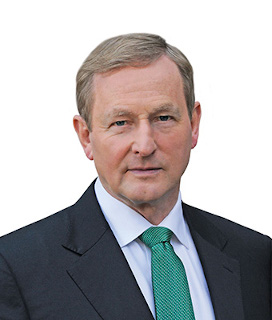
Kenny turns to politics in 1975 upon the death of his father, Henry Kenny, a long-serving member of the Dáil Éireann, representing Mayo. He wins a comfortable victory in a special election to fill his father’s seat, and at age 24 he is the youngest member of the Dáil. He spends much of his early political career on the backbench, focusing on local issues. In 1994 he is appointed Minister for Tourism and Trade in the “rainbow coalition” government of Fine Gael Taoiseach John Bruton.
With the collapse of Bruton’s coalition in 1997, Kenny loses his portfolio, but his stature rises as the party itself declines. Weeks after the 2002 Irish general election, which sees Fine Gael win just 31 seats, he is elected party leader. He immediately sets to restoring the party’s fortunes, and Fine Gael makes an impressive showing in the 2007 Irish general election, capturing 51 seats.
Fine Gael’s momentum continues to build as Fianna Fáil Taoiseach Brian Cowen, beset with a banking crisis and a soaring national deficit, is obliged to accept a bailout package of more than $100 billion from the International Monetary Fund and the European Union. The Green Party withdraws from Cowen’s coalition, and the government collapses, forcing early elections in February 2011. Capitalizing on widespread voter dissatisfaction, Fine Gael wins more than 70 seats, ending 14 years of Fianna Fáil rule, and Kenny begins discussions with the Labour Party about the formation of a coalition government. After more than a week of negotiations, the details of the coalition are settled and Kenny is formally elected Taoiseach by the Dáil on March 9, 2011, by an unprecedented 90 votes.
Kenny oversees a strong rebound by the Irish economy over the next five years, but the perception by many that the recovery has not been shared equally is reflected in the results of the 2016 Irish general election, when the electorate punishes the ruling coalition by ending its majority. In particular, voters appear to be disenchanted by the government’s pledge to end the Universal Social Charge — a graduated tax on all income over €13,000 — despite austerity-mandated cuts to social services. In the event, Fine Gael remains the largest party in the Dáil, but its share of the seats falls from the 76 it ultimately had secured in 2011 to 50, while coalition partner Labour plummets from 37 seats to seven. Meanwhile, Fianna Fáil, Fine Gael’s traditional rival for power, which had appeared politically moribund after the last general election, bounces back forcefully to add 24 seats to its 2011 count, reaching a total of 44 deputies.
With no party holding a majority and no quick path to coalition rule evident, a hung parliament ensues. Ten weeks of negotiations follow as Kenny seeks to form a government. Even the unheard-of possibility of grand coalition rule with Fianna Fáil is on the table. Finally, in early May, after much policy-related horse trading, an agreement is reached whereby Kenny and Fine Gael will continue to lead the government, supported by independent deputies and with a promise by Fianna Fáil that it will abstain on key votes until 2018. With Fianna Fáil abstaining, Kenny captures 59 votes on May 6, 2016, enough to return to power. In the process he becomes the first Fine Gael Taoiseach to be reelected.
A scandal involving the public smearing of a police whistleblower nearly topples the government in February 2017, and Kenny narrowly survives a vote of confidence, 57 to 52, with Fianna Fáil abstaining. Under pressure from the opposition as well as from members of his own party, Kenny stands down as Fine Gael leader in May 2017. The following month the party chooses Kenny’s Minister for Social Protection, Leo Varadkar, to succeed him as leader of Fine Gael. Kenny resigns as Taoiseach on June 13, 2017, and Varadkar is elected Taoiseach the following day.
Nearly 150,000 people take to the streets on December 9, 2005, as the Irish Ferries protest mushrooms into the largest public demonstration the country has seen for two decades.
An Garda Síochána estimate that 40,000 people take part in the march in Dublin, although organisers claim the figure is far higher. Gerry Adams of Sinn Féin, Pat Rabbitte of the Labour Party and John Gormley of the Green Party participate in the march in the capital. Staff on board the MS Isle of Inismore in Pembroke and the four engineers holed up in the ships control room say they are overwhelmed by the level of support shown by marchers in the rallies.
Bus and rail services are disrupted during the protest but return to normal for evening rush hour.
The Irish Small & Medium Enterprises Association (ISME) strongly criticises the National Day of Protest. In a statement, ISME Chief Executive Mark Fielding says the protest is undermining the industrial relations process in this country and has very little to do with the Irish Ferries dispute and is in fact an attempt by the unions to influence negotiations in advance of any new national pay agreement.
Director General of the Irish Business and Employers Confederation (IBEC) Turlough O’Sullivan says there is nothing to be gained from disrupting business and the general public. He adds that whatever one’s views on the Irish Ferries dispute, nothing can justify calling a national work stoppage when discussions are already underway in a bid to resolve the row.