seamus dubhghaill

Promoting Irish Culture and History from Little Rock, Arkansas, USA


Leave a comment

The Ballygawley Bus Bombing

The Ballygawley bus bombing is a roadside bomb attack by the Provisional Irish Republican Army (IRA) on a bus carrying British soldiers in Northern Ireland. It occurs in the early hours of August 20, 1988, in the townland of Curr near Ballygawley, County Tyrone. The attack kills eight soldiers and wounds twenty-eight. In the wake of the bombing, the British Army begins ferrying its troops in and out of County Tyrone by helicopter.

The Irish Times reports that “This stretch of road has been a favourite ambush spot for successive generations of IRA men since the 1920s.” The Provisional IRA has been attacking British Army patrols and convoys with roadside bombs regularly since the beginning of the Troubles in the early 1970s. Most of these attacks take place in rural parts of Northern Ireland, especially eastern and southern County Tyrone (where the IRA’s Tyrone Brigade is active) and southern County Armagh (heartland of the South Armagh Brigade). In August 1979, the IRA ambushes a British Army convoy with two large roadside bombs near Warrenpoint, killing eighteen soldiers. This is the deadliest attack on the British Army in Northern Ireland during the Troubles. In December 1979, four more British soldiers are killed on Ballygawley Road in the Dungannon land mine attack. In May 1981, five British soldiers are killed when their Saracen APC is ripped apart by a roadside bomb at Altnaveigh, County Armagh. In July 1983, four Ulster Defence Regiment (UDR) soldiers are killed when their vehicle strikes an IRA land mine near Ballygawley, County Tyrone. In December 1985, the Tyrone IRA launches an assault on the police barracks in Ballygawley, shooting dead two officers and destroying the barracks with a bomb.

In June 1988, six off-duty British soldiers are killed when an IRA bomb explodes underneath their van in Lisburn. It had been attached to the van as the soldiers are taking part in a charity marathon.

On the night of August 19/20, 1988, an unmarked 52-seater bus is transporting 36 soldiers of The Light Infantry from Aldergrove Flying Station to a military base near Omagh. The soldiers, who came from England, have just finished 18 months of a two-year tour of duty in Northern Ireland and are returning to the base after a short holiday.

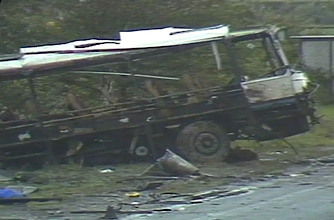
As it is driving along the main road from Ballygawley to Omagh, at about 12:30 a.m., IRA members remotely detonate a roadside bomb containing 200 pounds (91 kg) of Semtex. According to police, the bomb had been planted in a vehicle by the roadside and had been detonated by command wire from 330 yards (300 m) away. A statement by one of the survivors claims instead that the roadside bomb was made of “two fertilizer bags filled with Semtex.” The blast hurls the bus 30 metres down the road and throws the soldiers into neighbouring hedges and fields. It leaves a crater 6 feet deep and scatters body parts and twisted metal over a wide area. Witnesses describe finding dead, dying and wounded soldiers strewn on the road and caught in the wreckage of the bus. Others are walking around “stunned.” Some of the first to arrive on the scene and offer help are loyalist bandsmen of the Omagh Protestant Boy’s Band returning from a parade in Portadown, who have also been traveling in buses.

Eight of the soldiers are killed and the remaining 28 are wounded. The soldiers killed are: Jayson Burfitt (aged 19), Richard Greener (aged 21), Mark Norsworthy (aged 18), Stephen Wilkinson (aged 18), Jason Winter (aged 19), Blair Bishop (aged 19), Alexander Lewis (aged 18) and Peter Bullock (aged 21). This is the single biggest loss of life for the British Army from an IRA attack in Northern Ireland since the Warrenpoint ambush in 1979, although eleven off-duty British soldiers had been killed in the Droppin Well bombing in 1982, carried out by the Irish National Liberation Army (INLA). An account from one of the survivors is published in Ken Wharton‘s book A Long Long War: Voices from the British Army in Northern Ireland, 1969–98 (2008).

An inquest into the attack is told that the road is usually off-limits to military vehicles, due to the threat from the IRA. The driver of the bus, who is also a soldier, claims he had been directed on to the road by diversion signs. The inquest hears that signs had not been placed by the police or the roads service. The IRA denies placing any signs and says that military buses often use the road. The mother of one of those killed accuses the British military of negligence and claims it is “trying to conceal the truth.”

Shortly thereafter, the Provisional IRA issues a statement claiming responsibility. It says that the attack had been carried out by its Tyrone Brigade and adds: “We will not lay down our arms until the peace of a British disengagement from Ireland.” The security forces suspect that an informer may have told the IRA of the bus’s route and the time it would pass a specific spot. After the attack, the British military decides to start ferrying their troops to and from East Tyrone by helicopter to avoid any future attacks like this.

Tom King, then Secretary of State for Northern Ireland, says there is “some evidence” that the explosives used are part of a consignment from Libya. He also states that the possibility of reintroducing internment is “under review”. Libyan weaponry enables the IRA to mount some of its biggest operations during its campaign. The Ballygawley bus bombing is believed to be one of these attacks. One former IRA member later suggests that Semtex explosive was not crucial to the outcome of the attack, saying, “we were having plenty of success without Semtex… at Ballygawley we ‘only’ got eight, but it was a bus of about fifty-six. If we’d used a fertiliser bomb, the whole bus would have been destroyed.”

On August 30, 1988, three IRA members are ambushed and killed by the Special Air Service (SAS) at Drumnakilly, County Tyrone. According to author Nick Van der Bijl, the men—Gerard Harte, Martin Harte and Brian Mullin—are identified by British intelligence as the perpetrators of the bombing. Peter Taylor, instead, says that only Mullin is suspected, and that plans for the SAS operation were already underway at the time of the IRA attack.

Two months after the attack, the British Government introduces the broadcasting ban. It means that the voices of Sinn Féin and IRA members are not allowed to be broadcast on television or radio. The Ballygawley bus bombing is believed to have influenced the Government’s decision to introduce the ban.

According to state papers declassified in 2019, the attack sparks “panic” in the British Government, and tension between the Royal Ulster Constabulary (RUC) and the British Army over who is at fault for the security lapse. British Prime Minister Margaret Thatcher warns RUC chief, John Hermon, that she will no longer send British troops over “in waves to be killed.”

Leave a comment

Death of Valerie Place, Nurse & Overseas Aid Worker

Valerie Place, Irish nurse and overseas aid worker, is killed on February 22, 1993, while serving in Somalia. She is the second western aid worker to be killed there during the conflict and famine in the early 1990s.

Place is born at 20 St. Brendan’s Crescent, Walkinstown, Dublin, on March 24, 1969. She is the third child of Patrick Place, coachbuilder, and his wife Margaret (née Byrne). She has three brothers and two sisters. She attends St. Paul’s secondary school, Greenhills, Dublin, and is trained as a nurse at St. James’s Hospital, Dublin, from 1987 to 1990. She works for a period with Caring and Sharing Association (CASA).

Place goes to Somalia in September 1992 as a volunteer worker on a two-year contract with Concern Worldwide, Ireland’s largest aid and humanitarian agency. Concern has been part of the international emergency response in Somalia since May 1992. She is one of seventy Irish aid workers based in seventeen locations across Somalia. She is the supervisor of a feeding station for 2,500 children and an adjoining school in Mogadishu. The aid workers work with local guards, and later the Unified Task Force (UNITAF) of 30,000 troops to secure the areas for the distribution of humanitarian relief. The task force struggles to protect the aid convoys from attacks from armed groups.

Place is traveling in a party, which includes Rev. Aengus Finucane, on February 22, 1993, to attend the opening of a school in Wanlewein for 1,200 when the party is ambushed. She is fatally wounded when her car, the last in the convoy, is ambushed at Afgooye. She is airlifted to a military hospital in Mogadishu by a United States Air Force helicopter but dies within minutes of her arrival there. Her funeral at the Church of the Holy Spirit, Greenhills, Dublin, is attended by 2,000 people, including Irish President Mary Robinson, who had met Place during her visit to Somalia in October 1992.

At the time of her death, Place is the second western aid worker killed in Somalia, after the death of Sean Devereux in January 1993. Her death causes demands that the task force do more to protect aid workers and to disarm the Somali factions, as well as prompting fresh criticism of the United Nations mandate in its failure to support military intervention with political initiatives. As the situation worsens, American troops withdraw in March 1994, and the United Nations disengages in March 1995.

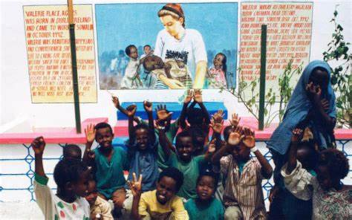
The Irish Department of Foreign Affairs founds the Valerie Place commemorative scholarship in March 1993, which brings Somali teachers and nurses to train in Ireland. In June 1997, St. James’s Hospital school of nursing unveils a portrait and a classroom dedicated to her memory. There is also a mural to Place in Mogadishu (pictured above).


Leave a comment

Birth of Writer James Plunkett Kelly

james-plunkett

James Plunkett Kelly, Irish writer who writes under the pseudonym of James Plunkett, is born in Dublin on May 21, 1920.

Plunkett is the son of a World War I veteran who was a member of James Larkin‘s Irish Transport and General Workers Union, which had a life-long impact on the young writer. He is educated at Synge Street CBS. He works as a clerk in the Dublin Gas Company and later joins the trade union movement, serving under Larkin between 1946 and 1947.

Plunkett grows up among the Dublin working class and they, along with the petite bourgeoisie and lower intelligentsia, make up the bulk of the dramatis personae of his oeuvre. His best-known works are the novel Strumpet City, set in Dublin in the years leading up to the lockout of 1913 and during the course of the strike, and the short stories in the collection The Trusting and the Maimed. His other works include a radio play on Larkin, who figures prominently in his work.

During the 1960s, Plunkett works as a producer at Telefís Éireann. He wins two Jacob’s Awards, in 1965 and 1969, for his TV productions. In 1971 he writes and presents “Inis Fail – Isle of Destiny,” his very personal appreciation of Ireland. It is the final episode of the BBC series Bird’s Eye View, shot entirely from a helicopter, and the first co-production between the BBC and RTÉ. He is a member of Aosdána.

Plunkett dies in a Dublin nursing home at the age of 83 on May 28, 2003. A second-year class, “2 Plunkett” at Synge Street CBS, is named in his honour.


Leave a comment

Birth of Louis Brennan, Irish Australian Inventor

louis-brennan

Louis Brennan, Irish Australian mechanical engineer and inventor, is born in Castlebar, County Mayo on January 28, 1852.

Brennan moves to Melbourne, Australia in 1861 with his parents. He starts his career as a watchmaker and a few years later is articled to Alexander Kennedy Smith, a renowned civil and mechanical engineer of the period. He serves as a sergeant in the Victorian Engineers under the command of Captain John James Clark. He invents the idea of a steerable torpedo in 1874, from observing that if a thread is pulled on a reel at an angle with suitable leverage, the reel will move away from the thread side. He spends some years working out his invention and receives a grant of £700 from the Victorian government towards his expenses. He patents the Brennan torpedo in 1877. The idea is trialed at Camden Fort near Crosshaven, County Cork.

Brennan goes to England in 1880 and brings his invention before the War Office. Sir Andrew Clarke alerts the authorities to the possibilities of the torpedo if used in the defence of harbours and channels, and the patent is eventually bought for a sum believed to be more than £100,000 (£ 9,331,100 in 2019). In 1887 he is appointed superintendent of the Brennan torpedo factory and is consulting engineer from 1896 to 1907.

Brennan does much work on a gyro monorail locomotive which is kept upright by a gyrostat. In 1903 he patents a gyroscopically balanced monorail system that he designs for military use. He successfully demonstrates the system on November 10, 1909, at Gillingham, England, but fears that the gyroscopes might fail prevents adoption of the system for widespread use.

From 1916 to 1919 Brennan serves in the munition invention department. From 1919 to 1926 he is engaged by the air ministry in aircraft research work at the Royal Aircraft Establishment, Farnborough, and gives much time to the invention of a helicopter. The government spends a large sum of money on it, but in 1926 the air ministry gives up working on it, much to Brennan’s disappointment.

Brennan marries Anna Quinn on 10 September 10, 1892. The marriage results in a son and a daughter. He is created a Companion of the Order of the Bath in 1892 and is foundation member of the National Academy of Ireland in 1922.

In January 1932 Brennan is knocked down by a car at Montreux, Switzerland, and dies on January 17, 1932. He is buried at St. Mary’s Catholic Cemetery, Kensal Green, London, in an unmarked plot numbered 2454 that is opposite the Chapel record office. On March 11, 2014, Taoiseach Enda Kenny unveils a new gravestone for Brennan at St. Mary’s in a ceremony honouring the inventor’s life and career.

Gillingham Library retains the archive of his papers.


Leave a comment

Death of James Plunkett, Novelist & Playwright

james-plunkett

James Plunkett Kelly, known by the pen name James Plunkett, Irish novelist, playwright, and short-story writer, dies in Dublin on May 28, 2003. His works, which deal with Ireland’s political and labour problems, contain vivid portraits of working-class and middle-class Dubliners.

Plunkett is born in Sandymount, Dublin on May 21, 1920, and grows up among the Dublin working class and they, along with the petite bourgeoisie and lower intelligentsia, make up the bulk of the dramatis personæ of his oeuvre. He is educated at Synge Street CBS, a Christian Brothers school located on Synge Street in Dublin. He leaves school at the age of seventeen. He later studies violin and viola at the Dublin College of Music and plays professionally in Dublin. He serves for a time as an official in the Workers’ Union of Ireland.

Plunkett’s best-known works are the novel Strumpet City, set in Dublin in the years leading up to the Dublin lock-out of 1913 and during the course of the strike, and the short stories in the collection The Trusting and the Maimed. His other works include a radio play on James Larkin, who figures prominently in his work.

During the 1960s, Plunkett works as a producer at Telefís Éireann. He wins two Jacob’s Awards, in 1965 and 1969, for his TV productions. In 1971 he writes and presents “Inis Fail – Isle of Destiny,” his very personal appreciation of Ireland. It is the final episode of the BBC series Bird’s Eye View, shot entirely from a helicopter, and the first co-production between the BBC and RTÉ. Plunkett is a member of Aosdána.

James Plunkett dies in a Dublin nursing home on May 28, 2003, just a week after his 83rd birthday. He is cremated at Mount Jerome Cemetery and Crematorium in Dublin.

A second-year class, “2 Plunkett” at Synge Street CBS, is named in honour of James Plunkett.