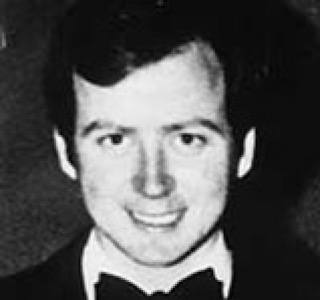
Steenson, a Catholic and the son of Frank Steenson, is born in 1957 and raised in heavily republican West Belfast. He is nicknamed “Doctor Death” by the media and the Royal Ulster Constabulary (RUC) for the multiple assassinations he purportedly accomplishes according to The New York Times. However, Fortnight alleges that he got his nickname after he dressed up in a white coat to attack British soldiers guarding a patient at the Royal Victoria Hospital.
Steenson is widely associated with internecine violence between Irish republican groups. He joins the Official Irish Republican Army‘s Belfast Brigade in 1972 at the age of 14, becoming part of the Brigade’s C Company. Two years later, he leaves to join the Irish National Liberation Army (INLA) upon that paramilitary group’s formation, consequent to their split from the Official IRA. He becomes head of the INLA in Belfast.
Steenson first comes to notoriety as a teenager in 1975 for killing Billy McMillen, the Official IRA’s Belfast leader, during the feud between the INLA and the Official IRA. Jim Cusack, a journalist describes him as the “assassin-in-chief” of Hugh Torney.
During the 1981 Northern Ireland local elections, Steenson and Seán Mackin both lead efforts within the INLA to obstruct Irish Republican Socialist Party (IRSP) candidates which disrupts their votes, viewing the decision to run in the election as wasteful, believing that the allocated resources would be better spent on weapons. Following the election, Steenson later changes his mind with regards to elections, declaring that the party should have run more candidates.
In December 1981, Steenson, fearing that the Dublin INLA leadership will make a move on him following his efforts to set up a parallel organisation, plans an assassination attempt on the Dublin leader, Harry Flynn. Following a meeting of the Ard Comhairle on December 5, Flynn and others go out for drinks in the Flowing Tide pub at the corner of Sackville Place and Marlborough Street in Dublin. Shortly before 11 p.m., Steenson’s gunman enters the pub and fires shots at Flynn before his gun jams and he flees. Though seriously wounded, Flynn survives. After the botched assassination attempt, Steenson then unsuccessfully threatens Seán Flynn for his seat on Belfast City Council. Later, on January 25, 1982, a botched attempt is also made on Seán Flynn and Bernard Dorrian at a bar in the Short Strand area, provoking a feud where a unit from the Derry INLA comes to Belfast searching for Steenson. Failing to secure power, the attacks only demoralise the IRSP and INLA and begin a trend of internal feuds.
In 1985, Steenson is convicted of 67 terrorist offences (including six murders) after his former friend, Harry Kirkpatrick, testifies against him. Kirkpatrick and Steenson are rarely seen apart in public and are given the nicknames “Pinkie and Perky.”
In 1986, Steenson, Jimmy Brown, and Martin “Rook” O’Prey form the Irish People’s Liberation Organisation (IPLO), consisting of disaffected and expelled INLA members, with the express intention of wiping out the INLA and IRSP and replacing them with their own organisation. He argues in letters, written while he is in prison in the early 1980s, that the INLA has become militarily “inefficient” and that the IRSP leadership has become “ineffective” and requires “realignment.”
Steenson is involved in the Rosnaree Hotel shooting on January 20, 1987, where a meeting between the leadership of the INLA and IPLO is to take place to end hostilities. However, IPLO members ambush the four INLA members at the hotel, killing Thomas “Ta” Power and John “Jap” O’Reilly, while Hugh Torney and Peter Stewart manage to escape.
Steenson is viewed highly in the movement with Brown calling him a “committed and highly efficient military activist and a dedicated revolutionary.” However, he is described by Lord Justice Carswell as “a most dangerous and sinister terrorist. A ruthless and highly dedicated, resourceful and indefatigable planner of criminal exploits who did not hesitate to take a leading role in assassinations and other crimes.” Henry McDonald and Jack Holland write, “Both his friends and enemies spoke in a tone of awestruck at his paramilitary abilities.” Ken Wharton refers to him as a “notorious psychopath.” Sean O’Callaghan describes him as someone who “never took to orders.”
Terry George writes of Steenson that he “was extremely clever and even wittier than Billy McMillan. He had an angelic face and women adored him. He was also ruthless, cunning and fearless.”
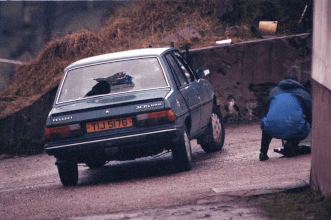
On March 14, 1987, Steenson and Tony “Boot” McCarthy return to Ballymurphy after a night of drinking which is cut short by anger over the INLA GHQ faction’s show of force in the Divis Flats earlier in the day. After bringing their car to a stop on Springhill Avenue, they are killed in an ambush by an INLA active unit, with a member of the unit closing the security gate at the top of the street to trap the pair. An INLA spokesperson says Steenson was killed for being “actively involved in continuous and concerted efforts to undermine the authority of the … movement.” Jimmy Brown gives the graveside oration.
The IPLO later kills Emmanuel Gargan in the Hatfield Bar on the Lower Ormeau Road and Kevin Barry Duffy in Armagh, County Armagh, in retaliation for the killing of Steenson. The IPLO draws the ire of the Lower Ormeau community through the circumstances surrounding the killing of Gargan, with graffiti appearing in the area labeled “IPLOscum.”
On Halloween 1992, the Provisional Irish Republican Army carries out a large-scale operation (dubbed the “Night of Long Knives”) with the goal of neutralising the IPLO. Following the operation and execution of Jimmy Brown, both the Belfast Brigade and Army Council factions disband.
Although nobody is ever charged in connection with the killings, it is widely believed by nationalists and much of the press that the attack had been planned and led by Billy Wright, the leader of the Mid-Ulster Brigade’s Portadown unit. Wright himself takes credit for this and boasts to The Guardian newspaper, “I would look back and say Cappagh was probably our best,” though some sources are sceptical about his claim.
On the evening of Sunday, March 3, 1991, a unit of the UVF’s Mid-Ulster Brigade drive into the heartland of the East Tyrone IRA, intent on wiping out an entire IRA unit that is based in the County Tyrone village of Cappagh. One team of the UVF men wait outside Boyle’s Bar, while a second team waits on the outskirts of the town. At 10:30 p.m. a car pulls into the car park outside the bar and the UVF gunmen open fire with vz. 58assault rifles, killing Provisional IRA volunteers John Quinn (23), Dwayne O’Donnell (17) and Malcolm Nugent (20). The victims and car are riddled with bullets. According to author Thomas G. Mitchell, Quinn, O’Donnell and Nugent are part of an IRA active service unit (ASU). The gunmen then attempt to enter the pub but are unable to after the civilians inside realise what is happening and barricade the door. Unable to get into the bar, a UVF gunman shoots through a high open toilet window killing local civilian, Thomas Armstrong (50) and badly wounding a 21-year-old man. Their intended target, IRA commander Brian Arthurs, escapes with his life by crouching behind the bar during the shooting. According to the Conflict Archive on the Internet (CAIN), the three IRA volunteers chose to go to the pub “on the spur of the moment,” thus are unlikely to be the UVF’s original target.
After the attack, the UVF issues a statement: “This was not a sectarian attack on the Catholic community, but was an operation directed at the very roots of the Provisional IRA command structure in the Armagh–Tyrone area.” The statement concludes with the promise that “if the Provisional IRA were to cease its campaign of terror, the Ulster Volunteer Force would no longer deem it necessary to continue with their military operations.” Privately the UVF are hugely pleased with the attack in a republican heartland and Billy Wright, leader of the Portadown unit of the UVF’s Mid-Ulster Brigade, who is alleged to be centrally involved, tells Jim Cusack and Henry McDonald the killings were “one of things we did militarily in thirty years. We proved we could take the war to the Provos in one of their strongest areas.” Cusack and McDonald assert that a wealthy UVF supporter with a business in South Belfast helped the UVF purchase the cars used in the attack at auctions in the city.
The Provisional IRA initially does not acknowledge that three of the victims are within its ranks, apparently with the aim of garnering sympathy from the wider world, particularly in the Republic of Ireland, toward nationalists in Northern Ireland.
The first reprisal takes place on April 9, 1991, when alleged UVF member Derek Ferguson, a cousin of local MP Reverend William McCrea, is shot and killed in Coagh by members of the East Tyrone Brigade. His family denies any paramilitary links. In the months following the 1991 shootings, two former UDR soldiers are killed by the IRA near Cappagh. One of them is shot dead while driving along Altmore Road on August 5, 1991. The other former soldier is blown up by an IRA bomb planted inside his car at Kildress on April 25, 1993. It is claimed that he has loyalist paramilitary connections. The 1993 bombing leads to allegations that the IRA is killing Protestant landowners in Tyrone and Fermanagh in an orchestrated campaign to drive Protestants out of the region. There are at least five botched IRA attempts against the life of Billy Wright before the Irish National Liberation Army (INLA) succeeds in killing him in 1997 inside the Maze Prison.
This is not the first time the UVF carries out an attack on Boyle’s Bar in Cappagh. On January 17, 1974, at around 7:40 p.m. two masked UVF gunmen enter the pub and open fire indiscriminately on the customers with a Sterling submachine gun and a Smith & Wessonrevolver, firing at least 35 shots. A Catholic civilian and retired farmer Daniel Hughes (73) is shot eleven times and killed in the attack and three other people are injured. A group calling itself the “Donaghmore-Pomeroy Battalion of the UVF” claim responsibility for the shooting. The attack is linked to the notorious Glenanne gang.
(Pictured: The scene of the UVF attack outside Boyle’s Bar in Cappagh in March 1991. Photo: Pacemaker Archive Belfast 153-91-BW)
The Tandragee killings take place in the early hours of Saturday, February 19, 2000, on an isolated country road outside Tandragee, County Armagh, Northern Ireland. Two young Protestant men, Andrew Robb and David McIlwaine, are beaten and repeatedly stabbed to death in what is part of a Loyalist feud between the Ulster Volunteer Force (UVF) and their rivals, the breakaway Loyalist Volunteer Force (LVF). The men are not members of any loyalist paramilitary organisation. It later emerges in court hearings that Robb had made disparaging remarks about the killing of UVF Mid-Ulster Brigade leader Richard Jameson by an LVF gunman the previous month. This had angered the killers, themselves members of the Mid-Ulster UVF, and in retaliation they lure the two men to the remote lane on the outskirts of town, where they kill and mutilate them. The UVF’s Brigade Staff (Belfast leadership) does not sanction the killings.
The origins of the lethal 2000–01 loyalist feud which erupts between the UVF and the LVF begins when a brawl breaks out in the Portadown F.C. Society Club on December 27, 1999. The leader of the UVF Mid-Ulster Brigade, Richard Jameson, is jostled and insulted by members of the LVF who are holding a celebration at the club to commemorate the second anniversary of the shooting death of their former leader and founder, Billy Wright, inside the Maze Prison by the Irish National Liberation Army (INLA).
Shortly after Jameson leaves the club, he returns with a number of UVF men armed with baseball bats and pickaxe handles. A violent altercation breaks out in which 12 people are seriously injured including three LVF prisoners out on Christmas parole. The LVF decides to retaliate and sends a gunman to assassinate Jameson in the driveway outside his home on January 10, 2000. The UVF’s Brigade Staff in Belfast immediately convenes a “war council” at “the Eagle,” their headquarters over a chip shop on the Shankill Road, where they discuss plans to avenge Jameson’s killing. The LVF’s leader, Mark “Swinger” Fulton, who is imprisoned at the time, claims to no avail that his organisation is not involved in the shooting.
At 1:30 a.m. on Saturday, February 19, 2000, Protestant acquaintances, Andrew Robb, a 19-year-old unmarried father, and David McIlwaine, an 18-year-old graphic design student at Lurgan Tech, both of Portadown, leave “The Spot” nightclub in Tandragee together with three others after spending Friday night out. The club is managed by Willie Frazer, well known as a loyalist victims’ advocate and political activist, who has since suggested that the killings were linked to a threat posed to him by the UVF. Billy Wright had reportedly frequented the nightclub before his imprisonment and death.
The group of three men and two women attempt to enter a taxi, but regulations stipulate that no more than four passengers can travel together. Robb and McIlwaine get out of the vehicle and head in search of a house party. The pair knocks on the door of a house in Sinton Park belonging to Mid-Ulster UVF member Stephen Leslie Brown, 19, also known as “Stephen Leslie Revels.” They are invited inside where other UVF members Noel Dillon and Mark Burcombe are also present. Alcoholic beverages are consumed at the party.
The atmosphere inside the house suddenly turns ugly when Dillon asks the teenagers how they feel about the LVF killing of UVF Mid-Ulster brigadier Richard Jameson. McIlwaine remains silent, however Robb replies, “So fucking what, it’s got fuck all to do with me,” to which Dillon takes exception. When he informs Robb that Jameson had been his good friend, Robb makes further disparaging comments which also anger Brown. Brown, out of earshot of the teenagers, decides to assault Robb in retaliation, saying he will “punch the head off Andrew.” Neither Robb nor McIlwaine has been a member of any loyalist paramilitary organisation, although Robb has tenuous links to the LVF having been an associate of Billy Wright and even photographed in 1996 at a march led by Wright. Writers Henry McDonald and Ian S. Wood allege that, unknown to the teenagers, a UVF unit had gone to “The Spot” to seek out two known LVF individuals rumoured to have been involved in Jameson’s killing; however, they had already left the nightclub by the time the UVF arrived. The UVF men encounter Robb and McIlwaine instead and target them as LVF members implicated in Jameson’s death.
Under the pretense of another party elsewhere, Brown lures Robb and McIlwaine into his car along with Dillon and Burcombe. Brown drives off toward Druminure Road where he stops the car at a gate leading to a field and orders the passengers to get out. Burcombe leads McIlwaine away from the vehicle. As they are walking downhill, Burcombe informs McIlwaine that the other two men are going to “give Andrew Robb a beating for slabbering about Richard Jameson. Don’t worry about it, it’s nothing to do with you.” Brown and Dillon proceed to attack Robb with a series of savage kicks. He is then stabbed deeply in the abdomen and throat and dies instantly. He also sustains wounds and gashes to his face and head.
The two perpetrators return, both “walking with a swagger” to where McIlwaine waits downhill from the parked car with Burcombe. McIlwaine makes an attempt to run away but Brown, Dillon, and Burcombe catch up with him as he falls to the ground. Brown gives him a severe kicking, mostly in the head. Dillon produces a butcher’s knife and cuts McIlwaine’s throat while Brown shouts encouragement and Burcombe overlooks the scene from about five feet away. Brown and Dillon leave McIlwaine still breathing on the ground. Once they are back inside the car, Brown proposes to drive the car over his head, but Dillon dissuades him. Brown halts the vehicle, takes the knife and walks back over to where McIlwaine is lying on the road making a “wheezing” sound. Brown stabs McIlwaine repeatedly in the face and chest. When he notices that McIlwaine appears to be looking up at him, Brown stabs him deeply in his left eye, the wound penetrating his brain, killing him. According to Burcombe’s later testimony, Brown appears “crazed” as he hands the knife back to Dillon and says he is “buzzing.” He subsequently goes on to recount stabbing McIlwaine in the eye. He threatens to cut Burcombe’s throat or kill a member of his family if he tells anyone what happened.
Several hours later, at 9:30 a.m., the mutilated bodies of Robb and McIlwaine are discovered lying in pools of blood on the roadside 100 metres apart from one another by a woman taking her children to dancing lessons. Because of the devastating stab wounds inflicted upon the teenagers, the Royal Ulster Constabulary (RUC) assumes that McIlwaine had received a shotgun blast to his face. Both of their throats are slashed so deeply that the teenagers are nearly decapitated. The RUC immediately sets up an inquiry into the killings. Postmortems reveal that Robb had sustained a severe cut to the neck and three penetrating wounds to the abdomen. There are no defence injuries. McIlwaine received a severe throat injury, seven penetrating wounds to the chest and penetrating wounds to the face and to the left eye. Both teenagers were intoxicated at the time of their deaths.
The killings deeply shock the community and are strongly condemned by local politicians. The young men’s funerals attract hundreds of mourners. They are buried in adjacent graves at Kernan Cemetery in Portadown.
After the attacks Adair brands the UVF “Protestant killers” and even produces a newssheet in which he lists McIlwaine and Robb as Protestant victims of the UVF along with the likes of the murdered Frankie Curry and regular targets Jackie Mahood, Kenny McClinton and Clifford Peeples. The UVF Brigade Staff in Belfast does not sanction the killings of Robb and McIlwaine. The LVF leadership, however, maintains that the blame for the killings lies with the UVF and threatens to strike back against carefully selected targets in the Belfast UVF.
The day after the homicides, a number of people are arrested in connection with the crime, including Noel Dillon. The arrests are not made under anti-terrorist legislation, and the suspects are all released unconditionally the same evening. On February 27, 2000, Stephen Brown is brought before the Armagh magistrate’s court after he is charged with both murders. The police tell the court they have plenty of forensic evidence connecting him to the homicides. Ten months later, Brown is released on bail after the court is told the prosecution has expressed doubts about their principal witness and the forensic evidence is not sufficient to secure a conviction. On February 6, 2001, the charges against Brown are unexpectedly dropped by the Director of Public Prosecutions. In April 2001, Mark Burcombe is arrested under the Prevention of Terrorism Acts in relation to his UVF activities but is released without charge.
David McIlwaine’s father, Paul, campaigns for nine years to obtain justice for his son. He enlists the aid of a nationalist human rights group and sets up his own online support group, “Justice for David McIlwaine.”
On November 2, 2005, the Tandragee double killing is reconstructed and featured on the BBC One programme Crimewatch in which a £10,000 award is offered. After viewing the programme, Mark Burcombe consults a clergyman and solicitor and subsequently presents himself to police outside Hillsborough Castle to give them information regarding the events which took place on February 19, 2000. He is interviewed about the killings over a period of four days and admits to having known both Robb and McIlwaine. He is arrested and charged with the murders along with Stephen Brown, who had also been arrested on November 7, 2005, in connection with the double killing. Noel Dillon had committed suicide in January of that same year. When Detective Chief Inspector Tim Hanley charges Brown with the murders, the latter pleads not guilty to each charge. In January 2008, shortly before his trial is due to start, Burcombe decides to turn “Queen’s evidence.” He formally agrees to admit to and give a full account of his own role in the murders and to give evidence against Stephen Brown. He signs an Agreement under the Serious Organised Crime and Police Act 2005 to receive a reduced sentence in return for giving evidence against his co-defendant.
Burcombe pleads guilty to the offence of conspiracy to cause grievous bodily harm to Andrew Robb and is sentenced to 28 months’ imprisonment with two months consecutive for an unrelated suspended sentence. The Robb and McIlwaine families are outraged and disappointed at the leniency shown to Burcombe. Sinn Féin president Gerry Adams asks Patricia Scotland, Baroness Scotland of Asthal, the Attorney General for Northern Ireland, to review the case and consider an appeal to impose a heavier sentence, writing that “all records before the courts on this crime verify it was a barbaric act.” Adams also goes on to affirm that he shares the McIlwaine family’s belief that a state agent was involved in the homicides and was being protected. Lady Scotland, however, backs the plea bargain deal.
Stephen Brown is found guilty of the murders on March 3, 2009. The trial, which commences on November 25, 2008, is held at the Belfast Crown Court without a jury. The prosecution relies upon three pieces of evidence to prove Brown’s culpability. These are the testimony of Mark Burcombe, the forensic material found by the RUC at the crime scene, and the hearsay evidence of Brown’s former girlfriend who claims he had admitted to her that he had killed McIlwaine. Burcombe declares that McIlwaine was murdered because he had witnessed Robb’s killing.
One month later, April 3, Brown is sentenced to 35 years in prison for each count of murder. The trial judge, who had passed sentence on Brown, declares that the murders are “among the most gruesome of the past 40 years.” He goes on to add, “they represent unbridled mindless violence and a total disregard for the value and dignity of human life.” Brown makes an unsuccessful appeal to have his murder conviction overturned on May 24, 2011.
Gerard “Jock” Davison, a former commander of the Provisional Irish Republican Army (IRA) in Belfast and later a supporter of Sinn Féin’s peace strategy, is shot dead in the city shortly after 9:00 a.m. on May 5, 2015, in the Markets area of south Belfast at the junction of Welsh Street and Upper Stanfield.
One of the first operations Davison is involved in is the shooting of Irish People’s Liberation Organisation (IPLO) Belfast Brigade commander Sammy Ward on October 31, 1992, during the Night of the Long Knives in Belfast.
Davison, the former IRA man, who more recently is a community worker in the working-class Markets area of Belfast, is questioned about the murder of 33-year-old Robert McCartney in January 2005. He is released without charge. He always denies ordering the murder of the father of two following an argument outside Magennis’s Bar in the city centre.
On May 5, 2015, around 9:00 a.m., Davison is shot numerous times at Welsh Street in the Markets area of south Belfast. While police do not identify who killed him, Kevin McGuigan, a former subordinate of Davison’s, is named as the chief suspect after he is also shot dead, reportedly by members of the Provisional IRA, on August 12, 2015.
On the evening of the killing, The Guardian’s Henry McDonald reports: “Davison is the most senior pro-peace processrepublican to have been killed since the IRA ceasefire of 1997. Security sources said it was highly unlikely that any Ulster loyalist group was behind the murders, adding that the killers may instead have come from within the nationalist community, possibly from people who had a longstanding grudge against the victim.”
Alasdair McDonnell, the Belfast SouthSocial Democratic and Labour Party (SDLP) Westminster candidate, condemns the shooting, saying, “This is a horrendous crime and those responsible have shown no regard for anyone that could have been caught in the middle of it during the school rush hour. My thoughts and prayers are with the individual’s family at this traumatic time.” He adds, “People here want to move on from the violence of the past. This community will reject those who bring murder and mayhem to our streets. I would appeal to anyone with any information to bring it forward as soon as possible.”
Sinn Féin president Gerry Adams says, “People will be appalled by this morning’s murder in the Markets area of south Belfast. This brutal act will be condemned by all sensible people. There can be no place today for such actions. I would urge anyone with any information to bring that forward to the PSNI (Police Service of Northern Ireland).”
Following his arrest in Fuengirola in August 2021, it is revealed Gerry ‘The Monk’ Hutch is to be questioned in relation to a weapon used in Davison’s murder.
The fourth of four paramilitary bombings in the centre of Dublin takes place in Sackville Place on January 20, 1973.
The first bombing takes place in Burgh Quay on November 26, 1972. The next two bombings take place on December 1, 1972, in Eden Quay and Sackville Place. Three civilians are killed and 185 people are injured in the four bombings. No group has ever claimed responsibility for the attacks, and nobody has ever been charged in connection with the bombings.
On Saturday, January 20, 1973, at 3:08 p.m., a male caller with an English accent calls the telephone exchange in Exchequer Street, Dublin, with the following bomb warning: “Listen love, there is a bomb in O’Connell Street at the Bridge.” Although the call is placed from a coin box in the Dublin area, the exact location is never determined. The receiver of the call immediately contacts the Garda Síochána. The streets of central Dublin are more crowded than usual as Ireland is playing the All Blacks at an international rugby match being held that afternoon in Lansdowne Road.
At 3:18 p.m., a man leaving Kilmartin’s betting shop in Sackville Place notices smoke or steam emanating from the boot of a red Vauxhall Victor car parked outside Egan’s pub facing the direction of O’Connell Street. Its registration number was EOI 1229. About five seconds later the bomb inside the red car’s boot explodes, scattering sections of the vehicle and throwing the man off his feet. The explosion is so powerful that it hurls the car’s roof over adjacent Abbey Street where it lands in Harbour Place. The right-hand rear hub and axle sections are blasted through a metal grill on a shop window.
A CIÉ bus conductor, 21-year-old Thomas Douglas, originally from Stirling, Scotland, is passing the betting shop just as the bomb goes off and the force of the blast hurls him through a shop front window where he dies minutes later of shock and hemorrhage from the multiple injuries he received in the explosion. The entire shop front is devastated and spattered with blood. Fourteen people are badly injured in the bombing which causes bedlam as hysterical Saturday afternoon shoppers seek to flee the area in panic and confusion. The car bomb detonates at almost the exact location of the December 1 bomb. Later eyewitness accounts suggest that the car had been parked at the curb several hours before it exploded. According to journalists Jim Cusack and Henry McDonald in their book UVF: The Endgame (Poolbeg Press, 2008), the bomb is designed to cause widespread chaos and alarm throughout the city, and to inflict massive injuries upon shoppers and pedestrians as Saturday is traditionally the busiest shopping day of the week for Dubliners.
Suspicion initially falls on the Provisional Irish Republican Army (IRA) and other republican groups. Shortly afterwards, however the blame shifts to loyalist paramilitary organisations, in particular, the Ulster Volunteer Force (UVF). Gardaí receives a telephone call from a male caller in Belfast who gives the names of five men who he claims are responsible for January 20 car bombing. The caller says that the five men were originally from Belfast’s Sailortown area but had since relocated to new housing estates in the city. It is not known what action, if any, was ever undertaken by the Garda Síochána to follow up this telephone call. The UVF has never admitted responsibility for the bombing.
Irish Supreme Court Justice Henry Barron commissions an official inquiry into the four bombings. The findings are published in a report in November 2004. The Inquiry concludes that it “seemed more likely than not” that the bombing of the Film Centre Cinema on November 26, 1972, was “carried out by Republican subversives as a response to a Government ‘crackdown’ on the IRA and their associates” and to influence the outcome of the voting in the Dáil regarding the passage of the controversial amendment to the Offences Against the State Acts. Regarding December 1, 1972, and January 20, 1973, car bombings, the Inquiry concludes that confidential information obtained by the Gardaí indicates the three attacks were perpetrated by the UVF, “but no evidence was ever found to confirm this. Nor was there any evidence to suggest the involvement of members of the security forces in the attacks.”
The UDA’s Shankill headquarters is above Frizzell’s fish shop on the Shankill Road. The UDA’s Inner Council and West Belfast brigade regularly meets there on Saturdays. Peter Taylor says it is also the office of the Loyalist Prisoners’ Association (LPA), and on Saturday mornings is normally crowded, as that is when money is given to prisoners’ families. According to Henry McDonald and Jim Cusack, the IRA have had the building under surveillance for some time. They say that the IRA decides to strike when one of their scouts spots Adair entering the building on the morning of Saturday, October 23, 1993. Later, in a secretly-recorded conversation with police, Adair confirms that he had been in the building that morning.
The IRA’s Belfast Brigade launches an operation to assassinate the UDA’s top commanders, whom it believes are at the meeting. The plan allegedly is for two IRA members to enter the shop with a time bomb, force out the customers at gunpoint and flee before it explodes, killing those at the meeting. As they believe the meeting is being held in the room above the shop, the bomb is designed to send the blast upwards. IRA members maintain that they would have warned the customers as the bomb was primed. It has an eleven-second fuse, and the IRA state that this would allowed just enough time to clear the downstairs shop but not enough for those upstairs to escape.
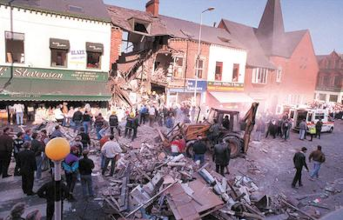
The operation is carried out by Thomas Begley and Seán Kelly, two IRA members in their early twenties from Ardoyne. They drive from Ardoyne to the Shankill in a hijacked blue Ford Escort, which they park on Berlin Street, around the corner from Frizzell’s. Dressed as deliverymen, they enter the shop with the five-pound bomb in a holdall. It is shortly after 1:00 PM on a Saturday afternoon and the area is crowded with mostly women and children. While Kelly waits at the door, Begley makes his way through the customers towards the counter, where the bomb detonates prematurely. Forensic evidence shows that Begley had been holding the bomb over the refrigerated serving counter when it exploded. Begley is killed along with nine other people, two of them children. They are the owner John Frizzell (63), his daughter Sharon McBride (29), Leanne Murray (13), UDA member Michael Morrison (27), his partner Evelyn Baird (27) and their daughter Michelle (7), George Williamson (63) and his wife Gillian (49), and Wilma McKee (38). The force of the blast causes the old building to collapse into a pile of rubble. The upper floor comes down upon those inside the shop, crushing many of the survivors under the rubble, where they remain until rescued some hours later by volunteers and emergency services. About 57 people are injured. At the scene during the rescue operation are several senior loyalists, including Adair and Billy McQuiston. The latter had been in a pub on the nearest corner when the bomb went off. Among those rescued from the rubble is the badly-wounded Seán Kelly.
Unknown to the IRA, if a UDA meeting had taken place, it had ended early and those attending it had left the building before the bomb exploded. McDonald and Cusack state that Adair and his men had stopped using the room for important meetings, allegedly because a sympathiser within the Royal Ulster Constabulary (RUC) told Adair that the police had it bugged.
There was great anger and outrage in the Shankill in the wake of the bombing. Billy McQuiston tells journalist Peter Taylor that “anybody on the Shankill Road that day, from a Boy Scout to a granny, if you’d given them a gun they would have gone out and retaliated.” Many Protestants see the bombing as an indiscriminate attack on them. Adair believes that the bomb was meant for him. Two days after the bombing, as Adair is driving away from his house, he stops and tells a police officer, “I’m away to plan a mass murder.”
In the week following the bombing, the UDA and UVF launch a wave of “revenge attacks,” killing 14 civilians. The UDA shoots a Catholic delivery driver in Belfast after luring him to a bogus call just a few hours after the bombing. He dies on October 25. On 26 October, the UDA shoots dead another two Catholic civilians and wounds five in an indiscriminate attack at a Council Depot on Kennedy Way, Belfast. On October 30, UDA members enter a pub in Greysteel frequented by Catholics and again open fire indiscriminately. Eight civilians, six Catholics and two Protestants, are killed and 13 are wounded. This becomes known as the Greysteel massacre. The UDA states it is a direct retaliation for the Shankill Road bombing.
Seán Kelly, the surviving IRA member, is badly wounded in the blast, having lost his left eye and is unable to move his left arm. Upon his release from hospital, however, he is arrested and convicted of nine counts of murder, each with a corresponding life sentence. In July 2000, he is released under the terms of the Good Friday Agreement. In an interview shortly after his release, he says he had never intended to kill innocent people and regrets what happened.



 seamus dubhghaill