seamus dubhghaill

Promoting Irish Culture and History from Little Rock, Arkansas, USA


Leave a comment

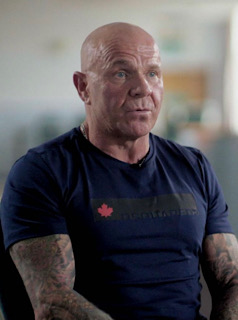
Birth of Johnny Adair, Northern Irish Loyalist

Johnny Adair, leader of “C Company” of the Ulster Loyalist paramilitary organisation Ulster Freedom Fighters (UFF), a cover name of the Ulster Defence Association, is born in Belfast, Northern Ireland, on October 27, 1963. He is known as Mad Dog. He is expelled from the organisation in 2002 following a violent power struggle. Since 2003, he, his family and a number of supporters have been forced to leave Northern Ireland by other loyalists.

Adair is born into a working class loyalist background and raised in Belfast. He grows up in the Lower Oldpark area, a site of many sectarian clashes during “The Troubles.” By all accounts, he has little parental supervision, and does not attend school regularly. He takes to the streets, forming a skinhead street gang with a group of young loyalist friends, who “got involved initially in petty, then increasingly violent crime.” Eventually, he starts a rock band called Offensive Weapon, which during performances espouses support for the British National Front.

While still in his teens, Adair joins the Ulster Young Militants (UYM), and later the Ulster Defence Association, a loyalist paramilitary organisation which also calls itself the Ulster Freedom Fighters.

By the early 1990s, Adair has established himself as head of the UDA/UFF’s “C Company” based on the Shankill Road. When he is charged with terrorist offences in 1995, he admits that he had been a UDA commander for three years up to 1994. During this time, he and his colleagues are involved in multiple and random murders of Catholic civilians. At his trial in 1995, the prosecuting lawyer says he is dedicated to his cause against those whom he “regarded as militant republicans – among whom he had lumped almost the entire Roman Catholic population.” Royal Ulster Constabulary (RUC) detectives believe his unit killed up to 40 people during this period.

Adair once remarks to a Catholic journalist from the Republic of Ireland upon the discovery of her being Catholic, that normally Catholics travel in the boot of his car. According to a press report in 2003, he is handed details of republican suspects by British Army intelligence, and is even invited for dinner in the early 1990s. In his autobiography, he claims he was frequently passed information by sympathetic British Army members, while his own whereabouts were passed to republican paramilitaries by the RUC Special Branch, who, he claims, hated him.

The Provisional Irish Republican Army (IRA) bombing of a fish shop on the Shankill Road in October 1993 is an attempt to assassinate Adair and the rest of the UDA’s Belfast leadership in reprisal for attacks on Catholics. The IRA claims that the office above the shop is regularly used by the UDA for meetings and one is due to take place shortly after the bomb is set to explode. The bomb goes off early, killing one IRA man, Thomas Begley, and nine Protestant civilians. The UFF retaliates with a random attack on the Rising Sun bar in Greysteel, County Londonderry, which kills eight civilians, two of whom are Protestants. Adair survives 13 assassination attempts, most of which are carried out by the IRA and Irish National Liberation Army (INLA).

During this time, undercover officers from the Royal Ulster Constabulary record months of discussions with Adair, in which he boasts of his activities, producing enough evidence to charge him with directing terrorism. He is convicted and sentenced to 16 years in HM Prison Maze. In prison, according to some reports, he sells drugs such as cannabis, ecstasy tablets and amphetamines to other loyalist prisoners, earning him an income of £5000 a week.

In January 1998, Adair is one of five loyalist prisoners visited in the prison by British Secretary of State for Northern Ireland, Mo Mowlam. She persuades them to drop their objection to their political representatives continuing the talks that leads to the Good Friday Agreement in April. In 1999, he is released early as part of a general amnesty for political prisoners after the Agreement.

Following his release, much of Adair’s activities are bound up with violent internecine feuds within the UDA and between the UDA and other loyalist paramilitary groupings. The motivation for such violence is sometimes difficult to piece together. It involves a combination of political differences over the loyalist ceasefires, rivalry between loyalists over control of territory and competition over the proceeds of organised crime.

In 1999, shortly after his release from prison, Adair is shot at and grazed in the head by a bullet at a UB40 concert in Belfast. He blames the shooting on republicans, but it is thought that rival loyalists are to blame.

In August 2000, Adair is again mildly injured by a pipe bomb he is transporting in a car. He again attempts to blame the incident on an attack by republicans, but this claim is widely discounted. A feud breaks out at the time between the UDA and the Ulster Volunteer Force (UVF) leaving several loyalists dead. As a result of Adair’s involvement in the violence, the then Secretary of State for Northern Ireland, Peter Mandelson, revokes his early release and returns him to prison.

In May 2002, Adair is released from prison again. Once free, he is a key part of an effort to forge stronger ties between the UDA/UFF and the Loyalist Volunteer Force (LVF), a small breakaway faction of the UVF loyalist paramilitary organization in Northern Ireland. The most open declaration of this is a joint mural depicting Adair’s UDA “C company” and the LVF. Other elements in the UDA/UFF strongly resist these movements, which they see as an attempt by Adair to win external support in a bid to take over the leadership of the UDA. Some UDA members dislike his overt association with the drugs trade, with which the LVF are even more heavily involved. A loyalist feud begins, and ends with several men dead and scores evicted from their homes.

On September 25, 2002, Adair is expelled from the UDA/UFF along with close associate John White, and the organisation almost splits as Adair tries to woo influential leaders such as Andre Shoukri, who are initially sympathetic to him. There are attempts on Adair’s and White’s lives.

Adair returns to prison in January 2003, when his early release licence is revoked by Secretary of State for Northern Ireland, Paul Murphy, on grounds of engaging in unlawful activity. On February 1, 2003, UDA divisional leader John Gregg is shot dead along with another UDA member, Rab Carson, on returning from a Rangers F.C. match in Glasgow. The killing is widely blamed on Adair’s C Company as Gregg is one of those who organised his expulsion from the UDA. Five days later, on February 6, about twenty Adair supporters, including White, flee their homes for Scotland, widely seen as a response to severe intimidation.

Adair is released from prison again on January 10, 2005. He immediately leaves Northern Ireland and joins his family in Bolton, Lancashire, where it is claimed he stays with supporters of Combat 18 and the Racial Volunteer Force.

The police in Bolton question Adair’s wife, Gina, about her involvement in the drugs trade, and his son, nicknamed both “Mad Pup” and “Daft Dog,” is charged with selling crack cocaine and heroin. Adair is arrested and fined for assault and threatening behaviour in September 2005. He had married Gina Crossan, his partner for many years and the mother of his four children, at HM Prison Maze on February 21, 1997. She is three years Adair’s junior and grew up in the same Lower Oldpark neighbourhood. 

After being released, Adair is almost immediately arrested again for violently assaulting Gina, who suffers from ovarian cancer. Since this episode he reportedly moves to Scotland, living in Troon in Ayrshire.

In May 2006, Adair reportedly receives £100,000 from John Blake publishers for a ghost-written autobiography.

In November 2006, the UK’s Five television channel transmits an observational documentary on Adair made by Dare Films.

Adair appears in a documentary made by Donal MacIntyre and screened in 2007. The focus of the film centers around Adair and another supposedly reformed character, a Neo-Nazi from Germany called Nick Greger, and their trip to Uganda to build an orphanage. Adair is seen to fire rifles, stating it is the first time he has done so without wearing gloves. He also admits to being “worried sick” and “pure sick with worry” after Greger disappears in Uganda for days on end. It turns out that he had gone off and married a Ugandan lady. Adair confesses via telephone that he “thought something might have happened to Nick.”

On July 20, 2015, three Irish republicans, Antoin Duffy, Martin Hughes and Paul Sands, are found guilty of planning to murder Adair and Sam McCrory. Charges against one of the accused in the trial are dropped on July 1.

On September 10, 2016, Adair’s son, Jonathan Jr., is found dead in Troon, aged 32. He dies from an accidental overdose while celebrating the day after his release from prison for motoring offences. He had been in and out of prison since the family fled Northern Ireland. He served a five-year sentence for dealing heroin and crack cocaine. The year before, he had been cleared of a gun raid at a party and in 2012 is the target of a failed bomb plot. He was also facing trial later that year on drugs charges.

In December 2023, while recording a podcast with far-right activist Tommy Robinson, Adair surprisingly expresses a grudging respect for the IRA hunger strikers, describing the manner of their deaths as “dedication at the highest level” for a political cause and admitting that he would not have volunteered to do the same if asked.

Leave a comment

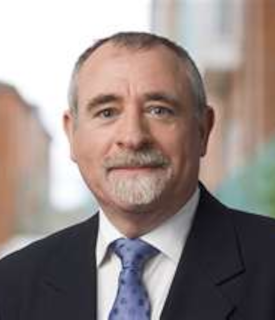
Birth of Eric Byrne, Former TD and Labour Party Politician

Eric Joseph Byrne, former Labour Party politician who serves as a Teachta Dála (TD) for the Dublin South-Central constituency from 1989 to 1992, 1994 to 1997 and 2011 to 2016, is born in Dublin on April 21, 1947. He is formerly a member of Official Sinn Féin, the Workers’ Party and Democratic Left.

Byrne is educated at Synge Street CBS and the Bolton Street College of Technology. A carpenter before entering politics, he stands unsuccessfully for election to Dáil Éireann as a Workers’ Party candidate for Dublin Rathmines West at the 1977 Irish general election and Dublin South-Central at the 1981, February 1982, November 1982 and 1987 Irish general elections.

He is elected in 1985 as a Workers’ Party member of Dublin City Council for CrumlinKimmage area, and is re-elected at subsequent local elections until 2011, when he is forced to resign his seat due to dual mandate. He is finally elected at the 1989 Irish general election. He joins with Workers’ Party members who form Democratic Left in 1992. He unexpectedly loses his seat at the 1992 Irish general election. Labour’s Pat Upton is unexpectedly returned on the first count, with Byrne finally losing the last seat to Fianna Fáil‘s Ben Briscoe by five votes after a marathon 10-day count.

Byrne is elected to the 27th Dáil at a by-election on June 9, 1994, following the resignation of long-serving Fianna Fáil TD John O’Connell, who had previously been a Labour TD for the same constituency. He is a backbench supporter of the Rainbow government led by Fine Gael‘s John Bruton.

He loses his seat again at the 1997 Irish general election. Although the Labour Party and the Democratic Left merge in 1999, he is not selected to contest the Dublin South-Central by-election which follows Pat Upton‘s death later that year. Upton’s sister Mary is elected for the Labour Party.

Byrne contests the 2002 Irish general election on the Labour Party ticket as Mary Upton’s running-mate but is unsuccessful. Along with Upton, he contests the Dublin South-Central constituency at the 2007 Irish general election advocating a Labour Party/Fine Gael government but misses the final seat by 69 votes. He is nominated by the Labour Party to contest the Seanad election in the Labour panel but is not elected. In 2009, he is re-elected to Dublin City Council. At the 2011 Irish general election he is re-elected to the Dáil, after a fourteen-year absence.

In January 2015, Byrne becomes involved in an altercation with Sinn Féin TD, Jonathan O’Brien. During ministers’ questions, O’Brien criticises Tánaiste Joan Burton over homelessness in Ireland, citing the experiences of his brother, a recovering heroin addict. Byrne asks of O’Brien, “Why doesn’t his good family give him a home?” This infuriates O’Brien. The Irish Times journalist Miriam Lord criticizes Byrne, remarking that “You sense the relief rising in the chamber. They don’t like it when the real world intrudes. These sort of things don’t really happen to TDs.”

Byrne loses his seat at the 2016 Irish general election.


Leave a comment

Birth of Tony Gregory, Independent Politician & Teachta Dála

Tony Gregory, Irish independent politician and a Teachta Dála (TD) for the Dublin Central constituency from 1982 to 2009, is born on December 5, 1947, in Ballybough on Dublin‘s Northside.

Gregory is the second child of Anthony Gregory, warehouseman in Dublin Port, and Ellen Gregory (née Judge). He wins a Dublin Corporation scholarship to the Christian BrothersO’Connell School. He later goes on to University College Dublin (UCD), where he receives a Bachelor of Arts degree and later a Higher Diploma in Education, funding his degree from summer work at the Wall’s ice cream factory in Acton, London. Initially working at Synge Street CBS, he later teaches history and French at Coláiste Eoin, an Irish language secondary school in Booterstown. His students at Synge Street and Coláiste Eoin include John Crown, Colm Mac Eochaidh, Aengus Ó Snodaigh and Liam Ó Maonlaí.

Gregory becomes involved in republican politics, joining Sinn Féin and the Irish Republican Army (IRA) in 1964. In UCD he helps found the UCD Republican Club, despite pressure from college authorities, and becomes involved with the Dublin Housing Action Committee. Within the party he is a supporter of Wicklow Republican Seamus Costello. Costello, who is a member of Wicklow County Council, emphasises involvement in local politics and is an opponent of abstentionism. Gregory sides with the Officials in the 1970 split within Sinn Féin. Despite having a promising future within the party, he resigns in 1972 citing frustration with ideological infighting in the party. Later, Costello, who had been expelled by Official Sinn Féin, approaches him and asks him to join his new party, the Irish Republican Socialist Party. He leaves the party after Costello’s assassination in 1977. He is briefly associated with the Socialist Labour Party.

Gregory contests the 1979 local elections for Dublin City Council as a “Dublin Community Independent” candidate. At the February 1982 general election, he is elected to Dáil Éireann as an Independent TD. On his election he immediately achieves national prominence through the famous “Gregory Deal,” which he negotiates with Fianna Fáil leader Charles Haughey. In return for supporting Haughey as Taoiseach, he is guaranteed a massive cash injection for his inner-city Dublin constituency, an area beset by poverty and neglect.

Although Gregory is reviled in certain quarters for effectively holding a government to ransom, his uncompromising commitment to the poor is widely admired. Fianna Fáil loses power at the November 1982 general election, and many of the promises made in the Gregory Deal are not implemented by the incoming Fine GaelLabour Party coalition.

Gregory is involved in the 1980s in tackling Dublin’s growing drug problem. Heroin had largely been introduced to Dublin by the Dunne criminal group, based in Crumlin, in the late 1970s. In 1982 a report reveals that 10% of 15- to 24-year-olds have used heroin at least once in the north inner city. The spread of heroin use also leads to a sharp increase in petty crime. He confronts the government’s handling of the problem as well as senior Gardaí, for what he sees as their inadequate response to the problem. He co-ordinates with the Concerned Parents Against Drugs group in 1986, who protest and highlight the activities of local drug dealers and defend the group against accusations by government Ministers Michael Noonan and Barry Desmond that it is a front for the Provisional IRA. He believes that the solution to the problem is multi-faceted and works on a number of policy level efforts across policing, service co-ordination and rehabilitation of addicts. In 1995 in an article in The Irish Times, he proposes what would later become the Criminal Assets Bureau, which is set up in 1996, catalysed by the death of journalist Veronica Guerin. His role in its development is later acknowledged by then Minister for Justice Nora Owen.

Gregory also advocates for Dublin’s street traders. After attending a sit-down protest with Sinn Féin Councillor Christy Burke, and future Labour Party TD Joe Costello on Dublin’s O’Connell Street in defence of a street trader, he, Burke and four others are arrested and charged with obstruction and threatening behaviour. He spends two weeks in Mountjoy Prison after refusing to sign a bond to keep the peace.

Gregory remains a TD from 1982 and, although he never holds a government position, remains one of the country’s most recognised Dáil deputies. He always refuses to wear a tie in the Dáil chamber stating that many of his constituents could not afford them.

Gregory dies on January 2, 2009, following a long battle with cancer. Following his death, tributes pour in from politicians from every party, recognising his contribution to Dublin’s north inner city. During his funeral, politicians from the Labour Party, Fianna Fáil and Fine Gael are told that although they speak highly of Gregory following his death, during his time in the Dáil he had been excluded by many of them and that they were not to use his funeral as a “photo opportunity.” He is buried on January 7, with the Socialist Party‘s Joe Higgins delivering the graveside oration.

Colleagues of Tony Gregory support his election agent, Dublin City Councillor Maureen O’Sullivan, at the 2009 Dublin Central by-election in June. She wins the subsequent by-election.


Leave a comment

Death of Tony Gregory, Independent Politician & TD

Tony Gregory, Irish independent politician and a Teachta Dála (TD) for the Dublin Central constituency from 1982 to 2009, dies in Dublin on January 2, 2009.

Gregory is born on December 5, 1947, in Ballybough on Dublin’s Northside, the second child of Anthony Gregory, warehouseman in Dublin Port, and Ellen Gregory (née Judge). He wins a Dublin Corporation scholarship to the Christian BrothersO’Connell School. He later goes on to University College Dublin (UCD), where he receives a Bachelor of Arts degree and later a Higher Diploma in Education, funding his degree from summer work at the Wall’s ice cream factory in Acton, London. Initially working at Synge Street CBS, he later teaches history and French at Coláiste Eoin, an Irish language secondary school in Booterstown. His students at Synge Street and Coláiste Eoin include John Crown, Colm Mac Eochaidh, Aengus Ó Snodaigh and Liam Ó Maonlaí.

Gregory becomes involved in republican politics, joining Sinn Féin and the Irish Republican Army (IRA) in 1964. In UCD he helps found the UCD Republican Club, despite pressure from college authorities, and becomes involved with the Dublin Housing Action Committee. Within the party he is a supporter of Wicklow Republican Seamus Costello. Costello, who is a member of Wicklow County Council, emphasises involvement in local politics and is an opponent of abstentionism. Gregory sides with the Officials in the 1970 split within Sinn Féin. Despite having a promising future within the party, he resigns in 1972 citing frustration with ideological infighting in the party. Later, Costello, who had been expelled by Official Sinn Féin, approaches him and asks him to join his new party, the Irish Republican Socialist Party. He leaves the party after Costello’s assassination in 1977. He is briefly associated with the Socialist Labour Party.

Gregory contests the 1979 local elections for Dublin City Council as a “Dublin Community Independent” candidate. At the February 1982 general election, he is elected to Dáil Éireann as an Independent TD. On his election he immediately achieves national prominence through the famous “Gregory Deal,” which he negotiates with Fianna Fáil leader Charles Haughey. In return for supporting Haughey as Taoiseach, he is guaranteed a massive cash injection for his inner-city Dublin constituency, an area beset by poverty and neglect.

Although Gregory is reviled in certain quarters for effectively holding a government to ransom, his uncompromising commitment to the poor is widely admired. Fianna Fáil loses power at the November 1982 general election, and many of the promises made in the Gregory Deal are not implemented by the incoming Fine GaelLabour Party coalition.

Gregory is involved in the 1980s in tackling Dublin’s growing drug problem. Heroin had largely been introduced to Dublin by the Dunne criminal group, based in Crumlin, in the late 1970s. In 1982 a report reveals that 10% of 15- to 24-year-olds have used heroin at least once in the north inner city. The spread of heroin use also leads to a sharp increase in petty crime. He confronts the government’s handling of the problem as well as senior Gardaí, for what he sees as their inadequate response to the problem. He co-ordinates with the Concerned Parents Against Drugs group in 1986, who protest and highlight the activities of local drug dealers and defend the group against accusations by government Ministers Michael Noonan and Barry Desmond that it is a front for the Provisional IRA. He believes that the solution to the problem is multi-faceted and works on a number of policy level efforts across policing, service co-ordination and rehabilitation of addicts. In 1995 in an article in The Irish Times, he proposes what would later become the Criminal Assets Bureau, which is set up in 1996, catalysed by the death of journalist Veronica Guerin. His role in its development is later acknowledged by then Minister for Justice Nora Owen.

Gregory also advocates for Dublin’s street traders. After attending a sit-down protest with Sinn Féin Councillor Christy Burke, and future Labour Party TD Joe Costello on Dublin’s O’Connell Street in defence of a street trader, he, Burke and four others are arrested and charged with obstruction and threatening behaviour. He spends two weeks in Mountjoy Prison after refusing to sign a bond to keep the peace.

Gregory remains a TD from 1982 and, although he never holds a government position, remains one of the country’s most recognised Dáil deputies. He always refuses to wear a tie in the Dáil chamber stating that many of his constituents could not afford them.

Gregory dies on January 2, 2009, following a long battle with cancer. Following his death, tributes pour in from politicians from every party, recognising his contribution to Dublin’s north inner city. During his funeral, politicians from the Labour Party, Fianna Fáil and Fine Gael are told that although they speak highly of Gregory following his death, during his time in the Dáil he had been excluded by many of them and that they were not to use his funeral as a “photo opportunity.” He is buried on January 7, with the Socialist Party‘s Joe Higgins delivering the graveside oration.

Colleagues of Tony Gregory support his election agent, Dublin City Councillor Maureen O’Sullivan, at the 2009 Dublin Central by-election in June. She wins the subsequent by-election.


Leave a comment

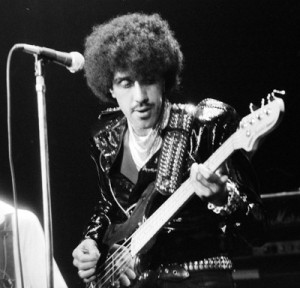
Birth of Phil Lynott, Thin Lizzy Vocalist & Bassist

Philip Parris “Phil” Lynott, Irish musician, singer, songwriter, and a founding member, principal songwriter, lead vocalist, and bassist of Thin Lizzy, is born on August 20, 1949, in Hallam Hospital in West Bromwich, Staffordshire, England.

Lynott goes to live with his grandmother, Sarah Lynott, in Crumlin, Dublin when he is four years old. He is introduced to music through his uncle Timothy’s record collection and becomes influenced by Tamla Motown and The Mamas and the Papas.

Growing up in Dublin in the 1960s, Lynott fronts several bands as a lead vocalist, most notably teaming up with bassist Brendan ‘Brush’ Shiels to form Skid Row in early 1968. It is during this period that Lynott learns to play the bass guitar.

Toward the end of 1969, Lynott, now confident enough to play bass himself in a band, teams with Brian Downey, Eric Bell, and Eric Wrixon to form Thin Lizzy. The band’s first top ten hit comes in 1973 with a rock version of the well-known Irish traditional song “Whiskey in the Jar.” With the release of the Jailbreak album in 1976, Lynott and Thin Lizzy become international superstars on the strength of the album’s biggest hit, “The Boys Are Back in Town.” The song reaches the Top 10 in the United Kingdom, No. 1 in Ireland, and is a hit in the United States and Canada.

Having finally achieved mainstream success, Thin Lizzy embarks on several consecutive world tours. However, the band suffers from personnel changes. By the early 1980s, Thin Lizzy is starting to struggle commercially and Lynott starts showing symptoms of drug abuse, including regular asthma attacks. After the resignation of longtime manager Chris O’Donnell, Lynott decides to disband Thin Lizzy in 1983.

In 1984, Lynott forms a new band, Grand Slam, with Doish Nagle, Laurence Archer, Robbie Brennan, and Mark Stanway. The band tours various clubs but suffers from being labeled a poor version of Thin Lizzy due to the inclusion of two lead guitarists. Grand Slam disbands at the end of the year due to a lack of money and Lynott’s increasing addiction to heroin.

Lynott’s last years are dogged by drug and alcohol dependency leading to his collapse on December 25, 1985, at his home in Kew. He is taken to Salisbury Infirmary where he is diagnosed as suffering from septicemia. His condition worsens by the start of the new year, and he is put on a respirator. He dies of pneumonia and heart failure due to septicemia in the hospital’s intensive care unit on January 4, 1986, at the age of 36.

Lynott’s funeral is held at St. Elizabeth of Portugal Church, Richmond, London on January 9, 1986, with most of Thin Lizzy’s ex-members in attendance, followed by a second service at Howth Parish Church on January 11. He is buried in St. Fintan’s Cemetery, Sutton, Dublin.


Leave a comment

Birth of Shane MacGowan, Lead Singer of The Pogues

shane-macgowan

Shane Patrick Lysaght MacGowan, Anglo-Irish musician and singer, best known as the lead singer and songwriter of Celtic trad punk band The Pogues, is born to Irish parents in Pembury, Kent, England, on December 25, 1957.

MacGowan spends his early childhood in County Tipperary, before his family moves back to England when he is six years old. He lives in many parts of the southeast of England, including Brighton and London.

MacGowan’s father, Maurice, works for a department store. MacGowan’s mother, Therese, is a singer and traditional Irish dancer, and has worked as a model in Dublin. In 1971, after attending Holmewood House School at Langton Green, Tunbridge Wells, MacGowan earns a literature scholarship and is accepted into Westminster School. He is found in possession of drugs and is expelled in his second year.

MacGowan gets his first taste of fame in 1976 at a concert by British punk band The Clash, when his earlobe is damaged by Jane Crockford, later to be a member of Mo-dettes. A photographer snaps a picture of him covered in blood and it makes the papers, with the headline “Cannibalism at Clash Gig.” Shortly after this, he forms his own punk rock band, The Nipple Erectors, later renamed The Nips.

MacGowan draws upon his Irish heritage when founding The Pogues and changes his early “punk” voice for a more authentic sound with tutoring from his extended family. Many of his songs are influenced by Irish nationalism, Irish history, the experiences of the Irish in London and the United States, and London life in general.

Between 1985 and 1987, he co-writes “Fairytale of New York,” which he performs with Kirsty MacColl. In the coming years MacGowan and The Pogues release several albums.

After The Pogues throw MacGowan out for unprofessional behaviour, he forms a new band, Shane MacGowan & The Popes, recording two studio albums, a live album, three tracks on The Popes Outlaw Heaven (2010) and a live DVD, and touring internationally. From December 2003 until May 2005, Shane MacGowan & The Popes tour extensively in the UK, Ireland, and Europe.

The Pogues and MacGowan reform for a sell-out tour in 2001 and each year from 2004 to 2009 for further tours, including headline slots at GuilFest in England and the Azkena Rock Festival in Basque Country. In May 2005, he rejoins The Pogues permanently.

The Pogues’ last performance on British soil occurs on July 5, 2014 at the British Summer Time festival in London’s Hyde Park.

For many years MacGowan suffers from binge drinking and heroin use. In 2001, Sinéad O’Connor reports MacGowan to the police in London for drug possession in what she says is an attempt to discourage him from using heroin. Initially furious, MacGowan later expresses gratitude towards O’Connor and claims that the incident helped him kick his heroin habit.

MacGowan has long been known for having very bad teeth. He loses the last of his natural teeth around 2008. In 2015, he has 28 new dentures on a titanium frame fitted in a nine-hour procedure which is the subject of an hour-long television programme. Dr. Darragh Mulrooney, the dental surgeon who carries out the procedure, comments that MacGowan recorded most of his great works while he still had some teeth: “We’ve effectively re-tuned his instrument and that will be an ongoing process.”

In the summer of 2015, MacGowan falls as he is leaving a Dublin studio, fracturing his pelvis. He is seen in public on crutches by December 2015, and continues to experience difficulty with general mobility.


Leave a comment

Death of Phil Lynott

phil-lynott

Philip Parris “Phil” Lynott, Irish musician, singer, songwriter, and a founding member, principal songwriter, lead vocalist, and bassist of Thin Lizzy, dies on January 4, 1986, in Salisbury, Wiltshire, England.

Born in West Bromwich, Staffordshire, England on August 20, 1949, Lynott goes to live with his grandmother, Sarah Lynott, in Crumlin, Dublin, when he is four years old. He is introduced to music through his uncle Timothy’s record collection and becomes influenced by Motown and The Mamas and the Papas.

Growing up in Dublin in the 1960s, Lynott fronts several bands as a lead vocalist, most notably teaming up with bassist Brendan ‘Brush’ Shiels to form Skid Row in early 1968. It is during this period that Lynott learns to play the bass guitar.

Toward the end of 1969, Lynott, now confident enough to play bass himself in a band, teams with Brian Downey, Eric Bell, and Eric Wrixon to form Thin Lizzy. The band’s first top ten hit comes in 1973 with a rock version of the well-known Irish traditional song “Whiskey in the Jar.” With the release of the Jailbreak album in 1976, Lynott and Thin Lizzy become international superstars on the strength of the album’s biggest hit, “The Boys Are Back in Town.” The song reaches the Top 10 in the United Kingdom, No. 1 in Ireland, and is a hit in the United States and Canada.

Having finally achieved mainstream success, Thin Lizzy embarks on several consecutive world tours. However, the band suffers from personnel changes. By the early 1980s, Thin Lizzy is starting to struggle commercially and Lynott starts showing symptoms of drug abuse, including regular asthma attacks. After the resignation of longtime manager Chris O’Donnell, Lynott decides to disband Thin Lizzy in 1983.

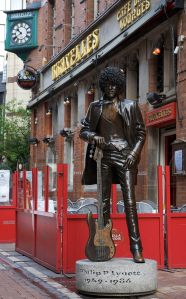
phil-lynott-statue

In 1984, Lynott forms a new band, Grand Slam, with Doish Nagle, Laurence Archer, Robbie Brennan, and Mark Stanway. The band tours various clubs but suffers from being labeled a poor version of Thin Lizzy due to the inclusion of two lead guitarists. Grand Slam disbands at the end of the year due to a lack of money and Lynott’s increasing addiction to heroin.

Lynott’s last years are dogged by drug and alcohol dependency leading to his collapse on December 25, 1985, at his home in Kew. He is taken to Salisbury Infirmary where he is diagnosed as suffering from septicemia. His condition worsens by the start of the new year, and he is put on a respirator. He dies of pneumonia and heart failure due to septicemia in the hospital’s intensive care unit on January 4, 1986, at the age of 36.

Lynott’s funeral is held at St. Elizabeth of Portugal Church, Richmond, London, on January 9, 1986, with most of Thin Lizzy’s ex-members in attendance, followed by a second service at Church of the Assumption, Howth, on January 11. He is buried in St. Fintan’s Cemetery, Sutton, Dublin.