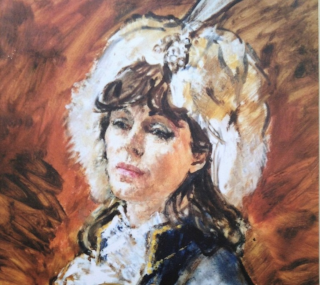
Guinness is born Hermione Maria-Gabrielle von Urach, the only child of the marriage of Albrecht von Urach, from Lichtenstein Castle, a member of the royal house of Wurtemberg, and Rosemary Blackadder (1901–1975) from Berwickshire in Scotland, a journalist and artist, who are married in Oslo, Norway in 1931. For the first few months of her life, she is very ill. In 1934, her parents, both working as journalists, move the family to Venice. They later move again to Japan. Her mother develops depression, and in 1937 tries to gain uninvited access to Emperor Hirohito‘s palace with her daughter. This results in her mother being arrested, sedated, and deported, which is the beginning of a decline in her mental health which culminates in a lobotomy in 1941 and spending the rest of her life in private mental institutions. Urach is returned to Europe, where she is raised by her godmother, Hermione Ramsden, in Surrey and Norway. She is educated by as many as seventeen governesses, with brief spells in boarding schools. Until the age of eighteen she is known as Gabrielle.
Urach meets Desmond Guinness in 1951, when she is nineteen, and they are married in Oxford in 1954. They have two children, Patrick (born 1956) and Marina (born 1957).
The couple moves to Ireland in 1955 where they rent Carton House, County Kildare. They share a love of Georgian architecture which results in them buying Leixlip Castle in 1958 and establishing the Irish Georgian Society on February 21 of the same year. Through the society they campaign for the restoration and protection of architectural sites such as Mountjoy Square, the gateway to the Dromana estate in County Waterford, the Tailors’ Hall in Dublin, and Conolly’s Folly in County Kildare. In 1967 they purchase Castletown House, also in County Kildare, with a plan to restore it, and make it a base for the Irish Georgian Society.
During the 1960s Leixlip Castle is a hub for those interested in architecture and conservation, and the Guinnesses work hands-on on a range of projects. By 1969, their marriage is in difficulties and Guinness moves to London. She later moves to Glenarm, County Antrim to live with Hugh O’Neill, and when that relationship ends, she returns to Leixlip Castle, but a divorce is finalised in 1981. Having lived in Dublin for a time, she rents Tullynisk House, the dower house of Birr Castle in County Offaly in 1983. Guinness becomes isolated and develops a problem with alcohol. While returning to Ireland from Wales on a car ferry on May 8, 1989, she has a massive heart attack which is compounded by a reaction to an injection of penicillin. She is buried at Conolly’s Folly.
Through Patrick, Guiness becomes grandmother of the fashion model Jasmine Guinness. Her daughter Marina is a patron of the arts and of Irish musicians including Glen Hansard, Damien Rice, and the band Kíla. Marina has three children of her own: Patrick (by Stewart Copeland of The Police), Violet (by photographer Perry Ogden), and Finbar (by record producer Denny Cordell).
In 2020, a new film on Guinness’s life and work, entitled Memory of Mariga, receives its United States premiere as part of the Elizabethtown Film Festival on Saturday, September 19, at the Crowne Pointe Theatre in Elizabethtown, Kentucky. In 2021, the same film receives its Irish premiere at the Fastnet Film Festival.
Hugh Roe O’Donnell (Aodh Rua ÓDomhnaill), sixteenth century Irish nobleman also known as Red Hugh O’Donnell, dies at Simancas Castle in Valladolid, Spain, on September 10, 1602. Evidence suggests he might have been poisoned by an English spy.
O’Donnell is born on October 30, 1572, in Lifford (which is in present-day County Donegal) and is the son of Hugh McManus O’Donnell, the Gaelic Lord of Tyrconnell, a territory which takes in most of the present-day county of Donegal except for the Inishowen peninsula. His mother, Aodh MacManus’ second wife, is the formidable and extremely well-connected Scottish lady, Fionnuala Nic Dhomhnaill, known to history as the Iníon Dubh or The Dark Daughter. A daughter of James Mac Donald she had been raised at the Scottish court.
In 1587, at the age of fifteen, O’Donnell marries Rose O’Neill, the daughter of Hugh O’Neill, Earl of Tyrone, a nephew of Turlough Lynagh O’Neill who is recognised by the Irish as The O’Neill. He is, therefore, a bridge between two traditional enemies, the O’Donnell’s and the O’Neills.
The English Lord Deputy of Ireland, Sir John Perrot, recognises the importance of the young O’Donnell prince and decides to secure him as a hostage thus giving him power over the O’Donnell clan and preventing them from forming a treaty with the O’Neills. In 1587, when he is sixteen, O’Donnell and two friends, a MacSweeney and an O’Gallagher, are persuaded to board a ship at Rathmullan which has been disguised as a Spanish wine barque. Once onboard they are carried off to Dublin Castle as prisoners. The O’Donnell’s offer to pay a large ransom and the Iníon Dubh also gives up 25 Spaniards rescued from the Armada. The English agree to this but as soon as the Spaniards are handed over, they are beheaded. The agreement is not kept.
Perrot has his hostage but a most reluctant one. The young man continuously seeks ways to escape. His first opportunity comes at Christmas in 1590 when a rope is smuggled in to the prince. He escapes and flees into the Wicklow Mountains. He seeks shelter with Phelim O’Toole who has him returned to the English as he fears the anger of the infamous Perrot.
A year later, at Christmas in 1591, O’Donnell makes his second attempt at escape, this time by crawling through the Dublin Castle sewers. With him are Henry and Art O’Neill, two sons of Shane O’Neill (Shane the Proud). This time the escapees make their way to the Glenmalure stronghold of Fiach McHugh O’Byrne. Unfortunately, the winter is very severe and Art O’ Neill dies from exposure just as the O’Byrne rescue party finds them. Both Red Hugh and Henry O’Neill suffer severe frostbite but are safely returned to Ulster.
While O’Donnell is held prisoner by the English, his father becomes senile. In 1592, when O’Donnell is sufficiently recovered, he is inaugurated as the O’Donnell and England, for her treachery, has an avowed and implacable enemy.
In 1595 O’Donnell ambushes an English force in the Curlew Mountains, killing 500 of them including their commander. However, the tide is turning against the Irish now. England is flooding the country with armies and many of the leading Gaelic families are beginning to make deals with them.
In 1601 the Spanish land in Kinsale and the English besiege them. O’Neill and O’Donnell march south from Ulster and Ballymote Castle in Sligo in an attempt to break the siege. This turns into a debacle causing the Irish to scatter and the Spanish to surrender. O’Neill marches back north and O’Donnell is sent to Spain to ask for more troops from Phillip III. In Spain, he is treated like a royal. He petitions aid from the King who gives him a promise of another Spanish force.
It is, however, unlikely that O’Donnell is poisoned. A more probable cause of death is the tapeworm that Simancas documents of the time state to be the cause of his demise. His Last Will and Testament, written in his dying moments with his loyal retinue, is an extremely evocative and moving document. One original is preserved in Simancas and the other in the Chancellery archive in Valladolid.
O’Donnell is buried in the chapter of the Franciscanmonastery in Valladolid. Though the building is demolished in 1837, the exact location of the tomb may have been discovered following a Spanish archaeological dig in May 2020.
O’Donnell is succeeded as chieftain of his clan and prince of Tyrconnell by his brother Rory.
(Pictured: Statue of Gaelic Chieftain Red Hugh O’Donnell in County Donegal)
The Battle of Curlew Pass is fought on August 15, 1599, during the campaign of the Earl of Essex in the Nine Years’ War, between an English force under Sir Conyers Clifford and a rebel Irish force led by Hugh Roe O’Donnell. The English are ambushed and routed while marching through a pass in the Curlew Mountains, near the town of Boyle, in northwestern Ireland. The English forces suffer heavy casualties. Losses by allied Irish forces are not recorded but are probably minimal.
In April 1599, Robert Devereux, 2nd Earl of Essex, lands in Ireland with over 17,000 troops and cavalry to put down the rebellion of Hugh O’Neill and Red Hugh O’Donnell, which has spread from Ulster to all Ireland. To this end, he supports an Irish enemy of O’Donnell’s, Sir Donogh O’Connor (O’Connor Sligo), encouraging him to repossess those territories of his in Sligo that O’Donnell has occupied. Sligo Town is an excellent advance base, with Ballyshannon 20 miles to the northeast commanding an important river-ford at the principal western passage into O’Donnell’s country in Ulster. English military advisers have long urged the government councils in Dublin and London to capture these strategic points. O’Connor’s brother-in-law, Tibbot ne Long Bourke, is appointed joint-commander with an English captain of a force sailing from Galway, and O’Connor is expected to receive them in Sligo. However, O’Donnell quickly besieges O’Connor at Collooney Castle with over 2,000 men in an effort to starve him out, and Essex is put on the back foot. Essex has no option but to support the besieged O’Connor, one of the few Gaelic chieftains the Crown can rely upon for support. He orders the experienced Sir Conyers Clifford, who is based in Athlone, to relieve the castle with 1,500 English infantry and 200 cavalry. It is hoped that the operation would also distract the chief rebel, O’Neill, and afford the crown an opportunity to march into his Ulster territory across its southeastern border.
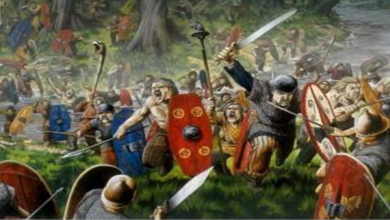
O’Donnell leaves 300 men at Collooney Castle under his cousin, Niall Garbh O’Donnell, and sends another 600 to Sligo town to prevent the landing of English reinforcements under Tibbot ne Long Bourke. He then marches to Dunavaragh with 1,500 of his men, where he is joined by additional forces under local chieftains Conor MacDermott and Brian Óg na Samhthach Ó Ruairc. The Irish then carefully prepare an ambush site in the Curlew Mountains, along the English line of march. O’Donnell has trees felled and placed along the road to impede their progress. When he gets word of the English passing through Boyle, O’Donnell positions his men. Musketeers, archers and javelin men are placed in the woods alongside the road to harass the English. The main body of Irish infantry, armed with pikes and axes, are placed out of sight behind the ridge of the mountain.
In hot harvest weather, Clifford’s force marches from Athlone through Roscommon, Tulsk and Boyle. At 4:00 PM on August 15, they reach the foot of the Curlew Mountains, which have to be crossed before Sligo can be approached. The expedition is poorly supplied, and Clifford’s men are tired and hungry, and probably in no fit state to continue. But Clifford has received false intelligence that the pass is undefended, and he therefore chooses to seize the opportunity and march across, promising his troops plenty of beef in the evening. This means that his men miss out on the rest that had been planned for them in Boyle, whereas the Irish are well fed and prepared.
The English come under gunfire, arrow and javelin attack as soon as they reach the first of O’Donnell’s barricades, between Boyle and Ballinafad. The barricade is immediately abandoned by the Irish but as the English moved past and proceed up the hill they sustain further casualties. The road consists of “stones of six or seven foot broad, lying above ground, with plashes of bog between them,” and is lined with woodland on one side. The further the English advance, the more intensive the rebels’ fire becomes, and some English soldiers begin to lose their nerve and slip away. Eventually, there is a firefight, lasting about 90 minutes, at the end of which the English vanguard has run out of gunpowder. The commander of the vanguard, Alexander Radcliffe, can no longer control his troops. They wheel about in a panic and collide with the main column, which breaks and flees. The commander leads a charge with his remaining pikemen but is shot dead. With the English ranks in disarray, the main body of Irish infantry, which has concealed itself on the reverse slope of the hill, closes in and fights hand to hand. Clifford tries to regain control over his men, but appears overcome by his circumstances. He manages to rally himself and is killed by a pike-thrust as he rushes the enemy. The English are routed, but the situation is prevented from becoming a complete disaster for them when the commander of the horse, Sir Griffin Markham, charges uphill and temporarily drives the rebels back.
Though the actions of the English cavalry allows many of their foot soldiers to escape, Clifford’s men are pursued as far as the town of Boyle, where they find shelter in Boyle Abbey. About 500 English are killed in the battle. Irish losses are not recorded, but are probably small, having been firing from prepared positions and then routing a disorganised and demoralised enemy.
Clifford’s head is cut off and delivered to O’Donnell, who has remained nearby but without taking part in the fight. While the head is brought to Collooney Castle to intimidate its defenders, the trunk is carried by MacDermott to the monastery of Lough Key, where he hopes to use it to ransom his own prisoners. At last, the trunk is given a decent burial in the monastery.
O’Connor Sligo surrenders the castle shortly afterwards and reluctantly joins with the rebels. After the victory, there is a noticeable increase in the rate of desertion by Irish troops from the ranks of Essex’s army, and the earl orders that the surviving troops be divided up as fit only to hold walls.
The battle is a classic Gaelic Irish ambush, similar to the Battle of Glenmalure in 1580 or the Battle of the Yellow Ford in 1598. According to the Annals of the Four Masters, the victory is put down to the intercession of the Blessed Mary, rather than to arms. But Clifford had been overconfident, a trait in him that Essex once warned against, and it is clear that English military commanders are choosing to learn the hard way about the increased effectiveness of Irish rebel forces. Queen Elizabeth I‘s principal secretary, Sir Robert Cecil, rates this defeat (and the simultaneous defeat of Sir Henry Harrington in the Battle of Deputy’s Pass in County Wicklow) as the two heaviest blows ever suffered by the English in Ireland, and seeks to lay the blame indirectly on Essex. It leaves O’Donnell and O’Neill free from any threat from the Connacht side, and renders a land-based attack through Armagh highly improbable, a factor that weighs with Essex as he marches northward later in the year and enters a truce with O’Neill.
In August 1602, the Curlew Pass is the scene of the last victory won by the rebels during the war, when a panicking English force is again routed and suffers significant losses. This time the rebels are led by Rory O’Donnell who commands 400 musketeers.
Today the battlefield at Curlew Pass is overlooked by an impressionistic sculpture by Maurice Harron called “The Gaelic Chieftain”, unveiled in 1999.
The Nine Years War begins with a conflict over English efforts to maintain a string of garrisons along the southern border of Tyrone’s territory in Ulster. The Irish leader promptly besieges the English garrison at Monaghan Castle, and Sir Henry Bagenal, commander of the English forces, marches out to its relief on May 25 from Dundalk, via Newry. His army is made up of 1,750 troops, including some veterans and certain companies newly arrived from the Spanish campaign in Brittany, but there are many recruits in the ranks. Bagenal’s men are predominantly infantry, armed with muskets and pikes. There is also a small number of horsemen raised in the Pale.
The Battle of Clontibret is essentially a two day running battle, as Bagenal’s column is ambushed on its way to and from the castle at Monaghan town. The Irish fight sharply along the roads about Crossdall, around 4 miles from Monaghan, firing on the English column with calivers from the surrounding woodland. With the loss of 12 dead and 30 wounded the English reach the castle, which is re-supplied and reinforced with one company. Bagenal has misgivings about his supply of powder and lead, much of which had been used on the way, and can afford little for the garrison before he starts back.
Two days later, on May 27, Bagenal sets out for Newry in a column, but by another route, past the townland of Clontibret. The route lay through drumlin country, which abounds with hills, bogs and woods, making it ideal for an ambush. The column comes under fire from the outset, and then falls into a major ambush at a pass near Clontibret. Tyrone’s army, about 4,000 strong, consists of contingents from the O’Neill, MacMahon and Maguire clans, as well as Scottish mercenaries. The Irish also deploy a greatly enlarged force of cavalry and caliver-men. To Bagenal’s puzzlement, the caliver-men are turned out in red coats and acquitted themselves with expertise. Fire from the flanks is heavy, and many English troops are killed or wounded while the Irish cavalry plays around the fringes. Tyrone himself is almost killed in hand-to-hand combat with a Palesman named Seagrave, who leads a cavalry charge on the Irish position. Seagrave has his arm chopped off by Tyrone’s standard bearer O’Cahan, and is killed by Tyrone with a dagger thrust to the groin. Bagenal’s column is slowed to a crawl and, as night falls in the wilderness, the commander calls his men to a halt and camps at the hilltop of Ballymacowen. It seems that hundreds are missing, and there is fear that the Irish will renew the attack under cover of darkness. There is no further attack and, a little after first light, reinforcements from Newry arrive to relieve the column.
According to intelligence received in the days following, Tyrone’s failure to follow up is caused by a lack of powder, ironic given the state of Bagenal’s own supplies. The overall sense in government is of disquiet, and a bad job is made of hushing up the casualty figures. This gives fuel to the rumours of a severe defeat, and many people set greater store on the numbers put about by confederate supporters.
Sir Ralph Lane, the muster-master-general, informs the queen’s principal secretary, William Cecil, 1st Baron Burghley, that “more men were hurt and killed in that late service than was convenient to declare.” The casualty figures for both sides vary depending on sources. Bagenal admits only 31 killed and 109 wounded on the second day of fighting, but his losses are almost certainly higher. The Irish annals claimed up to 700 English killed. Estimates of the confederate losses vary between 100 to 400 killed. Three years later, Bagenal leads an army into another ambush by Tyrone, at the Battle of the Yellow Ford. The English general is killed and his troops are routed with heavy losses.
(From: “Battle of Clontibret,” wikia.org, https://military.wikia.org | Pictured: The marker stone on the northern edge of the battlefield commemorating the Irish victory at Clontibret, 1595)
Hugh O’Neill (Irish: Aodh Mór Ó Néill), the 3rd Baron Dungannon and 2nd Earl of Tyrone, dies in Rome on July 20, 1616. His career is played out against the background of the Tudor conquest of Ireland, and he is best known for leading the resistance during the Nine Years’ War, the strongest threat to Tudor authority in Ireland since the revolt of Silken Thomas. The defeat of O’Neill and the conquest of his province of Ulster is the final step in the subjugation of Ireland by the English.
Although born into the powerful O’Neill dynasty of Ulster, O’Neill is fostered as a ward of the Crown in County Dublin after the assassination of his father, Matthew, in 1558. His wardship ends in 1567 and, after a visit to the court in London, he returns to Ireland in 1568 and assumes his grandfather’s title of Earl of Tyrone. By initially cooperating with the government of Queen Elizabeth I, he establishes his base of power, and in 1593 he replaces Turlough Lynagh O’Neill as chieftain of the O’Neills. But his dominance in Ulster leads to a deterioration in his relations with the Crown, and skirmishes between his forces and the English in 1595 are followed by three years of fruitless negotiations between the two sides.
In 1598 O’Neill reopens hostilities. His victory over the English on August 14 in the Battle of the Yellow Ford on the River Blackwater, Ulster, the most serious defeat sustained by the English in the Irish wars, sparks a general revolt throughout the country. Pope Clement VIII lends moral support to his cause, and, in September 1601, four thousand Spanish troops arrive at Kinsale, Munster, to assist the insurrection. But those reinforcements are quickly surrounded at Kinsale, and O’Neill suffers a staggering defeat in December 1601 while attempting to break the siege. He continues to resist until forced to surrender on March 30, 1603, six days after the death of Queen Elizabeth.
Elizabeth’s successor, King James I, allows O’Neill to keep most of his lands, but the chieftain soon finds that he cannot bear the loss of his former independence and prestige. In September 1607 he, with Rory O’Donnell, 1st Earl of Tyrconnell, and their followers, secretly embark on a ship bound for Spain. The vessel is blown off course and lands in Normandy. From there the refugees make their way via the Spanish Netherlands to Rome, where they are acclaimed by Pope Paul V. This “Flight of the Earls” signals the end of Gaelic Ulster and thereafter the province is rapidly Anglicized. Outlawed by the English, O’Neill lives in Rome the rest of his life. He dies there at the age of 66 on July 20, 1616. He is interred in the Spanish church of San Pietro in Montorio.
O’Sullivan Beare conceals 300 of the women, children and aged of his community in a stronghold on Dursey Island, but this position is attacked, and the defenders hanged. In what is later termed the Dursey Massacre, Philip O’Sullivan Beare, nephew of O’Sullivan Beare, writes that the women and children of the Dursey stronghold are massacred by the English, who tie them back-to-back, throw them from the cliffs, and shoot at them with muskets.
After the fall of Dursey and Dunboy, O’Sullivan Beare, Lord of Beara and Bantry, gathers his remaining followers and sets off northwards on December 31, 1602, on a 500-kilometre march with 1,000 of his remaining people. He hopes to meet Hugh O’Neill on the shores of Lough Neagh.
O’Sullivan Beare fights a long rearguard action northwards through Ireland, through Munster, Connacht and Ulster, during which the much larger English force and their Irish allies fight him all the way. The march is marked by the suffering of the fleeing and starving O’Sullivans as they seek food from an already decimated Irish countryside in winter. They face equally desperate people in this, often resulting in hostility, such as from the Mac Egans at Redwood Castle in County Tipperary and at Donohill in O’Dwyer’s country, where they raid the Earl of Ormonde‘s foodstore.
O’Sullivan Beare marches through Aughrim, where he raids villages for food and meets local resistance. He is barred entrance to Glinsk Castle and leads his refugees further north. On their arrival at Brian Oge O’Rourke‘s castle in Leitrim on January 4, 1603, after a fortnight’s hard marching and fighting, only 35 of the original 1,000 remain. Many had died in battles or from exposure and hunger, and others had taken shelter or fled along the route. O’Sullivan Beare had marched over 500 kilometres, crossed the River Shannon in the dark of a midwinter night, having taken just two days to make a boat of skin and hazel rods to carry 28 at a time the half-kilometre across the river, fought battles and constant skirmishes, and lost almost all of his people during the hardships of the journey.
In Leitrim, O’Sullivan Beare seeks to join with other northern chiefs to fight the English, and organises a force to this end, but resistance ends when Hugh O’Neill, 2nd Earl of Tyrone signs the Treaty of Mellifont. O’Sullivan Beare, like other members of the Gaelic nobility of Ireland who flees and seeks exile, making his escape to Spain by ship. O’Sullivan Beare settles in Spain and continues to plead with the Spanish government to send another invasion force to Ireland. King Phillip III gives him a knighthood, pension, and the title Earl of Bearhaven, but never that which he desires most, another chance to free his homeland.
Many generations of O’Sullivan Beare’s family later achieve prominence in Spain. In 1618, Donal Cam O’Sullivan Beare is killed in Madrid by John Bathe, an Anglo-Irishman, but the legend of “O’Sullivan’s March” lives on.
The Beara-Breifne Way long-distance walking trail follows closely the line of the historical march.
The crown forces are organized in six regiments — two forward, two centre, and two rear, and with cavalry at centre. As soon as they leave Armagh garrison, they are all harassed with gunfire from rebel forces concealed in the woods. As a result, the different regiments become separated from one another as they pause to deal with the hit and run attacks. The problem is accentuated when one of their ox-drawn artillery pieces becomes stuck in the bog with a damaged wheel and a rear regiment stays behind to guard it as it is slowly coaxed through the bog. The regiment at the front of the march encounters a mile-long trench, 4 feet wide and 5 feet deep. The regiment succeeds in crossing the trench but then comes under heavy attack from large forces and decides to retreat back across the trench, suffering significant losses during the retreat. This regiment then merges into the ranks of the other forward regiment.
At this point, Henry Bagenal is killed by a shot through the head. Command of the army is assumed by Thomas Maria Wingfield. Further demoralising the crown troops and causing chaos, their gunpowder store explodes, apparently ignited accidentally by the fuse of a matchlock musket. Daunted, Wingfield decides to retreat to Armagh. The commander of the forward part either doesn’t get the command or refuses to obey it or is unable to execute an orderly retreat and judges it necessary to maintain his forward position. Seeing their enemy in confusion, the O’Neill cavalry rushes at the head of the forward part, followed by swordsmen on foot. Crown troops in this part of the field are cut to pieces and any wounded left on the field after the battle are slain as well. The rest of the crown forces have to struggle their way back to the Armagh garrison. They reach it largely intact but are harried all the way by the Irish.
Crown forces lose approximately 1,500 men in the battle, including 18 “captains” or officers. Three hundred soldiers desert to the rebels including two English recruits. Out of 4,000 soldiers who set out from Armagh, just over 2,000 reach the town after the battle and become virtual prisoners inside. The cavalry breaks out and dashes south escaping the Irish.
After three days of negotiations, it is agreed that the crown troops can leave Armagh as long as they leave their arms and ammunition behind and that the garrison of the Blackwater Fort surrenders. O’Neill’s forces suffer perhaps 200 to 300 casualties in the battle, though sources for the number lost on O’Neill’s side are very scanty. In light of the battle’s outcome, the court at London greatly and rapidly increase its military forces in Ireland. Simultaneously, many in Ireland who have been neutral on the sidelines begin to support the rebellion. Thus, the ultimate outcome of the battle is an escalation of the war.





 seamus dubhghaill