seamus dubhghaill

Promoting Irish Culture and History from Little Rock, Arkansas, USA


Leave a comment

The Founding of Saor Éire

saor-eire

Saor Éire, a left-wing political organisation, is established on September 26, 1931 by communist-leaning members of the Irish Republican Army, with the backing of the IRA leadership. Notable among its founders is Peadar O’Donnell, former editor of An Phoblacht and a leading left-wing figure in the IRA. Saor Éire describes itself as “an organization of workers and working farmers.”

It is believed that the support of the then IRA chief of staff Moss (Maurice) Twomey is instrumental in the organisation’s establishment. However, Tim Pat Coogan claims that Twomey is doubtful about the organisation, worrying about involvement in electoral politics and possible communist influence.

During its short existence Saor Éire uses the republican publication An Phoblacht, under the editorship of Frank Ryan, to report on its progress and to promote its radical, left-wing republican views.

On the weekend of September 26-27, 1931, Saor Éire holds its first conference in Dublin at Iona Hall. One hundred and fifty delegates from both the Irish Free State and Northern Ireland attend the conference against a background of police raids on the houses and offices connected with Saor Éire and An Phoblacht. Seán Hayes is chairman, while David Fitzgerald acts as secretary.

The conference elects an executive of Hayes, Fitzgerald, Sean McGuinness, May Laverty, Helena Molony, Sheila Dowling, Sheila Humphreys, D. McGinley, Mick Fitzpatrick, Seán MacBride, Michael Price, Peadar O’Donnell, Mick Hallissey, M. O’Donnell, Patrick McCormack, Tom Kenny, L. Brady, Nicholas Boran, John Mulgrew and Tom Maguire. George Gilmore and Frank Ryan are also involved.

The constitution elaborates upon the aims by describing a two-phase programme. The first phase is described as being one of organisation and propagandising in order to organise a solid front for mass resistance to the oppressors. This is to build upon the day-to-day resistance and activity towards “rents, annuities, evictions, seizures, bank sales, lock-outs, strikes and wage-cuts.” This challenge, it is believed, would lead to power passing from the hands of the imperialists to the masses. The second phase is one of consolidation of power through the organisation of the economy and a workers’ and working farmers’ republic.

Ideologically Saor Éire adheres to the Irish socialist republicanism developed by James Connolly and Peadar O’Donnell. As a consequence of the heavy influence of O’Donnell, Saor Éire strongly advocates the revival of Gaelic culture and the involvement of the poorer rural working communities in any rise against the Irish capitalist institutions and British imperialism.

The organisation is attacked by the centre-right press and the Catholic Church as a dangerous communist group, and is quickly banned by the Free State government. The strength of reaction against it prevents it from becoming an effective political organisation. O’Donnell and his supporters attempt a similar initiative two years later with the establishment of the Republican Congress in 1933.


2 Comments

Irish Free State Admitted to League of Nations

league-of-nations-delegationThe Irish Free State is admitted into the League of Nations on September 10, 1923.

In 1922, Éamon de Valera speaks at a League of Nations meeting and is critical of Article 10 of the League Covenant which preserves the existing of territorial integrity of member states. This article prevents Ireland from gaining membership in the League of Nations, because it is a territory of the United Kingdom, who is a member state. However, it does not clarify what rights dominion states have and if they can have their own seat. This means that when the Constitution of the Irish Free State goes into effect, the Irish government does not know what type of role it can play in the League of Nations and if, at that point, it is possible to become a member. The League of Nations final decision is that Ireland can not become a member until it’s constitution is officially enacted and it officially becomes a free state.

The Constitution of the Irish Free State is enacted on December 6, 1922, and is recognized as an official international instrument. This allows Ireland to submit an application for entry into the League of Nations.

The applications process goes smoothly until the spring of 1923 when the Seanad Éireann, the upper house of the Oireachtas, complains that only Dáil Éireann, the lower house, has approved the application. A previous decision has made the application an Executive Council decision, and under the Provisional Government, the Seanad has approved the application process. With this approval, the Executive Council continues the application process, however, the new Seanad is upset about their lack of input. This problem is settled when the Attorney-General creates the League of Nations (Guarantee) Bill, which gives both Houses an opportunity to discuss and approve the application.

With this approval in September, Ireland is admitted as a full and equal member to the League of Nations on September 10, 1923, giving it access to the rest of the world. This membership means that Ireland now has representatives in one place, who can meet with other representatives, instead of sending delegates to each country. One location not only saves time, but money. Early Irish foreign policy is driven by the need to stress the country’s legal status as a platform from which to pursue a fuller foreign policy. With admission to the League of Nations this is now possible. Ireland’s acceptance into the League of Nations helps create legitimacy for the new nation.

(Pictured: Irish Delegation to the League of Nations, 1923)


Leave a comment

Birth of Novelist Liam O’Flaherty

liam-oflaherty

Liam O’Flaherty, novelist, short story writer, and a major figure in the Irish literary renaissance, is born on August 28, 1896, in the remote village of Gort na gCapall on Inis Mór, one of the Aran Islands of County Galway. He is involved for a time in left-wing politics, as is his brother Tom Maidhc O’Flaherty (also a writer), and their father, Maidhc Ó Flaithearta, before them.

At the age of twelve, O’Flaherty goes to Rockwell College and later University College Dublin and the Dublin Diocesan teacher training college Holy Cross College. It is intended he enter the priesthood, but he joins the Irish Guards in 1917 under the name Bill Ganly. Serving on the Western Front, he finds trench life devastatingly monotonous and is badly injured in September 1917 during the Battle of Langemarck. It is speculated that shell shock is responsible for the mental illness which becomes apparent in 1933.

He returns from the front a socialist. Having become interested in Marxism as a schoolboy, atheistic and communistic beliefs evolve in his 20s and he is a founding member of the Communist Party of Ireland. Two days after the establishment of the Irish Free State, O’Flaherty and other unemployed Dublin workers seize the Rotunda Concert Hall in Dublin and hold it for four days in protest at “the apathy of the authorities.” Free State troops force their surrender.

O’Flaherty then leaves Ireland and moves first to England where, destitute and jobless, he takes to writing. In 1925 he scores immediate success with his best-selling novel The Informer about a rebel with confused ideals in the Irish War of Independence, which wins him the 1925 James Tait Black Memorial Prize for fiction. Four years later his next short novel Return of the Brute, set in the World War I trenches, proves another success. He then travels to the United States, where he lives in Hollywood for a short time. The well-known director John Ford, a cousin, later makes a film of O’Flaherty’ first novel. The novel is also the source of a 1929 film of the same name directed by Arthur Robison.

Many of his works have the common theme of nature and Ireland. He is a distinguished short story writer, and some of his best work in that genre is in Irish. The collection Dúil, published towards the end of his life, contains Irish language versions of a number of stories published elsewhere in English. This collection, now widely admired, has a poor reception at the time, and this seems to discourage him from proceeding with an Irish language novel he has in hand.

In a letter written to The Sunday Times in later years he confesses to a certain ambivalence regarding his work in Irish and speaks of other Irish writers who receive little praise for their work in the language. This gives rise to some controversy. His First Flight, a short story which symbolizes the nervousness one experiences before doing something new, is regarded as one of his most famous works. In 1923, O’Flaherty publishes his first novel, Thy Neighbour’s Wife, thought to be one of his best. Over the next couple of years, he publishes other novels and short stories. In 1933 he suffers the first of two mental breakdowns.

He travels in the United States and Europe, and the letters he writes while travelling have now been published. He has a love of French and Russian culture. Before his death he leaves the Communist Party and returns to the Roman Catholic faith. O’Flaherty dies in Dublin on September 7, 1984, and many of his works are subsequently republished. He is remembered today as a powerful writer and a strong voice in Irish culture.


Leave a comment

The Assassination of Michael Collins

michael-collins

Michael Collins, soldier and politician who is a leading figure in the struggle for Irish independence in the early 20th century, is shot and killed in ambush at Béal na Bláth, County Cork, on August 22, 1922.

In August 1922, the Irish Civil War seems to be winding down. The Irish Free State has regained control of most of the country and Collins is making frequent trips to inspect areas recently recovered from anti-Treaty forces.

His plan to travel to his native Cork on August 20 is considered particularly dangerous and he is strenuously advised against it by several trusted associates. County Cork is an Irish Republican Army (IRA) stronghold, much of it still held by anti-Treaty forces. Yet he seems determined to make the trip without delay. He has fended off a number of attempts on his life in the preceding weeks and has acknowledged more than once, in private conversation, that the Civil War might end his life at any moment. On several occasions Collins assures his advisors that they will not shoot him in his own county.

On August 22, 1922, Collins sets out from Cork City on a circuitous tour of West Cork. He passes first through Macroom then takes the Bandon road via Crookstown. This leads through Béal na Bláth, an isolated crossroads. There they stop at a local pub, now known as the The Diamond Bar, to ask a question of a man standing at the crossroad. The man turns out to be an anti-Treaty sentry. He and an associate recognise Collins in the back of the open-top car. As a result, an ambush is laid by an anti-Treaty column at that point, on the chance that the convoy might come through again on their return journey.

Shortly before 8:00 PM, Collins’ convoy approaches Béal na Bláth for the second time. By that time most of the ambush party has dispersed and gone for the day, leaving just five or six men on the scene. Two are disarming a mine in the road, while three on a laneway overlooking them, provide cover. A dray cart, placed across the road, remains at the far end of the ambush site.

Shots are exchanged. Collins, who suffers a head wound, is the only fatality. Almost every other detail of what happens is uncertain, due to conflicting reports from participants and other flaws in the record.

michael-collins-body

Some of the most disputed details include how the shooting starts, what kind of fire the convoy comes under, where the ambushers’ first shots strike, where Collins is and what he is doing when he is hit, whether anyone else is wounded, whether the armoured car’s machine gun is fully functional throughout the engagement, who moves Collins’ body, and who is nearby when Collins falls.

Many questions have been raised concerning the handling of Collins’s remains immediately following his death. Among them are the inordinately long time the convoy takes to cover the twenty miles back to Cork City, who searched his clothes, and what became of documents he is known to have been carrying on his person.

Collins’s body is transported by sea from Cork to Dublin. He lay in state for three days in Dublin City Hall where tens of thousands of mourners file past his coffin to pay their respects, including many British soldiers departing Ireland who had fought against him. His funeral mass takes place at Dublin’s Pro Cathedral where a number of foreign and Irish dignitaries are in attendance. Some 500,000 people attend his funeral, almost one fifth of the country’s population at that time.

No official inquiry is ever undertaken into Collins’s death and consequently there is no official version of what happened, nor are there any authoritative, detailed contemporary records.

An annual commemoration ceremony takes place each year in August at the ambush site at Béal na Bláth, County Cork, organised by The Béal na mBláth Commemoration Committee. There is also a remembrance ceremony in Dublin’s Glasnevin Cemetery at Collins’s grave on the anniversary of his death.


Leave a comment

First Prisoners Arrive at Kilmainham Gaol

kilmainham-gaol

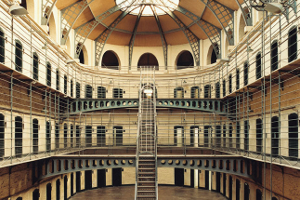
Kilmainham Gaol in Dublin receives its first prisoners on August 12, 1796. When it is first built in 1796, Kilmainham Gaol is called the “New Gaol” to distinguish it from the old prison it is intended to replace. It is officially called the County of Dublin Gaol, and is originally run by the Grand Jury for County Dublin.

Originally, public hangings take place at the front of the prison. However, from the 1820s onward very few hangings, public or private, take place at Kilmainham. A small hanging cell, located on the first floor between the west wing and the east wing, is built in the prison in 1891.

There is no segregation of prisoners as men, women, and children are incarcerated up to five in each cell, with light and heat provided by a single candle which has to last for two weeks. The cells are roughly 28 square metres in area.

At Kilmainham the poor conditions in which women prisoners are kept provide the spur for the next stage of development. Remarkably, for an age that prides itself on a protective attitude for the “weaker sex,” the conditions for women prisoners are persistently worse than for men. Male prisoners are supplied with iron bedsteads while females lay on straw on the floor. Half a century later, however, there is little improvement.

Many Irish revolutionaries, including the leaders of the 1916 Easter Rising, are imprisoned and executed in the prison by the British.

Kilmainham Gaol is decommissioned as a prison by the Irish Free State government in 1924. Seen principally as a site of oppression and suffering at the time, there is no declared interest in its preservation as a monument to the struggle for national independence. The jail’s potential function as a location of national memory is also undercut and complicated by the fact that the first four republican prisoners executed by the Free State government during the Irish Civil War are shot in the prison yard.

The Irish Prison Board contemplates reopening it as a prison during the 1920s but the plans are abandoned in 1929. In 1936 the government considers the demolition of the prison, but the price of this undertaking is seen as prohibitive.

In February 1960 detailed plans submitted by the Kilmainham Gaol Restoration Society for the restoration of Kilmainham, which notably also envisions the site’s development as a tourist attraction, receive the approval of the notoriously parsimonious Department of Finance. Restoration work begins in May of the same year. The final restoration of the site is completed in 1971 when Kilmainham Gaol chapel is re-opened to the public.

Kilmainham Gaol now houses a museum on the history of Irish nationalism and offers guided tours of the building. An art gallery on the top floor exhibits paintings, sculptures, and jewelry of prisoners incarcerated in prisons all over contemporary Ireland.  It is run by the Office of Public Works, an agency of the Government of Ireland.


Leave a comment

Founding of the Gaelic League

conradh-na-gaeilge-logo

The Gaelic League (Irish: Conradh na Gaeilge), a social and cultural organisation which promotes the Irish language in Ireland and worldwide is founded in Dublin on July 31, 1893.

Conradh na Gaeilge is founded by Douglas Hyde, the son of a Church of Ireland rector from Frenchpark, County Roscommon, with the aid of Eugene O’Growney, Eoin MacNeill, Thomas O’Neill Russell, and others. The organisation develops from Ulick Bourke‘s earlier Gaelic Union and becomes the leading institution promoting the Gaelic Revival, carrying on efforts like the publishing of the Gaelic Journal. The League’s first newspaper is An Claidheamh Soluis (The Sword of Light) and its most noted editor is Patrick Pearse. The motto of the League is Sinn Féin, Sinn Féin amháin (Ourselves, Ourselves alone).

The League encourages female participation from the start and a number of women play a prominent role. They are not restricted to subordinate roles, but play an active part in leadership, although males are in the overwhelming majority. Local notables, such as Lady Gregory in Galway, Lady Esmonde in County Wexford, and Mary Spring Rice in County Limerick, and others such as Norma Borthwick, found and lead branches in their communities. At the annual national convention in 1906 women are elected to seven of the forty-five positions on the Gaelic League executive. Executive members include Máire Ní Chinnéide, Úna Ní Fhaircheallaigh (who writes pamphlets on behalf of the League), Bean an Doc Uí Choisdealbha, Máire Ní hAodáin, Máire de Buitléir, Nellie O’Brien, Eibhlín Ní Dhonnabháin, and Eibhlín Nic Néill.

Though apolitical, the organisation attracts many Irish nationalists of different persuasions, much like the Gaelic Athletic Association. It is through the League that many future political leaders and rebels first meet, laying the foundation for groups such as the Irish Volunteers. However, Conradh na Gaeilge does not commit itself entirely to the national movement until 1915, causing the resignation of Douglas Hyde, who feels that the culture of language should be above politics. Most of the signatories of the 1916 Proclamation are members. It still continues to attract many Irish Republicans. Seán Mac Stíofáin, the first chief of staff of the Provisional IRA was a prominent member in his later life.

After the foundation of the Irish Free State in 1922, the organisation has a less prominent role in public life as Irish is made a compulsory subject in state-funded schools. It does unexpectedly bad in the Irish Seanad election of 1925, when all the candidates it endorses are defeated, including Hyde.


Leave a comment

The Abbey Theatre Destroyed by Fire

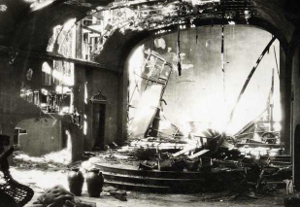
abbey-theatre-fire-1951Fire destroys the Abbey Theatre in Dublin on July 17, 1951, with only the Peacock, a small experimental theatre in the ground floor of the main theatre surviving intact. The play earlier in the evening closes with soldiers on stage singing Keep the Home Fires Burning.

In February 1961, the ruins of the Abbey are demolished. The board has plans for rebuilding with a design by the Irish architect Michael Scott. On September 3, 1963, the President of Ireland, Éamon de Valera, lays the foundation stone for the new theatre. The Abbey reopens on July 18, 1966, at its new location at 26 Lower Abbey Street, Dublin 1.

The Abbey Theatre first opens its doors to the public on December 27, 1904. Despite the loss of the original building to the 1951 fire, it has remained active to the present day. The Abbey is the first state-subsidized theatre in the English-speaking world. From 1925 onwards it receives an annual subsidy from the Irish Free State.

In its early years, the theatre is closely associated with the writers of the Irish Literary Revival, many of whom are involved in its founding and most of whom have plays staged there. The Abbey serves as a nursery for many of the leading Irish playwrights and actors of the 20th century, including William Butler Yeats, Lady Gregory, Seán O’Casey, and John Millington Synge. In addition, through its extensive programme of touring abroad and its high visibility to foreign, particularly American, audiences, it has become an important part of the Irish tourist industry.


Leave a comment

Death of Countess Constance Georgine Markievicz

markievicz-funeral-procession

Countess Constance Georgine Markievicz, née Gore-Booth, Irish politician, revolutionary nationalist, and suffragette, dies on July 15, 1927, in Sir Patrick Dun’s Hospital, Dublin, of complications related to appendicitis.

Constance Gore-Booth is born into the Anglo-Irish aristocracy and grows up at her family’s estate, Lissadell House, in County Sligo. Constance enrolls at London’s Slade School of Fine Art in 1893. In the late 1890s she travels to Paris, where she meets Count Casimir Dunin-Markievicz of Poland. They are married in 1900.

In 1903 the Markieviczes move to Dublin, where Constance’s interests soon turn from art to Irish politics. At age 40, in 1908, she embraces Irish nationalism, joining the revolutionary women’s group Inghinidhe na hÉireann (Daughters of Ireland) and the Sinn Féin political party. The following year she forms Na Fianna Éireann (Soldiers of Ireland), a republican organization loosely based on the Boy Scouts, in which young boys are trained to be nationalist soldiers.

In 1911 she is arrested for demonstrating against King George V’s visit to Ireland. This is just the first of several arrests and imprisonments for Markievicz, whose political activism results in jail time intermittently for the remainder of her life. In 1913–14 she provides food for workers and their families during a labour dispute in which thousands of people are locked out of their workplaces for refusing to reject union membership.

In April 1916 Markievicz takes part in the Easter Rising, the republican insurrection in Dublin against British government in Ireland. After the general surrender, she is arrested and imprisoned. Though many women participate in the uprising, Markievicz is the only one to be court-martialed. She is sentenced to death, but the sentence is commuted to a lifetime of penal servitude on account of her gender. The following year, under a general amnesty, Markievicz is released, but soon finds herself back in jail for supposed participation in a plot against the British government. In December 1918, while still carrying out a prison sentence, Markievicz is elected to the House of Commons as the representative for Dublin’s St. Patrick’s division. Along with the other members of Sinn Féin, she refuses to swear an oath of allegiance to the king and, thus, does not take her seat. Instead, under the leadership of Éamon de Valera, the Irish republicans set up their own provisional government, Dáil Éireann.

After her release from prison, Markievicz serves in the first Dáil Éireann as the minister of labour, a post she holds from 1919 until she is defeated in the 1922 elections. That same year the Irish Free State is established, and Dáil Éireann is incorporated as the lower house of the Oireachtas (Irish parliament). Markievicz is elected to the Dáil in the 1923 general election but, along with the other members of Sinn Féin, she again refuses to swear allegiance to the king and does not take her seat. Instead, she devotes herself to charity work. Markievicz joins de Valera’s Fianna Fáil party on its founding in 1926 and is again elected to the Dáil in 1927 but dies a month later without having taken her seat.

Refused a state funeral by the Free State government, Markievicz is buried at Glasnevin Cemetery, Dublin, and de Valera gives the funeral oration.


Leave a comment

Enactment of the Constitution of Ireland

constitution-of-ireland

The current Constitution of Ireland is enacted by a national plebiscite of voters on July 1, 1937, in what is then the Irish Free State. The Constitution comes into effect on December 29, 1937. The Constitution is closely associated with Éamon de Valera, the President of the Executive Council of the Irish Free State at the time, who is personally eager to replace the Constitution of the Irish Free State.

There are two main motivations for replacing the constitution in 1937. Firstly, the Irish Free State constitution of 1922 is, in the eyes of many, associated with the controversial Anglo-Irish Treaty. The second motive for replacing the original constitution is primarily symbolic. De Valera wants to put an Irish stamp on the institutions of government and chooses to do this in particular through the use of Irish nomenclature.

De Valera, as President of the Executive Council, personally supervises the writing of the Constitution. It is drafted initially by John Hearne, legal adviser to the Department of External Affairs. De Valera serves as his own External Affairs Minister, hence the use of the Department’s Legal Advisor, with whom he has previously worked closely, as opposed to the Attorney General or someone from the Department of the President of the Executive Council. He also receives significant input from John Charles McQuaid, the Catholic Archbishop of Dublin, on religious, educational, family, and social welfare issues. The text is translated into Irish over a number of drafts by a group headed by Micheál Ó Gríobhtha who works in the Department of Education.

The framers of the 1937 Constitution decide that it will be enacted not by an elected body but by the people themselves by means of a plebiscite. The preamble to the 1937 Constitution is thus written in the name not of the legislature but of “We, the people of Éire.” On June 2, 1937, the Oireachtas passes the Plebiscite (Draft Constitution) Act 1937, which mandates the holding of a plebiscite on the draft constitution on the same date as the next general election. The Dáil is dissolved on June 14, 1937, as soon as it has approved the draft constitution. The ensuing general election is held on July 1, 1937, and the plebiscite is held in parallel. The question put to voters is simply “Do you approve of the Draft Constitution which is the subject of this plebiscite?” It is passed by a plurality – 56% of voters are in favour, comprising 38.6% of the entire electorate.

Neither the Dáil resolution approving the draft Constitution nor the Plebiscite (Draft Constitution) Act 1937 provide for the plebiscite establish how the Constitution would come into force. It is the Constitution itself which states that this will occur 180 days after its approval, and that the 1922 Constitution will simultaneously be repealed. This happens on December 29, 1937, one hundred eighty days after the July 1 plebiscite.

Consequential acts are passed between July and December to provide for the establishment of, and holding elections for, the new Seanad and the Presidency, as well as for other adaptations. The Presidential Establishment Act, 1938 is passed after the Constitution has come into effect but before the first President, Douglas Hyde, takes office.


Leave a comment

Death of Seán Francis Lemass, Taoiseach (1959-1966)

sean-francis-lemass

Seán Francis Lemass, one of the most prominent Irish politicians of the 20th century and Taoiseach from 1959 until 1966, dies at Mater Misericordiae University Hospital in Dublin on May 11, 1971, at the age of 71.

John Francis Lemass is born in Ballybrack, County Dublin before his family moves to Capel Street in Dublin city centre. He is the second of seven children born to John and Frances Lemass. Within the family his name soon changes to Jack and eventually, after 1916, he himself prefers to be called Seán. He is educated at O’Connell School where he was described as studious, with his two best subjects being history and mathematics.

As early as the age of sixteen, Lemass becomes a freedom fighter in the streets of Dublin, engaging in the 1916 Easter Rising, the Irish War of Independence, and the Irish Civil War, landing in jail again and again. He opposes the establishment of the Irish Free State as a dominion under the Anglo-Irish Treaty of 1921 and becomes a member of the headquarters staff of the Irish Republican Army in the civil war of 1922–1923.

Lemass is first elected as a Sinn Féin Teachta Dála (TD) for the Dublin South constituency in a by-election on November 18, 1924, and is returned at each election until the constituency is abolished in 1948, when he is re-elected for Dublin South–Central until his retirement in 1969.

He plays a key role in persuading Éamon de Valera to found a new republican party, Fianna Fáil, in 1926. After de Valera rises to the premiership in 1932, Lemass holds portfolios in all his cabinets for 21 of the next 27 years, notably as Minister for Industry and Commerce, Minister for Supplies, and Tánaiste (deputy prime minister).

When de Valera becomes President of Ireland in 1959, Lemass inherits the office of Taoiseach, serving in this position until 1966. Under him the country takes a more outward-looking approach, and he especially presses for Ireland’s entry into the European Economic Community (EEC), now the European Community embedded in the European Union, and for reconciliation with Northern Ireland.

Ill health forces Lemass to relinquish the leadership of his party in 1966 and he withdraws from politics altogether in 1969. He has been a heavy pipe smoker all his life, smoking almost a pound of tobacco a week in later life. At the time of his retirement, it is suspected that Lemass has cancer, but this is later disproved. In February 1971, while attending a rugby game at Lansdowne Road, he becomes ill, is rushed to hospital, and is told by his doctor that one of his lungs is about to collapse.

On Tuesday, May 11, 1971, Seán Lemass dies in Dublin’s Mater Misericordiae University Hospital. He is afforded a state funeral and is buried in Dean’s Grange Cemetery.

Lemass is widely regarded as the father of modern Ireland, primarily due to his efforts in facilitating industrial growth, bringing foreign direct investment into the country, and forging permanent links between Ireland and the European community. His greatest legacy, Ireland’s membership in the EEC, is not secured until 1973, after his death.