seamus dubhghaill

Promoting Irish Culture and History from Little Rock, Arkansas, USA


Leave a comment

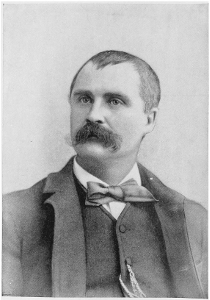
Birth of Writer John Boyle O’Reilly

John Boyle O’Reilly, poet, journalist and fiction writer, is born in Dowth, County Meath on June 28, 1844.

O’Reilly is the third child of a headmaster and a schoolteacher. When he is fifteen, he moves to Lancashire and lives with his aunt and uncle. There he becomes a reporter with a local newspaper and joins the 11th Lancashire Rifle Volunteers in 1861. He returns to Ireland in 1863 and enlists with the 10th Royal Hussars in Dublin. However, after realising the way the British are treating his fellow people, he leaves the army and joins the Irish Republican Brotherhood around 1865.

In 1866 O’Reilly, along with many other members of the Brotherhood, are arrested and put on trial for treason. O’Reilly is found guilty and sentenced to death however, due to his young age, his sentence is reduced to 20 years penal servitude. He spends a year and a half in some English prisons before being transported to Western Australia in 1867, arriving in 1868.

A month after arriving O’Reilly is moved to the town of Bunbury where he starts receiving attention for protesting the chopping down of a tree. A year after arriving he decides to escape from the colony with the help of a local Catholic priest and some farmers from the nearby town of Dardanup. In February 1869 O’Reilly absconds from his convict camp and makes his way towards the Leschenault Peninsula where he waits for a ship to arrive. After approximately two weeks O’Reilly escapes on the Gazelle bound for the United States, arriving there in November 1869.

O’Reilly moves to Boston and becomes a well-known figure in the town where he becomes involved in civil rights, sports, and Irish American causes. He also becomes part owner of The Pilot newspaper. He publishes four books of poetry – Songs from the Southern Seas (1873), Songs, Legends and Ballads (1878), The Statues in the Block (1881) and In Bohemia (1886). He also publishes a novel Moondyne (1879) based on the convict of the same name and O’Reilly’s experiences in Western Australia. It becomes his most popular work. He also writes one last book of poems entitled Watchwords, which is released after his death.

John Boyle O’Reilly dies in Hull, Massachusetts on August 10, 1890, from heart failure after overdosing on his wife’s medication. His sudden death receives an outpouring of grief and tributes from the Boston community and also globally.

His funeral is held at St. Mary’s Church in Charlestown on August 13 and is attended by thousands. The streets near the church are lined with mourners. His wife does not attend the funeral due to grief and is unable to leave her bed. He is originally buried at Calvary Cemetery in Roxbury, but in November 1890 his remains are exhumed and moved to Holyhood Cemetery in Brookline.


Leave a comment

Birth of Eva Gore-Booth, Suffragist & Sister of Countess Markievicz

Eva Selina Laura Gore-Booth, poet and dramatist, and a committed suffragist, social worker and labour activist, is born at Lissadell HouseCounty Sligo, on May 22, 1870. She is the younger sister of Constance Gore-Booth, later known as the Countess Markievicz.

The work of Gore-Booth, alongside that of Esther Roper, the English woman who would become her lifelong companion, is responsible for the close link between the struggle for women’s rights in industry and the struggle for women’s right to vote. As a middle-class suffragist representing Manchester, the work of Gore-Booth is mainly recognized in the Lancashire cotton towns from 1899 to 1913. Her struggle begins when she becomes a member of the executive committee of the National Union of Women’s Suffrage Societies. Carrying out work at the Ancoats settlement, Eva becomes co-secretary of the Manchester and Salford Women’s Trade Union Council.

In 1902 Gore-Booth campaigns at the Clitheroe by-election on behalf of David Shackleton, a Labour candidate who promises her that he would show support for the women’s enfranchisement. Shackleton is elected but does not act upon his promise. This leads to the founding of the Lancashire and Cheshire Women Textile and Other Worker’s Representation Committee by Gore-Booth, Esther Roper and Sarah Reddish. When the Women’s Trade Union Council refuses to make women’s suffrage one of its aims, Gore-Booth resigns from the council.

In 1902 Gore-Booth campaigns at the Clitheroe by-election on behalf of David Shackleton, a Labour candidate who promises her that he would show support for the women’s enfranchisement. Shackleton is elected but does not act upon his promise. This leads to the founding of the Lancashire and Cheshire Women Textile and Other Worker’s Representation Committee by Gore-Booth, Esther Roper and Sarah Reddish. When the Women’s Trade Union Council refuses to make women’s suffrage one of its aims, Gore-Booth resigns from the council.

In 1907 Gore-Booth, reluctant to give up hope, contributes an essay “The Women’s Suffrage Movement Among Trade Unionists” to The Case for Women’s Suffrage. In this essay Eva gives a summary of reasons for the methods of the LCWTOW campaign to gain a vote for working women.

As World War I breaks out, Gore-Booth and Esther Roper take up welfare work among German women and children in England. Gore-Booth becomes a member of the Women’s Peace Crusade in 1915 and the No-Conscription Fellowship in 1916.

When Gore-Booth embarks on her writing career she is visited by William Butler Yeats who is very much taken with her work. Yeats hopes that she will take up his cause of writing Irish tales to enchant and amuse. Instead, Eva takes Irish folklore and put emphasis on the females in the story. Her widely discussed sexuality in later years is never declared but her poetry reflects it quite overtly. Gore-Booth is also one of a group of editors of the magazine Urania that publishes three issues per year from 1916 to 1940. It is a feminist magazine that reprints stories and poems from all over the world with editorial comment.

After years of playing a lead role in the Women’s Suffrage Movement and fighting for equality of women’s rights in the UK as well as staying true to her literary roots, Gore-Booth and Roper relocate to London from Manchester in 1913 due to Gore-Booth’s deteriorating respiratory health.

Just weeks after the 1916 Easter Rising, Gore-Booth travels to Dublin accompanied by Roper and is pivotal in the efforts to reprieve the death sentence of her sister Constance Markievicz awarded for her instrumental role in the rising, which is successfully converted to a life sentence. She further campaigns to abolish the death sentence overall and to reform prison standards. She attends the trial of Irish nationalist and fellow poet Roger Casement thus showing solidarity and support for the overturning of his death sentence.

During the remaining years of her life, which is claimed by cancer on June 30, 1926, Gore-Booth remains devoted to her poetry, dedicates time to her artistic talents as a painter, studies the Greek language and is known as a supporter of animal rights. She dies in her home in Hampstead, London, which she shares with Roper until her passing. She is buried alongside Roper in St. John’s churchyard, Hampstead.


Leave a comment

Birth of Irish Nationalist Joseph Mary Plunkett

joseph-mary-plunkett

Joseph Mary Plunkett, Irish nationalist, poet, journalist, and a leader of the 1916 Easter Rising, is born at 26 Upper Fitzwilliam Street in Dublin on November 21, 1887.

Both his parents come from wealthy backgrounds, and his father, George Noble Plunkett, has been made a papal count. Despite being born into a life of privilege, young Joe Plunkett does not have an easy childhood.

Plunkett contracts tuberculosis at a young age. This is to be a lifelong burden. His mother is unwilling to believe his health is as bad as it is. He spends part of his youth in the warmer climates of the Mediterranean and North Africa. He spends time in Algiers where he studies Arabic literature and language and composes poetry in Arabic. He is educated at the Catholic University School and by the Jesuits at Belvedere College in Dublin and later at Stonyhurst College, in Lancashire, England, where he acquires some military knowledge from the Officers’ Training Corps. Throughout his life, Plunkett takes an active interest in Irish heritage and the Irish language and also studies Esperanto. He is one of the founders of the Irish Esperanto League. He joins the Gaelic League and begins studying with Thomas MacDonagh, with whom he forms a lifelong friendship. The two are both poets with an interest in theatre, and both are early members of the Irish Volunteers, joining their provisional committee. Plunkett’s interest in Irish nationalism spreads throughout his family, notably to his younger brothers George and John, as well as his father, who allows his property in Kimmage, south Dublin, to be used as a training camp for young men who wish to escape conscription in Britain during the First World War. Men there are instead trained to fight for Ireland.

Sometime in 1915 Plunkett joins the Irish Republican Brotherhood (IRB) and soon after is sent to Germany to meet with Roger Casement, who is negotiating with the German government on behalf of Ireland. Casement’s role as emissary is self-appointed, and, as he is not a member of the IRB, the organisation’s leadership wishes to have one of their own contact Germany to negotiate German aid for an uprising the following year. Plunkett is seeking, but not limiting himself to, a shipment of arms. Casement, on the other hand, spends most of his energies recruiting Irish prisoners of war in Germany to form a brigade to fight instead for Ireland. Some nationalists in Ireland see this as a fruitless endeavour, and prefer to seek weapons. Plunkett successfully gets a promise of a German arms shipment to coincide with the rising.

Plunkett is one of the original members of the IRB Military Committee that is responsible for planning the Easter Rising, and it is largely his plan that is followed. Shortly before the rising is to begin, Plunkett is hospitalised following a turn for the worse in his health. He has an operation on his neck glands days before Easter and has to struggle out of bed to take part in what is to follow. Still bandaged, he takes his place in the General Post Office with several other of the rising’s leaders, including Patrick Pearse and Tom Clarke, though his health prevents him from being terribly active. His energetic aide-de-camp is Michael Collins.

Following the surrender Plunkett is held in Kilmainham Gaol, and faces a court-martial. Seven hours before his execution by firing squad at the age of 28, he is married in the prison chapel to his sweetheart Grace Gifford, a Protestant convert to Catholicism, whose sister, Muriel, had years before also converted and married his best friend Thomas MacDonagh, who is also executed for his role in the Easter Rising. Plunkett is executed by firing squad on May 4, 1916, and is the fourth and youngest signatory of the Proclamation of the Irish Republic to be executed.

Plunkett’s brothers, George Oliver Plunkett and Jack Plunkett, join him in the Easter Rising and later become important Irish Republican Army (IRA) men. His father’s cousin, Horace Plunkett, is a Protestant and unionist who seeks to reconcile unionists and nationalists. Horace Plunkett’s home is burned down by the Anti-Treaty IRA during the Irish Civil War.

The main railway station in Waterford City is named after Plunkett as is Joseph Plunkett Tower in Ballymun. Plunkett barracks in the Curragh Camp, County Kildare is also named after him.