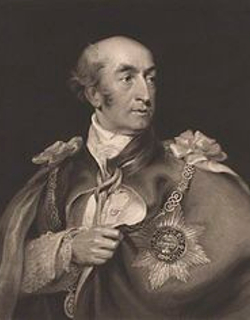
John Blaquiere, 1st Baron de Blaquiere, British soldier, diplomat and politician of French descent, is born on May 15, 1732. He serves as Chief Secretary for Ireland between 1772 and 1776. He is the fifth son of Jean de Blaquiere, a French merchant who had emigrated to England in 1685, and his wife Marie Elizabeth de Varennes.
Blaquiere at first serves in the Army, in the 18th Dragoons, later renumbered the 17th Dragoons, where he achieves the rank of Lieutenant Colonel. In 1771 he is appointed Secretary of Legation at the British Embassy in Paris, a post he holds until 1772. The latter year Simon Harcourt, 1st Earl Harcourt, the British Ambassador in Paris, is appointed Lord Lieutenant of Ireland, and Blaquiere joins him as Chief Secretary for Ireland. He is admitted to the Privy Council of Ireland the same year and made a Knight Companion of the Order of the Bath two years later.
Blaquiere is to remain Chief Secretary until December 6, 1776. He is elected to the Irish House of Commons for Old Leighlin in 1773, a seat he holds until 1783. After representing Enniskillen for a few months in 1783, he sits then for Carlingford from 1783 to 1790, for Charleville from 1790 to 1798 and for Newtownards from 1798 until the Act of Union comes into force in 1801. He is created a Baronet, of Ardkill in County Londonderry, in 1784, and is raised to the Peerage of Ireland as Baron de Blaquiere, of Ardkill in the County of Londonderry, in 1800, for his support for the Act of Union. Lord de Blaquiere also sits as a Member of the British House of Commons for Rye from 1801 to 1802 and for Downton from 1802 to 1806. He is elected a Fellow of the Royal Society in 1803.
Lord de Blaquiere marries Eleanor, daughter of Robert Dobson, in 1775. They have four sons, including Peter de Blaquière, and three daughters. Lord de Blaquiere dies at the age of 80 in Bray, County Wicklow, on August 27, 1812. He is succeeded in his titles by his eldest son, John. Lady de Blaquiere dies at Regent’s Park, Marylebone, London, in December 1833.
Mayne attends school at Regent House School, a school for students aged 4 to 18. While at Regent he discovers his skill and love for the game of rugby. He also enjoys cricket and golf and becomes a marksman with the rifle club. He goes on to Queen’s University Belfast to study law. At university he takes up boxing and becomes the Irish Universities Heavyweight Champion in August 1936. He also wins the Scrabo Golf Club President’s cup in 1937. He graduates from Queen’s University in 1939.
During 1938, Mayne travels to Africa on the 1938 British Lions Tour to South Africa. He plays on a team that tours around Africa playing other local clubs. While traveling, it is discovered that Mayne has a wild side and on various occasions finds himself in trouble. His “go to” is to trash the hotel rooms of his teammates. The team includes some of the best players from around Ireland and Britain.
In 1939, with outbreak of World War II, Mayne joins the Supplementary Reserves in Newtownards and receives a commission in the Royal Artillery. He serves in several units in Ireland and England, generally with light and heavy anti-aircraft units. He volunteers for the No. 11 (Scottish) Commando unit which is sent to the Middle East. There he sees action during the Syria-Lebanon campaign. Specifically, during the Battle of the Litani River, he draws attention from Captain David Stirling who is forming the new Special Air Service (SAS). Sterling recruits Mayne for the new SAS while he is in jail for striking his commanding officer.
From November 1941 to the end of 1942, Mayne is involved in several raids behind enemy lines with the SAS. He uses jeeps to go to various Axis bases and begin blowing up planes and fuel dumps. It is claimed that he personally destroyed 100 planes during these missions. In addition to serving in the Middle East, he serves as well in Sicily, Italy, Belgium, the Netherlands, Germany, Norway and France. In most of these locations he works with the resistance behind the enemy lines. In France he helps to train the French Resistance.
By the end of the war, Mayne has been promoted to the rank of Lieutenant Colonel and has also received the British Army’s Distinguished Service Order with three bars, which means he received the award four times. After the war he joins the British Antarctic Survey in the Falkland Islands. He returns home to Newtownards when back issues, which started while he was serving in the Middle East, become more difficult for him.
Mayne is initiated into Eklektikos Lodge No. 542 in Newtownards in 1945. He is a very enthusiastic mason and joins a second lodge in Newtownards, Friendship Lodge No. 447. On the evening of December 13, 1955, he attends a meeting of Friendship Lodge and then joins some of his masonic brothers at a local bar. At about 4:00 AM on December 14, he is found dead in his Riley RM roadster in Mill Street, Newtownards, having reportedly collided with a farmer’s vehicle.
At his funeral hundreds of mourners turn out to pay their respects and to see him interred in a family plot in the town’s old Movilla Abbey graveyard. After his death his masonic jewel is preserved for many years by an old school friend before it is presented to Newtownards Borough Council where it is displayed in the Mayoral Chamber of the Council Offices.
In November 1938, Lord Killanin is commissioned into the Queen’s Westminsters, a territorial regiment of the British Army, where he is responsible for recruiting fellow journalists, including future The Daily Telegraph editor Bill Deedes, and friends who are musicians and actors. He reaches the rank of major and takes part in the planning of D-Day and the Invasion of Normandy in 1944, acting as brigade major for the 30th Armoured Brigade, part of the 79th Armoured Division. He is appointed, due to the course of operations, a Member of the Order of the British Empire (MBE). After being demobilised, he goes to Ireland. He resigns his TA commission in 1951.
In 1950, Lord Killanin becomes the head of the Olympic Council of Ireland (OCI) and becomes his country’s representative in the IOC in 1952. He becomes senior vice-president in 1968, and succeeds Avery Brundage, becoming President-elect at the 73rd IOC Session (August 21–24) held in Munich prior to the 1972 Summer Olympics. He takes office soon after the Games.
Lord Killanin serves as Honorary Consul-General of Monaco in Ireland from 1961 to 1984 and as Chairman of the Race Committee for Galway Racecourse from 1970 to 1985. A keen horse racing enthusiast, he also serves as a steward of the Irish Turf Club on two occasions and on the National Hunt Steeplechase Committee. In his business life Lord Killanin is a director of many companies including Irish Shell, Ulster Bank, Beamish & Crawford and Chubb Ireland. He is a founder member of An Taisce (The National Trust for Ireland) and is chairman of the National Monuments Advisory Council until his death.
Lord Killanin dies at his home in Dublin on April 25, 1999, at the age of 84 and, following a bilingual funeral Mass at St. Enda’s Church in Spiddal, County Galway, he is buried in the family vault in the New Cemetery, Galway.