Gallagher is commissioned to write essays for The Irish Times, the Irish Medical Times and various journals. She takes up writing screenplays and stage plays. The result is a prolific list of productions which have been staged around the world as well as broadcast by RTÉ and the BBC.
Gallagher varies work from plays to speech therapy, as well as working with prisoners, and this leads her to be a visiting lecturer at universities across the globe. She is deeply involved in the organisations of her craft, leading her to being a member of Irish PEN, both on its committee and as vice president, on the Irish Writers’ Union committee as well as a council member of the Society of Irish Playwrights. Over the years she wins a number of awards including the Arts Council and European Script Fund Awards, the MHA TV Script Award, and the EU Theatre Award.
Gallagher’s husband is Gerhardt Gallagher. They live in Dublin and have three children, Mia, Donnacha, and Etain. In 2012 she is diagnosed with cancer and kidney disease. She dies on January 15, 2018.
Harris is born to a farming family on October 1, 1930, in Limerick, County Limerick. He is the son of Mildred Josephine (Harty) and Ivan John Harris. He is an excellent rugby player with a strong passion for literature. Unfortunately, a bout of tuberculosis as a teenager ends his aspirations to a rugby career. He becomes fascinated with the theater and skips a local dance one night to attend a performance of Henry IV. He is hooked and goes on to learn his craft at the London Academy of Music and Dramatic Art, followed by several years in stage productions.
Harris’ breakthrough performance is as the quintessential “angry young man” in the sensational drama This Sporting Life (1963), for which he receives an Academy Award nomination. He then appears in the World War II commando tale The Heroes of Telemark (1965) and in the Sam Peckinpah-directed western Major Dundee (1965). He next shows up in Hawaii (1966) and plays King Arthur in Camelot (1967), a lackluster adaptation of the famous Broadway play. Better performances follow, among them a role as a reluctant police informer in The Molly Maguires (1970) alongside Sean Connery. He takes the lead role in the violent western A Man Called Horse (1970), which becomes something of a cult film and spawns two sequels.
As the 1970s progress, Harris continues to appear regularly on screen, however, the quality of the scripts vary from above average to woeful. His credits during this period include directing himself as an aging soccer player in the delightful The Hero (1971), the western The Deadly Trackers (1973), the big-budget “disaster” film Juggernaut (1974), the strangely-titled crime film 99 and 44/100% Dead (1974), with Connery again in Robin and Marian (1976), Gulliver’s Travels (1977), a part in the Jaws (1975) ripoff Orca (1977) and a nice turn as an ill-fated mercenary with Richard Burton and Roger Moore in the popular action film The Wild Geese (1978).
The 1980s kick off with Harris appearing in the silly Bo Derek vanity production Tarzan, the Ape Man (1981) and the remainder of the decade has him appearing in some very forgettable productions.
Harris is diagnosed with Hodgkin’s lymphoma in August 2002, reportedly after being hospitalised with pneumonia. He dies at University College Hospital in Fitzrovia, London on October 25, 2002, after spending his final three days in a coma. His body is cremated, and his ashes are scattered in the Bahamas, where he had owned a home.
Harris is schooled by the Jesuits at Crescent College. He is a talented rugby player; however, his athletic career is cut short when he comes down with tuberculosis in his teens. After recovering from tuberculosis, Harris moves to Britain, wanting to become a director. Unable to find any suitable training courses, he enrolls in the London Academy of Music and Dramatic Art (LAMDA) to learn acting.
Harris performs the role of King Arthur in the film adaptation of the musical play Camelot (1967). He continues to appear on stage in this role for many years, including a successful Broadway run in 1981–1982. In 1970 British exhibitors vote him the 9th most popular star at the UK box office.
Other film performances follow, among them a role as a reluctant police informant in the coal-mining tale The Molly Maguires (1970), also starring Sean Connery. Harris stars in Cromwell (1970), a film based on the life of Oliver Cromwell who leads the Parliamentary forces during the English Civil War and, as Lord Protector, ruled Great Britain and Ireland in the 1650s.
Harris’ film career collapses after the late 1970s and in the next decade he is rarely seen on screen, although he continues to act on stage. During his career Harris appears in two films which win the Academy Award for Best Picture. First, as the gunfighter “English Bob” in the Western Unforgiven (1992); second, as the Roman EmperorMarcus Aurelius in Ridley Scott‘s Gladiator (2000).
Harris is diagnosed with Hodgkin’s disease in August 2002, reportedly after being hospitalised with pneumonia. He dies at University College Hospital in Fitzrovia, London on October 25, 2002, at the age of 72. He was in a coma in his final three days. Harris’ body is cremated, and his ashes are scattered in the Bahamas, where he had owned a home.


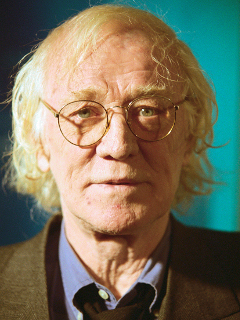

 seamus dubhghaill