Kelly is the oldest child in a Roman Catholic family of five. He lives in Carrickfergus until he is sixteen, at which time the family returns to live in Dungannon. His uncle is the Irish Republican activist and elected official Liam Kelly.
Kelly becomes a member of the Provisional Irish Republican Army at the beginning of the 1970s and becomes one of the most experienced IRA men in County Tyrone. He is arrested in February 1982 based on testimony from an informant named Patrick McGurk but is released in October 1983 due to lack of evidence, after a trial that lasts fifteen minutes.
In 1985, Kelly becomes brigade commander in East Tyrone and begins developing tactics for attacking isolated Royal Ulster Constabulary (RUC) bases in his area. Under his leadership the East Tyrone Brigade becomes the most active IRA unit.
In 1986, Kelly attends the IRA Army Convention where the main topic of discussion is the principle of abstentionism. Gerry Adams and others argue that the abstentionist rule should be dropped and the Provisional movement should become involved in constitutional politics. Kelly votes against dropping the rule, and a rift with the majority of the IRA Army Council ensues.
Kelly is killed by the Special Air Service (SAS) on May 8, 1987, while he is participating in an attack on Loughgall police station, in which seven other IRA men, Pádraig McKearney, Declan Arthurs, Seamus Donnelly, Tony Gormley, Eugene Kelly, Jim Lynagh, and Gerard O’Callaghan, also die. His funeral in Dungannon is one of the largest in Tyrone during the Troubles.
Kelly is buried in Edendork Cemetery, two miles from his home in Dungannon.
McCaughey, from Aughnagar, Galbally, County Tyrone, Northern Ireland, is born on February 24, 1967, the oldest son of Owen and Bridget McCaughey. He is a boyhood friend of several of the “Loughgall Martyrs” including Declan Arthurs, Seamus Donnelly, Tony Gormley and Eugene Kelly, with whom he travels to local discos and football matches when they are growing up.
McCaughey is elected as a Sinn Féin councillor for Dungannon and South Tyrone Borough Council and at the time is the youngest elected representative on the island of Ireland.
Two months prior to his shooting, McCaughey is disqualified from holding his office on the council as he had failed to appear for a monthly council meeting. After his death, the Royal Ulster Constabulary (RUC) reveals the explanation behind his disappearance. He had been shot and wounded in a shoot-out with undercover British Army security forces near Cappagh, County Tyrone. He is then taken south across the Irish border into the Republic of Ireland where he is given hospital treatment and therefore unable to attend the meetings.
Ulster UnionistMP and fellow Dungannon councillor Ken Maginnis alleges that McCaughey had conspired to kill him while both sat as councillors.
McCaughey is shot dead on October 9, 1990, along with Dessie Grew, in an operation by undercover British soldiers. A secret undercover intelligence unit named 14 Intelligence Company, also known as the DET, are monitoring three AK-47s at a farm building in a rural part of County Armagh and are aware that the pair are due to remove the guns.
As McCaughey and Grew are approaching an agricultural shed which is being used to grow mushrooms and also thought to be an IRA arms dump, as many as 200 shots are fired at the two men. British Army reports of the shooting state that the two men left the shed holding two rifles. Republican sources state the men were unarmed.
McCaughey is buried at Galbally Cemetery in October 1990.
The family of McCaughey claims that he and Grew were ambushed after a stakeout by the Special Air Service (SAS). In January 2002, Justice Weatherup, a Northern Ireland High Court judge, orders that official military documents relating to the shooting should be disclosed. However, Police Service of Northern Ireland (PSNI) Chief ConstableHugh Orde has the ruling overturned on appeal in January 2005.
Fellow Sinn Féin representative, Francie Molloy, replaces McCaughey on Dungannon Council after a by-election is held following McCaughey’s death.
In January 2007, the lawyers representing McCaughey and another volunteer, Pearse Jordan, apply to the House of Lords to challenge the details of how the inquests into their deaths are to proceed.
McCaughey’s father, Owen, seeks to compel Chief Constable Hugh Orde to produce key documents including intelligence reports relevant to the shooting and the report of the RUC’s investigating officer.
In 2010, a commemorative portrait of McCaughey is unveiled in the mayor’s parlour at Dungannon council.
The son of a member of the Royal Air Force (RAF), Keenan is born on July 17, 1941, in Swatragh, County Londonderry, Northern Ireland, before his family moves to Belfast. As a teenager, he moves to England to find work, for a time working as a television repairman in partnership with his brother in Corby, Northamptonshire. During this time, he comes to the attention of the police when he damages a cigarette machine, which leads to police having his fingerprints on file. He returns to Northern Ireland when the Troubles begin and starts working at the Grundig factory in the Finaghy area of Belfast where he acquires a reputation as a radical due to his involvement in factory trade union activities.
Despite his family having no history of republicanism, Keenan joins the Provisional Irish Republican Army in 1970 or 1971, and by August 1971 is the quartermaster of the Belfast Brigade. He is an active IRA member, planning bombings in Belfast and travelling abroad to make political contacts and arrange arms smuggling, acquiring contacts in East Germany, Libya, Lebanon and Syria. In 1972, he travels to Tripoli to meet with Libyan leader Muammar Gaddafi in order to acquire arms and finance from his government. In early 1973 he takes over responsibility for control of the IRA’s bombing campaign in England and also becomes IRA Quartermaster General. In late 1973, he is the linchpin of the kidnap of his former employer at Grundig, director Thomas Niedermayer.
In early 1974, Keenan plans to break Gerry Adams and Ivor Bell out of Long Kesh using a helicopter, in a method similar to Seamus Twomey‘s escape from Mountjoy Prison in October 1973, but the plan is vetoed by Billy McKee. He is arrested in the Republic of Ireland in mid-1974 and sentenced to twelve months imprisonment for IRA membership. On March 17, 1975, he is shot and wounded while attempting to lead a mass escape from Portlaoise Prison. While being held in Long Kesh, Gerry Adams helps to devise a blueprint for the reorganisation of the IRA, which includes the use of covert cells and the establishment of a Southern Command and Northern Command. As the architects of the blueprint, Adams, Bell and Brendan Hughes, are still imprisoned, Martin McGuinness and Keenan tour the country trying to convince the IRA Army Council and middle leadership of the benefits of the restructuring plan, with one IRA member remarking “Keenan was a roving ambassador for Adams.” The proposal is accepted after Keenan wins support from the South Derry Brigade, East Tyrone Brigade and South Armagh Brigade, with one IRA member saying, “Keenan was really the John the Baptist to Adams’ Christ.”
In December 1975, members of an IRA unit based in London are arrested following the six-day Balcombe Street siege. The IRA unit had been active in England since late 1974 carrying out a series of bombings, and a few months after his release from prison Keenan visits the unit in Crouch Hill, London, to give it further instructions. In follow-up raids after the siege, police discover crossword puzzles in his handwriting and his fingerprints on a list of bomb parts. A warrant is issued for his arrest.
Garda Síochána informer Sean O’Callaghan claims that Keenan recommended IRA Chief of Staff Seamus Twomey to authorise an attack on Ulster Protestants in retaliation to an increase in sectarian attacks on Catholic civilians by Protestant loyalist paramilitaries, such as the killing of three Catholics in a gun and bomb attack by the Ulster Volunteer Force (UVF) on Donnelly’s Bar in Silverbridge, County Armagh on December 19, 1975. According to O’Callaghan “Keenan believed that the only way, in his words, to put the nonsense out of the Prods [Protestants] was to just hit back much harder and more savagely than them.” Soon after the sectarianKingsmill massacre occurs, when ten Protestant men returning home from their work are ordered out of a minibus they are travelling in and executed en masse with a machine gun on January 5, 1976.
Keenan is arrested on the basis of the 1975 warrant near Banbridge on March 20, 1979, when the Royal Ulster Constabulary (RUC) stopped two cars travelling north on the main road from Dublin to Belfast and is extradited to England to face charges relating to the Balcombe Street Gang‘s campaign in England. His capture is a blow to the IRA, in particular as he was carrying an address book listing his contacts including Palestinian activists in the United Kingdom. The IRA responds by dispatching Bobby Storey and three other members to break Keenan out of prison using a helicopter, but all four are arrested and remanded to Brixton Prison. Keenan stands trial at the Old Bailey in London in June 1980 defended by Michael Mansfield and is accused of organising the IRA’s bombings in England and being implicated in the deaths of eight people including Ross McWhirter and Gordon Hamilton Fairley. He is sentenced to eighteen years imprisonment after being found guilty on June 25, 1980.
Keenan continues to support Gerry Adams while in prison. In August 1982 Adams is granted permission by the IRA’s Army Council to stand in a forthcoming election to the Northern Ireland Assembly, having been refused permission at a meeting the previous month. In a letter sent from Leicester Prison, Keenan writes that he “emphatically” supports the move and endorses the Army Council’s decision.
Keenan is released from prison in June 1993 and by 1996 is one of seven members of the IRA’s Army Council. Following the events after the IRA’s ceasefire of August 1994, he is openly critical of Gerry Adams and the “tactical use of armed struggle,” or TUAS, strategy employed by the republican movement. After the Northern Ireland peace process becomes deadlocked over the issue of the IRA decommissiong its arms, he and the other members of the Army Council authorise the Docklands bombing which kills two people and marks the end of the IRA’s eighteen-month ceasefire in February 1996.
Keenan outlines the IRA’s public position in May 1996 at a ceremony in memory of hunger striker Seán McCaughey at Milltown Cemetery, where he states, “The IRA will not be defeated…Republicans will have our victory…Do not be confused about decommissioning. The only thing the Republican movement will accept is the decommissioning of the British state in this country.” In the same speech he accuses the British of “double-dealing” and denounces the Irish government as “spineless.”
On February 25, 2001, Keenan addresses a republican rally in Creggan, County Armagh, saying that republicans should not fear “this phase” of “the revolution” collapsing should the Good Friday Agreement fail. He confirms his continued commitment to the Armalite and ballot box strategy, saying that both political negotiations and violence are “legitimate forms of revolution” and that both “have to be prosecuted to the utmost.” He goes on to say, “The revolution can never be over until we have British imperialism where it belongs—in the dustbin of history,” a message aimed at preventing rank-and-file IRA activists defecting to the dissident Real IRA.
Keenan plays a key role in the peace process, acting as the IRA’s go-between with the Independent International Commission on Decommissioning (IICD). Gerry Adams remarks, “There wouldn’t be a peace process if it wasn’t for Brian Keenan.” Keenan resigns from his position on the Army Council in 2005 due to ill-health, and is replaced by Bernard Fox, who had taken part in the 1981 Irish hunger strike. On May 6, 2007, he is guest speaker at a rally in Cappagh, County Tyrone, to commemorate the 20th anniversary of the deaths of the so-called “Loughgall Martyrs,” eight members of the IRA East Tyrone Brigade killed by the Special Air Service (SAS) in 1987.
In July 2002, Keenan is diagnosed as suffering from terminal colorectal cancer. It is alleged by the Irish Independent and The Daily Telegraph that Keenan succeeded Thomas “Slab” Murphy as Chief of Staff of the Provisional IRA at some point between the late 1990s and the mid-2000s before he relinquished the role to deal with his poor health caused by cancer.
Keenan’s last years are spent living with his wife in Cullyhanna, County Armagh, where he dies of cancer on May 21, 2008. He is an atheist and receives a secular funeral, representing a major republican show of strength.
Arthurs is one of six children, and the fourth of Paddy and Amelia Arthurs. He works on the family farm learning how to drive diggers. He works as an agricultural contractor for the farm. He has one young daughter.
Arthurs joins the East Tyrone Brigade of the Provisional IRA in 1982 in the wake of Martin Hurson‘s death on the 1981 Irish Hunger Strike. Hurson is also from Galbally like Arthurs, and Arthurs and his friends look up to Hurson. At the time he joins so do other young men from the same area, like Tony Gormley, Eugene Kelly, Seamus Donnelly and Martin McCaughey.
Arthurs takes part in two of the IRA’s biggest attacks of the 1980s. At the attack on the Ballygawley barracks in December 1985 and the attack on the RUC Birches barracks in August 1986, Arthurs is a key member of the team who drives a digger past a security fence, stops it outside the barracks, lights a fuse, runs to safety and wrecks the barracks with a 200-pound bomb in the JCB Digger.
Arthurs is killed along with seven other IRA Volunteers who are ambushed by the Special Air Service (SAS) during the Loughgall Ambush on May 8, 1987. Before the SAS fires he lights the 40-second fuse on the bomb and it destroys most of the station, injuring a number of British decoys inside. The Loughgall ambush is supposed to be a carbon copy attack of the bombing of The Birches barracks, with the IRA expecting no resistance. One of the photos of the aftermath of the ambush shows that Arthurs died with the Zippo lighter he used to light the fuse still in his hand.
Amelia Arthurs, Declan’s mother, says of the ambush in an interview to journalist Peter Taylor, “He was mowed down. He could have been taken prisoner. They knew that the ‘boys’ were coming and they lay in wait. The SAS never gave them a chance. Declan died for his country and I’m very proud of him. He was caught up in a war and he died.”
Arthurs is buried in St. John’s Cemetery, Galbally, beside IRA Volunteer Seamus Donnelly who also died in the Loughgall ambush.
In 1985 the IRA’s East Tyrone Brigade, commanded by Patrick J. Kelly, begins a campaign of destroying remote RUC stations and preventing anyone from rebuilding them, to create no-go zones. On December 7, 1985, it launches an attack on the RUC barracks in Ballygawley, County Tyrone, destroying the base and killing two RUC officers.
On January 22, 1986, the East Tyrone Brigade fires mortars at the Ulster Defence Regiment (UDR) base in Dungannon, County Tyrone, injuring two UDR soldiers and damaging the base. Just over a week later, on February 1, it carries out a large van bomb attack on the RUC base at Coalisland, County Tyrone, damaging the base and several houses and shops.
The Birches base attack is a complex attack that involves several units, including teams of lookouts, an armed team and bomb-makers as well as a team to carry out a diversionary attack. A diversionary bomb attack is staged at Pomeroy to draw security forces away from the real target at the Birches. Another team hijacks a JCB digger, getaway vehicles and scout cars at Washing Bay.
The digger is used to deliver the bomb to its target. The IRA does not expect any resistance as the RUC station is unmanned at the time of the attack. The IRA first rakes the base with automatic gunfire while the digger, with the bomb in its bucket, is driven through the high wire perimeter fence which had been constructed to protect the base from grenade or mortar attack. The digger is most likely driven by young IRA volunteer Declan Arthurs from Galbally, County Tyrone, who has experience driving diggers on his family’s farm. A volunteer then lights a fuse, and the bomb explodes after the IRA hads retreated to safety in a waiting van. The blast destroys most of the base and also damages nearby buildings, blowing the roof off a pub across the road. The IRA team then makes its getaway. According to journalist Mark Urban, the armed members of the unit evade British security force roadblocks by escaping in a boat across Lough Neagh.
About 35 people are reportedly involved in the Birches attack, from planning, executing the attack and creating an escape route. A partially disabled American tourist and six local civilians are slightly injured in the blast.
A member of the British security forces tells Mark Urban of the attack: “The Birches RUC station was destroyed by the bomb, creating problems for the authorities about how to re-build it. The Tyrone IRA was able to combine practical skills such as bomb-making and the welding needed to make mortars with considerable resources. Its members went on operations carrying the latest assault rifles and often wore body-armour similar to that used by the security forces, giving them protection against pistol or sub-machine-gun fire. By 1987 they had also succeeded in obtaining night-sights, allowing them to aim weapons or observe their enemy in darkness.”
The IRA unit’s next major target is the RUC station at Loughgall, which is attacked in the same manner. This operation is a disaster for the IRA as the IRA unit is ambushed by the Special Air Service (SAS). The entire IRA unit of eight, along with a Catholic civilian, are shot dead. Many of those IRA volunteers killed at Loughgall had taken part in the Birches attack, like Pádraig McKearney, Jim Lynagh and Patrick J. Kelly.
Lynagh joins the Provisional Irish Republican Army in the early 1970s. In December 1973 he is badly injured in a premature bomb explosion, arrested, and spends five years in the Maze Prison. While imprisoned, he studies and becomes a great admirer of Mao Zedong. After his release from prison in 1979 he is elected as a Sinn Féincouncillor for Monaghan and holds this position until he is killed.
After his release from prison Lynagh becomes active in the IRA again, active with the Provisional IRA East Tyrone Brigade. He quickly becomes a unit commander and gradually builds up his ruthless reputation. After a series of Ulster loyalist attacks against Irish nationalist politicians in late 1980 and early 1981, he is suspected of involvement in an attack on the Stronge estate near Middletown, County Armagh, where the IRA murdered the retired Ulster Unionist PartyStormont speaker, Sir Norman Stronge, and his son James, a Royal Ulster Constabulary (RUC) officer, before burning down their home, Tynan Abbey, and shooting their way out through a police cordon.
Lynagh is known as “The Executioner” by the Royal Ulster Constabulary. He is arrested and interrogated many times by the Garda Síochána in County Monaghan but is never charged. During this period, he devises a Maoist military strategy, aimed at escalating the war against the British state in Northern Ireland. The plan envisages the destruction of police stations and British Army military bases in parts of Northern Ireland to create “liberated” areas that will be thereby rendered under the domination of the IRA. In 1984 he starts co-operating with Pádraig McKearney who shares his views. The strategy begins materialising with the destruction of an RUC police station in Ballygawley in December 1985 which kills two police officers, and in The Birches in August 1986.
Lynagh is killed by the British Army’s Special Air Service on May 8, 1987 during an attack on the isolated rural part-time police station at the small County Armagh village of Loughgall, the third such attack that he had taken part in. During the incident the IRA detonates a 200-lb. bomb, and attacks the station with automatic weapons, and in the process are ambushed by the British Army which is lying in wait for them, having been forewarned of the IRA operation. All eight of the IRA attacking force are killed in the exchange of fire, the British forces involved incurring no fatalities. The incident subsequently becomes known as the Loughgall ambush.
At the time of his death, Lynagh is living in a flat on Dublin Street in Monaghan. He is buried at St. Joseph’s Cemetery (Latlurcan Cemetery) in Monaghan. During his funeral, as his coffin is carried through the village of Emyvale, Irish Garda Síochána officers are attacked by the crowd of mourners after they pursue three gunmen who had fired a volley over his coffin.
McKearney joins the Provisional IRA and is first arrested in 1972 on charges of blowing up the post office in Moy. He spends six weeks on remand but is released due to insufficient evidence. In December 1973 he is arrested again and later sentenced to seven years for possession of a rifle. He is imprisoned in Long Kesh Detention Centre and later in Magilligan Prison. During this time, a younger brother, Seán, also an IRA paramilitary, is killed on May 13, 1974. He is released in 1977 but is sentenced to 14 years in August 1980 after being caught by the British Army with a loaded Sten gun along with fellow IRA member Gerard O’Callaghan. That same year an older brother, Tommy McKearney, who had been sentenced to life imprisonment for the murder of an off-duty Ulster Defence Regiment (UDR) soldier who worked as a postman in 1977, nearly dies on hunger strike after refusing food for 53 days. Another brother, Kevin, and an uncle, Jack McKearney, are both murdered by Loyalist paramilitaries in revenge attacks upon the family.
On September 25, 1983, McKearney takes part in the Maze Prison escape along with 37 other prisoners. At the beginning of 1984 he rejoins IRA activity in his native East Tyrone with the Provisional IRA East Tyrone Brigade. He advocates the commencement of the “third phase” of the armed struggle, the ‘strategic defensive,’ in which the Royal Ulster Constabulary (RUC), Ulster Defence Regiment and British Army would be denied all support in selected areas following repeated attacks on their bases. In 1985 Patrick Kelly becomes commander of the Provisional IRA East Tyrone Brigade, and it is under his leadership that this strategy is pursued. Remote Royal Ulster Constabulary bases are attacked and destroyed, and building contractors who try to repair them are targeted and sometimes murdered, as occurs with the attack on the Ballygawley barracks in December 1985, which results in the death of two policemen, and The Birches police station in August 1986.
McKearney is shot dead by the British Army on May 8, 1987, during an IRA attack that he is taking part in upon Loughgall police station, which also claims the lives of seven other IRA members. His body is buried at his hometown of Moy.
According to journalistEd Moloney, the IRA Army Council, suspecting a great deal of infiltration by double agents at the grassroots level of the IRA, decide to form an experimental flying column (rather than the usual active service unit) to mount a large-scale operation against a permanent vehicle checkpoint along the border. It hopes that this will prevent any information leak that might result in another fiasco like the Loughgall Ambush of 1987.
Moloney maintains that the planning is in the charge of Thomas Murphy, alleged leader of the South Armagh Brigade, and that the raid is to be led by East Tyrone Brigade member Michael “Pete” Ryan. Journalist Ian Bruce instead claims that the IRA unit is led by an Irish citizen who had served in the Parachute Regiment, citing intelligence sources. The column is made up of about 20 experienced IRA volunteers from throughout Northern Ireland, eleven of whom are to carry out the attack itself. Bruce reports that IRA members from County Monaghan, supported by local Fermanagh militants, carry out the raid.
The target is a permanent vehicle checkpoint at Derryard. Described as a “mini base,” it includes an accommodation block and defensive sangars. It is manned by eight soldiers of the 1st Battalion, King’s Own Scottish Borderers and a Royal Ulster Constabulary (RUC) officer. The eleven IRA members are driven to the checkpoint in the back of a makeshift Bedford armoured dumper truck. They are armed with 7.62mm AK-47s, 5.56mm ArmaLite AR-18s, two 12.7mm DShK heavy machine-guns, RPG-7s, different kinds of grenades, and a LPO-50 flamethrower. The heavy machine guns and the flamethrower are mounted on a tripod on the lorry bed. To assure widespread destruction, the column plan to detonate a van bomb after the initial assault.
The attack takes place shortly after 4:00 PM. IRA members seal off roads leading to the checkpoint in an attempt to prevent civilians from getting caught up in the attack. The truck is driven from the border and halted at the checkpoint. As Private James Houston begins to check the back of the truck, the IRA open fire with assault rifles and throw grenades into the compound. Two RPG-7s are fired at the observation sangar while the flamethrower stream is directed at the command sangar. Heavy shooting continues as the truck reverses and smashes through the gates of the compound. At least three IRA volunteers dismount inside the checkpoint and spray the portacabins with gunfire and the flamethrower’s fire stream, while throwing grenades and nail bombs. The defenders are forced to seek shelter in sangars, from where they fire into their own base. A farmer some distance away sees an orange ball of flames and hears gunfire ‘raking the fields.’ As the truck drives out of the now wrecked compound, a red transit van loaded with a 400-lb. (182 kg) bomb is driven inside and set to detonate once the IRA unit has made its escape. However, only the booster charge explodes.
The attack is finally repulsed by a four-men Borderers section from the checkpoint that is patrolling nearby, with the support of a Westland Wessex helicopter. The patrol fires more than 100 rounds at the IRA unit. The Wessex receives gunfire and is forced to take evasive action. The IRA column, at risk of being surrounded, flee toward the border in the armoured truck. It is found abandoned at the border with a 460-lb. (210 kg) bomb on board.
Two soldiers are killed in the attack: Private James Houston (22) from England and Lance-Corporal Michael Patterson (21) from Scotland. Corporal Whitelaw is badly wounded by shrapnel and later airlifted for treatment. Another soldier suffers minor injuries.
There is outrage in Westminster and among unionists, as a supposedly well-defended border post has been overrun by the IRA and two soldiers killed. On the other hand, according to Moloney, there is also some disappointment among republicans. Despite the positive propaganda effect, the quick and strong reaction from the outpost’s defenders convince some high-ranking IRA members that the Army Council has been infiltrated by a mole.
KOSB officers and security sources believe that the IRA unit involved was not locally recruited, putting the blame instead on IRA members from Clogher, County Tyrone and South Monaghan in the Republic. The same sources say that the attack was executed “in true backside-or-bust Para style.”
After the action of Derryard, the British Army in Northern ireland are issued the French designed Luchaire 40mm rifle grenade, fitted on the muzzle of the SA80 rifle. This gives the troops a lightweight armour piercing capability to deal with the threat imposed by improvised armoured vehicles. Permanent checkpoints along the border are also fitted with general-purpose machine guns. From 1990 until the end of the IRA campaign in 1997, there are a number of further bloodless, small-scale attacks against permanent vehicle checkpoints along this part of the border using automatic weapons, particularly in County Fermanagh and against a military outpost at Aughnacloy, County Tyrone.
Two soldiers, Corporal Robert Duncan and Lance Corporal Ian Harvey, are bestowed the Distinguished Conduct Medal (DCM), while Lance-Corporal Patterson receives a posthumous mention in dispatches for his actions during the attack. The checkpoint is dismantled in March 1991, as part of a major border security re-arrangement codenamed Operation Mutilate.
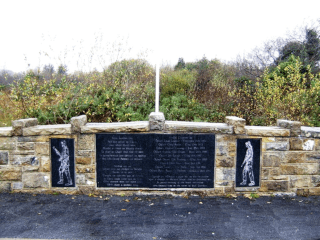
(Pictured: Republican memorial at Carragunt bridge, on the border between Northern Ireland and the Republic, often crossed by Provisional IRA forces during the Troubles to attack British targets inside County Fermanagh)
The Ballygawley attack involves two IRA active service units from the East Tyrone Brigade: an armed assault unit and a bomb unit. There are also several teams of IRA observers in the area. The assault team is armed with AK-47 and AR-15 rifles, while the bombing unit is responsible for planting and detonating a 100-pound (45 kg) bomb. Both units are commanded by Patrick Kelly.
The assault is launched on Saturday, December 7, at 6:55 PM, when the handful of RUC officers manning the base are getting ready to hand over to the next shift. In the first burst of automatic fire, the two guards at the entrance are killed, Constable George Gilliland and Reserve Constable William Clements. Constable Clements’s Ruger Security-Sixrevolver is taken by the attackers. The base is then raked with gunfire. Another three RUC officers who are inside run out to the back of the base, where they hope the walls might offer some cover. IRA members go into the building and take documents and weapons. The bomb is placed inside and, upon detonation, destroys the entire base, injuring three officers.
The republican IRIS Magazine (#11, October 1987) describes the attack as follows:
“One volunteer took up a position close to the front gate. Two RUC men opened the gate and the volunteer calmly stepped forward, shooting them both dead at point blank range. Volunteers firing AK-47 and Armalite rifles moved into the barracks, raking it with gunfire. Having secured the building, they planted a 100-lb. bomb inside. The bomb exploded, totally destroying the building after the volunteers had withdrawn to safety.”
The first British Army unit to arrive at the base in the wake of the attack is X Company, 1st Battalion, Royal Regiment of Fusiliers.
The attack is one of the Provisional IRA’s biggest during this period. Twelve days later the same IRA brigade mortar the RUC station at Castlederg badly damaging the base and injuring four people. The Ballygawley base is rebuilt by the Royal Engineers in 1986.
The East Tyrone IRA launches two similar attacks in the following years: the successful attack on the Birches base in 1986, and the ill-fated attack on the Loughgall base in 1987, in which eight IRA members are killed. Ballygawley itself had seen conflict before with the Ballygawley land mine attack in 1983 and would see more violence in 1988 with the Ballygawley bus bombing, that cost the lives of eight British soldiers. The gun taken from Constable Clements is found by security forces after the SAS ambush at Loughgall.
The RUC base at Ballygawley is once again targeted by the East Tyrone Brigade on December 7, 1992, in what becomes the debut of the IRA’s brand-new Mark-15 improvised mortar, better known as “Barrack Buster.” Another attack with a horizontal mortar occurs on April 30, 1993, when a RUC mobile patrol leaving Ballygawley compound is targeted. According to an IRA statement, the projectile misses one of the vehicles, hits a wall and explodes.
(Pictured: A Provisional Irish Republican Army badge, with the phoenix symbolising the origins of the Provisional IRA)
The IRA’s East Tyrone Brigade is active mainly in eastern County Tyrone and neighbouring parts of County Armagh. By the mid-1980s it had become one of the IRA’s most aggressive formations. The British security forces receive intelligence of the IRA’s plan weeks prior to the attack and learn the target at least 10 days before the attack. It has been alleged that the security forces had a double agent inside the IRA unit, and that he was killed by the British Army‘s Special Air Service (SAS) during the ambush. Other sources claim that the security forces had instead learned of the ambush through other surveillance methods.
Three local RUC officers work at the station, which is only open part-time, from 9:00 AM to 11:00 AM, and from 5:00 PM to 7:00 PM daily.The IRA’s attack involves two teams. One team is to drive a digger with a bomb in its bucket through the base’s perimeter fence and light the fuse. At the same time, another team is to arrive in a van and open fire on the base, with the intent of killing the three RUC officers as they come off duty.
The IRA unit arrives in Loughgall from the northeast shortly after 7:00 PM, when the station is scheduled to close for the night. They are armed and wearing bulletproof vests, boilersuits, gloves and balaclavas. The digger drives past the police station, turns around and drives back again with the Toyota van carrying the main IRA assault party doing the same. Not seeing any activity in the station, members of the IRA unit feel that something is amiss and debate whether to continue, but decide to go ahead with the attack. Tony Gormley and Gerard O’Callaghan get out of the van and join Declan Arthurs on the digger. At about 7:15 PM Arthurs drives the digger towards the station with the front bucket containing 300–400 lbs. of Semtex inside an oil drum, partially hidden by rubble and wired to two 40-second fuses. The other five members of the unit follow in the van with Eugene Kelly driving, unit commander Patrick Kelly in the passenger seat, with unit commander Jim Lynagh, Pádraig McKearney, and Seamus Donnelly in the back seat.
The digger crashes through the light security fence and the fuses are lit. The van stops a short distance ahead and, according to the British security forces, three of the team jump out and fire on the building with automatic weapons. At the same time, the bomb detonates, the blast destroying the digger and badly damaging the building.
Within seconds the SAS opens fire on the IRA attackers from the station and from hidden positions outside. All eight IRA members are killed in the hail of gunfire, each with multiple wounds to their bodies. Declan Arthurs is shot in a lane-way opposite Loughgall F.C. premises. Three of the IRA members are shot at close range as they lay either dead or wounded on the ground. Three other IRA members in the scout cars escape from the scene, managing to pass through British Army and RUC checkpoints set up after the ambush had been sprung. The two RUC Headquarters Mobile Support Unit (HMSU) officers are injured in the explosion and an SAS soldier receives a facial injury from glass after a window is broken by gunfire.
Two civilians, brothers Anthony and Oliver Hughes, traveling in a car that happens to drive into the scene of the ambush while it is underway are also fired upon by the British forces. Oliver is wearing overalls similar to those being worn by the IRA unit. About 130 yards from the police station, British soldiers open fire on their car from behind, killing Anthony and badly wounding Oliver. The villagers had not been told of the operation and no attempt had been made to evacuate anyone or to seal off the ambush zone, as this might have alerted the IRA.
The security forces recover eight IRA firearms from the scene. The RUC links the weapons to seven known murders and twelve attempted murders in the Mid-Ulster region. On of the weapons, a Ruger Security-Six, had been stolen from Reserve RUC officer William Clement, killed two years earlier in the IRA attack on Ballygawley RUC base. It is found that another of the guns had been used in the murder of Harold Henry, a builder employed by the British Army and RUC in facilities construction in Northern Ireland.
(Pictured: Mural commemorating the IRA members killed in the ambush)




 seamus dubhghaill