seamus dubhghaill

Promoting Irish Culture and History from Little Rock, Arkansas, USA


Leave a comment

Birth of Sylvester O’Halloran, Surgeon & Historian

Sylvester O’Halloran, Irish surgeon with an abiding interest in Gaelic poetry and history, is born on December 31, 1728, at Caherdavin, County Limerick. For most of his life he lives and practises in Limerick and is later elected a member of the Royal Irish Academy (RIA).

O’Halloran is the third son of Michael O’Halloran, a prosperous farmer, and his wife Mary McDonnell. He is named after Sylvester Lloyd, the titular Catholic bishop of Killaloe (1728–39). His mother’s cousin, Sean Claragh McDonnell, teaches him much at an early age, including some Greek and Latin. He goes on to a Limerick school run by Robert Cashin, a Protestant clergyman, which is unusual at the time as the O’Hallorans are Roman Catholics during the difficult time of the Penal Laws.

O’Halloran and his brothers engage successfully in areas of life that work around the restrictions of the Penal Laws. Joseph becomes a Jesuit and holds chairs in rhetoric, philosophy and divinity at the Jesuit College at Bordeaux in France. George becomes a jeweler and in time a property-owner. O’Halloran goes to London to learn medicine at the age of 17, particularly studying the methods of Richard Mead, as well as the oculists Taylor and Hillmer. After further study at Leiden, and in Paris under the anatomist and academician Antoine Ferrein, he sets up practice as a surgeon in Limerick in early 1749.

O’Halloran writes several learned treatises on medical matters, and his fame is acknowledged by his membership of the RIA in 1787. He is a founder of the County Limerick Infirmary that starts with four beds in 1761 before moving to larger premises at St. Francis’s Abbey in 1765. The foundation stone of the original infirmary is now preserved in the Sylvester O’Halloran Post Graduate Centre at the Mid-Western Regional Hospital, Limerick.

While in France, O’Halloran is very impressed with the Académie Royale de Chirurgie, which had been founded in Paris in 1731 during the reign of Louis XV. He is subsequently instrumental in founding the Royal College of Surgeons in Ireland (RCSI), by writing its blueprint, Proposals for the Advancement of Surgery in Ireland, in 1765. In 1780, he is made an honorary member of the new Dublin Society of Surgeons and, when the RCSI receives its charter in 1784, is again elected an honorary member, equivalent to a Fellowship today.

As well as his scientific knowledge, O’Halloran’s interest in the arts begins with his collection of Gaelic poetry manuscripts and this leads on to an interest in Irish history. Given his background, he argues to validate the pre-Norman history of Ireland which had often been dismissed as a period of barbarism.

O’Halloran’s correspondents include Edmund Burke on early history. With Charles O’Conor of Bellanagare he discusses James Macpherson‘s translated version of Ossian and advises him about an eye complaint.

In 1789, Charlotte Brooke publishes the first English-language compendium of Irish poetry, the seminal “Reliques of Irish Poetry”, giving full due to O’Halloran for lending her his manuscript collection and for having written the essential history underlying her anthology.

In 1752, O’Halloran marries Mary Casey of Ballycasey, County Limerick, and they have four sons and a daughter. Their homes are in Change Lane and then on Merchants’ Quay. One of their sons is Major-General Sir Joseph O’Halloran, the father of Thomas Shuldham O’Halloran, after whom the Adelaide, South Australia suburb of O’Halloran Hill is named. Mary dies in 1782.

After a stroke, O’Halloran is infirm and confined to his chair for some time before his death on August 11, 1807, at his home on Limerick’s Merchant Quay. His is buried at St. Munchin’s graveyard at Killeely, which is now a suburb of Limerick.

Though politically restricted in his life by the Penal Laws, O’Halloran helps establish the county Infirmary, is elected President of the city’s Free Debating Society in 1772 and is elected to a committee in 1783 that examines the River Shannon navigation. Appropriately, a Limerick bridge over the River Shannon has been named after him.

Leave a comment

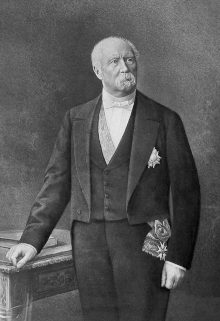
Patrice de MacMahon Resigns As President of France

Patrice de MacMahon, a descendant of an Irish family, resigns as president of France on January 30, 1879, and retires to private life. His resignation comes after he dissolves the Chamber of Deputies, resulting in public outrage and a Republican electoral victory earlier in the month.

Born Marie Edme Patrice Maurice de MacMahon on July 13, 1808, in Sully, France, he serves as Marshal of France and second president of the French Third Republic. During his presidency the Third Republic takes shape, the new constitutional laws of 1875 are adopted, and important precedents are established affecting the relationship between executive and legislative powers.

The MacMahon family is of Irish origin. They were Lords of Corcu Baiscind in Ireland and descended from Mahon, the son of Muirchertach Ua Briain, High King of Ireland. After losing much of their land in the Cromwellian confiscations, a branch moved to Limerick for a time before settling in France during the reign of William III of England because of their support of the deposed King James II in the Glorious Revolution. They applied for French citizenship in 1749. After the definitive installation of the family in France, their nobility was recognised by the patent letter of King Louis XV of France.

MacMahon begins his army career in 1827 in Algeria and distinguishes himself during the Siege of Constantine (1837) and in the Crimean War (1853–56). The climax of his military career comes in the Italian campaign of 1859, when his victory at Magenta results in his being created Duke of Magenta. In 1864 he becomes Governor General of Algeria. Commanding the I Army Corps in Alsace during the Franco-Prussian War (1870–71), he is wounded and defeated at the Battle of Wörth. After a short convalescence at Sedan, he is appointed head of the army of the French Third Republic, which defeats the Paris Commune revolt in May 1871.

When Adolphe Thiers resigns as president of the republic on May 24, 1873, French rightists turn to MacMahon as his successor. He is elected president the same day. On November 20, 1873, the National Assembly passes the Law of the Septennate, conferring upon him presidential power for seven years. He assumes his presidential duties somewhat reluctantly, for he dislikes publicity and lacks an understanding of the complex political issues of his day.

During MacMahon’s term the French Constitutional Laws of 1875 are promulgated. The National Assembly dissolves itself, and the elections of 1876 returns a large majority of republicans to the new chamber. The first crisis comes in December 1876, when the republican chamber compels him to invite the moderate republican Jules Simon to form a government. The conservative Senate disapproves of Simon because he had purged some rightist officials, and, on May 16, 1877, MacMahon posts a letter to Simon that is tantamount to dismissal. Premier Simon’s resignation precipitates the crise du seize mai. When MacMahon commissions conservative Albert de Broglie to form a ministry and wins the Senate’s assent to dissolve the chamber on June 25, 1877, the question of whether the President or Parliament would control the government is squarely posed.

The new elections to the chamber return a majority of republicans, and the de Broglie ministry is given a vote of “no confidence.” The succeeding ministry, headed by Gaëtan de Rochebouët, also collapses. By December 13, 1877, MacMahon gives in to the extent of accepting a ministry led by conservative republican Jules Dufaure and composed mostly of republicans. On January 5, 1879, the republicans gain a majority in the Senate, and MacMahon resigns on January 30. The constitutional crisis during his presidency is resolved in favour of parliamentary as against presidential control, and thereafter during the Third Republic the office of president becomes largely an honorific post.

From 1887 to 1893, MacMahon directs the Société de secours aux blessés militaires (S.S.B.M) – Rescue Society of Wounded Military, which in 1940 becomes the French Red Cross.

MacMahon dies on October 17, 1893, at the Château de la Forêt at Montcresson, after having written his memoirs. He is buried on October 22 at the Hôtel des Invalides after a state funeral and a religious mass at La Madeleine, Paris.


Leave a comment

Death of Marie-Louise O’Murphy, Mistress of Louis XV

Marie-Louise O’Murphy, one of the lesser mistresses of King Louis XV of France and possibly the model for the famous painting by François Boucher, dies in Paris on December 11, 1814.

O’Murphy is born in Rouen, France on October 21, 1737 as the youngest of twelve children of Daniel Morfi and Marguerite Iquy, a family of Irish origin. Her parents have well-known criminal histories. Her father was involved in a case of espionage and blackmail while her mother was accused of prostitution and theft. She and her sisters are also known for being involved in prostitution.

Contemporary and modern historiography believe O’Murphy is the very young model who posed for the Jeune Fille allongée (Reclining Girl), of François Boucher, a painting famous for its undisguised eroticism, dating from 1752. Two versions of this painting have survived, both conserved in Germany, one in the Alte Pinakothek at Munich and the other in the Wallraf-Richartz Museum at Cologne.

The term petite maîtresse (little mistress) is given to Louis XV’s mistresses that are not formally presented at court, and unlike the official mistress (maîtresse-en-titre) do not have an apartment in Palace of Versailles. Generally recruited by the King’s valets in Paris surroundings, if their affair lasts more than a single night, they are placed in a group of houses in the district of Parc-aux-Cerfs in Versailles, or close to other royal residences. O’Murphy resides there for two years, from 1753 to 1755.

After a miscarriage in mid-1753 which almost kills her, O’Murphy gives birth to Louis XV’s illegitimate daughter, Agathe-Louise de Saint-Antoine de Saint-André, born in Paris on June 20, 1754. The King, who does not want to recognize the offspring born from petites maîtresses and brief affairs, orders that the newborn must be immediately placed in care of a wet nurse. Subsequently, Agathe-Louise is sent to the Couvent de la Présentation, where she is raised.

After serving as a mistress to the King for almost two years, O’Murphy makes a mistake that is common for many courtesans, that of trying to replace the official mistress. She unwisely tries to unseat the longtime royal favorite, Madame de Pompadour. This ill-judged move quickly results in her downfall at court. In November 1755 she is expelled at night from her home at Parc-aux-Cerfs, repudiated by the King, and sent far away from Versailles.

O’Murphy hastily marries Jacques Pelet de Beaufranchet, Seigneur d’Ayat on November 25, 1755. Soon after she becomes pregnant. Her first child, a daughter named Louise Charlotte Antoinette Françoise Pelet de Beaufranchet, is born on October 30, 1756 (she dies at the age of two). Thirteen months later, on November 5, 1757, her husband is killed in action at the Battle of Rossbach. Seventeen days after his death she gives birth a second child, a son, Louis Charles Antoine de Beaufranchet, the later Comte de Beaufranchet and General under the Republic.

On February 19, 1759, O’Murphy marries François Nicolas Le Normant, Comte de Flaghac and Receiver General of Finance in Riom, a divorcee with three children. From this marriage, she gives birth to a daughter, Marguerite Victoire Le Normant de Flaghac on January 5, 1768, who, according to one theory, could be another illegitimate daughter of Louis XV. François Le Normant dies on April 24, 1783.

During the Reign of Terror O’Murphy is imprisoned as a “suspect,” under the name of O’Murphy, at Sainte-Pélagie Prison and later at the English Benedictine convent in Paris. After her release she marries Louis Philippe Dumont, a moderate MP for Calvados in the National Convention and twenty-eight years her junior, on June 19, 1795. This union quickly fails, and after almost three years, they divorce on March 16, 1798. She never marries again.

Marie-Louise O’Murphy dies in Paris on December 11, 1814 aged 77, at the home of her daughter Marguerite Le Normant.


Leave a comment

Birth of Thomas Arthur, comte de Lally, baron de Tollendal

thomas-arthur-lally

Thomas Arthur, comte de Lally, baron de Tollendal, French General of Irish Jacobite ancestry, is born on January 13, 1702. Lally commands French forces in India during the Seven Years’ War, including two battalions of his own red-coated Regiment of Lally of the Irish Brigade.

Lally is born at Romans-sur-Isère, Dauphiné, the son of Sir Gerald Lally, one of the original “Wild Geese” of 1691 and an Irish Jacobite from Tuam, County Galway, who married a French lady of noble family. His title is derived from the Lally’s ancestral home, Castel Tullendally in County Galway where the Lally’s, originally called O’Mullallys, are prominent members of the Gaelic Aristocracy who can trace their ancestry back to the second century High King of Ireland, Conn of the Hundred Battles.

Entering the French army in 1721 he serves in the war of 1734 against Austria. He is present at the Battle of Dettingen in 1743 and commands the regiment de Lally in the famous Irish brigade in the Battle of Fontenoy in May 1745. He is made a brigadier on the field by Louis XV of France.

Lally is a staunch Jacobite and in 1745 accompanies Charles Edward Stuart to Scotland, serving as aide-de-camp at the Battle of Falkirk Muir in January 1746. Escaping to France, he serves with Marshal Maurice de Saxe in the Low Countries. At the Siege of Maastricht in 1748 he is made a maréchal de camp.

When war breaks out with Britain in 1756 Lally is appointed governor-general of French India and commands a French expedition to India, made up of four battalions, two of whom are from his own Regiment of Lally of the Irish Brigade. He reaches Pondicherry in April 1758, and within six weeks has pushed the British back from the coast to Madras, the headquarters of the British East India Company.

He is a man of courage and a capable general, but his pride and ferocity make him unpopular with his officers and men. He is unsuccessful in an attack on Tanjore, and as he lacks French naval support he has to retire from the Siege of Madras in 1758, owing to the timely arrival of the British fleet. He is defeated by Sir Eyre Coote at the Battle of Wandiwash in 1760, and besieged in Pondicherry, where he is forced to capitulate in 1761.

Lally is sent to England as a prisoner of war. Public opinion in France is very hostile, blaming him for the defeat by the British, and there are widespread calls for Lally to be put on trial. While in London, he hears that he is accused of treason in France, and insists, against advice, on returning on parole to stand trial. He is kept prisoner for nearly two years before the trial begins in 1764. When the Advocate General of the Paris Parlement Joseph Omer Joly de Fleury begins the prosecution, Lally has not received any documentation of the charges and is not allowed a defence lawyer. Throughout the trial, which lasts for two years, Lally fights against Joly de Fleury’s charges but on May 6, 1766, he is convicted and sentenced to death.

Lally makes an unsuccessful attempt at suicide in prison after his sentencing. On May 9, 1766, three days after his conviction, he is gagged to prevent him from protesting his innocence further and is transported in a garbage cart to the Place de Grève to be beheaded. The executioner’s first blow only slices open his skull, and it takes a second blow to kill him.