seamus dubhghaill

Promoting Irish Culture and History from Little Rock, Arkansas, USA


4 Comments

Death of American-Born Painter Charles Brady

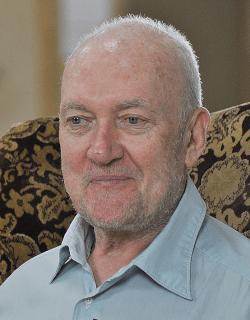
Charles Brady, American-born painter who spends most of his life in Ireland, dies in Dublin on August 1, 1997.

Brady is born on July 27, 1926, in New York City, the son of Arthur Brady, an industrial hardware merchant. He is best known for small-scale paintings of still life and landscape. At the end of World War II, while serving with the United States Navy, he suffers an accident which results in his discharge. As a result of this, he has the opportunity of pursuing further study. In 1948, he enrolls at the Art Students League of New York. Founded in 1875 and distinguished by its progressive approach to art education, it is one of the most important art schools in the United States in the early twentieth century.

Initially, Brady studies design and fashion before studying fine art under John Groth and Morris Kantor. In 1949, he becomes Groth’s assistant. In 1950, his work is included in the exhibition “American Painting 1950,” held at the Metropolitan Museum of Art, New York, where he is employed as a guard at the time. Around this time, he meets artists associated with abstract expressionism such as Franz Kline, Willem de Kooning, and Jackson Pollock, and exhibits with them in exhibitions such as the “9th Street Show” (1951). Four years later, his first solo exhibition is held at the Urban Gallery, New York. By this time, his father, mother, and a younger brother have all died. In 1956 he decides to leave New York and spend some time in Ireland.

On his arrival, Brady bases himself in Lismore, County Waterford, where the landscapes he begins to paint are in contrast to the abstract style he had developed in New York. In May 1956, he joins his aunt and uncle on a tour that include London and Paris. He remains in Ireland until early in 1958 and during this time becomes acquainted with such figures as Camille Souter, Frank Morris and Desmond McAvock. Though he spends the next year in the United States, he soon decides to return to Ireland. In 1959 he is living in Dublin, where, along with artists such as Noel Sheridan and Patrick Pye, he is involved in founding the Independent Artists group. His work is included in the group’s first exhibition in 1960.

Also in 1960, Brady marries Eelagh Noonan, and the couple go to live in Spain. On their return to Ireland in 1961, they settle in Dún Laoghaire, where he begins to produce still lifes of objects such as envelopes and boxes painted in muted tones. Though figurative, the painterly quality of these works and the way in which they assert the flat nature of the picture plane suggest something of his experience of postwar American abstract art. Soft, hazy light, another key characteristic of his work, can also be seen in his paintings of Sandymount Strand, which might be compared with the work of Nathaniel Hone the Younger, whose work Brady had seen on his first trip to Ireland. He also works in other media, producing lithographs and, from the mid-1980s, small bronzes of such mundane objects as discarded bus tickets.

From 1976 to 1983 Brady lectures in painting at the National College of Art and Design. In 1981 he becomes a member of Aosdána and in 1994 he is elected an honorary member of the Royal Hibernian Academy (RHA). He exhibits regularly in Ireland at venues such as the RHA. He receives a number of awards including the P. J. Carroll award at the Irish Exhibition of Living Art as well as the Douglas Hyde Gold Medal and the landscape award at the Oireachtas exhibitions of 1973 and 1989 respectively.

Brady dies of cancer at the age of 71 on August 1, 1997, in Dublin. He is buried in Shanganagh Cemetery, Shankill, County Dublin. His work can be found in collections such as those of the Arts Council of Ireland, Bank of Ireland, Ulster Museum, Allied Irish Bank, and Dublin City Gallery The Hugh Lane.

(From: “Brady, Charles” by Rebecca Minch, Dictionary of Irish Biography, http://www.dib.ie, October 2009 | Pictured: “Charles Brady, 1967,” oil on board by Koert Delmonte)
Leave a comment

Birth of Sean Scully, Painter, Printmaker, Sculptor & Photographer

Sean Scully, Irish-born American-based artist working as a painter, printmaker, sculptor and photographer, is born in Dublin on June 30, 1945. His work is held in museum collections worldwide and he has twice been named a Turner Prize nominee.

Four years after his birth, Scully’s family moves to London where they live in a working-class part of South London, moving from lodging to lodging for a number of years. By the age of 9, he knows he wants to become an artist. From the age of 15 until he is 17, he is apprenticed at a commercial printing shop in London as a typesetter, an experience that greatly influences his future artwork.

Scully studies at Croydon School of Art between 1965-67 and at Newcastle University between 1967-71. He is awarded the Frank Knox Memorial Fellowship in 1972 to attend Harvard University. It is during this first stay in the United States that he begins to experiment with new techniques such as tape and spray paint. In 1975 he is awarded a Harkness Fellowship and establishes a studio in New York, where he settles, becoming an American citizen in 1983.

Over the years, Scully develops and refines his own recognisable style of geometric abstraction and most notably his characteristic motif of the ‘stripe.’ Although he is predominately known for his monumental paintings, he is also a gifted printmaker who has made a notable body of woodcuts and etchings.

Scully has his first solo exhibition at the Rowan Gallery, London in 1973. He has his first retrospective at the Ikon Gallery in Brindleyplace, Birmingham, in 1981, which travels throughout the United Kingdom. In 1989 his first solo exhibition in a European museum travels from the Whitechapel Gallery in London to Palacio Velázquez in Madrid and Städtische Galerie im Lenbachhaus in Munich. He has further solo exhibitions at Kunstsammlung Nordrhein Westfalen in Düsseldorf (2001) which travels to Haus der Kunst in Munich and the Institut Valencià d’Art Modern in Valencia; The Phillips Collection in Washington, D.C. (2005) travels to the Modern Art Museum of Fort Worth in Texas, the Cincinnati Art Museum in Ohio and finally the Metropolitan Museum of Art in New York City. A major retrospective tours multiple venues in China between 2015 and 2017.

Scully’s paintings and prints are held in the collections of Tate in London, the Albertina in Vienna, Museo Nacional Centro de Arte Reina Sofía in Madrid, Instituto Valencia d’Arte Modern in Valencia, the Metropolitan Museum of Art and the Solomon R. Guggenheim Museum in New York City, the National Gallery of Art in Washington D.C., Modern Art Museum of Fort Worth in Texas, Guangzhou Museum of Art in Guangzhou, China, and the Central Academy of Fine Arts in Beijing, China.

Scully has held teaching positions at Chelsea College of Arts and Goldsmith’s College of Art and Design, both in London, Princeton University in New Jersey, Parsons School of Design in New York, and most recently at the Akademie der Bildenden Künste in Munich. He is shortlisted for the Turner Prize in 1989 and in 1993, and is elected a Royal Academician in 2013. He participates for the first time at the Venice Biennale in 2014.

Sean Scully lives and works in New York and in Bavaria, Germany.


Leave a comment

Birth of Irish American Painter William Harnett

william-michael-harnett

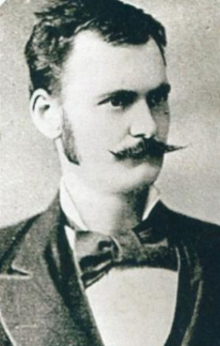
William Michael Harnett, Irish American painter known for his trompe-l’œil still lifes of ordinary objects, is born in Clonakilty, County Cork on August 10, 1848, during the time of the Great Famine.

Shortly after his birth Harnett’s family emigrates to the United States, settling in Philadelphia. Becoming a United States citizen in 1868, he makes a living as a young man by engraving designs on table silver, while also taking night classes at the Pennsylvania Academy of the Fine Arts and later, in New York City, at Cooper Union and at the National Academy of Design. His first known oil painting, a still life, dates from 1874.

The style of trompe-l’œil painting that Harnett develops is distinctive and inspired many imitators, but it is not without precedent. A number of Dutch Golden Age painters, Pieter Claesz for instance, had specialized in tabletop still life of astonishing verisimilitude. Raphaelle Peale, working in Philadelphia in the early 19th century, pioneers the form in America. What sets Harnett’s work apart, besides his enormous skill, is his interest in depicting objects not usually made the subject of a painting.

Harnett paints musical instruments, hanging game, and tankards, but also paints the unconventional Golden Horseshoe (1886), a single rusted horseshoe shown nailed to a board. He paints a casual jumble of second-hand books set on top of a crate, Job Lot, Cheap (1878), as well as firearms and even paper currency. His works sell well, but they are more likely to be found hanging in a tavern or a business office than in a museum, as they did not conform to contemporary notions of high art.

still-life-violin-and-music

Harnett spent the years 1880–1886 in Europe, staying in Munich from 1881 until early 1885. His best-known paintings, the four versions of After the Hunt, are painted between 1883 and 1885. Each is an imposing composition of hunting equipment and dead game, hanging on a door with ornate hinges at the right and keyhole plate at the left. These paintings, like the horseshoe or currency depictions mentioned earlier, are especially effective as trompe-l’œil because the objects occupy a shallow space, meaning that the illusion is not spoiled by parallax shift if the viewer moves.

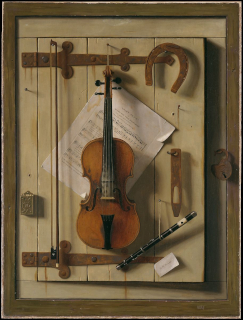
Overall, Harnett’s work is most comparable to that of the slightly younger John F. Peto. The two artists know each other, and a comparison can be made between two paintings featuring violins. Harnett’s Music and Good Luck from 1888 shows the violin hanging upright on a door with ornate hinges and with a slightly torn piece of sheet music behind it. The elements are arranged in a stable, deliberate manner. Peto’s 1890 painting shows the violin hanging askew, as well as chipped and worn, with one broken string. The sheet music is dog-eared and torn around the edges and placed haphazardly behind the instrument. The hinges are less ornate, and one is broken. Harnett’s objects show signs of use but are well preserved, while Peto’s more humble objects are nearly used up.

Crippling rheumatism plagues Harnett in his last years, reducing the number but not the quality of his paintings. He dies in New York City on October 29, 1892. Other artists who paint similar compositions in Harnett’s wake include his contemporary John Haberle and successors such as Otis Kaye and Jefferson David Chalfant.

Harnett’s work is in collections in the Albright-Knox Art Gallery (Buffalo, New York), the Amon Carter Museum of American Art (Fort Worth, Texas), the Dallas Museum of Art, the Art Institute of Chicago, the Brooklyn Museum, the Carnegie Museum of Art (Pittsburgh, Pennsylvania), the Cincinnati Art Museum, the Cleveland Museum of Art, the Detroit Institute of Arts, the Fine Arts Museums of San Francisco, Harvard Art Museums, the High Museum of Art (Atlanta, Georgia), the Honolulu Museum of Art, the Joslyn Art Museum (Omaha, Nebraska), the Los Angeles County Museum of Art, the Metropolitan Museum of Art (New York, New York), the National Gallery of Art (Washington D.C.), the National Gallery of Canada (Ottawa, Ontario), the Philadelphia Museum of Art, the San Diego Museum of Art, Thyssen-Bornemisza Museum (Madrid, Spain), the Toledo Museum of Art (Toledo, Ohio), the Wadsworth Atheneum (Hartford, Connecticut), and the Wichita Art Museum (Wichita, Kansas) among others.

(Pictured: Music and Good Luck, oil on canvas by William Michael Harnett, 1888, Metropolitan Museum of Art)


Leave a comment

Founding of the American Irish Historical Society

american-irish-historical-society

The American Irish Historical Society (AIHS), a historical society devoted to Irish American history, is founded in Boston on January 20, 1897. In continuous operation since its founding, the Society has been non-partisan and non-sectarian since its inception. The Society is founded as a response to the establishment in 1889 of the Scotch-Irish Society.

AIHS is relocated to New York City in 1904 by T. H. Murray, then serving as Society’s Secretary-General. Perhaps the most notable member of AIHS at the time is President Theodore Roosevelt. The Society’s formal purpose is “to place permanently on record the story of the Irish in America from the earliest settlement to the present day, justly, impartially, fully, and sympathetically correcting neglect and misrepresentation by certain historians of the part taken in the founding, upbuilding and safeguarding of the Nation by persons of Irish birth and descent.” Notable members through the years have included politician William Bourke Cockran, tenor John McCormack, New York Governor Hugh Carey, and performer/composer George M. Cohan. In 1940, the Society moves its headquarters to a Beaux-Arts townhouse at 991 Fifth Avenue in New York City opposite the Metropolitan Museum of Art. The AIHS remains at this location today.

The Society hosts cultural and historical events, publishes a journal entitled The Recorder, and annually awards a Gold Medal to an Irish American or Irish-national of significant accomplishment. Past honorees have included Bono, George J. Mitchell, Mary Higgins Clark, Wilbur Ross, Michael J. Dowling, and Robert McCann.

During the holiday season of 2016, AIHS is home to the Irish Repertory Theatre‘s production of The Dead, 1904. The show is an adaptation of James Joyce‘s The Dead, by novelist Jean Hanff Korelitz and her husband, Irish poet, Paul Muldoon.