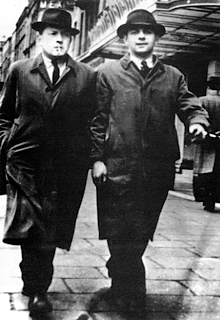
In 1921, McCaughey’s family moves to the Ardoyne district in north Belfast. Hus father is a founding member of the Irish republican Dungannon Clubs and organizes the first branch of Sinn Féin in County Tyrone. As a teenager he joins the Gaelic League and Sinn Féin and also becomes a long time student and teacher of the Irish language in the Glens of Antrim. He joins the IRA in 1935 and in 1938 is promoted to Officer Commanding (O/C) of its Northern Command, headquartered near the town of Carrickmore, County Tyrone, which is the ancestral home of Joseph McGarrity and Patrick McCartan, both leaders of the Irish republican organization Clan na Gael. In December 1939, he is arrested and imprisoned at the Curragh Camp. After being released in 1940 he returns to the Northern Command of the IRA. He is held in high regard and is considered to be one of the best officers of the northern IRA. At the time of his arrest in Rathmines, Dublin, on September 2, 1941, he is acting Chief of Staff.
In September 1941, McCaughey is found guilty by a Dublin court of having detained and assaulted Stephen Hayes, IRA Chief of Staff, who was accused of being a spy for the Irish Free State government. Hayes escapes and later testifies against him at a Military Court. He is sentenced to death by firing squad. His sentence is commuted to a life sentence of penal servitude.
Imprisoned in Portlaoise Prison on July 24, 1941, McCaughey joins other IRA prisoners in the ongoing blanket protest. Refusing to wear a criminal’s prison clothes, he is kept in solitary confinement and spends nearly five years naked except for a blanket. This form of resistance by Irish republican prisoners is also used in the 1980s blanket protests in the Maze prison (also known as “Long Kesh”) and the HM Prison Armagh (women’s prison) in Northern Ireland. He and other Irish republican prisoners endure years of hardships. Sitting month after month, year after year in bleak solitary cells, they are taken out once a week for a bath, and for the rest of the week live the life of an animal trapped in a burrow. That they do not go mad is a remarkable comment on mans capacity for survival. During his almost five years in Portlaoise, he Is never permitted to have visitors.
McCaughey commences a hunger strike on April 19, 1946. After ten days, he stops taking water and dies on May 11, 1946, the twenty-third day of his protest. An inquest is held in the prison at which the prison doctor admits that during his over four and a half years of imprisonment that McCaughey had never been allowed out in the fresh air or sunlight and that “he would not treat his dog the way Seán McCaughey had been treated in Portlaoise.”
McCaughey is the last person to die on hunger strike in the Irish state. There is a long history of hunger striking in Ireland – within the 20th century a total of 22 Irish republicans die on hunger strike with survivors suffering long-term health and psychological effects. Four men die during the 1920 Cork hunger strike. The largest hunger strike in Irish history is the 1923 Irish hunger strikes, during which five men die. Ten men die during the 1981 Irish hunger strike.
(Pictured: Seán McCaughey (right) and Charlie McGlade, O’Connell Street, Dublin, 1941)
On June 5, 1976, a bomb explodes at the door of the Times Bar on York Road, killing two Protestants. The pub is frequented by members of the Ulster Defence Association (UDA), a legal loyalist paramilitary group. Irish republicans are blamed for the bombing. Shortly after, the UVF Brigade Staff (its Shankill Road-based leadership) decide to hit back by attacking the Chlorane Bar. It is a hastily arranged operation devised by its military commander “Bunter,” whom investigative journalistMartin Dillon refers to as “Mr. F.” The Chlorane Bar is located at 23 Gresham Street in Belfast’s city centre, near Smithfield Market. Its clientele is mixed (Protestant and Catholic), which is unusual during The Troubles. On August 17, 1973, the Chlorane Bar had been firebombed, however, no one was injured as the pub was closed at the time of the attack. Later that same month, the Ulster Freedom Fighters (UFF), a cover name sometime used by the UDA, claim responsibility for a car bomb which exploded in Gresham Street. Although there were no human casualties, a pet shop located near the bomb’s epicentre was damaged in the blast and a number of animals inside the building were either killed or injured.
The attack is planned and executed by the UVF platoons based at the Brown Bear and the Windsor Bar respectively. These are two pubs located on the Shankill Road and regularly frequented by UVF members. Dillon sometimes refers to the former platoon as the “Brown Bear Team” because the members generally meet at that particular pub, which faces Shankill Library on the corner of Mountjoy Street. To carry out the attack, along with the procuring of weapons and masks, a black taxi is hijacked by two young men outside the Long Bar on the Shankill Road to transport the gunmen to the Chlorane Bar. Taxi driver Mark Hagan and a passenger are held hostage at the Windsor Bar.
The Chlorane Bar is likely chosen for its nearness to the Shankill Road, affording the attackers a speedy getaway. There is not much of a security presence that evening in the area. The driver of the taxi, with four specifically chosen armed men seated in the rear of the vehicle in the manner of genuine passengers, makes his way from the Shankill Road to North Street and turns south into Gresham Street. Upon arrival outside the Chlorane Bar, the four gunmen don their masks, devised from yellow money bags, and exit the taxi.
At 10:00 p.m., the four masked gunmen storm through Chlorane Bar’s front door leading to the public bar. There are about sixteen customers inside the pub at the time. One of the four gunmen is Robert “Basher” Bates, a member of the violent Shankill Butchers gang led by Lenny Murphy, who is in police custody at the time the attack against the Chlorane takes place. Bates is the only one of the four to have been from the “Brown Bear Team.” The hit squad is commanded by a “Mr. G,” leader of the Windsor Bar UVF platoon, with “Mr. D” as his second-in-command and “Mr. C” completing the team. Entering the bar in single file, “Mr. G” orders everybody to stand up, and then asks the startled customers whether there are any “Prods” (Protestants) among them. William Greer, a Protestant, thinking the gunmen are from the Irish Republican Army, quickly flees to the men’s toilet where he places his feet up against the door. Customer Frederick Graham and his girlfriend, Pat Mahood, assume the same thing. “Mr. G” tells the customers to separate into two groups, with the Protestants standing at the bottom end of the bar, and the Catholics at the top.
When one man, Edward Farrell, admits to being a Catholic, the UVF men open fire. Farrell tries to run toward the toilet but is shot dead. The Catholic owner of the Chlorane, 64-year-old James Coyle, is standing behind the bar when he is hit at close-range. The bullet enters his heart and he dies instantly. The gunmen continue firing and two Protestant men, Daniel McNeil and Samuel Corr, are also struck by the hail of bullets. McNeil is killed on the spot and Corr is fatally wounded. Another Catholic man, John Martin, is shot and dies of his injuries on June 23. Several other customers are hit as gunfire is sprayed around the bar. One customer pretends to be dead, however, a gunman walks over to where he lay and deliberately fires three shots into his thigh, knee, and below the ankle. The man later recounts that he had then looked up to see “men lying shot all over the place.” William Greer, hiding in the toilet, is shot when one of the gunmen fire through the door. He survives despite being hit in the leg and neck. There are more customers upstairs in the lounge area, but although they hear the gunshots, the gunmen never go near them. Dillon maintains that it had not been the UVF unit’s intention to kill any Protestants.
“Mr. G” calls a halt to the shooting, saying “that’s it,” and the four-man UVF team nonchalantly walks out of the pub and re-enters the hijacked black taxi, which is parked so the driver has easy access to North Street. This route offers a quick return to the Shankill. After the four men get into the back seat, the driver (“Mr. H”) drives off. As the taxi passes by the Catholic Unity Flats area, three shots are fired from the vehicle. Two young men walking nearby get a look at the driver. He is described as being around 38 to 40 years old and having shoulder-length, black curly hair. Upon the taxi’s return to the Shankill, Mark Hagan and the passenger are released. They immediately go to the Tennent Street Royal Ulster Constabulary (RUC) Station off the Shankill where they report the taxi’s hijacking. The shooting team proceeds to the Long Bar pub where “Mr. I” (commander of UVF 1st Battalion) procures a forty-ounce bottle of vodka for “Mr. G” and “Mr. D” – their payment for leading the operation.
Having heard the gunshots, a barmaid serving in the upstairs lounge goes downstairs to investigate and discovers the body of her employer, James Coyle, lying on the floor behind the bar and those of the other dead and wounded. The first policeman on the scene is Constable George McElnea, from the RUC Special Patrol Group in Tennent Street. He quickly notices the pile of bodies near the men’s toilet as Samuel Corr stumbles toward him, gravely injured. McElnea places Corr on a bench and offers what assistance he can but to no avail. Corr dies of his gunshot wounds before the ambulance arrives. Alan McCrum, a Scenes of Crime officer, appears at the Chlorane fifteen minutes after the shootings. He retrieves 24 spent bullet casings from the floor and determines that most of the shots had been fired at the rear of the pub. Later ballistic testing establishes that the weapons used in the attack were a .22 caliber pistol, a 9 mm pistol, and two .45 snub-nosed revolvers. Police believe one of the victims, Daniel McNeil, had tenuous UVF connections, although he is not an active member.
The hijacked black taxi is found by police the following morning in a cul-de-sac in Beresford Street, off the Shankill Road. A cyclist, who had witnessed the masked gunmen entering the Chlorane Bar, describes the four men as having been in the 20 to 30 age group, all about 5’10 in height and well-built. The last gunman to enter had shoulder-length brown hair. The witness had gone to a nearby British Army post where he told soldiers what he had seen.
Ten days after the gun attack, the Chlorane Bar is blown up by a bomb. Three weeks after the attack the Provisional IRA, using their sometime cover-name of the “Republican Action Force“, enter Walker’s Bar in Templepatrick and kill three Protestant civilians in retaliation for the Chlorane attack. As part of this series of deadly tit for tat attacks on pubs, the UVF responds by killing six customers at the Catholic-owned Ramble Inn outside Antrim.
No one is ever charged with the shootings. In February 1979, Bates is convicted of the murders he had committed as part of the Shankill Butchers, and given ten life sentences. In his statement to the police following his arrest in 1977, he recounts his role in the Chlorane Bar attack. He alleges while working as a barman in the Long Bar on the evening of June 5, 1976, he is approached by the UVF military commander, “Mr. F”, who informs him of a job in which he is to take part that same evening. It is decided to attack the city centre pub in retaliation for the IRA’s earlier bombing of The Times pub. Bates goes on to say that “Mr. I” provides the weapons which are used in the shooting and “Mr. J” (UVF Provost Marshal) procures the masks. Bates claims that his revolver malfunctions and therefore he never fires his gun during the attack. However, forensic evidence proves that two .45 revolvers had been fired inside the Chlorane. Upon his release from the HM Prison Maze, Bates is gunned-down in June 1997 by the son of James Curtis Moorhead, a UDA man he had killed in 1977.