seamus dubhghaill

Promoting Irish Culture and History from Little Rock, Arkansas, USA


Leave a comment

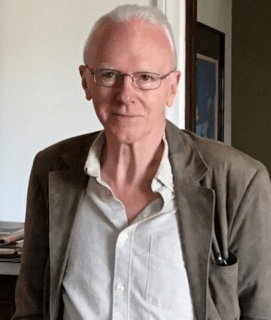
Birth of Irish Poet Trevor Joyce

Irish poet Trevor Joyce is born in Dublin on October 26, 1947. He co-founds New Writers’ Press (NWP) in Dublin in 1967 and is a founding editor of NWP’s The Lace Curtain, a magazine of poetry and criticism in 1968.

Joyce is brought up between Mary Street, in the city centre, and the Galway Gaeltacht. Galway is the ancestral home of both his mother’s and father’s families, and Patrick Weston Joyce, historian, writer and collector of Irish music, and Robert Dwyer Joyce, poet, writer and fellow collector of music, are numbered among his great granduncles. Recent poems such as “Trem Neul” see Joyce appropriate elements of the folk music gathered by Patrick Weston Joyce and engage ideas of lineage and transmission.

In Dublin and Oxford, in the early eighties, Joyce conducts seminars and lectures on classical Chinese poetry. Having studied Philosophy and English at University College Dublin (UCD), he moves in 1984 to Cork, where he reads Mathematical Sciences at University College Cork (UCC). He now resides in the city.

Joyce’s early books include Sole Glum Trek (1967), Watches (1969), Pentahedron (1972) and The Poems of Sweeny Peregrine: A Working of the Corrupt Irish Text (1976). The last of these is a version of the Middle-Irish Buile Shuibhne, well known from Seamus Heaney‘s later translation in Sweeney Astray (1983).

After a near-total silence for 20 years, Joyce resumes publishing in 1995 with stone floods, followed by Syzygy and Without Asylum (1998). In 2001, with the first dream of fire they hunt the cold is published, which gathers all of the poet’s major work from 1966 to 2000. In 2007, What’s in Store: Poems 2000–2007 appears, and in 2009 he publishes Courts of Air and Earth. His work appears in many anthologies, including Keith Tuma’s Anthology of Twentieth-Century British and Irish Poetry and Patrick Crotty’s The Penguin Book of Irish Poetry.

Joyce’s poetry employs a wide range of forms and techniques, ranging from traditional to modern experimentalism. He has published notable versions from Chinese and from the middle-Irish, which he refers to as “workings” rather than “translations” to emphasise that they are poetic reimaginings in the tradition of Ezra Pound rather than “straight” translations.

A collected poems up to 2000, including his “workings” from the Irish and Chinese, is published as with the first dream of fire they hunt the cold (2001). He also experiments with web-based poetry projects such as the collaborative project OffSets. A collection of his post-with the first dream work, What’s in Store, is published in 2007. A separate collection of new and old translations from the Irish, entitled Courts of Air and Earth, is issued by Shearsman in 2009 and is shortlisted for the Popescu Prize for European Poetry in Translation 2009.

Joyce also publishes several papers on contemporary poetics, and lectures and gives public readings of his work throughout Ireland, the UK and the United States.

Awarded a Literary Bursary by the Irish Arts Council in 2001, Joyce is a Fulbright Scholar for the year 2002–03. In 2004 he is elected a member of Aosdána, the Irish affiliation of artists, and is the first writer to be awarded a fellowship by the Ballinglen Arts Foundation. He holds the Judith E. Wilson Fellowship for poetry to the University of Cambridge for 2009-10. In 2017 he is named by previous winner, the English poet Tom Raworth, as the latest recipient of the biennial N. C. Kaser prize for poetry.

Joyce has residencies at Cill Rialaig, County Kerry, and at the University of Galway. He is also co-founder and director of the annual SoundEye Festival that is held in Cork City.


Leave a comment

Birth of Poet Michael Hartnett

Michael Hartnett, Irish poet who writes in both English and Irish, is born in Croom Hospital in Croom, County Limerick, on September 18, 1941. He is one of the most significant voices in late 20th-century Irish writing and has been called “Munster‘s de facto poet laureate.”

Although Hartnett’s parents’ name is Harnett, he is registered in error as Hartnett on his birth certificate. In later life he declines to change this as his legal name is closer to the Irish Ó hAirtnéide. He grows up in the Maiden Street area of Newcastle West, County Limerick, spending much of his time with his grandmother, Bridget Halpin, who resides in the townland of Camas, in the countryside nearby. He claims that his grandmother is one of the last native speakers to live in County Limerick, though she is originally from northern County Kerry. Although she speaks to him mainly in English, he listens to her conversing with her friends in Irish, and as such, he is quite unaware of the imbalances between English and Irish. When he begins school, he is made aware of the tensions between both languages, and is surprised to discover that Irish is considered an endangered language, taught as a contrived, rule-laden code, with little of the literary attraction which it holds for him. He is educated in the local national and secondary schools in Newcastle West. He emigrates to England the day after he finishes his secondary education and goes to work as a tea boy on a building site in London.

Hartnett has started writing by this time and his work comes to be known of the poet John Jordan, who is professor of English at University College Dublin. Jordan invites him to attend the university for a year. While back in Dublin, he co-edits the literary magazine Arena with James Liddy. He also works as curator of James Joyce‘s tower at Sandycove for a time. He returns briefly to London, where he meets Rosemary Grantley on May 16, 1965, and they are married on April 4, 1966. His first book, Anatomy of a Cliché, is published by Poetry Ireland in 1968 to critical acclaim and he returns to live permanently in Dublin that same year.

Hartnett works as a night telephonist at the telephone exchange on Exchequer Street. He now enters a productive relationship with New Writers Press, run by Michael Smith and Trevor Joyce. They publish his next three books. The first of these is a translation from the Irish, The Old Hag of Beare (1969), followed by Selected Poems (1970) and Tao (1972). This last book is a version of the Chinese Tao Te Ching. His Gypsy Ballads (1973), a translation of the Romancero Gitano of Federico García Lorca, is published by the Goldsmith Press.

In 1974 Hartnett decides to leave Dublin and return to his rural roots, as well as deepen his relationship with the Irish language. He goes to live in Templeglantine, five miles from Newcastle West, and works for a time as a lecturer in creative writing at Thomond College of Education, Limerick.

In his 1975 book, A Farewell to English, Hartnett declares his intention to write only in Irish in the future, describing English as “the perfect language to sell pigs in.” A number of volumes in Irish follow including Adharca Broic (1978), An Phurgóid (1983) and Do Nuala: Foighne Chrainn (1984). A biography on this period of his life entitled A Rebel Act Michael Hartnett’s Farewell To English by Pat Walsh is published in 2012 by Mercier Press.

In 1984 Hartnett returns to Dublin to live in the suburb of Inchicore. The following year marks his return to English with the publication of Inchicore Haiku, a book that deals with the turbulent events in his personal life over the previous few years. This is followed by a number of books in English including A Necklace of Wrens (1987), Poems to Younger Women (1989) and The Killing of Dreams (1992).

Hartnett also continues working in Irish, and produces a sequence of important volumes of translation of classic works into English. These include Ó Bruadair, Selected Poems of Dáibhí Ó Bruadair (1985) and Ó Rathaille The Poems of Aodhaghán Ó Rathaille (1999). His Collected Poems appear in two volumes in 1984 and 1987 and New and Selected Poems in 1995.

Hartnett dies from Alcoholic Liver Syndrome on October 13, 1999. A new Collected Poems appears in 2001.

Every April a literary and arts festival is held in Newcastle West in honour of Hartnett. Events are organised throughout the town and a memorial lecture is given by a distinguished guest. Former speakers include Nuala O’Faolain, Paul Durcan, David Whyte and Fintan O’Toole. The annual Michael Hartnett Poetry Award of € 4,000 also forms part of the festival. Funded by the Limerick City and County Council Arts Office and the Arts Council of Ireland, it is intended to support and encourage poets in the furtherance of their writing endeavours. Previous winners include Sinéad Morrissey and Peter Sirr.

During the 2011 Éigse, Paul Durcan unveils a bronze life-sized statue of Hartnett sculpted by Rory Breslin, in the Square, Newcastle West. Hartnett’s son Niall speaks at the unveiling ceremony.