The first siege of Enniskillen takes place at Enniskillen in Fermanagh, present day Northern Ireland, beginning on January 25, 1594, during the Nine Years’ War. In February 1594, the English have captured Enniskillen Castle from the Irish after a waterborne assault and massacre the defenders after they surrender. From May 1594, an Irish army under Hugh Maguire and Cormac MacBaron O’Neill besiege the English garrison in the castle, and in August they defeat an English relief force. A second relief force is allowed to resupply the garrison, but the castle remains cut off. Eventually, in May 1595, the English garrison surrenders to the Irish and are then massacred.
In 1593, Hugh Maguire, Chief of the Name and Lord of Fermanagh, objects to the behaviour of the newly-appointed English Crown sheriff Humphrey Willis. As he had done before being expelled by Hugh Roe O’Donnell from Tyrconnell in 1592, Willis is cattle raiding and plundering throughout Clan Maguire territory. Maguire is not strong enough to resist the sheriff, but after receiving reinforcements from Hugh O’Neill, Earl of Tyrone, Maguire expelled Willis. In May and June 1593, Maguire and Brian Oge O’Rourke of West Breifne raids lands held by the English Lord President of Connaught, Richard Bingham. They destroy the town around Ballymote Castle. This is part of a proxy war waged to distract the Crown while Hugh O’Neill strengthens his position in Ulster. As hoped for, the Crown responds by sending an army under Sir Henry Bagenal and Gaelic leader Hugh O’Neill, Earl of Tyrone (outwardly still loyal to the Crown), who defeats Maguire’s force at the Battle of Belleek in October 1593. However, Maguire’s main force remains unscathed.
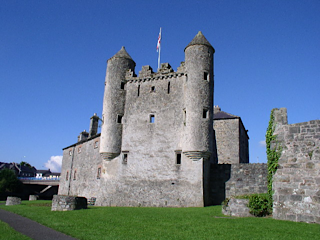
Enniskillen Castle sits on the River Erne and commands the strategic bottleneck between Upper and Lower Lough Erne. On January 25, 1594, English Captain John Dowdall arrives at Enniskillen by boat with three infantry companies. They dig trenches in which they place light cannons and musketeers, but the cannons are too small to make much of an impact on the castle walls. On January 30, Captain George Bingham arrives with 300 men.
They launch a waterborne assault on the castle. While musketeers in boats and artillery on land fire at the castle, a large boat holding 67 men anchors at a vulnerable part of the walls. They make a breach in the wall with pickaxes, forcing the Irish to take shelter in the keep. Dowdall threatens to destroy the castle with gunpowder if the garrison does not surrender. An Irish witness claims there are 36 fighting men and 40 women and children in the castle, while Dowdall claims there are 200. After they surrender, Dowdall has them put to the sword and claims to have killed 150. Captain Thomas Lee, who is present, describes this as a great dishonor to the Queen as the defenders had surrendered “uppon composicion, And your majesties worde being past to the poore beggars that kept it, they were all notwithstandinge dishonourably putt to the sworde in a most miserable state.”
Dowdall writes on February 2 to the Lord Deputy of Ireland that he has captured the castle from the “rebel” Hugh Maguire. An English garrison is left in place. A detailed coloured illustration of the siege was made shortly after.
A second siege begins on May 17, 1594. Now acting with the covert support of Hugh O’Neill, Hugh Maguire and Cormac MacBaron O’Neill lay siege to Enniskillen which is now isolated in hostile country. This siege ends on August 30 when Lord Deputy William Russell’s beleaguered garrison withdraws. Following this, there is a truce, but “subterfuge and deception were the hallmarks of this stage of the war.”
A third siege begins when Maguire raises the clan and attacks the castle again in January 1595. In May 1595 the garrison agrees to surrender Enniskillen to the Irish in exchange for their lives. However, the entire garrison is then massacred.
Doire Leathan is on the eastern shores of Teelin Bay, being just across from the village of Teelin. The battle is part of the ongoing succession dispute for the leadership of the Gaelic lordship of O’Donnell. A combined force of Irish clans and ScottishRedshankmercenaries hired by Iníon Dubh (pronounced “In-neen Doo”) defeat and kill Sir Domhnall Ó Domhnaill (Sir Donnell O’Donnell). The Tanist of Tír Conaill, Sir Domhnall’s younger half-brother and Iníon Dubh’s son, Red Hugh O’Donnell, is still imprisoned in Dublin Castle, but later rises following a subsequent escape to lead Clan O’Donnell and is a prominent figure during the Nine Years’ War.
According to the Annals of the Four Masters, “The son of O’Donnell, i.e. Donnell, the son of Hugh, son of Manus, son of Hugh Duv, son of Hugh Roe, son of Niall Garv, son of Turlough of the Wine, attempt to depose his father, after he had grown weak and feeble from age, and after his other son had been imprisoned in Dublin; so that Donnell brought under his power and jurisdiction that part of Tirconnell from the mountain westwards, i.e. from Bearnas to the River Drowes; and also the people of Boylagh and Tir-Boghaine. It was a cause of great anguish and sickness of mind to Ineenduv, the daughter of James Mac Donnell, that Donnell should make such an attempt, lest he might attain the chieftainship of Tirconnell in preference to her son, Hugh Roe, who was confined in Dublin, and who she hoped would become chief, whatever time God might permit him to return from his captivity; and she, therefore, assembled all the Kinel-Connell who were obedient to her husband, namely, O’Doherty, with his forces; Mac Sweeny-na dTuath (Owen Oge), with his forces; and Mac Sweeny Fanad, with his forces; with a great number of Scots along with them. After Donnell O’Donnell had received intelligence that this muster had been made to oppose him, he assembled his forces to meet them. These were they who rose up to assist him on this occasion: Mac SweenyBanagh (Donough, the son of Mulmurry); a party of the Clan Sweeney of Munster, under the conduct of the three sons of Owen, the son of Mulmurry, son of Donough, son of Turlough, and their forces; and O’Boyle (Teige Oge, the son of Teige, son of Turlough), with all his forces, assembled. The place where the son of O’Donnell happened to be stationed along with these chieftains was Doire-leathan at the extremity of Tir-Boghaine, to the west of Gleann Choluim Cille. The other party did not halt until they came to them to that place; and a battle ensued between them, which was fiercely fought on both sides. The Scots discharged a shower of arrows from their elastic bows, by which they pierced and wounded great numbers, and, among the rest, the son of O’Donnell himself, who, being unable to display prowess or defend himself, was slain at Doire-leathan, on one side of the harbour of Telinn, on the 14th of September. Seldom before that time had his enemies triumphed over him; and the party by whom he was slain had not been by any means his enemies until they encountered on this occasion; and although this Donnell was not the rightful heir of his father, it would have been no disgrace to Tirconnell to have elected him as its chief, had he been permitted to attain to that dignity. In this conflict were slain along with Donnell the three sons of Owen, son of Mulmurry, son of Donough above mentioned, together with two hundred others, around Donnell.”
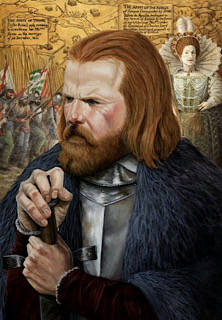
(Pictured: Hugh Roe O’Donnell, otherwise known in history and lore as Red Hugh O’Donnell)
The siege of Enniskillen takes place at Enniskillen in Fermanagh, present day Northern Ireland, in 1594 and 1595, during the Nine Years’ War. In February 1594, the English had captured Enniskillen Castle from the Irish after a waterborne assault and massacred the defenders after they surrendered. From May 1594, an Irish army under Hugh Maguire and Cormac MacBaron O’Neill besiege the English garrison in the castle, and in August they defeat an English relief force. A second relief force is allowed to resupply the garrison, but the castle remains cut off. Eventually, in May 1595, the English garrison surrenders to the Irish and are then massacred.
In 1593, Hugh Maguire, Chief of the Name and Lord of Fermanagh, had objected to the behaviour of the newly-appointed English Crown sheriff Humphrey Willis. As he had done before being expelled by Hugh Roe O’Donnell from Tyrconnell in 1592, Willis is cattle raiding and plundering throughout Clan Maguire territory. Maguire is not strong enough to resist the sheriff, but after receiving reinforcements from Hugh O’Neill, Earl of Tyrone, Maguire expels Willis. In May and June 1593, Maguire and Brian Oge O’Rourke of West Breifne raid lands held by the English Lord President of Connaught, Richard Bingham. They destroy the town around Ballymote Castle. This is part of a proxy war waged to distract the Crown while Tyrone strengthens his position in Ulster. As hoped for, the Crown responds by sending an army under Sir Henry Bagenal and Gaelic leader Hugh O’Neill, Earl of Tyrone (outwardly still loyal to the Crown), who defeat Maguire’s force at the Battle of Belleek in October 1593. However, Maguire’s main force remains unscathed.
On May 17, 1594, now acting with the covert support of Tyrone, Hugh Maguire and Cormac MacBaron O’Neill lay siege to Enniskillen which is now isolated in hostile country. Their army consists of 1,400 foot soldiers and 600 horsemen. It quickly grows with support arriving from HughRoeO’Donnell. The English commander, James Eccarsall, has only 50 foot soldiers and 24 horsemen to defend the castle, along with some light artillery. Eccarsall launches a sortie by boat but has to retreat under heavy fire. Irish fortifications cut off access by river and the castle is attacked nightly. Many of the garrison fall sick due to food shortages and exhaustion brought on by incessant skirmishing with the Irish.
On August 7, Maguire and his allies defeat an English relief force for Enniskillen at the Battle of the Ford of the Biscuits. A second relief force commanded by the Lord DeputyWilliam Russell is sent by another route. Although it is not attacked by the Irish, none of Russell’s scouts or messengers reach the castle nor return. Russell relieves the beleaguered garrison by August 30 with six months supplies, then withdraws. Following this, there is a truce, but “subterfuge and deception were the hallmarks of this stage of the war.”
In January and February 1689, Butler votes against the motion to put William of Orange and Mary on the throne and against the motion to declare that James II has abdicated it. Nevertheless, he subsequently joins the forces of William of Orange, by whom he is made colonel of the 2nd Troop of Horse Guards on April 20, 1689. He accompanies William in his Irish campaign, debarking with him in Carrickfergus on June 14, 1690, and commands this troop at the Battle of the Boyne in July 1690. In February 1691 he becomes Lord Lieutenant of Somerset.
Butler serves on the continent under William of Orange during the Nine Years’ War and, having been promoted to major general, he fights at the Battle of Steenkerque in August 1692 and the Battle of Landen in July 1693, where he is taken prisoner by the French and then exchanged for the Duke of Berwick, James II’s illegitimate son. He is promoted to lieutenant general in 1694.
Butler plays a dramatic role at the notorious meeting of the Privy Council on March 8, 1711, when Antoine de Guiscard, a French double agent who is being questioned about his treasonable activities, attempts to assassinate Robert Harley, 1st Earl of Oxford, against whom he has a personal grudge for drastically cutting his allowance, by stabbing him with a penknife. Harley is wounded, but not seriously, due largely to the fact that he is wearing a heavy gold brocade waistcoat in which the knife gets stuck. Several Councillors, including Butler, stab Guiscard in return. Guiscard implores Butler to finish the deed, but he replies that it is not for him to play the hangman. In any case, he has the sense to see that Guiscard must be kept alive at least long enough to be questioned, although as it turns out Guiscard’s wounds are fatal, and he dies a week later.
On April 23, 1712, Butler leaves Harwich for Rotterdam to lead the British troops taking part in the war. Once there he allows himself to be made the tool of the Tory ministry, whose policy is to carry on the war in the Netherlands while giving secret orders to him to take no active part in supporting their allies under Prince Eugene. In July 1712, he advises Prince Eugene that he can no longer support the siege of Le Quesnoy and that he is withdrawing the British troops from the action and instead intends to take possession of Dunkirk. The Dutch are so exasperated at the withdrawal of the British troops that they close the towns of Bouchain on Douai to British access, despite the fact that they have plenty of stores and medical facilities available. Butler takes possession of Ghent and Bruges as well as Dunkirk, in order to ensure his troops are adequately provided for. On April 15, 1713, he becomes Lord Lieutenant of Norfolk.
Ormonde’s position as Captain-General makes him a personage of much importance in the crisis brought about by the death of Queen Anne and, during the last years of Queen Anne, he almost certainly has Jacobite leanings and corresponds with the Jacobite Court including his cousin, Piers Butler, 3rd Viscount Galmoye, who keeps barrels of gunpowder at Kilkenny Castle. King George I, on his accession to the throne in August 1714, institutes extensive changes and excludes the Tories from royal favour. Butler is stripped of his posts as Captain-General, as colonel of the 1st Regiment of Foot Guards and as Commander in Chief of the Forces with the first two posts going to the Duke of Marlborough and the role of Commander-in-Chief going to John Dalrymple, 2nd Earl of Stair. On November 19, 1714, Butler is instead made a member of the reconstituted Privy Council of Ireland.
Accused of supporting the Jacobite rising of 1715, Butler is impeached for high treason by Lord Stanhope on June 21, 1715. He might avoid the impending storm of Parliamentary prosecution, if he remains in England and stands trial but instead, he chooses to flee to France in August 1715 and initially stays in Paris with Henry St. John, 1st Viscount Bolingbroke. On August 20, 1715, he is attainted, his estate forfeited, and honours extinguished. The Earl Marshal is instructed to remove the names and armorial bearings of Butler and Bolingbroke from the list of peers and his banner as Knight of the Garter is taken down in St. George’s Chapel.
On June 20, 1716, the Parliament of Ireland passes an act extinguishing the regalities and liberties of the county palatine of Tipperary; for vesting Butler’s estate in the crown and for giving a reward of £10,000 for his apprehension, should he attempt to land in Ireland. But the same parliament passes an act on June 24, 1721, to enable his brother, Charles Butler, 1st Earl of Arran, to purchase his estate, which he does accordingly.
Butler subsequently moves to Spain where he holds discussions with Cardinal Giulio Alberoni. He later takes part in a Spanish and Jacobite plan to invade England and puts James Francis Edward Stuart on the British throne in 1719, but his fleet is disbanded by a storm in the Bay of Biscay. In 1732, he moves to Avignon, where he is seen in 1733 by the writer Lady Mary Wortley Montagu. He dies at Avignon in exile on November 16, 1745, but his body is returned to London and buried in Westminster Abbey on May 22, 1746.
On July 20, 1682, Butler, then called Lord Ossory, marries Lady Anne Hyde, daughter of Laurence Hyde, who is then Viscount Hyde of Kenilworth but becomes Earl of Rochester in November. The couple has a daughter, Mary, who dies young in 1688.
Following the death of his first wife in 1685, Butler plans to marry again in order to secure a male heir. He gains permission from the House of Lords for the arranging of a jointure for another marriage in May 1685, and in August of that year, he marries Lady Mary Somerset, daughter of the Duke of Beaufort and Mary Capel. The couple has a son, Thomas (1686–1689), and two daughters, Elizabeth (1689–1750) and Mary (1690–1713). His second wife is a Lady of the Bedchamber to Queen Anne. Their younger daughter, Mary, marries John Ashburnham, 1st Earl of Ashburnham.
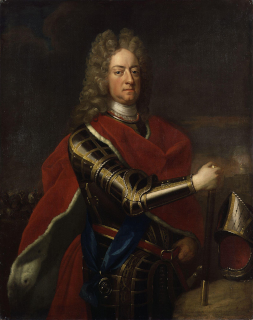
(Pictured: Portrait of James Butler, 2nd Duke of Ormonde, by Michael Dahl, National Portrait Gallery)
The assault focuses on the English fort which sits at a bridge on the River Blackwater, marking the border between Counties Tyrone and Armagh. It is built by Walter Devereux, 1st Earl of Essex, in 1575 as an outpost of English military strength in the heart of Gaelic Ulster, but also to secure the power of the main Irish ally in the region, Hugh O’Neill, Baron of Dungannon. The fort is composed of a square earthwork bawn “twelve score yards in circuit” reinforced by two bulwarks and punctuated with gun loops in its ramparts. In one corner stands a wooden tower, four stories tall, topped with a wooden walkway and a slate-covered building. It is accessed by two doors, one leading out onto the ramparts, another leading to a cellar. Each story has defensive firing loops, also known as spike holes. This tower overlooks a road and bridge across the river. At the other side of the river, on the Tyrone side, is a stone tower. The stone tower controls access to the bridge, as the road runs through it via large wooden doors.
Hugh O’Neill, Lord of Tyrone, is thought an ally of the English Crown and he is supported by the English authorities in Dublin as a counterweight to the power of other native lords in Ulster such as Turlough Lynagh O’Neill. However, encroachment by English authorities on the liberties of the native Irish lords in Ulster during the 1580s and early 1590s causes O’Neill to create an alliance of Irish lords, which look to throw off English rule with the help of Philip II of Spain. From April 1593, O’Neill orchestrates a proxy war against the English using Hugh Maguire, Lord of Fermanagh, and Hugh Roe O’Donnell, Lord of Tyrconnell. They engage the English in the west of Ulster while O’Neill, outwardly still loyal to the Crown, strengthens his power base in Ulster and subdues the Crown’s Irish allies in the north. The Irish lay siege to Enniskillen Castle and defeat an English force sent to relieve it.
O’Neill’s alliance is not limited to Ulster as he is allied to Fiach McHugh O’Byrne in Leinster. He has come under increasing pressure from Lord DeputyWilliam Russell‘s military expeditions into the Wicklow Mountains. In desperation, Fiach McHugh asks that Tyrone offer help or at least raid the northern Pale to draw Russell out of Wicklow. O’Neill requests a meeting with Russell to discuss how to proceed but this is dismissed by the Lord Deputy as a ploy to draw him out of O’Byrne’s lands. Therefore, to help O’Byrne, O’Neill makes his first open move against the Crown.
On the morning of Sunday, February 16, 1595, Art MacBaron O’Neill approaches the fort from the direction of Armagh with 40 men, escorting what appears to be two prisoners. As they cross the bridge one of the English warders notices the match cords of the Irishmen’s matchlock calivers are lit, a sign that they are ready to fire. The English open fire and MacBaron’s men force their way into the stone tower, but the English withdraw to the upper stories and prevent the Irish from taking the tower. Meanwhile, on the other side of the river, 200 Irish soldiers sweep over the earth ramparts and take the bawn. The English soldiers and their families retreat to the wooden tower. Defensive fire from within keeps the Irish back and twice the warders thwart MacBaron’s attempts to burn the position. Fifteen of MacBaron’s men are killed attempting to storm the towers, and eight more later die of their wounds. The stalemate lasts until five o’clock in the evening when MacBaron calls for a ceasefire. He offers the garrison terms for their surrender. The English, led by Edward Cornwall, are critically low on ammunition but still prevaricate until MacBaron threatens to burn the fort to the ground with all in it. The ward’s surrender is agreed and MacBaron guarantees their safe passage to Newry.
The loss of the fort is doubtless a military setback for the Crown, but of more significance is the presence of the Earl of Tyrone in person. According to the English commander, O’Neill arrives after the surrender and is outraged at the losses suffered in taking the fort and is angry that the defenders had not been executed. After the English soldiers and their families leave, O’Neill looks on as the bridge is demolished and the fort’s defence slighted. Up until this point there is no concrete proof that O’Neill was active in the attacks by Maguire and O’Donnell in the west of Ireland. Now there is indisputable proof that the Crown was at war with O’Neill.
(Pictured: The Blackwater Fort at present-day Blackwatertown in County Armagh, built by the Earl of Essex during a foray into Ulster in 1575 and captured and destroyed by the Irish in 1595. This pen and ink sketch measures 22½ by 16½ inches and is dated March 27, 1587.)
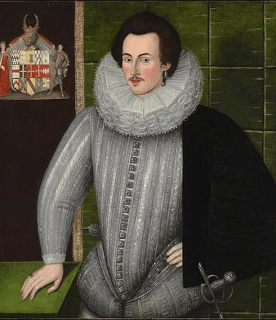
Blount is born in 1563, the second son of James, 6th Baron Mountjoy, and Catherine, only daughter of Sir Thomas Legh. He is among the most distinguished of the family, succeeding as 8th Baron Mountjoy on the death in 1594 of his unmarried elder brother William, 7th Baron Mountjoy. The good fortune of his youthful and handsome looks find favour with Queen Elizabeth I which arouses the jealousy of Robert Devereux, 2nd Earl of Essex, leading to a duel between the two courtiers, who later become close friends.
The downfall of Lord Essex does not damage Blount’s career. After the failure of his rebellion, Essex shocks many by denouncing his sister Penelope, who is Blount’s mistress, as a traitor, which inevitably raises the question of his own possible involvement. But the Crown, anxious to retain Blount’s services, and also to show as much leniency as possible to the defeated rebels, simply ignore the accusation.
On February 24, 1600, Blount lands in Ireland as Lord Deputy following Lord Essex and in the ensuing years brings the Nine Years’ War to an end. The leader of the rebellion, Hugh O’Neill, Earl of Tyrone, writes about Blount’s “refined manners” that he would lose a whole season of campaigning “while waiting until breakfast is prepared to his mind!” Despite this, Blount proves that he is quite qualified to pursue the war.
In early 1600, Blount dispatches Sir Henry Docwra with an army of 4,200 troops to land at Culmore to erect a fortress commanding the shores of Lough Foyle in the northwest of Ulster. To prevent Hugh O’Neill from sending a strong force to repulse Dowcra’s forces, Blount advances in force from Dublin to Newry causing O’Neill to fear a southern advance into Tyrone.
Blount aims to avoid the mistakes of previous Lords-Deputy. After the Battle of Moyry Pass, he has it cleared, and a garrison is established there. It had long been a problem for English forces advancing into Ulster from the south. He also establishes posts with garrisons at Mountnorris and Armagh.
On July 13, 1601, Blount and his army along with Turlough McHenry O’Neill of the Fews who had recently switched to the English side in the war, have a stand-off with Hugh O’Neill’s forces at the River Blackwater. After a few shots in vain from either side, O’Neill’s forces withdraw, and Blount sends his forces to occupy the ruined Blackwater fort destroyed by O’Neill in 1595. Later O’Neill’s forces attack Blount’s camp before withdrawing. In response, the Lord-Deputy sends his forces across the river where they find strong artificially fortified fords, which would have held out against the English.
By July 15, 1601, the Lord-Deputy has secured the surrender of O’Neill’s ally Hugh Magennis. That month, he has a new fort near the old Blackwater fort erected.
Blount reports to the council in England that O’Neill is determined to prevent his forces from advancing into Tyrone and toward Dungannon. As such, he initiates a policy of burning large quantities of corn to induce a famine to drive the rebels out of their strongholds.
Blount sets about trying to entice Hugh’s forces to come out and attack by fetching some materials for the new fort from the Tyrone side of the river as well as burning more corn. Further skirmishes between Blount and O’Neill’s forces ensue during the summer of 1601.
Spanish forces land in Munster in August 1601, forcing Blount to send his forces southward leaving O’Neill remaining in his unbroken heartland of Tyrone. The Spanish arrival culminates in the Siege of Kinsale that December, which sees a major defeat of the rebels and their allies.
O’Neill during this time has also moved south to assist some of his allies, however, after some serious defeats at the hands of the forces of Richard Burke, 4th Earl of Clanricarde of Connacht, he is in no place to offer any effective resistance once Blount marches once more to Tyrone in the summer of 1602.
Blount advances to the location he found the previous summer at the River Blackwater, which commands safe and secure passage into Tyrone, previously inaccessible, and sets about erecting a new fort. Having observed this, O’Neill burns his capital at Dungannon and flees to his last refuge in Glenconkeyne.
Advancing northward through Tyrone, Blount erects a fort in the townland of Magheralamfield, afterward known as Mountjoy Castle. He also christens the new fort at the Blackwater Charlemont Fort after himself.
Once in Tyrone, Blount carries out a campaign of devastation throughout it resulting in the mass hunting of rebels, spoiling of corn, the burning of houses and the killing of churls so as to force the submission of O’Neill and his remaining allies. Most symbolically, Blount has the inauguration site of the O’Neill’s at Tullyhogue Fort destroyed.
On March 30, 1603, six days after the death of Elizabeth and the accession of James I, O’Neill makes peace with Blount, signing the Treaty of Mellifont. Blount continues in office with the more distinguished title of Lord-Lieutenant. He declares amnesty for the rebels and grants them honourable terms, which causes some severe criticism from England. He shows similar moderation in putting down the abortive risings in Cork, Waterford and Wexford, where the aldermen, apparently with some vague idea of gaining greater toleration for Roman Catholics, refuse to proclaim the new King. In Cork, three insurgents are hanged after a summary trial, but the rest are acquitted or pardoned.
As part of the Plantation of Ulster, the majority of the barony of Loughinsholin is detached from County Tyrone and made part of the newly created County Londonderry. The rest of Loughinsholin along with the northern parts of Dungannon barony are merged to create the short-lived barony of Mountjoy. It is later amalgamated with the barony of Dungannon.
On his return to England, Blount serves as one of Sir Walter Raleigh’s judges in 1603, and in the same year King James I appoints him Master-General of the Ordnance as well as creating him Earl of Devonshire, granting him extensive estates. He is one of the founder members of the Spanish Company re-founded by royal charter in 1605.
Toward the end of Blount’s life, on December 26, 1605, at Wanstead House near London, in a ceremony conducted by his chaplain William Laud, afterward Archbishop of Canterbury, he marries his long-time mistress Lady Penelope, formerly wife of Robert Rich, 3rd Baron Rich (later 1st Earl of Warwick) and sister of Robert Devereux, 2nd Earl of Essex.
Blount leaves no legitimate children, and so his hereditary titles become extinct at his death on April 3, 1606, at Savoy House, London.
The Battle of Moyry Pass begins on September 20, 1600, ending on October 9, in counties Armagh and Louth, in the north of Ireland, during the Nine Years’ War. It is the first significant engagement of forces following the cessation of arms agreed in the previous year between the Irish leader Hugh O’Neill and the English Crown commander, Robert Devereux, 2nd Earl of Essex.
The battle is fought by the armies of O’Neill and Charles Blount, 8th Baron Mountjoy, a follower of the late Earl of Essex. Mountjoy is determined to pierce O’Neill’s heartland in central and western Ulster by the Moyry Pass. In the course of the two-week assault the English troops establish a garrison near Armagh, taking heavy casualties, and Mountjoy retires with difficulty to Dundalk.
Mountjoy’s strategy for putting down O’Neill’s rebellion is gradually to constrict his territory in Ulster with a ring of fortified garrisons on the borders. To this end, he lands seaborne forces at Derry in the north of the province and at Carrickfergus in the east of Ulster. In September 1600, Mountjoy moves north from Dublin and concentrates at Dundalk in order to mount an expedition further into Ulster and re-establish a garrison at Armagh, which position had been evacuated by the English Crown forces after O’Neill’s victory at the Battle of the Yellow Ford in 1598.
On September 17, 1600, Mountjoy sets out from Dundalk, intending to march to Newry and then on to Armagh. The Moyry Pass (or “Gap of the North”) is the sole point of entry to Ulster as much of the terrain is wooded and mountainous, and it has been well fortified by O’Neill with trenches and barricades. There are three lines of trenches, barricaded with earth and stone, and on the flanks the Irish have made further earth and stone works and “plashed” (twisted) the branches of low-growing trees in order to provide cover for themselves and prevent the English occupying the heights on either side of the Pass.
The English reach the pass on September 20 and set up camp just outside, to the south on Faughart Hill. Taking advantage of a misty day on the 25th, an officer named Thomas Williams (who had commanded the Blackwater Fort during the Battle of the Yellow Ford) makes a sortie into the pass. After heavy fighting he identifies the Irish defence works and returns to the English camp with 12 dead and 30 wounded. For six days heavy rain holds up the fighting, until the weather clears on October 2. The weather is important because the matchlock muskets of the day do not work in wet conditions. On October 2, Sir Samuel Bagnall leads his regiment of infantry into the Pass at the head of four other regiments. The English breach the first barricade, and Thomas Bourke’s regiment leads the way to the second and third lines of defence. The English take the second line only to find themselves in a trap, with gunfire concentrated from three sides. They try to dislodge the Irish from their remaining positions for three more hours before retreating, with the Irish in close pursuit. The English admit 46 killed and 120 wounded, but it is thought that they understated their losses throughout the campaign.
On October 5, Mountjoy sends two regiments on a flanking march over the hill to the west, with one further regiment supported by horsemen advancing up the centre of the Pass. No significant gains are made, and the regiments turn back, reporting casualties of 50 dead and 200 wounded.
By October 9 the privy councilorGeoffrey Fenton complains, “we are now but where we were in the beginning.” Mountjoy retires to Dundalk on either October 8 or 9, but on October 14 word reaches the English camp that O’Neill has abandoned the Pass and retreated to a crannog stronghold at Lough Lurcan. The most likely explanation for O’Neill’s withdrawal from his position of strength is that he is short of ammunition and food and fears a flanking attack on his rear from Newry.
Mountjoy occupies the Moyry Pass on October 17 and dismantles O’Neill’s earthworks. He marches on to Carrickban, just outside Newry, and by Sunday, November 2, sets up camp at Mountnorris, halfway between Newry and Armagh. There he builds an earthwork fort and leaves a garrison of 400 men under the command of Captain Edward Blaney. He then marches back to Dundalk via Carlingford, but is attacked on November 13 by O’Neill, close to the Fathom Pass. Mountjoys men force their way through, and the Lord Deputy claims the army lost 15–20 killed and 60–80 wounded, but a later report suggests the losses are much heavier, with 80 killed.
The battle of Moyry Pass is a stalemate as Mountjoy cannot take the Pass and O’Neill cannot keep it. Mountjoy does establish a garrison at Mountnorris, but has to retire to Dundalk after taking substantial casualties. Mountjoy claims his force lost only 200 men killed and 400 wounded in the fighting from September 20 to November 13, though this may be a considerable underestimate. More, he says, died of disease. The Irish casualties are given by the English as an incredible 900–1,200 killed and wounded, but this is questionable given that the Irish were in a strong defensive position of their own choosing, behind the protection of fieldworks. These figures probably say more about what Mountjoy wanted Queen Elizabeth I to hear than about the actual casualty figures. The following year Mountjoy builds Moyry Castle to secure the pass.
(Pictured: View of the entrance to the Moyry Pass looking north from Faghart Hill)
O’Neill, along with O’Donnell, train an army and before long they find a powerful ally, King Phillip III of Spain. King Phillip is more than keen to help the Irish for two reasons. Firstly, he wants revenge for the famous defeat of his Spanish Armada in 1588 and secondly, he sees Ireland as a terrific foundation from which he can invade England.
King Phillip agrees to the request of O’Neill and O’Donnell to send a large army to help them defeat the English. For several years prior they had held the English at bay from the strongholds in Ulster, beating them at Yellow Ford in 1598 and Moyry Pass in 1600. But if they are to ever drive the English back across the Irish Sea, they have to come out from the hills and passes and meet them in open battle. King Phillip eventually sends his army of 4,800 men to Kinsale in County Cork, thirteen miles south of Cork, arriving on September 21, 1601. They are surrounded by the English army, led by Charles Blount, 8th Baron Mountjoy, and George Carew, 1st Earl of Totnes, the President of Munster.
The landing of the Spanish army is not where O’Neill would have hoped as he and O’Donnell are located in the northern county of Donegal. He had sent a message asking them to land further north, so they might join forces and march against the English, but that message either never arrives or arrives too late. Now O’Neill and O’Donnell face a long march to join with their allies, and the English are much closer to Kinsale than they.
Before the Irish can get there, Mountjoy’s army has laid siege to the Spaniards at Kinsale. To leave their northern strongholds holds many dangers for the Irish chieftains, but leave they do, marching their army 250 miles to Kinsale to put the future of Gaelic Ireland to the test on the battlefield, a march which many say is one of the greatest marches to date in Irish History.
On the morning of December 24, O’Neill moves to attack Mountjoy’s army. There is no coordination between O’Neill’s army and the Spanish in Kinsale, under Don Juan del Águila. The Spaniards make no attempt to attack in force or even create a diversion. O’Neill’s army, especially his cavalry, which perform badly, are not ready to meet the English in this sort of combat. The battle lasts only an hour, with Irish losses of 1,200 soldiers whereas the English lose only twenty. The critical battle of the Nine Years’ War has been lost.
Afterwards, O’Donnell flees to Spain where he lives comfortably until he dies a few months later, said to have been poisoned by a spy of Carew’s named Blake.
Hugh O’ Neill surrenders to the English in 1603 and later returns to Ulster, where Lord Mountjoy treats him respectively well. However, most of his lands and authority are non-existent. In 1607, he goes to Spain with a number of family members and supporters, most of whom are lesser chieftains, and this becomes famously known as the Flight of the Earls. The power of the Gaelic chiefs in Ireland become a thing of the past.
In January and February 1689, Butler votes against the motion to put William of Orange and Mary on the throne and against the motion to declare that James II has abdicated it. Nevertheless, he subsequently joins the forces of William of Orange, by whom he is made colonel of the 2nd Troop of Horse Guards on April 20, 1689. He accompanies William in his Irish campaign, debarking with him in Carrickfergus on June 14, 1690, and commands this troop at the Battle of the Boyne in July 1690. In February 1691 he becomes Lord Lieutenant of Somerset.
Butler serves on the continent under William of Orange during the Nine Years’ War and, having been promoted to major general, he fights at the Battle of Steenkerque in August 1692 and the Battle of Landen in July 1693, where he is taken prisoner by the French and then exchanged for the Duke of Berwick, James II’s illegitimate son. He is promoted to lieutenant general in 1694.
Butler plays a dramatic role at the notorious meeting of the Privy Council on March 8, 1711, when Antoine de Guiscard, a French double agent who is being questioned about his treasonable activities, attempts to assassinate Robert Harley, 1st Earl of Oxford, against whom he has a personal grudge for drastically cutting his allowance, by stabbing him with a penknife. Harley is wounded, but not seriously, due largely to the fact that he is wearing a heavy gold brocade waistcoat in which the knife gets stuck. Several Councillors, including Butler, stab Guiscard in return. Guiscard implores Butler to finish the deed, but he replies that it is not for him to play the hangman. In any case, he has the sense to see that Guiscard must be kept alive at least long enough to be questioned, although as it turns out Guiscard’s wounds are fatal, and he dies a week later.
On April 23, 1712, Butler leaves Harwich for Rotterdam to lead the British troops taking part in the war. Once there he allows himself to be made the tool of the Tory ministry, whose policy is to carry on the war in the Netherlands while giving secret orders to him to take no active part in supporting their allies under Prince Eugene. In July 1712, he advises Prince Eugene that he can no longer support the siege of Le Quesnoy and that he is withdrawing the British troops from the action and instead intends to take possession of Dunkirk. The Dutch are so exasperated at the withdrawal of the British troops that they close the towns of Bouchain on Douai to British access, despite the fact that they have plenty of stores and medical facilities available. Butler takes possession of Ghent and Bruges as well as Dunkirk, in order to ensure his troops are adequately provided for. On April 15, 1713, he becomes Lord Lieutenant of Norfolk.
Ormonde’s position as Captain-General makes him a personage of much importance in the crisis brought about by the death of Queen Anne and, during the last years of Queen Anne, he almost certainly has Jacobite leanings and corresponds with the Jacobite Court including his cousin, Piers Butler, 3rd Viscount Galmoye, who keeps barrels of gunpowder at Kilkenny Castle. King George I, on his accession to the throne in August 1714, institutes extensive changes and excludes the Tories from royal favour. Butler is stripped of his posts as Captain-General, as colonel of the 1st Regiment of Foot Guards and as Commander in Chief of the Forces with the first two posts going to the Duke of Marlborough and the role of Commander-in-Chief going to John Dalrymple, 2nd Earl of Stair. On November 19, 1714, Butler is instead made a member of the reconstituted Privy Council of Ireland.
Accused of supporting the Jacobite rising of 1715, Butler is impeached for high treason by Lord Stanhope on June 21, 1715. He might avoid the impending storm of Parliamentary prosecution, if he remains in England and stands trial but instead, he chooses to flee to France in August 1715 and initially stays in Paris with Lord Bolingbroke. On August 20, 1715, he is attainted, his estate forfeited, and honours extinguished. The Earl Marshal is instructed to remove the names and armorial bearings of Butler and Bolingbroke from the list of peers and his banner as Knight of the Garter is taken down in St. George’s Chapel.
On June 20, 1716, the Parliament of Ireland passes an act extinguishing the regalities and liberties of the county palatine of Tipperary; for vesting Butler’s estate in the crown and for giving a reward of £10,000 for his apprehension, should he attempt to land in Ireland. But the same parliament passes an act on June 24, 1721, to enable his brother, Charles Butler, 1st Earl of Arran, to purchase his estate, which he does accordingly.
Butler subsequently moves to Spain where he holds discussions with Cardinal Giulio Alberoni. He later takes part in a Spanish and Jacobite plan to invade England and puts James Francis Edward Stuart on the British throne in 1719, but his fleet is disbanded by a storm in the Bay of Biscay. In 1732, he moves to Avignon, where he is seen in 1733 by the writer Lady Mary Wortley Montagu. He dies at Avignon in exile on November 16, 1745, but his body is returned to London and buried in Westminster Abbey on May 22, 1746.
On July 20, 1682, Butler, then called Lord Ossory, marries Lady Anne Hyde, daughter of Laurence Hyde, who is then Viscount Hyde of Kenilworth but becomes Earl of Rochester in November. The couple has a daughter, Mary, who dies young in 1688.
Following the death of his first wife in 1685, Butler plans to marry again in order to secure a male heir. He gains permission from the House of Lords for the arranging of a jointure for another marriage in May 1685, and in August of that year, he marries Lady Mary Somerset, daughter of the Duke of Beaufort and Mary Capel. The couple has a son, Thomas (1686–1689), and two daughters, Elizabeth (1689–1750) and Mary (1690–1713). His second wife is a Lady of the Bedchamber to Queen Anne. Their younger daughter, Mary, marries John Ashburnham, 1st Earl of Ashburnham.
(Pictured: Portrait of James Butler, 2nd Duke of Ormonde, by Michael Dahl, National Portrait Gallery)
Catinat, advancing from Fenestrelle and Susa to the relief Pinerolo, defended by René de Froulay, Comte de Tessé, and which the Duke of Savoy is besieging, takes up a position in formal order of battle north of the village of Marsaglia, near Orbassano. Here, on October 4, the Duke of Savoy attacks him with his entire army, front to front, but the greatly superior regimental efficiency of the French, and Catinat’s minute attention to details in arraying them, gives the new marshal a victory that is a worthy pendant to Neerwinden.
During the battle, Irish dragoons are reported to have “overthrown squadrons, sword in hand,” but elsewhere on the battlefield, Prince Eugene of Savoy overruns a French line and advances to the second line, held by Irish regiments. There Eugene’s advance is broken, and his troops are soon put to rout. The impetuous Irish then pursue without orders. Seeing this development, the French commander orders a general advance and the allied army breaks and runs. Official French reports speak of the “extreme valor” of the Irish that day.
The Piedmontese and their allies lose approximately 12,000 killed, wounded and prisoners, as against Catinat’s 1,800. Among the Irish killed in this great victory are Brigadier Francis O’Carroll of the dragoons and Colonel Daniel O’Brien, 4th Viscount Clare. One very young officer of the Irish Brigade who survives the fight is Lieutenant Peter Lacy.
Marsaglia is, if not the first, at any rate, one of the first, instances of a bayonet charge by a long deployed line of infantry. Hussars figure here for the first time in Western Europe. A regiment of them had been raised in 1692 from deserters from the Austrian service. It is also notable as one of the first major battles to see the new Irish Brigade in action for the French army.
(Pictured: Marshal Nicholas Catinat at the Battle of Marsaglia, October 4, 1693, painting by Eugène Devéria, 1837, Museum of the History of France)





 seamus dubhghaill